Every general contractor, subcontractor, and estimator eventually hits a wall where they ask themselves: What’s the best bidding strategy? When you spend countless hours reviewing architectural plans, performing detailed takeoffs, and compiling subcontractor quotes only to lose the job, it is natural to question your approach. Are you pricing jobs too high? Are you leaving money on the table?
The truth is that winning more work is not always about being the lowest bidder. The construction industry is highly complex, and the contractors who secure the most profitable work do not rely on guesswork or a rigid, one-size-fits-all formula. Instead, they adapt their approach based on the project type, the level of competition, the client relationship, and their own business goals.
In this comprehensive guide, we will break down what a construction bidding strategy actually is, why the “best” approach depends heavily on the specific situation, and how you can choose the right strategy to win more bids and grow your bottom line profitably.
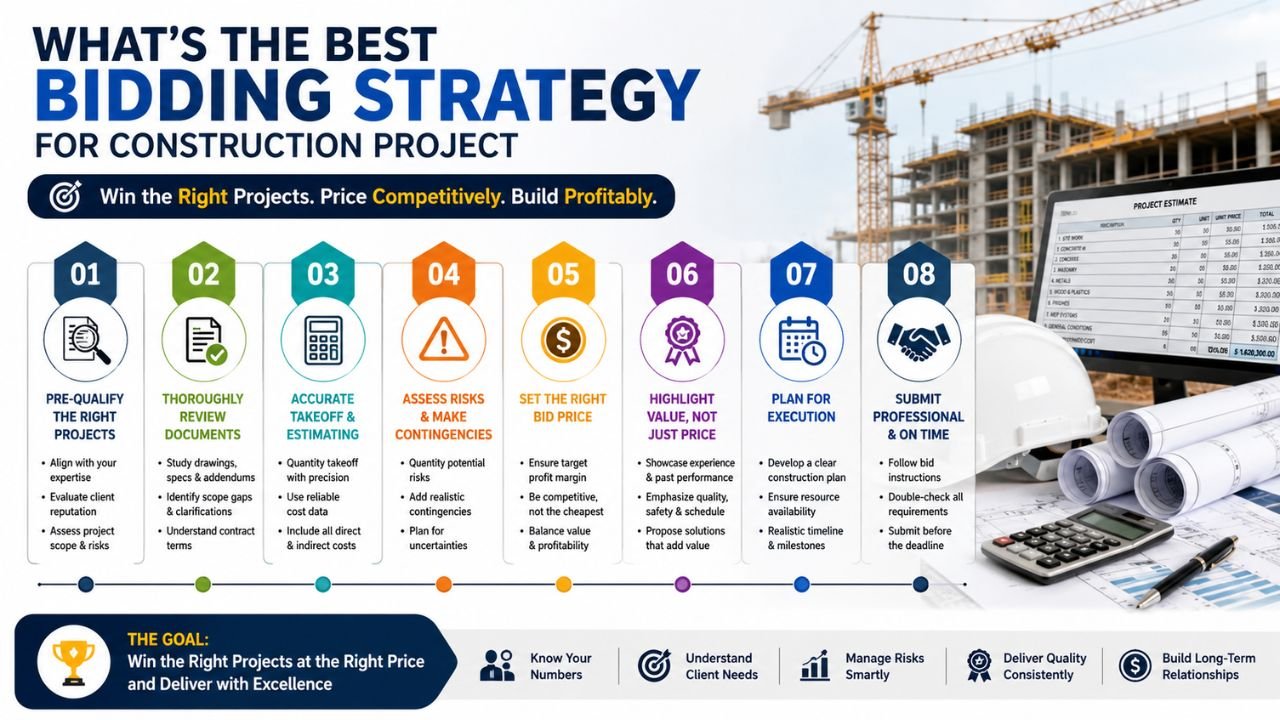
What Is a Bidding Strategy?
In simple terms, a bidding strategy is the systematic approach a contractor uses to decide which projects to pursue, how to price those projects, and how to present the final offer to the client. It is the bridge between your internal estimating process and your external contractor sales efforts.
A well-defined bid strategy goes far beyond just calculating material and labor costs. It involves analyzing market conditions, understanding the client’s true priorities, assessing project risks, and positioning your company as the best possible choice.
Your chosen strategy directly affects two critical metrics: your win rate (how often you win the jobs you bid) and your profitability (how much money you actually make on the jobs you win). If you bid without a strategy, you risk either losing consistently to smarter competitors or winning jobs at margins so low that they threaten your company’s survival.
Why There Is No Single Best Strategy
If you are looking for a magic formula to apply to every estimate, you will be disappointed. There is no single best bidding strategy because every construction project presents a unique set of variables. What works perfectly for a custom home builder will likely fail for a commercial heavy civil contractor.
The “best” strategy for any given project is influenced by several shifting factors:
-
Project Size: A massive, multi-year commercial build requires a different risk assessment and margin structure than a two-week office remodel.
-
Risk Level: Projects with complex site conditions, tight deadlines, or incomplete drawings require a strategy that heavily protects your downside.
-
Client Type: Private developers, homeowners, and government agencies all evaluate bids using completely different criteria.
-
Competition: Bidding against two contractors you know well requires a different approach than an open public tender with twenty unknown bidders.
-
Scope Clarity: If the scope is vaguely defined, your strategy must focus on detailed exclusions and contingencies to protect your margins.
-
Schedule Pressure: Clients under extreme time constraints will often pay a premium for a contractor who guarantees a fast, reliable completion date.
Ultimately, the best bidding strategy is the one that perfectly aligns your company’s strengths with the specific demands of the opportunity in front of you.
Common Bidding Strategies
To become a more agile and profitable contractor, you must understand the different tools at your disposal. Here are the main types of bidding approaches used in the construction industry:
-
Manual Bidding: This is the traditional, highly customized approach where every single line item, markup, and contingency is manually adjusted based on the estimator’s gut feeling and experience with the specific project variables. It is highly intentional but time-consuming.
-
Aggressive Bidding: This strategy involves cutting overhead and profit margins to the absolute minimum to offer the lowest possible price. It works best when you need to secure market share, keep your crews busy during an economic downturn, or break into a new client account.
-
Selective Bidding: This involves bidding only on a small number of high-probability jobs that perfectly match your niche. You bid less often, but with higher margins and a much higher win rate.
-
Value-Based Bidding: Instead of competing on price, you compete on the unique value you provide. You might charge more, but you justify it through faster schedules, superior quality, unique problem-solving, or exceptional warranties.
-
Relationship-Based Bidding: This strategy leverages existing trust. You work directly with past clients or partners to negotiate contracts without entering a hard-bid scenario, often using an open-book or cost-plus pricing model.
Bidding Strategy Comparison Table
| Strategy | Best Used For | Primary Focus | Potential Risk |
| Aggressive | Slow seasons, entering new markets | Lowest possible price | Razor-thin margins, no room for error |
| Selective | Busy seasons, specialized niches | High win rate, high profit | Missing out on volume growth |
| Value-Based | Complex projects, tight schedules | Solving client problems | Pricing yourself out of strict budgets |
| Relationship | Repeat clients, private developers | Trust and transparency | Client may eventually test the open market |
How to Choose the Right Strategy
Choosing the right strategy starts long before you ever look at a blueprint. Good strategy is proactive, not reactive. Here is practical guidance on how to evaluate each opportunity:
-
Bid/No-Bid Decisions: The smartest bidding strategy is knowing when not to bid. Evaluate every invitation to bid (ITB). If the project is outside your expertise, the client has a bad reputation, or you do not have the crew capacity, pass on it.
-
Margin Goals and Workload Capacity: Your strategy should shift based on your backlog. If you have a full schedule of work for the next six months, use a value-based or selective strategy with high margins. If your crews are sitting idle next month, you may need to pivot to an aggressive strategy to keep cash flowing.
-
Level of Design Completion: Are the architectural plans at 30% completion or 100%? Incomplete designs carry massive risk. You cannot use an aggressive, low-margin strategy on incomplete drawings without risking a financial disaster.
-
Client Trust: If you have worked with the client for a decade, rely on a relationship-based strategy. Focus on collaboration rather than cutthroat pricing.
-
Competitiveness of the Market: If you are bidding on a highly commoditized scope (like basic drywall installation on a standard warehouse), the market will force you toward a tighter, more aggressive strategy.
Estimating Still Matters
It is vital to understand that even the most brilliant bid strategy will fail if it is built on a foundation of bad math. Before you can strategize about how to adjust your margins, you must have absolute confidence in your baseline costs. The estimating process is the engine that drives your bidding success.
A highly accurate estimate supports smart strategy by mastering these elements:
-
Quantity Takeoff: You cannot price what you have not measured. Ensure your digital takeoffs are flawless, capturing every linear foot, square foot, and piece count accurately.
-
Labor Pricing: Labor is your highest risk. Calculate your fully burdened labor rates (including taxes, insurance, and benefits) and use realistic production rates.
-
Material Pricing: Do not rely on historical data for volatile commodities like lumber, steel, or copper. Get current, project-specific quotes from your suppliers.
-
Subcontractor Quotes: If you are a general contractor, clearly level your subcontractor bids to ensure no scopes of work overlap or fall through the cracks.
-
Overhead and Profit (O&P): You must know your exact break-even point. Ensure your estimate covers your company’s fixed overhead before you apply a strategic profit margin.
-
Contingency: A strong estimate includes a contingency fund to absorb the unpredictable variables of construction, protecting your core profit.
If you struggle to produce accurate baselines, utilizing professional estimating service can give you the accurate data you need to confidently apply your chosen bidding strategies.
Winning Without Always Being Cheapest
Many contractors feel trapped in a race to the bottom, believing that the only way to win a job is to be the cheapest. However, you can significantly improve your bid-hit ratio by proving to the client that you offer the best overall value.
Here is how trust, clarity, responsiveness, and professionalism can beat low-price competitors:
-
Clear Proposals: A messy, confusing quote creates anxiety for the client. Using a clean, professional [bid proposal template] that clearly outlines inclusions, exclusions, and assumptions shows the client that you are organized and reliable.
-
Value Engineering: If a project is over budget, do not just drop your price and take a loss. Instead, offer value engineering. Suggest alternative materials, different mechanical systems, or faster construction methods that save the client money while preserving your profit margin.
-
Timely Communication: If a client requests a revision or sends an RFI, answer it immediately. Speed and responsiveness during the bidding phase prove that you will be communicative during the construction phase.
-
Consistent Follow-Up: A shocking number of construction bids are lost simply because the contractor never followed up. Call the client a few days after submitting your bid to answer questions and keep your company top-of-mind.
Bid-Hit Ratio and Strategy
To refine your approach over time, you must track your bid-hit ratio. Your bid-hit ratio is a metric that compares the number of bids you win to the total number of bids you submit. For example, if you bid 10 jobs and win 2, your ratio is 20% (or 5-to-1).
Tracking your win/loss results is the ultimate feedback loop for your bidding strategy. The data will reveal exactly which strategies work best for different job types.
-
If your overall win rate is 80%, you are likely leaving money on the table and should pivot to a higher-margin, selective strategy.
-
If your win rate is 5%, your pricing may be too high, or you are bidding on the wrong types of projects where you have no competitive advantage.
By analyzing this data, you can uncover hidden patterns. You might find that your value-based strategy wins 40% of the time on medical office renovations, but only 2% of the time on basic retail build-outs. This allows you to focus your estimating resources entirely on the most profitable niches.
Industry and Project Differences
It is also crucial to recognize that the rules of the game change entirely depending on the sector of the industry you are operating in. You must tailor your strategy to the specific environment:
-
Public Bids: Government and municipal projects are almost exclusively awarded based on the lowest responsible bid. In this environment, an aggressive strategy with razor-sharp estimating accuracy is usually required. Compliance and strict adherence to the bidding rules are mandatory.
-
Private Bids: Private developers and commercial clients care about price, but they also care deeply about risk, schedule, and quality. A value-based strategy emphasizing your track record of finishing on time can easily beat a lower-priced competitor.
-
Negotiated Work: In negotiated contracts, relationship-based bidding is king. The focus shifts away from hard pricing and moves toward collaboration, transparency, and early pre-construction involvement.
-
Residential Projects: Homeowners are making emotional decisions with their personal finances. Trust, communication, and clear proposals are vital. Value-based strategies work incredibly well here because homeowners will pay a premium for peace of mind.
-
Commercial Projects: Commercial owners are driven by Return on Investment (ROI). If your strategy can prove that your slightly higher price will allow them to open their doors and start generating revenue a month earlier, you will win the job.
Final Thoughts
So, what’s the best bidding strategy? The ultimate answer is the strategy that balances your win rate, your profitability, and your risk tolerance for a specific project. Winning more work requires shifting away from the mindset of simply guessing a number and hoping for the best.
To build a smarter, more profitable construction business, you must choose your projects carefully, estimate with relentless accuracy, and present your bids with unwavering professionalism. Remember that strategy is not a static document; it is a dynamic process. Test different approaches, track your bid-hit ratio, and continuously refine your tactics based on real-world data.
If you are ready to stop racing to the bottom and want to implement a more effective approach to securing profitable work, start by streamlining your lead generation and estimating processes. Visit our [lead generation page] to find higher-quality projects, or reach out through our contact us to learn how we can help you build a smarter, more effective bidding strategy today.