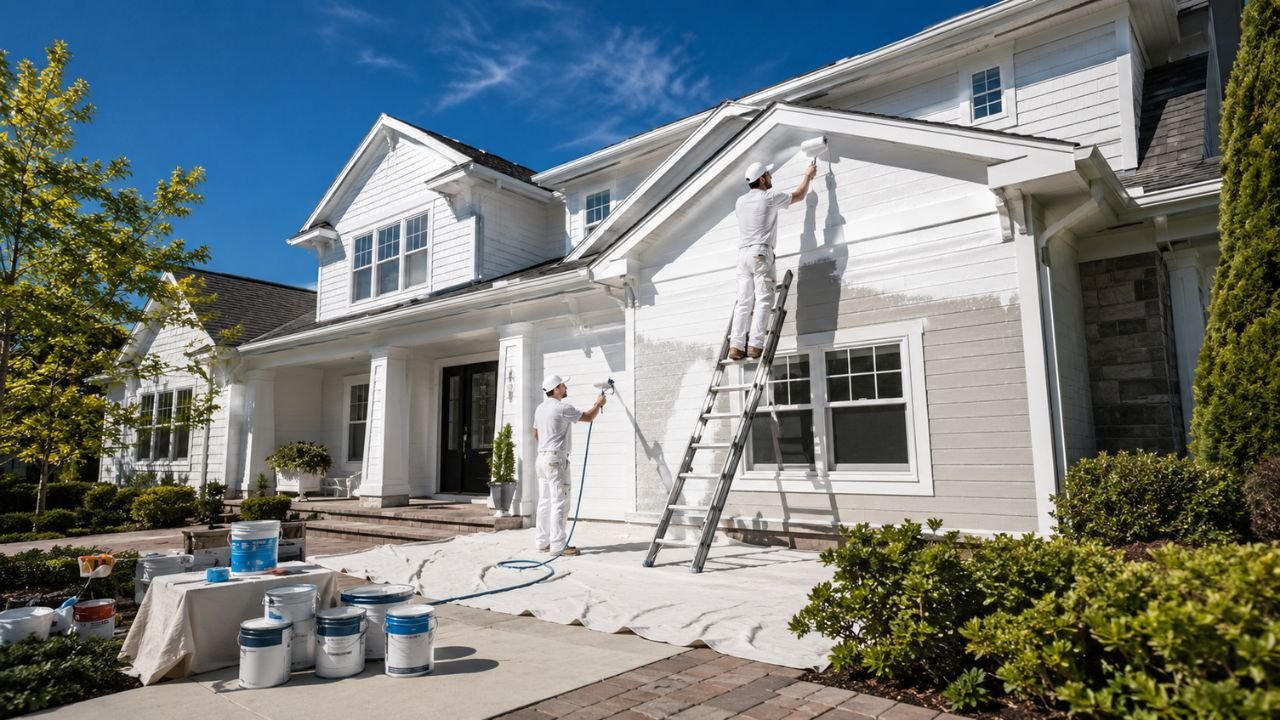
For developers and investors in 2026, the question of how much does it cost to build a multifamily home in Florida is met with a range of $190 to $500 per square foot. On a “per door” basis, standard projects typically range from $250,000 to $450,000 per unit, depending heavily on the building’s height, configuration, and proximity to the High-Velocity Hurricane Zone (HVHZ). A standard duplex may cost between $350,000 and $620,000, while larger institutional-grade complexes exceed $135 million.
Key Takeaways for Florida Multifamily Projects
- Average Square Foot Cost: $190 – $360 (Standard) up to $500+ (Luxury).
- Cost Per Unit: $100,000 – $150,000 (Studio) to $400,000+ (3-Bedroom).
- The “Hurricane Tax”: Projects in South Florida (Miami-Dade/Broward) cost 15%–25% more due to HVHZ mandates.
- Regulatory Driver: Adherence to the 9th Edition Florida Building Code and ASCE 7-22 wind standards is mandatory.
- Precision Tip: Professional Florida construction estimating services are essential to navigate 2026 material volatility and labor premiums.
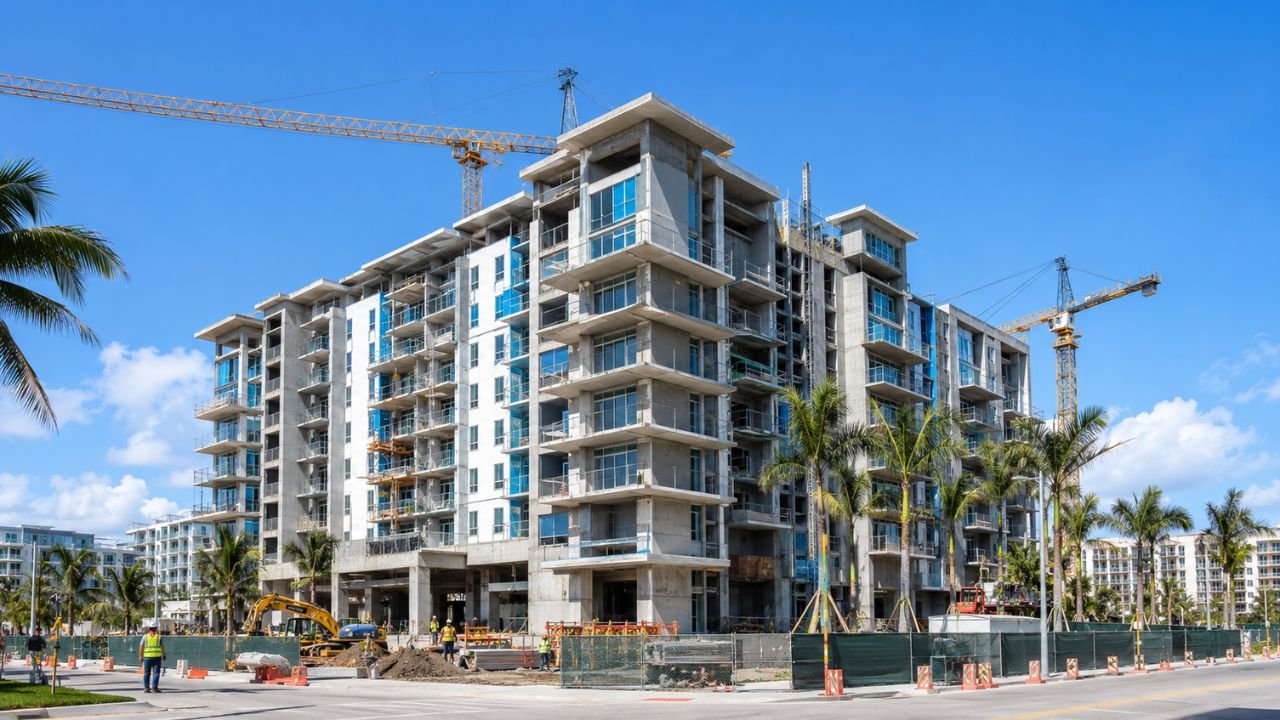
2026 Construction Market Overview: How Much Does It Cost to Build a Multifamily Home in Florida?
The Florida multifamily market in 2026 is defined by a unique intersection of high demand and increasingly complex regulatory hurdles. As population growth continues in hubs like Miami, Orlando, and Tampa, the pressure to deliver housing units quickly has led to a market where “ballpark” figures are no longer sufficient for securing financing. Investors must now account for a “new normal” in pricing that includes stabilized but high material costs and a chronic shortage of skilled trades.
When evaluating how much does it cost to build a multifamily home in Florida, one must consider the sheer variety of the state’s geography. Building a triplex in the Panhandle is a fundamentally different financial exercise than erecting a 4-story luxury condo building in West Palm Beach. In 2026, the total project valuation is increasingly influenced by “site-specific” costs—such as high water table mitigation and jurisdictional impact fees—rather than just the cost of raw materials like lumber and concrete.
Furthermore, the 2026 market is grappling with the implementation of the 9th Edition of the Florida Building Code. This code update has pushed structural requirements to new heights, particularly regarding wind resistance and energy efficiency. Consequently, developers must integrate advanced moisture control systems and impact-rated glazing into their baseline budgets, often adding 10% to 20% to the shell cost compared to projects built just five years ago.
Average Multifamily Home Construction Cost Florida: Breaking Down the Project Tiers
Understanding the average cost to build multi-family home Florida requires segmenting the project by its “grade” or luxury level. The gap between an affordable housing project and a high-end coastal development is wider in Florida than in many other states due to the cost of luxury finishes combined with extreme environmental protection requirements.
Florida Multifamily Cost Benchmarks by Project Class (2026 Estimates)
| Project Type | Cost Per Square Foot | Typical Hard Cost Range |
|---|---|---|
| Standard / Affordable | $190 – $250 | $2.5M – $5.0M |
| Mid-Range / Market Rate | $260 – $360 | $5.0M – $15.0M |
| High-End / Luxury | $380 – $500+ | $15.0M – $50.0M+ |
Standard multifamily homes typically utilize Type V wood-frame construction for garden-style designs. These are the most cost-effective to build but face the highest insurance premiums in the Florida market. Conversely, luxury builds often move toward Type II or III construction, utilizing reinforced concrete and steel to provide superior hurricane resistance and satisfy the aesthetic demands of high-net-worth tenants.
For those planning institutional-grade projects, the multifamily home construction cost Florida at scale (50+ units) sees some economies of scale in material procurement, but these are often offset by the complexity of structured parking and advanced fire suppression systems required for higher densities. In 2026, a mid-rise project (4–7 stories) rarely falls below $300 per square foot in urban cores like Miami or Orlando.
Cost to Build Duplex Triplex Fourplex Florida: Small-Scale Investment Benchmarks
For the individual investor or the “house hacker,” the cost to build duplex triplex fourplex Florida represents the entry point into multifamily development. These small-scale residential structures (up to four units) are often treated as residential rather than commercial for financing purposes, but they still carry many of the same Florida-specific cost drivers as larger complexes.
Duplex Construction Costs
A duplex in Florida for 2026 typically costs between $350,000 and $620,000 for a standard 2,000 to 3,000-square-foot configuration. If you choose a “stacked” (up-down) design, costs can be slightly lower ($150/sq.ft.) due to a shared roof and foundation footprint. Side-by-side units, however, are more popular for marketability and often range from $180 to $250 per square foot.
Triplex and Quadplex Construction Costs
Moving from a duplex to a triplex or quadplex increases the total project budget but improves the potential return on investment (ROI) by maximizing land use.
- Triplex: Costs generally range from $500,000 to $850,000.
- Quadplex: Costs typically range from $700,000 to $1,200,000.
At this scale, Florida multifamily building costs 2026 must account for shared parking requirements and stormwater retention mandates. For example, a quadplex in a suburban area might require 6 to 8 parking spots, which adds significant sitework and paving costs that a single-family home would not incur. Furthermore, fire separation requirements between units become more stringent as the unit count increases, necessitating specialized drywall and fire-stopping labor.
Multifamily Construction Cost Per Unit Florida: Analyzing the “Per Door” Metric
Investors often rely on the multifamily construction cost per unit Florida to determine the feasibility of a purchase or a new build. This metric, often called “cost per door,” is heavily influenced by the unit mix—the ratio of studios to three-bedroom apartments.
Unit Mix Financial Impact (2026 Estimates)
| Unit Type | Average Square Footage | Estimated Construction Cost |
|---|---|---|
| Studio | 500 – 650 | $100,000 – $160,000 |
| 1-Bedroom | 800 – 950 | $120,000 – $210,000 |
| 2-Bedroom | 1,050 – 1,250 | $150,000 – $300,000 |
| 3-Bedroom | 1,350+ | $230,000 – $400,000 |
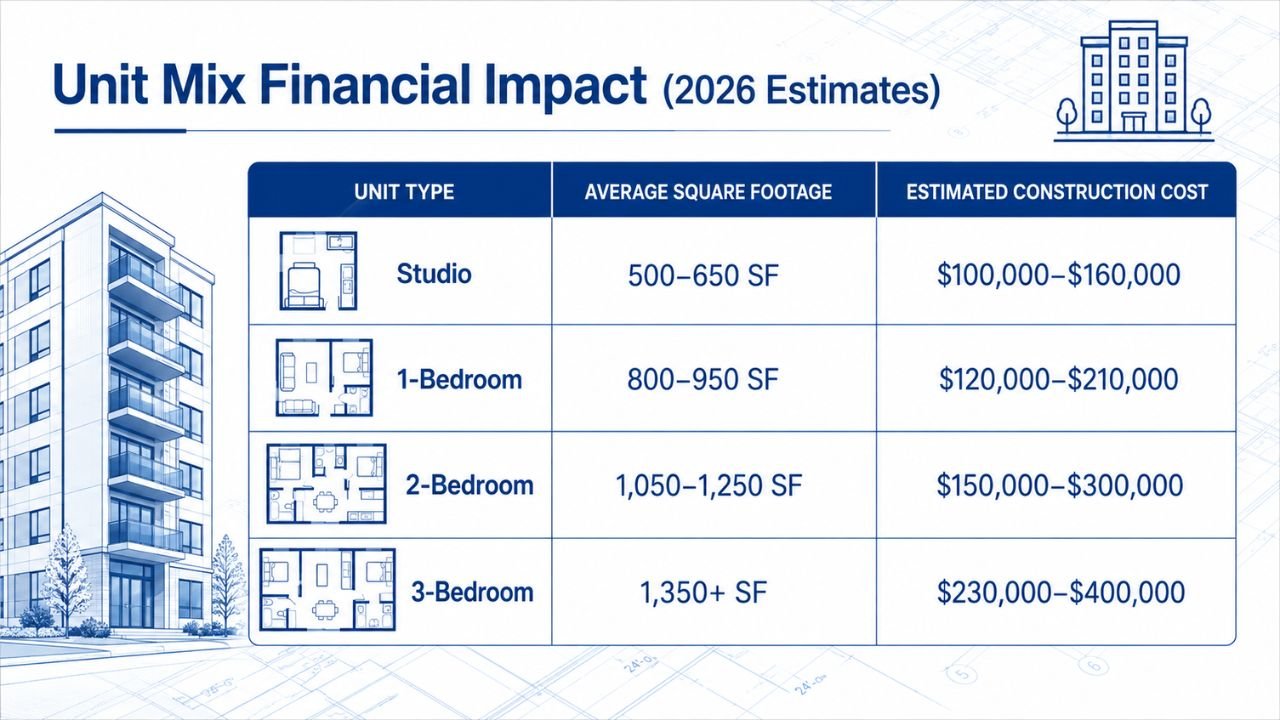
Kitchens and bathrooms are the most expensive rooms in any residential project due to the density of plumbing, electrical, cabinetry, and tiling. Consequently, a building full of studio units will have a much higher cost per square foot than a building of large 3-bedroom units, even if the total project budget is lower.
When calculating the cost to build multifamily housing Florida, developers must also factor in the “common area” load. This includes hallways, lobbies, fitness centers, and leasing offices. In a typical apartment building, these non-revenue-generating spaces can account for 15% to 25% of the total square footage, effectively raising the cost per “leasable” unit. Utilizing professional quantity takeoffs and cost estimates allows developers to see the true “net” cost per unit after accounting for these shared assets.
Cost to Build Townhomes in Florida: Luxury vs. Standard Developments
The cost to build townhomes in Florida occupies a unique space between single-family homes and traditional apartment buildings. Townhomes offer private entrances and often private garages, which appeals to families, but they share walls, which provides construction efficiencies.
In 2026, townhome construction costs typically range from $180 to $350 per square foot. However, several factors can push this higher:
- Verticality: 3-story townhomes are increasingly common in urban areas to maximize density. These require more complex framing and often the inclusion of internal stairs that consume leasable space.
- Foundations: Each townhome unit often requires its own plumbing stack and heavy fire-rated separation walls (party walls) that extend from the foundation through the roofline.
- Exterior Finishes: Since townhomes are often sold as “fee simple” or luxury rentals, the exterior “curb appeal”—including stone accents, metal roofs, and high-end landscaping—can add $20,000 to $50,000 per unit to the budget.
For developers seeking statewide Florida estimating coverage, townhome projects in coastal areas must also account for salt-air corrosion resistance. This means utilizing stainless steel or PVC-coated electrical components and specialized HVAC coatings, adding a “coastal premium” to the MEP (Mechanical, Electrical, Plumbing) budget.
Regional Variance: South Florida vs. Central vs. North Florida Multifamily Building Costs 2026
Geography is perhaps the single largest factor in the multifamily construction cost Florida landscape. The state is divided into distinct pricing zones based on labor availability, material transport logistics, and hurricane risk profiles.
Regional Cost Multipliers (2026 Forecast)
| Florida Region | Labor & Material Multiplier | Primary Cost Driver |
|---|---|---|
| South Florida (Miami/Dade) | 1.15 – 1.30 | HVHZ Codes, High Land Cost |
| Central Metro (Orlando/Tampa) | 1.00 – 1.05 | High Demand, Skilled Labor Gap |
| North Florida (Jacksonville) | 0.90 – 0.96 | Stable Labor, Lower Impact Fees |
| Panhandle (Pensacola) | 0.85 – 0.95 | Lower Density, Variable Logistics |
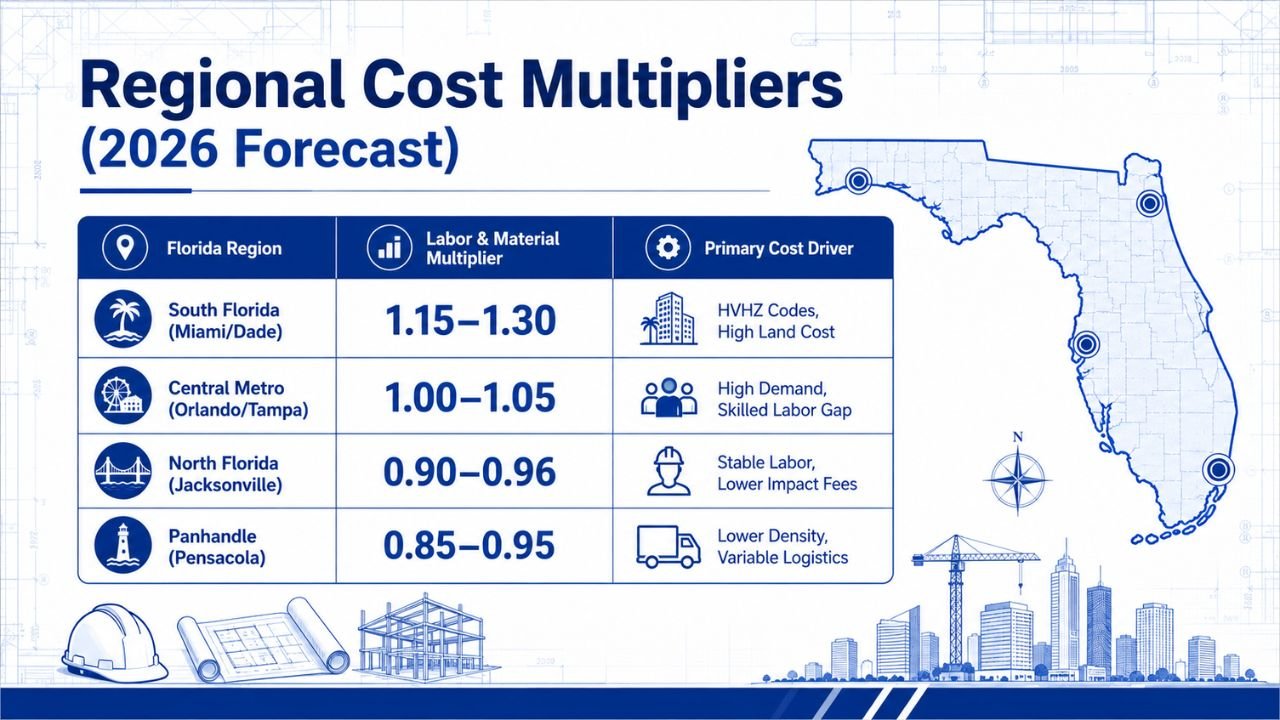
South Florida remains the most expensive region. The High-Velocity Hurricane Zone (HVHZ) requirements mandate the highest grade of impact windows and reinforced masonry in the nation. For a 50-unit complex, the “HVHZ premium” can add millions to the building envelope cost compared to a similar build in Tallahassee.
Central Florida (Orlando and Tampa) serves as the pricing baseline. While it avoids the extreme HVHZ requirements of the south, the massive volume of construction in these hubs has led to “trade premiums,” where master electricians and plumbers can command $140+ per hour.
North Florida and the Panhandle offer the most competitive rates for developers. Land is generally more available, and municipal impact fees—which cover schools and roads—are often half of what is charged in South Florida. However, material transport costs can rise in rural areas far from major distribution hubs.
Hard Costs vs. Soft Costs: The “Hidden” Budget Killers in Florida
When answering how much does it cost to build a multifamily home in Florida, most people think only of the “hard costs”—the physical bricks, mortar, and labor. However, in 2026, “soft costs” are often what make or break a project’s viability.
Hard Costs (70%–80% of Budget)
- Shell and Core: Foundation, framing, and roofing.
- MEP Systems: HVAC, plumbing, and electrical distribution.
- Finishes: Flooring, cabinetry, and interior paint.
- Sitework: Paving, retention ponds, and utility hookups.
Soft Costs (20%–30% of Budget)
- Architecture & Engineering: 3%–7% of total construction value.
- Impact Fees: These are mandatory fees paid to the county. In high-growth areas, these can range from $15,000 to $25,000 per unit.
- Permitting & Inspections: 1%–3% of the project value.
- Insurance: Builder’s Risk and General Liability in Florida have reached record highs in 2026.
For a 20-unit project, if you are paying $500,000 in impact fees alone, you are starting the project $25,000 “per door” in the hole before the first yard of concrete is poured. This makes accurate construction estimating across all 67 Florida counties vital to ensure your pro forma accounts for these jurisdictional outliers.
Factors Affecting Multifamily Construction Cost Florida: The “Florida Factor”
Several environmental and regulatory variables are unique to the Sunshine State. These factors affecting multifamily construction cost Florida are non-negotiable and must be accounted for during the pre-construction phase.
1. Hurricane Code Compliance (ASCE 7-22)
Under the 9th Edition Florida Building Code, buildings must withstand 140–180 MPH wind speeds depending on the zone. This requires specialized hurricane straps, reinforced masonry, and impact-resistant glazing. Impact windows alone for a small multifamily building can cost between $1,000 and $2,500 per opening.
2. High Water Table and Drainage
Florida’s geography often means you hit water just a few feet below the surface. This necessitates specialized “slab-on-grade” foundations with moisture barriers, and in many cases, dewatering systems during construction. Furthermore, Florida law requires strict stormwater management, meaning 15% to 20% of your land may be dedicated to retention ponds or expensive underground vaults.
3. Moisture and Mold Mitigation
Florida’s humidity is an enemy of multifamily longevity. Advanced HVAC systems with dehumidification cycles are now a standard requirement. Additionally, energy code R406 mandates high-efficiency lighting and advanced insulation, which increases upfront electrical costs but reduces long-term operational expenses.
Technical Thresholds: Structural Systems and MEP in Florida Multifamily
The height of your multifamily building triggers different code requirements that drastically alter the cost profile. As noted by industry experts, “Four stories is a code pivot”.
- Low-Rise (1–3 Stories): Typically Type V wood-frame. Cheapest to build ($160–$250/sq.ft.) but has limited density.
- Mid-Rise (4–7 Stories): Requires a transition to Type III or II construction (Concrete/Steel). Elevators become mandatory for ADA compliance, and fire suppression systems (sprinklers/standpipes) become significantly more complex.
- High-Rise (8+ Stories): Involves deep foundation systems (pilings) and high-velocity wind loads. Costs jump to $250–$400+ per square foot.
The MEP (Mechanical, Electrical, Plumbing) systems for a 2026 multifamily building represent roughly 25% to 35% of the total budget. Standard electrical wiring for an apartment unit averages $10,000 to $15,000, but “Smart Building” configurations with integrated fiber optics and automated thermostats can exceed $25,000 per door.
FAQ: Common Questions on Florida Multifamily Building Costs
How much does it cost to build a multifamily home in Florida in 2026?
On average, expect to spend $190 to $360 per square foot for standard construction. Total project costs for a duplex start around $350,000, while a 10-unit building typically ranges from $2.5 million to $7.5 million.
Why is South Florida more expensive for multifamily builds?
The primary driver is the High-Velocity Hurricane Zone (HVHZ) designation. This mandates impact-rated glass and reinforced structures that add a 15%–25% “hurricane tax” to the building.
Does the cost per unit include the land?
No, most construction cost benchmarks refer to “Hard Costs” (sticks and bricks). Land acquisition in Florida can add another 20% to 40% to your total investment budget.
How long does it take to build a 20-unit apartment building in Florida?
Typically, construction takes 14 to 20 months from groundbreaking. However, permitting and site prep in Florida can add another 6 to 12 months to the timeline.
Are concrete buildings cheaper to insure than wood-frame in Florida?
Yes. While concrete is more expensive to build ($300+/sq.ft.), it attracts significantly lower annual insurance premiums because of its fire and hurricane resistance.
What are impact fees, and why are they so high in Florida?
Impact fees are one-time charges by municipalities to fund infrastructure for new residents. In counties like Orange or Miami-Dade, these can exceed $20,000 per unit.
Is impact glass mandatory statewide?
While not mandatory in every inland county, most Florida developers include it to meet wind-load requirements and to lower the owner’s insurance costs.
Can I build 10 units on a half-acre lot?
It depends on zoning and parking. Most Florida municipalities require 1.5 to 2.25 parking spots per unit. For 10 units, that is 20+ spots, which often requires a full acre once you include stormwater retention.
Conclusion: Securing Your ROI with Precision
Building a multifamily property in Florida is a high-reward endeavor, but in 2026, the margin for error is razor-thin. Whether you are navigating multifamily construction cost per unit Florida variations or managing the “soft cost” hurdles of impact fees and insurance, your success depends on starting with an accurate number.
Generic square footage calculators and national averages are a recipe for bankruptcy in the Sunshine State. To secure a construction loan and protect your margins, you need a site-specific, line-item budget that reflects current 2026 Florida market realities.
Ready to see the real numbers for your project?
Don’t leave your multifamily investment to chance. Contact Estimate Florida Consulting today for a professional, data-backed cost analysis. Whether you are building a duplex in Jacksonville or a mid-rise complex in Miami, our precision is your protection.
- Email your plans to: info@estimateflorida.com
- Get a Quote: Upload Your Blueprints