How much does it cost to buy a golf course in Florida? Purchase prices vary widely, from roughly $1 million for distressed daily-fee properties trading near land value to $20 million–$100 million or more for trophy private clubs and resort assets. Location, course condition, revenue performance, acreage, amenities, and redevelopment potential all influence the final number. Some golf courses sell primarily as operating businesses, while others are valued mainly for the underlying land. This article breaks down the main factors that affect golf course acquisition cost so investors, operators, and land buyers can approach Florida golf real estate with clearer expectations.

What Affects the Purchase Price Most?
Several core factors drive golf course purchase prices in Florida:
- Location and local market demand
- Total acreage and usable land
- Number of holes and course type
- Physical condition of the course and facilities
- Current revenue and operating expenses
- Amenities (clubhouse, practice areas, food and beverage)
- Redevelopment or alternative-use potential
Two courses that look similar on the surface can trade at very different prices. A well-located, profitable 18-hole daily-fee course with strong rounds will command more than a similar layout with deferred maintenance or weak cash flow. Conversely, a course with limited golf demand but high-value surrounding land may sell primarily on its real estate potential.
Revenue and Business Performance
For most going-concern purchases, cash flow is the primary valuation driver. Key revenue streams include:
- Green fees and cart fees
- Membership dues (for private or semi-private clubs)
- Pro shop sales
- Food and beverage
- Events, outings, and range revenue
Stabilized operating profit and the applicable capitalization rate often matter more than physical appearance alone. Stronger, more consistent cash flow typically supports a higher purchase price. Buyers commonly evaluate historical financial statements, rounds played, revenue per round, and expense ratios. Florida daily-fee courses that consistently generate 35,000–50,000 rounds per year tend to be viewed more favorably than facilities falling well below that benchmark.
Land Value and Redevelopment Potential
In high-growth or coastal Florida markets, the land beneath the golf course can represent a significant portion of the total value. Zoning, comprehensive plan designations, and entitlement potential influence whether a property is valued mainly as a golf operation or as a future development site.
Some courses trade close to raw land value when golf demand is soft or capital needs are high. Others retain strong golf value because of location, membership base, or tourism demand. Buyers evaluating redevelopment potential should carefully review local land-use regulations, wetland constraints, and infrastructure capacity. Florida land values in desirable markets can push asking prices well above what pure golf economics would support.
Course Type and Size
Price expectations differ meaningfully by course type and scale:
- 9-hole courses – Generally lower absolute prices; often suited to community or executive play.
- 18-hole public / daily-fee courses – Broadest market segment; pricing tied closely to rounds and net operating income.
- Executive or par-3 courses – Typically smaller footprints and lower price points.
- Private clubs – Valued more on membership economics, initiation fees, and equity structure than traditional cap rates.
- Resort courses – Often command premiums when tied to lodging, real estate, or strong tourism markets.
Hole count, service level, and amenity package heavily affect both asking price and buyer pool.
Condition and Capital Needs
Physical condition directly affects both purchase price and post-acquisition capital requirements. Buyers should carefully evaluate:
- Irrigation system age, capacity, and reliability
- Turf quality and drainage performance
- Cart path condition
- Clubhouse and maintenance building condition
- Maintenance equipment inventory and remaining useful life
Deferred maintenance often leads to price reductions, but buyers must still budget for repairs, upgrades, and eventual replacements. A course that appears inexpensive on the surface can require substantial additional investment after closing.
Florida Market Factors
Florida golf properties operate in a distinct market environment shaped by:
- Strong tourism and snowbird demand
- Year-round playability
- Population growth in many regions
- Elevated coastal and high-growth land values
- Insurance and property tax costs
Industry data and market reports show that Florida continues to attract both operators and investors. Resources from Florida Realtors, the Golf Course Superintendents Association of America, and the Florida Department of Revenue Property Tax portal can help buyers understand broader real estate trends, management best practices, and tax implications. Market conditions can push prices higher in high-demand areas and create opportunities in locations with softer golf economics or higher capital needs.
Due Diligence Before Buying
Thorough due diligence is essential before making an offer. Key areas to review include:
- Multi-year financial statements and tax returns
- Property tax records and assessments
- Environmental reports and wetland delineations
- Zoning, land-use, and entitlement status
- Utility capacity, water permits, and irrigation systems
- Maintenance equipment condition and inventory
- Deferred maintenance and capital expenditure history
Legal, financial, and technical reviews help identify risks related to water rights, environmental compliance, membership liabilities, and hidden capital needs. Skipping these steps can lead to costly surprises after closing.
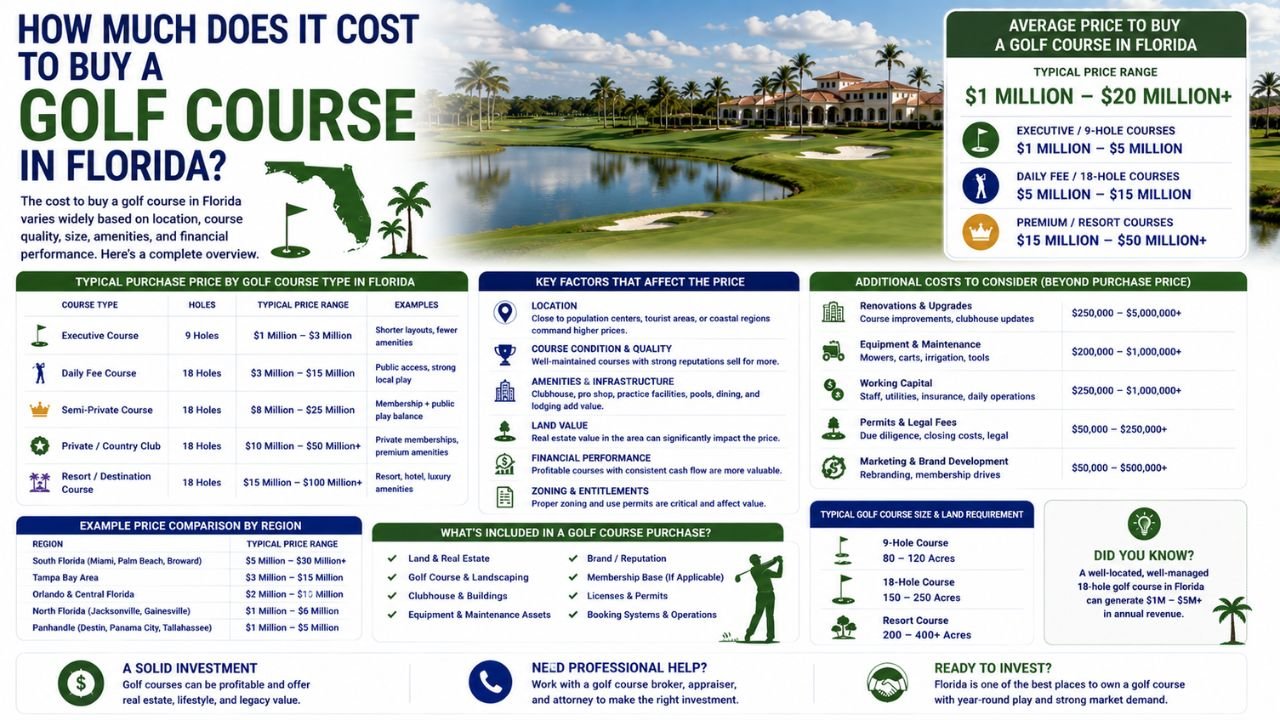
Cost Ranges by Course Type
Actual prices vary by market, revenue performance, condition, and land value. The following ranges provide practical order-of-magnitude guidance for Florida golf course acquisitions:
| Course Type | Approximate Purchase Price Range | Notes |
|---|---|---|
| 9-hole public / executive | $1 million – $6 million | Often smaller footprint; condition and location matter |
| 18-hole public / daily-fee | $3 million – $20 million | Strongly tied to rounds and cash flow |
| Private club | $10 million – $50 million+ | Membership economics and equity structure drive value |
| Resort course | $15 million – $100 million+ | Premium for tourism or real-estate-linked assets |
| Distressed or turnaround property | $1 million – $8 million | Frequently priced near land value; higher capital needs |
These figures are illustrative. Trophy assets in high-demand coastal or growth markets can exceed the upper end of these ranges, while properties with significant deferred maintenance or limited demand may trade lower.
How to Budget for the Purchase
A realistic acquisition budget should account for more than the purchase price:
- Down payment and equity requirements
- Financing structure and terms
- Closing costs and transaction fees
- Working capital for operations
- Immediate repair and upgrade reserves
- Transition and operator ramp-up costs
Buyers should compare total acquisition and post-closing capital needs against expected operating performance. Understanding both the business economics and the real estate component is essential. Related planning resources such as how much does it cost to build a golf course in Florida, how much does it cost to build a warehouse in Florida, construction BOQ template for a building in Florida, residential construction estimating, and what are the 7 stages of construction can help buyers evaluate whether renovation, expansion, or alternative development paths make sense after acquisition.
Final Thoughts
The cost to buy a golf course in Florida depends on a combination of revenue performance, physical condition, land value, location, and redevelopment potential. Some properties are priced primarily as operating businesses; others derive much of their value from the underlying real estate. The strongest acquisitions typically come from buyers who understand both the golf operation and the land economics.
Working with a specialized golf property broker, experienced attorney, and financial advisor early in the process remains one of the most practical ways to identify opportunities, complete thorough due diligence, and structure a realistic acquisition.