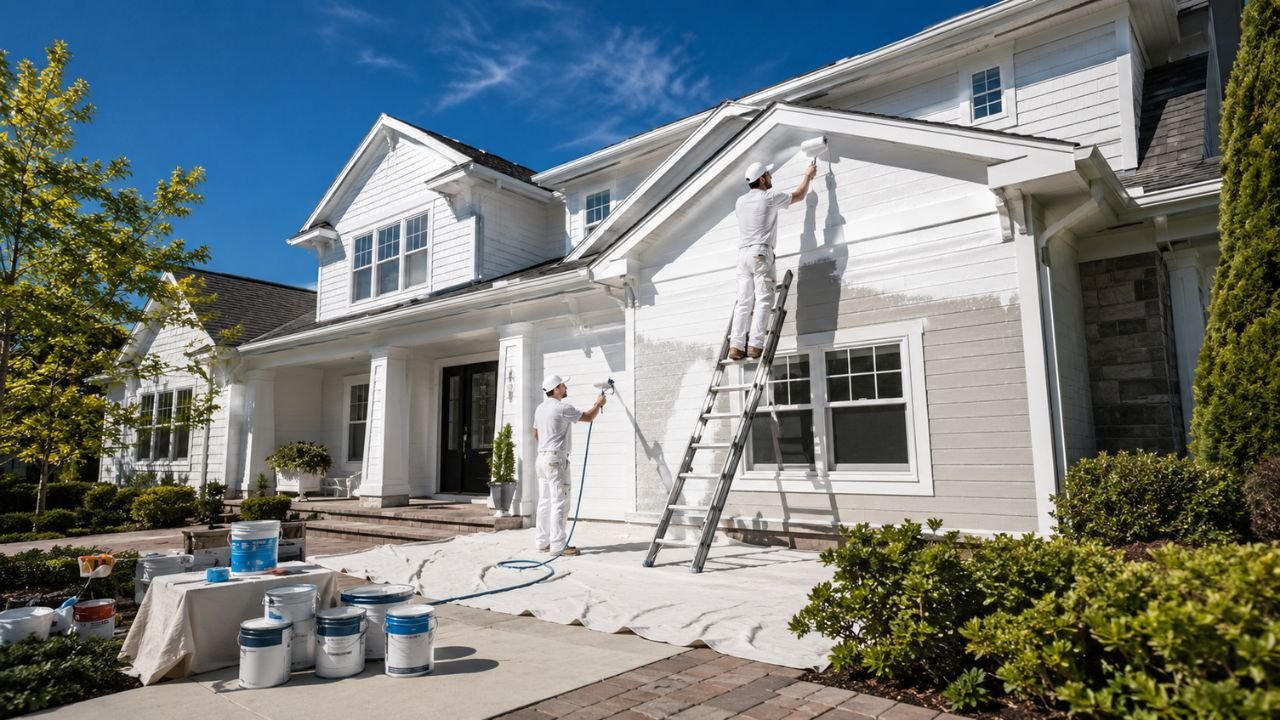
Understanding exactly what is the penalty for building without a permit in Florida is crucial for anyone planning construction. Florida law treats unpermitted work with extreme severity. Penalties typically include administrative fines that can reach $500 per day. Local jurisdictions often charge double or triple the original permit fees as an “after-the-fact” investigation fee. Beyond money, you face stop-work orders, mandatory structural corrections, and even full demolition of the structure. These violations also create legal liens and prevent property sales or insurance claims.
Key Takeaways on Florida Permit Penalties
- Double/Triple Fees: Most Florida counties automatically double or triple permit application fees for unpermitted work.
- Daily Fines: Code enforcement can levy fines up to $500 per day for ongoing violations.
- Stop Work Orders: Construction ceases immediately, causing massive project delays and labor costs.
- Property Liens: Unpaid fines and violations are recorded against the property title.
- Insurance Denial: Florida insurers may refuse coverage or deny claims for damage involving unpermitted structures.
- Demolition Risk: If the structure cannot meet the Florida Building Code, the city can mandate total removal.
Understanding the Florida Building Code and Permit Requirements
Florida maintains one of the strictest building codes in the United States. This is primarily due to our unique climate and the constant threat of hurricanes. The Florida building code violation penalties exist to ensure every structure can withstand high wind loads, particularly in High Velocity Hurricane Zones (HVHZ).
When you bypass the permitting process, you aren’t just skipping paperwork. You are bypassing a safety check designed to protect lives. The state mandates permits for most structural, electrical, plumbing, and mechanical work. Whether you are adding a room or simply replacing a water heater, the local building department must verify the work meets safety standards.
Professional Florida construction estimating services help you avoid these pitfalls. By accounting for all code-required materials and permit fees during the pre-construction phase, you ensure your project is compliant from day one. Proper statewide Florida estimating coverage ensures that local amendments in all 67 counties are considered.
What is the Penalty for Building Without a Permit in Florida? (The Financial Breakdown)
The financial impact of unpermitted work is multifaceted. It begins with the building department and extends to code enforcement boards.
Double and Triple Permit Fees
When a building inspector discovers unpermitted work, the first administrative step is usually the “After-the-Fact” permit application. Most jurisdictions, such as Miami-Dade or Orange County, impose an investigation fee. This fee is typically twice or three times the amount of the standard permit fee. If a standard permit cost $2,000, you might pay an additional $4,000 to $6,000 just to begin the legalization process.
Code Enforcement Board Fines
If the violation is not corrected within a specified timeframe, the case moves to the Code Enforcement Board. Under Florida Statute Chapter 162, local governments can impose fines. For a first-time violation, fines can be up to $250 per day. For repeat violations, this jumps to $500 per day. In some cases of “irreparable” damage or health hazards, a one-time fine of $5,000 can be issued.
Structural Investigation Costs
To legalize unpermitted work, you must prove it meets code. This often requires hiring a structural engineer to perform “destructive testing.” This means tearing down drywall to inspect wiring, plumbing, or framing. The cost of building without a permit Florida homeowners often forget is the expense of hiring professionals to verify work that is already finished.
| Penalty Type | Estimated Range (Varies by County) | Impact Level |
|---|---|---|
| After-the-Fact Permit Fee | 2x to 4x the Standard Permit Fee | Moderate |
| Daily Code Enforcement Fine | $50- $500 per day | High |
| Structural Engineering Report | $1,500 – $5,000+ | Moderate |
| Demolition Costs | Full cost of removal + disposal | Extreme |
| Administrative Hearing Fees | $150 – $500 per session | Low |
The Immediate Consequences of Building Without a Permit in Florida
The moment a neighbor reports your project or an inspector drives by, the “clock” starts.
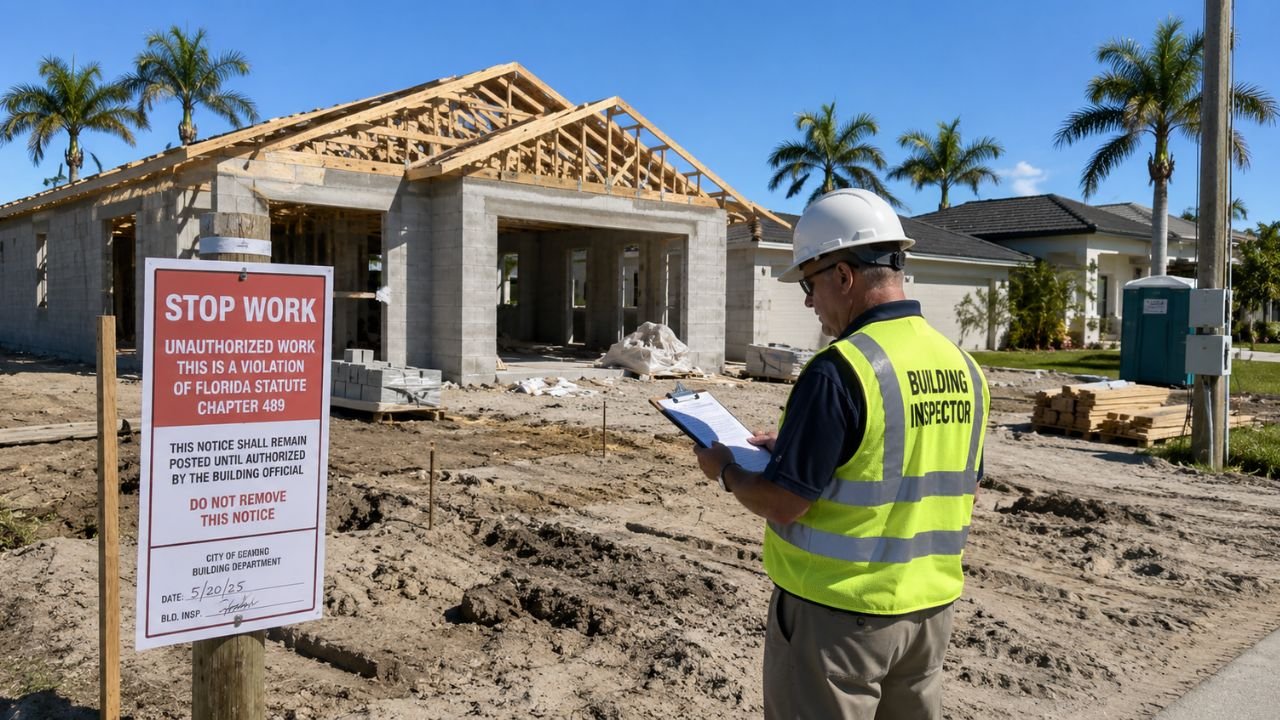
The Dreaded Stop Work Order for No Permit Florida
A stop work order for no permit Florida is a physical notice posted on your property. Legally, all construction must cease immediately. If you or your contractors continue to work after this order is posted, you can be arrested or face even steeper criminal penalties.
This causes a domino effect:
- Labor Loss: Your crew may leave for other jobs while you fight the city.
- Material Spoilage: Unprotected framing or open roofs can suffer water damage.
- Rental Costs: If you are renting equipment like scaffolding or dumpsters, the costs keep mounting while work is frozen.
Consequences of Building Without a Permit in Florida for Contractors
If you are a contractor, the stakes are even higher. Performing work without a permit is a violation of Florida’s licensing laws. The Florida Department of Business and Professional Regulation (DBPR) can suspend or revoke your license. Furthermore, it is a first-degree misdemeanor in Florida to work as an unlicensed contractor or to aid and abet unlicensed activity.
Unpermitted Work Penalties Florida Counties: Local Variations
While the Florida Building Code is statewide, enforcement is local. Every one of Florida’s 67 counties has a different approach to unpermitted work penalties Florida counties enforce.
Miami-Dade and Broward (HVHZ Rules)
In South Florida, the rules are the strictest in the nation. Because of the High Velocity Hurricane Zone (HVHZ) requirements, unpermitted roofing or windows are treated as major safety threats. The penalties here are often higher, and the requirements for structural verification are significantly more rigorous.
Central Florida (Orange and Hillsboro)
Counties like Orange and Hillsborough often focus on the “legalization” process. They have robust code enforcement departments that use satellite imagery and aerial photography to spot unpermitted pools, decks, and additions. Once spotted, they are quick to issue notices of violation.
North Florida and Rural Areas
While some believe rural areas are more “relaxed,” Florida’s state laws still apply. Smaller counties may have fewer inspectors, but when a violation is found, the fines for unpermitted construction Florida law allows are still applicable. Small municipalities often use these fines as a significant revenue source for the city.
How Unpermitted Construction Affects Property Value and Insurance
Many property owners think they “got away with it” once the construction is finished. However, the consequences of building without a permit in Florida often surface years later during a sale or a storm.
The “Clouded” Title and Real Estate Sales
When you sell a home in Florida, you must provide a disclosure. If you have unpermitted work, you must disclose it. Most savvy buyers will demand that you legalize the work before closing. If there is an open code violation, no title company will issue a clean title, and no mortgage lender will fund the loan. You may be forced to sell for cash at a massive discount.
Insurance Claim Denials
Florida is prone to hurricanes. If a storm damages your home, an insurance adjuster will inspect the property. If they find that the damage occurred to an unpermitted addition—or that the unpermitted work caused a structural failure—they have legal grounds to deny your claim entirely. You could be left paying hundreds of thousands of dollars out of pocket for repairs that would have been covered if you had followed the law.
Refinancing Obstacles
Lenders require appraisals. If an appraiser notices a new bedroom or a finished garage that doesn’t match county records, they will flag the property. The bank will typically halt the refinancing process until a “Certificate of Occupancy” or “Certificate of Completion” is produced for the work.
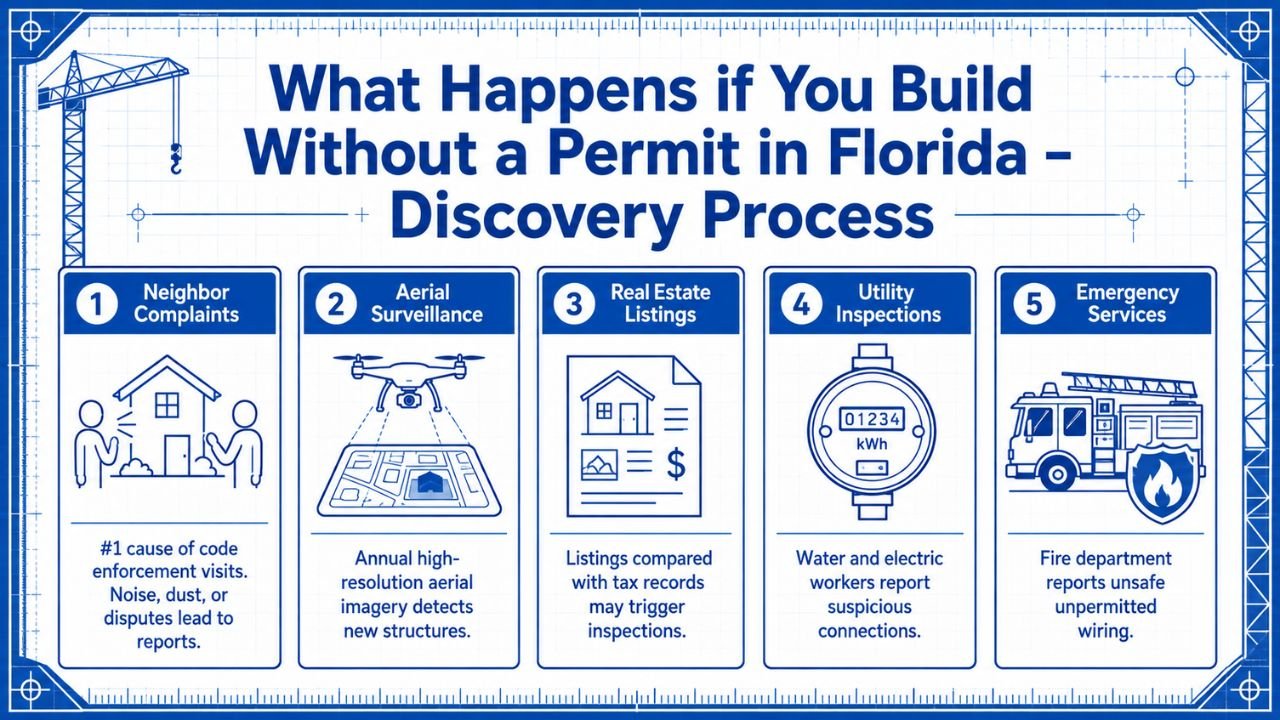
What Happens if You Build Without a Permit in Florida Discovery Process
How does the city find out? Many people assume they are safe if their backyard is fenced. In reality, there are several common ways violations are discovered:
- Neighbor Complaints: This is the #1 cause of code enforcement visits. Noise, dust, or simple disputes lead neighbors to call the city.
- Aerial Surveillance: Many Florida counties now use high-resolution aerial photography that is updated annually to detect new footprints or structures.
- Real Estate Listings: Code enforcement officers often scan Zillow or MLS. If a house is listed as a 4-bedroom but the tax records show 3, an inspector may visit.
- Utility Inspections: If a utility worker (water, electric) notices suspicious connections during a routine meter check, they are required to report it.
- Emergency Services: If the fire department responds to a call and notices unsafe, unpermitted wiring, they will notify the building department.
The Process of Resolving a Florida Building Permit Violation
If you are currently facing a violation, the process to fix it is long and expensive. You cannot simply pay a fine and move on.
Step 1: The Notice of Violation
You will receive a formal letter outlining the specific codes you have violated. This letter will include a “compliance date.” You must respond by this date to avoid the highest daily fines.
Step 2: Hiring Professionals
To resolve the issue, you will likely need:
- An Architect or Engineer to create “as-built” plans.
- A Professional Estimator to determine the value of the work for tax and fee purposes.
- A Licensed Contractor to pull the after-the-fact permit.
Step 3: The Inspection and Testing Phase
The building inspector will visit the site. Since they cannot see through walls, they will likely order “destructive testing.” You may have to remove sections of roofing, siding, or drywall so they can inspect the underlying structure, electrical bonds, and plumbing.
Step 4: Corrections and Final Approval
If the work is not up to code, you must fix it. This often means redoing work that you already paid for. Once the corrections are made and the inspections pass, you will pay your “After-the-Fact” fees and any accumulated fines to close the case.
Why Professional Estimating is the Best Defense Against Penalties
Avoiding the cost of building without a permit Florida owners face starts with accurate planning. Many people skip permits because they are afraid of the cost or the complexity. However, when you use residential construction estimating or commercial estimating services, the permit process becomes a manageable line item.
Accurate Budgeting for Compliance
A professional estimate includes all necessary fees, structural requirements, and specialized materials required by the Florida Building Code. When you know the true cost upfront, you are less likely to take “shortcuts” that lead to legal trouble.
Speeding Up the Permit Process
Building departments are more likely to approve permits quickly when the submitted plans and cost breakdowns are detailed and professional. Estimate Florida provides the level of detail that satisfies municipal requirements, helping you move from the “planning” phase to the “building” phase without delays.
Frequently Asked Questions About Florida Building Permits
What is the penalty for building without a permit in Florida if I didn’t know I needed one?
Ignorance of the law is not a defense in Florida. Even if you were unaware, you are still liable for the double fees, daily fines, and the cost of bringing the work up to code. Homeowners are ultimately responsible for ensuring their property is compliant.
Can the city really tear down my house?
Yes. If unpermitted work is deemed structurally unsound or a threat to public safety, and it cannot be brought up to current Florida Building Code standards, the city can obtain a court order for mandatory demolition at the owner’s expense.
How long does a permit violation stay on my record?
A code violation remains attached to the property title until it is formally “cleared” by the building department. It does not go away with time or even with the death of the owner. It will eventually be discovered during a title search when the property is sold.
Do I need a permit for a shed in Florida?
In almost all cases, yes. While small, portable sheds under a certain square footage may have relaxed rules in some counties, most require a permit to ensure the structure is anchored against hurricane-force winds.
What if the previous owner did the unpermitted work?
When you purchase a property, you inherit all existing code violations. This is why a “Lien Search” and “Permit Search” are essential during the home-buying process. You will be responsible for fixing the previous owner’s mistakes.
Is it a crime to build without a permit in Florida?
In most cases, it is a civil violation. However, it can become a criminal matter (misdemeanor) if you are working as an unlicensed contractor, aiding unlicensed activity, or if you violate a Stop Work Order.
How much are the fines for unpermitted construction in Florida?
Typical fines range from $50 to $500 per day. Additionally, administrative fees for “After-the-Fact” permits usually start at $500 and go up depending on the value of the project.
Can I get a permit after the work is already done?
Yes, this is called an “After-the-Fact” permit. It involves a more rigorous inspection process and significantly higher fees, but it is the only legal way to resolve a violation.
Will my property taxes go up if I get a permit?
Generally, yes. Permits notify the County Property Appraiser of improvements. While this increases your taxes, it also increases the documented value of your home, which is beneficial for resale.
Avoiding Florida Building Code Violation Penalties
The best way to handle a permit violation is to never have one. Florida’s strict environment requires a “measure twice, cut once” mentality. This applies not just to the wood you cut, but to the legal framework of your project.
Working with professional quantity takeoffs and cost estimates ensures that your project is grounded in reality. By following the proper legal channels, you protect your investment, your family’s safety, and your peace of mind.
Summary of Penalties and Impacts:
- Immediate: Stop Work Orders and labor delays.
- Administrative: Double or triple permit application fees.
- Ongoing: Daily fines from $250 to $500.
- Long-term: Title clouds, insurance denials, and potential demolition.
Conclusion: Plan Your Project the Right Way
Don’t let your Florida dream turn into a legal nightmare. Understanding what is the penalty for building without a permit in Florida should be enough to convince any rational property owner to follow the rules. The costs of “saving money” by skipping a permit are almost always higher than the cost of doing it right the first time.
At Estimate Florida, we provide the accuracy you need to navigate Florida’s complex construction landscape. From Miami to Jacksonville, we help you understand the true costs of code-compliant building.
Contact Estimate Florida today for a detailed construction estimate that keeps your project on track, on budget, and fully compliant with the Florida Building Code.