Securing funding for a building project requires more than just a good credit score and a set of architectural plans. When you approach a lender, the most critical document you will provide is a highly detailed, professionally structured estimate. Having the correct construction estimate format for bank loan in Florida can mean the difference between a swift approval and a frustrating, drawn-out denial.
Most Florida lenders require a comprehensive, professional construction estimate before approving any construction loan. Banks and lending institutions need to see a clear, itemized breakdown of hard costs, soft costs, contingencies, and a projected timeline to accurately assess their financial risk. They are not just evaluating you or your builder; they are evaluating the financial viability of the project itself.
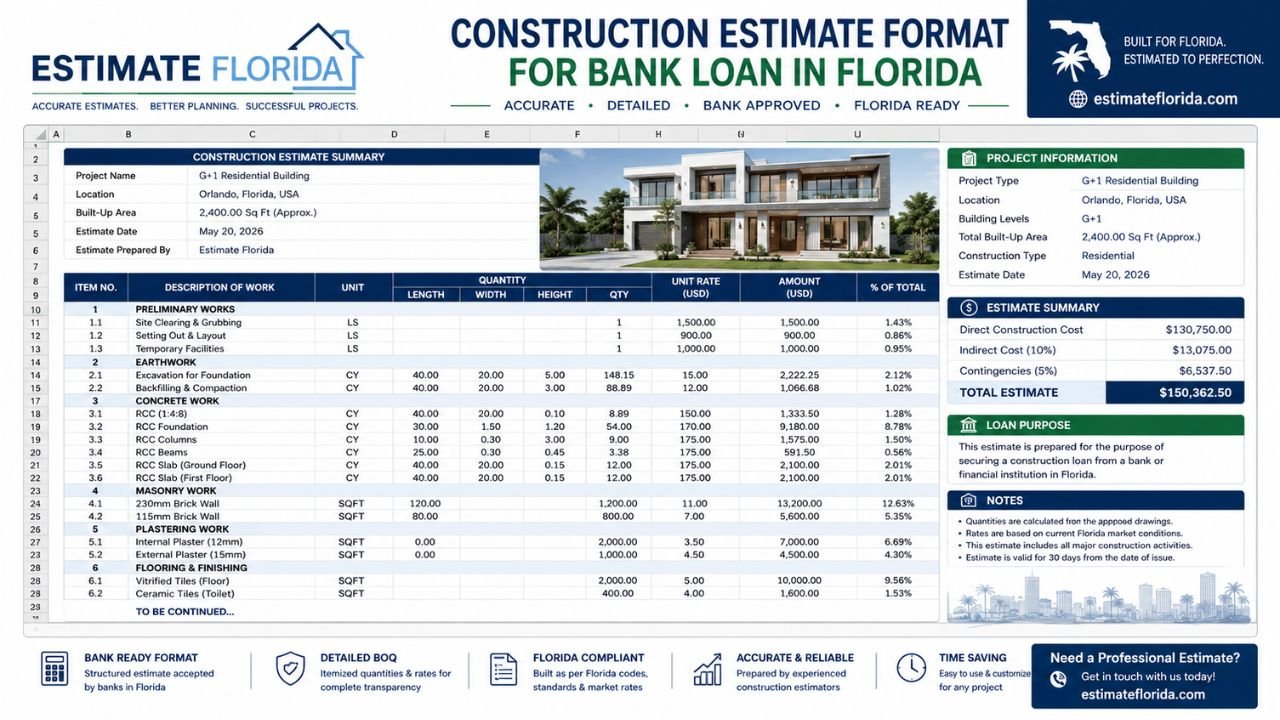
This article explains the ideal construction estimate format for bank loans in Florida, why lenders demand this specific structure, and how you can prepare a bank-ready document that speeds up your financing approval.
What Is a Construction Estimate Format for Bank Loan?
A bank-ready construction estimate format is a structured, itemized document that details exactly how much a construction project will cost from start to finish. Unlike a rough quote or an internal budget that a contractor might sketch out on a notepad, a lender estimate format is a formal financial document. It aligns with the strict underwriting standards of financial institutions.
When a bank reviews your Florida construction financing application, they use this estimate for several key purposes. First, it is used for underwriting to ensure the loan amount is justified by the actual costs of construction. Second, it is provided to the appraiser, who uses the cost breakdown and the architectural plans to determine the future value of the completed property. Finally, it serves as the foundation for the draw schedule, which dictates how and when funds will be disbursed to the builder as work is completed.
A professional construction loan estimate goes far beyond a single lump-sum price. It breaks the project down phase by phase. Understanding what are the 7 stages of construction is incredibly helpful here, as a bank estimate template generally follows the chronological progress of the build, from site preparation and foundation to final framing, MEP (mechanical, electrical, plumbing), and interior finishes.
Why Florida Banks Require a Specific Estimate Format
Florida is a unique construction market with distinct environmental and regulatory challenges. Because of these localized factors, lenders are particularly cautious. A generic estimate that might work in another state will likely be rejected by a Florida bank.
Lenders require a specific Florida bank loan construction estimate format because they need to mitigate risk across several fronts:
-
Accurate Total Project Cost: Lenders need to know that the loan amount will actually cover the cost to finish the building. An unfinished project is a lender’s worst nightmare.
-
Realistic Contingency: Florida weather is unpredictable. Banks want to see a contingency fund (usually 5% to 10%) built into the estimate format to cover unexpected delays, material price spikes, or storm-related setbacks.
-
Local Florida Pricing: Lenders know that building a home in a High-Velocity Hurricane Zone (HVHZ) costs more than building inland. The estimate must reflect realistic costs for hurricane-resistant construction, elevated flood zone designs, and high windstorm insurance premiums.
-
Permit and Impact Fees: Florida municipalities frequently assess steep impact fees for schools, water, and roads. A proper estimate format ensures these soft costs are accounted for upfront.
-
Qualified Builder/Contractor: The estimate must clearly show who is doing the work. Lenders want assurance that the budget was prepared by a professional who understands local market rates.
Mastering residential construction estimating for bank loans means proactively addressing these lender concerns through a meticulous, transparent cost breakdown.
Essential Sections of a Bank-Ready Construction Estimate
A lender-approved estimate format Florida style is typically divided into distinct, logical sections. This segmentation makes it easy for the loan officer, the underwriter, and the appraiser to review the data.
Here are the key sections that must be included in your estimate:
-
Executive Summary: A high-level project overview including the property location, project type, total requested loan amount, and estimated timeline.
-
Detailed Cost Breakdown (Hard Costs): The physical costs of building, including raw materials, direct labor, equipment rentals, and subcontractor fees.
-
Soft Costs: Non-physical expenses such as architectural design, structural engineering, municipal permits, impact fees, builder’s risk insurance, and financing costs.
-
Site Work and Foundation: Clearing, grading, excavation, fill dirt, and the pouring of footings or slabs.
-
Framing and Structural Work: Lumber, masonry block, roof trusses, and structural steel.
-
MEP Systems: Mechanical (HVAC), Electrical, and Plumbing rough-ins and final trims.
-
Interior and Exterior Finishes: Drywall, paint, flooring, cabinetry, stucco, siding, and landscaping.
-
Overhead, Profit, and Contingency: The builder’s margin and the emergency reserve fund.
-
Draw Schedule (If required): A milestone-based timeline showing when the bank will need to release funds.
Below is a simple table showing how these sections function within the estimate:
| Section Name | Purpose for the Bank | Typical Line Items Included |
| Soft Costs | Proves administrative prep is covered | Permits, impact fees, architectural plans, insurance |
| Site & Foundation | Validates groundwork costs | Clearing, fill dirt, concrete slab, pilings, surveys |
| Hard Costs (Structure) | Shows cost of the physical shell | CMU block, lumber, roof trusses, impact windows |
| Finishes & MEP | Details the interior completion | Drywall, flooring, HVAC units, plumbing fixtures |
| Contingency & Profit | Ensures financial safety margin | 5-10% emergency fund, GC overhead and profit |
If you are looking for a practical framework to build this document, utilizing a sample BOQ for house construction excel complete format with example can provide an excellent starting point for organizing these critical sections.
Recommended Line Items and Cost Categories
When structuring your construction estimate for bank loan Florida submission, the line items must be granular enough to prove accuracy but organized enough to be easily readable. Lenders generally prefer costs to be grouped in a standard chronological order.
Your core categories should include:
-
Permits, Impact Fees, Insurance, and Surveys: Never hide these in a general category. Break them out so the bank sees you are prepared for Florida’s municipal costs.
-
Architectural and Engineering Fees: The cost of the stamped blueprints and structural calculations.
-
Site Work: Lot clearing, grading, excavation, dewatering, and bringing utilities (water, sewer, electric) to the site.
-
Foundation: Footings, monolithic slabs, stem walls, or driven pilings (common in coastal areas).
-
Framing: Floor joists, wall framing (wood or concrete block), roof decking, and engineered trusses.
-
Roofing: Underlayment, secondary water barriers, and final coverings (shingles, metal, or tile).
-
Exterior Windows/Doors: Impact-resistant glazing, garage doors, and exterior entryways.
-
Plumbing: Underground rough-in, top-out, and final plumbing fixtures.
-
Electrical: Temporary site power, wiring, electrical panels, and lighting fixtures.
-
HVAC: Ductwork, air handlers, and condenser units.
-
Interior Finishes: Insulation, drywall hanging/finishing, flooring, painting, millwork, and cabinetry.
-
Exterior Finishes: Stucco application, fiber cement siding, masonry veneer, and soffit/fascia.
-
Landscaping and Site Improvements: Driveways, walkways, sod, and irrigation (if these are being financed).
-
Overhead, Profit, Contingency: Clear, percentage-based line items marking the contractor’s fee and the risk buffer.
Detailing these line items accurately is essential whether you are building a custom home or a commercial project. For reference on typical regional pricing, clients often look at how much does it cost to build a house in Florida and how much does it cost to build a warehouse in Florida to ensure their line-item totals are aligning with current market averages.
How to Structure the Estimate in Excel or PDF
Banks expect a clean, professional presentation. While some lenders may provide their own blank forms, most expect the borrower or the builder to supply a well-structured document. Setting this up correctly in Excel ensures mathematical accuracy and makes it easy to generate a clean PDF for submission.
Setting Up the Document:
-
Clear Header: At the top of every page, include the project name, property address, borrower name, builder/contractor information, and the date of the estimate.
-
Itemized Cost Table: Create clear columns for Item Description, Quantity (optional but helpful), Unit Cost, and Total Cost.
-
Summary Section: At the bottom or on a separate cover page, list the subtotals for each major phase, apply the overhead and contingency percentages, and display a bold Grand Total.
-
Draw Schedule: If aligned with project milestones (e.g., 10% at clearing, 20% at foundation pour, 20% at dry-in), outline this clearly so the bank knows your disbursement expectations.
Best Practices:
-
Use consistent formatting, fonts, and numbering systems (such as CSI MasterFormat divisions).
-
Never use hard-coded grand totals in your Excel file. Always use
SUMformulas so that if a line item changes during a revision, the total updates automatically. -
Include a “Notes” section detailing any specific assumptions or exclusions.
-
Always export the final document as a clean PDF before sending it to the loan officer to prevent formatting errors or accidental alterations.
Common Mistakes in Loan Estimate Formats
Submitting a sloppy or incomplete bank-ready construction estimate Florida style will result in immediate delays. Underwriters will kick the file back if they spot red flags. To ensure a smooth approval process, avoid these common mistakes:
-
Missing Key Cost Categories: Forgetting to include soft costs like municipal permits, builder’s risk insurance, or impact fees will make the bank question the validity of the entire budget.
-
No Contingency or Unrealistic Contingency: Submitting an estimate with a 0% contingency tells the bank you are not prepared for reality. Always include a 5% to 10% buffer.
-
Outdated or Non-Local Pricing: Using national cost averages instead of current Florida market rates will result in a budget shortfall.
-
Unclear or Missing Builder Information: The bank is lending to you, but they are trusting the builder to execute. The estimate must clearly identify the contractor.
-
No Timeline or Draw Schedule: If the bank requires a draw schedule and you omit it, your application will stall.
-
Inconsistencies Between Plans and Estimate: If the architectural blueprints show a metal roof but the estimate prices out asphalt shingles, the appraiser will flag the discrepancy, halting the loan.
A solid, standardized format inherently reduces these risks by forcing you to fill in all the necessary blanks before submission.
Florida Code, Flood, Insurance, and Regional Cost Considerations
Florida’s building environment is highly regulated, and lenders are acutely aware of this. Your construction loan estimate template Florida must reflect the actual cost of building a safe, code-compliant structure in the state.
Hurricane-Resistant Construction:
The Florida Building Code dictates stringent wind-load requirements. Lenders expect your estimate to clearly show costs for continuous load-path tie-downs, impact-resistant openings (especially in coastal zones), and enhanced roof deck attachments.
Flood Elevation and Foundation Design:
If the property is located in a designated flood zone, reference FEMA Flood Maps. The bank needs to see that you have budgeted for the necessary fill dirt, stem walls, or driven pilings required to reach Base Flood Elevation (BFE).
Higher Insurance and Windstorm Coverage:
Lenders require strict insurance policies to protect their collateral during construction. Make sure your soft costs reflect the realities of Florida’s insurance market, including builder’s risk and specific windstorm coverage.
Local Impact Fees and Permit Costs:
Counties in Florida frequently charge heavy impact fees to offset the burden on local infrastructure. These must be quantified.
Regional Differences:
Building costs vary wildly across the state. The labor and material costs in South Florida or the Keys are significantly higher than in Central or North Florida. You can review resources provided by the Consumer Financial Protection Bureau regarding construction loans to understand how lenders evaluate regional cost disparities. Furthermore, ensuring your builder is in good standing with the Florida Department of Business and Professional Regulation is a critical part of the lender’s risk assessment.
How to Prepare Your Estimate for Loan Submission
Approaching a bank with confidence requires preparation. Follow these practical steps to ensure your Florida construction financing estimate is ready for the underwriter:
-
Confirm Lender Requirements: Before you spend hours on formatting, ask your loan officer if they have a mandatory template or specific formatting requirements.
-
Align Estimate with Approved Plans: The estimate must perfectly match the final, stamped architectural plans and specifications. Any deviation will cause delays during the appraisal phase.
-
Verify Florida Market Rates: Ensure all unit costs reflect current local pricing. Do not guess; get hard quotes from key subcontractors and suppliers.
-
Include Contractor Information: Prominently display the builder’s company name, contact info, and license numbers.
-
Add a Reasonable Contingency: Protect the project by including a realistic contingency fund.
-
Proofread for Errors: Check all Excel formulas, ensure taxes are calculated correctly, and verify that the math adds up flawlessly.
If you are new to the administrative side of the industry, understanding the backend of construction management is essential. Resources detailing how to become a builder in Florida, how to become a contractor in Florida, and how to become a general contractor in Florida offer great insight into establishing professional business practices.
Additionally, understanding the bureaucratic side, such as how to get a building permit in Florida and knowing how to choose a contractor to build a house in Florida, ensures you bring a well-vetted, highly professional package to the bank’s underwriting team. Working with an experienced construction estimator can also drastically reduce the frustrating back-and-forth communication with the bank, accelerating your path to closing.
Final Thoughts
A meticulously prepared construction estimate format for bank loan in Florida is one of the most critical tools for securing your project financing. Lenders are inherently risk-averse, and a clear, highly detailed, and realistic cost breakdown is the best way to prove that your project is financially sound and well-managed.
By ensuring your estimate accurately captures Florida’s unique hard costs, soft costs, impact fees, and hurricane-compliance measures, you significantly improve your chances of a swift loan approval. Invest the time and resources into a clean, lender-ready estimate before approaching the bank; it will reduce delays, establish trust with the underwriter, and set a realistic financial foundation for a successful build.