
In the highly competitive and heavily regulated construction industry, precision in project cost management is the line between profit and loss. For architects, developers, engineers, and general contractors, a bill of quantities template construction Excel in Florida is an essential, foundational document. Whether you are bidding on a commercial high-rise in Miami or managing a custom residential build in the Panhandle, a well-structured BOQ provides the definitive baseline for accurate estimating, transparent tendering, and strict cost control.
However, estimating in the Sunshine State is a unique undertaking. Florida construction projects face complex challenges that simply do not exist in most other parts of the country. From stringent hurricane building codes and variable flood zone elevations to hyper-regional pricing and extreme moisture conditions, these localized variables must be meticulously documented in your pricing sheets.
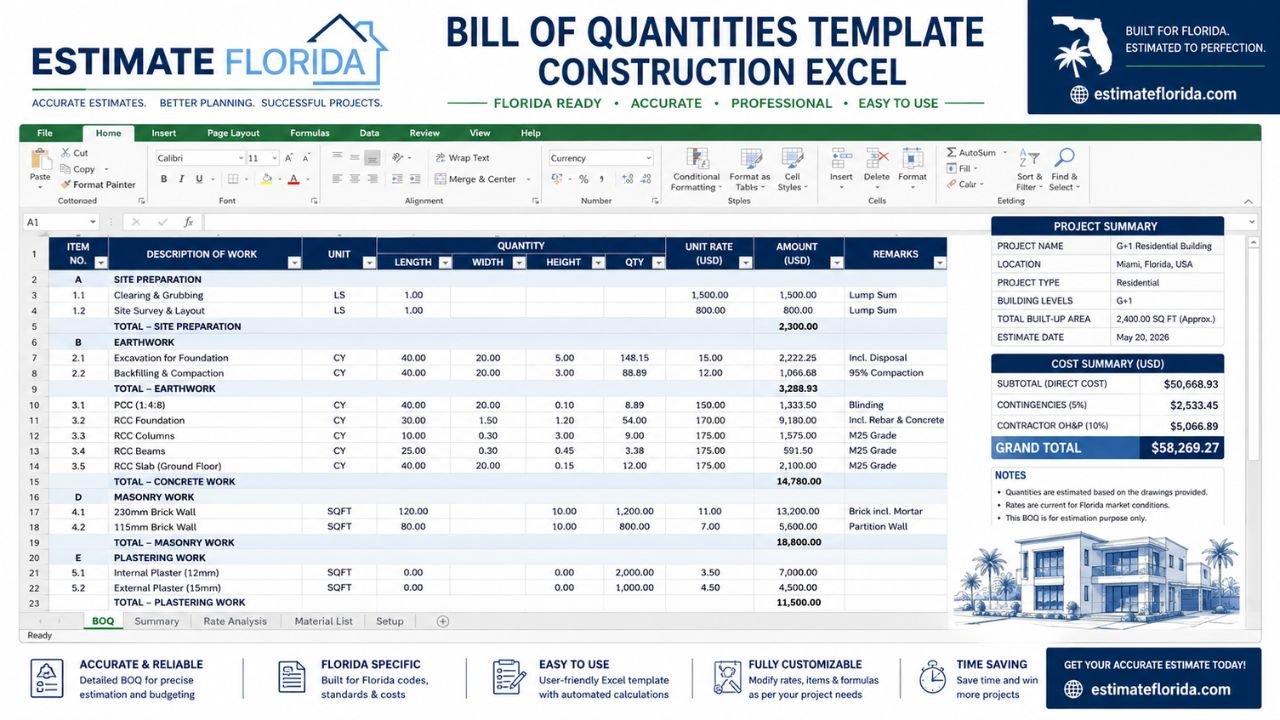
This comprehensive guide will explain what a Bill of Quantities is, the essential components every BOQ format should feature, and how to structure the ultimate bill of quantities template in Excel for Florida construction projects.
What Is a Bill of Quantities (BOQ)?
A Bill of Quantities (BOQ) is a highly detailed, structured tender document prepared primarily by a quantity surveyor or lead estimator. In simple terms, it provides an exhaustive, itemized list of the materials, parts, and labor (and their associated costs) required to construct a building according to the architectural and engineering drawings.
Unlike a rough conceptual estimate or a preliminary budget, a professional BOQ is a rigorous cost estimate structure. It breaks down the entire scope of work into measurable work items, attaching a specific unit of measurement, an exact quantity, a unit rate, and a total amount to every single line.
A BOQ serves multiple critical functions throughout a project’s lifecycle:
-
Cost Planning & Estimating: It provides a highly accurate financial roadmap before ground is ever broken.
-
Bid Comparison (Tendering): When distributed to bidding subcontractors, a BOQ ensures all parties are pricing the exact same scope of work, creating an “apples-to-apples” comparison matrix for the general contractor.
-
Progress Billing: It serves as the baseline for monthly payment applications, allowing owners to pay for the exact percentage of work completed per line item.
-
Change Order Management: If a project scope changes, the BOQ provides pre-established unit rates to price variations fairly and accurately.
Why Florida Projects Need a Specialized Bill of Quantities Template Construction Excel in Florida
Building in Florida requires a hyper-local approach to estimating and quantity takeoff. Utilizing a generic, national BOQ template will often lead to dangerous omissions, as it fails to prompt the estimator to account for the state’s unique environmental and regulatory demands.
Florida-specific factors that necessitate a specialized BOQ include:
-
Hurricane and Wind-Load Requirements: Since the adoption of stringent wind codes, Florida structures require specialized hardware. Your BOQ must include detailed lines for continuous load-path tie-downs, impact-resistant glazing, reinforced masonry, and engineered roofing attachments.
-
Flood Zone Construction and Elevation: Coastal and low-lying inland projects are heavily dictated by FEMA base flood elevations. Your spreadsheet must accommodate the massive costs associated with importing fill dirt, driving concrete pilings, or constructing breakaway ground-floor walls.
-
Moisture and Corrosion Concerns: High humidity, intense UV exposure, and coastal salt spray rapidly degrade standard building materials. A localized BOQ prompts estimators to price marine-grade stainless steel fasteners, specialized vapor barriers, and robust anti-corrosive coatings.
-
Regional Labor and Material Pricing: The cost to build fluctuates wildly across the state. A specialized BOQ allows estimators to easily update localized material rates, accounting for the drastic price differences between building in the Florida Keys versus Jacksonville.
-
Local Permit and Impact Fees: Florida municipalities are known for levying heavy impact fees for water, sewer, environmental mitigation, and schools. These soft costs must be clearly categorized to protect builder margins.
Understanding what are the 7 stages of construction is incredibly helpful when determining how to group these regional costs chronologically within your spreadsheet. By aligning your BOQ format Excel Florida with the actual phases of the build, mastering residential construction estimating becomes a far more predictable and profitable process.
Essential Sections of a Professional BOQ Template
A professional BOQ is systematically divided into distinct, logical sections. This strategic segmentation transforms a chaotic database of numbers into a readable, professional tender document.
Here is a breakdown of the critical sections your BOQ template must include:
| BOQ Section | Role in the Document | Key Fields & Work Items Included |
| 1. Header & Cover Page | Identifies the project and the parties involved. | Project name, site address, client, date, BOQ reference number. |
| 2. Introduction & Notes | Establishes the rules of the estimate. | Basis of estimate, measurement rules, assumed site conditions, overarching exclusions. |
| 3. Trade-Wise Sections | The core line-item financial breakdown. | Earthwork, concrete, structural steel, masonry, finishes, framing, and MEP systems. |
| 4. Summary / Abstract Sheet | A high-level financial overview for quick review. | Section totals, overhead, contingency fund, profit margin, tax, and the grand total. |
The trade-wise BOQ sections are the heart of the document, where the exhaustive quantity takeoff is translated into dollar amounts. If you want to see exactly how these sections integrate into a live, working document, reviewing a sample BOQ for house construction excel complete format with example can provide an excellent structural blueprint for your own custom spreadsheets.
Recommended Column Structure for BOQ Lines
The functional body of your BOQ is dictated by its column layout. The specific BOQ columns you choose will determine how easily the document can be read, audited, and edited by different project stakeholders.
Every individual line item in your Excel template should feature the following core columns:
-
Item Number/Code: A standard reference number (often aligned with CSI MasterFormat divisions) that helps in sorting data and referencing specific trades.
-
Description of Work or Item: A highly specific explanation of the material or labor task. This must include specification references (e.g., “3000 PSI Cast-in-Place Concrete for Footings” rather than just “Concrete”). Clear descriptions are the best defense against scope disputes.
-
Unit of Measurement (UOM): Crucial for accurate pricing. Common units include m³ (cubic meters), m² (square meters), LF (linear feet), EA (each), and KG (kilograms) or Tons for steel.
-
Quantity: The exact numerical amount derived from the architectural plans.
-
Rate (Unit Price): The cost per single unit of measure for either material, labor, or a combined installed price.
-
Amount: The calculated extended price (Quantity multiplied by Rate).
-
Remarks: A dedicated space for assumptions, exclusions, or noted deviations from the blueprints.
For highly detailed projects, you may include optional columns such as Location/Zone (e.g., separating the East Wing from the West Wing) or Phase. Consistent columns make it incredibly easy for contractors to filter data, allowing an electrical sub, for example, to view only their specific scope of work.
How to Structure Formulas and Summaries in Excel
The true mechanical power of an Excel estimator layout lies in its formulas. When designed correctly, Microsoft Excel handles all the mathematics, virtually eliminating the risk of human calculation errors.
Start with the fundamental formula in the body of your BOQ:
Amount = Quantity * Rate
From there, structure your subtotal formulas to group costs by their specific trade or CSI division. You should have distinct SUM formulas for Site Work, Foundation, Superstructure, Exterior Finishes, and Interior Finishes. These separate division buckets will feed dynamically into your Summary Sheet to generate the Total Direct Costs.
Below the direct costs on the summary sheet, your template must carefully calculate soft costs and markups. Establish independent, formula-driven cells for your Overhead percentage, your Contingency reserve, and your Profit markup. Calculate your applicable taxes, and sum it all up for the Grand Total.
Best Practices for Structuring Excel Formulas:
-
Use Separate Sheets: Keep the workbook organized by placing the detailed BOQ on one tab, the high-level summary on a second tab, and a hidden master rate list on a third tab.
-
Avoid Hard-Coded Totals: Never manually type a final sum into a total cell. Always rely on formulas so that if an architect changes a design quantity, the grand total updates automatically.
-
Protect Formula Cells: Utilize Excel’s “Protect Sheet” feature to lock the cells containing mathematical formulas, ensuring users only input data into the quantity and rate columns.
Structuring your formulas rigorously is the foundation of professional residential construction estimating. Using a proven baseline, such as a sample BOQ for house construction excel complete format with example, guarantees that every mathematical variable is accounted for before the bid is submitted.
Benefits of a Standardized Bill of Quantities Template Construction Excel in Florida
Adopting a rigorous, standardized BOQ format Excel Florida template transforms your estimating department into a highly efficient, risk-mitigating operation.
First and foremost, a consistent template reduces measurement and pricing errors. When your BOQ features permanent, dedicated rows for every phase of construction, estimators are far less likely to accidentally omit critical items like site dewatering, dumpster swap fees, or final clean-up costs. Second, it exponentially speeds up tender preparation. Estimators do not have to reinvent the spreadsheet for every new set of plans; they simply open the master file and begin populating quantities.
Furthermore, a standardized BOQ makes subcontractor bid comparisons entirely objective. When all bidders submit their pricing on your exact template, you can instantly identify who is underpricing a specific line item. It also massively improves communication with owners and lenders by presenting data transparently.
If a prospective client asks how much does it cost to build a house in Florida, an archive of past BOQs allows you to quickly provide a highly accurate historical baseline. The exact same advantage applies to commercial estimating; if a developer asks how much does it cost to build a warehouse in Florida, your standardized commercial BOQ templates serve as a powerful, reusable database of hard historical costs, permanently eliminating “rough estimate” guessing.
Common Mistakes in BOQ Templates
Even highly experienced quantity surveyors and estimators can jeopardize project profitability if their Excel bill of quantities for construction is poorly designed. Avoid these common formatting pitfalls:
-
Missing Key Header Fields: Forgetting to include the current date, revision number, or BOQ reference makes version control impossible when dealing with multiple architectural addendums.
-
Unclear or Inconsistent Item Descriptions: Writing vague terms like “wood flooring” instead of “3/4-inch Engineered Oak Hardwood – Glue Down” leads to massive change order disputes.
-
Mixing Units of Measure Without Labeling: Entering a quantity without specifying if it means Square Feet, Linear Feet, or Cubic Yards will completely invalidate your final cost totals.
-
Hard-Coding Amounts Instead of Using Formulas: If you type a static dollar amount into a total cell, it will not dynamically update when a unit rate fluctuates, leading to hidden losses.
-
No Clear Separation Between Sections or Trades: Lumping electrical, plumbing, and HVAC into a single “MEP” line item makes it impossible to accurately vet subcontractor bids.
-
Forgetting Notes, Assumptions, and Exclusions: Omitting a clear preamble or remarks section leaves the contractor legally vulnerable to absorbing costs for unforeseen site conditions.
A well-architected template naturally reduces these risks by forcing the user to populate data systematically.
Florida Code, Flood, and Regional Cost Considerations
To be an effective tool, your BOQ must seamlessly handle the strict realities of building in Florida. The state operates under some of the most rigorous building safety codes in the world, and your spreadsheet’s line items must reflect absolute compliance.
Your BOQ must actively account for the hurricane-resistant construction materials mandated by the Florida Building Code. If you are estimating a project in a coastal High-Velocity Hurricane Zone (HVHZ), your document needs explicit callouts for impact-resistant glazing, secondary water barriers, and specialized engineered roof trusses.
If the construction site sits in a designated flood zone, you will need to reference FEMA Flood Maps to determine the Base Flood Elevation (BFE). Your foundation and substructure BOQ divisions must be uniquely formatted to handle the vastly increased costs of driving auger-cast pilings, constructing stem walls, or pouring heavy monolithic slabs. Furthermore, Florida’s extreme ambient moisture dictates the need for advanced HVAC ventilation and heavy-duty corrosion protection, which must be clearly defined in your item descriptions.
Labor and material pricing also vary wildly depending on the region. Sourcing skilled masonry labor in the South Florida market requires a completely different cost baseline than building in the rural northern counties. Always cross-reference your internal unit rates with reliable industry data sources like RSMeans and rigorously verify your subcontractors’ licensing status through the Florida Department of Business and Professional Regulation.
Ensuring your BOQ is strictly code-compliant and built on highly accurate regional data is the best way to build trust with homeowners when they are figuring out how to choose a contractor to build a house in Florida.
How to Build or Adapt Your Own BOQ Template in Excel
Creating the ultimate bill of quantities template construction Excel in Florida does not require an advanced background in data science. Florida builders, engineers, and quantity surveyors have several practical options to build a highly effective layout.
You can start by downloading a standard, reputable BOQ format online and manually customizing the columns, headers, and summary sections to match your specific operational workflow. Alternatively, you can adapt an existing residential or commercial BOQ sheet from a past project that proved financially successful. The most robust formats utilize separate interconnected tabs: one tab for the high-level summary, one tab for the deeply detailed trade-wise BOQ, and a hidden tab housing your master rate schedules.
Many professionals organize their BOQs strictly by CSI (Construction Specifications Institute) divisions, while others prefer simpler local trade categories. The goal is to design a template that matches your company’s typical project types.
Having a dialed-in administrative and estimating setup is critical for anyone looking to scale their construction operations. If you are actively expanding your footprint in the state, establishing these reliable BOQ formats early is vital. Resources detailing how to become a builder in Florida, how to become a contractor in Florida, and how to become a general contractor in Florida consistently highlight the importance of backend financial tracking and precise estimating. Furthermore, understanding exactly how to get a building permit in Florida ensures you build the proper municipal impact costs, expediting fees, and timeline delays directly into your master BOQ format.
Final Thoughts
A solid, professionally structured bill of quantities template construction Excel in Florida is far more than just a digital spreadsheet—it is a critical strategic tool that actively drives the financial health and operational success of your construction projects.
By establishing a clear, standardized BOQ layout, you eliminate client confusion, drastically reduce the risk of catastrophic bidding errors, and maintain strict, transparent control over your project budgets from the initial tender to the final handover. Investing the time and effort upfront to build a clean, consistent, and highly detailed BOQ template ensures that every future Florida project is easier to estimate, bid, and manage profitably.