Roofing contractors bidding work in Fort Lauderdale are competing in one of the most demanding roofing markets in the country. Every project sits inside Broward County’s High-Velocity Hurricane Zone, which means every shingle, tile, membrane, and fastener has to meet wind-uplift standards that don’t exist in most of the rest of the United States. A roofing estimate that’s off by even a few squares, or that misses a Notice of Acceptance requirement, doesn’t just cost margin — it can cost the bid entirely.
That’s where a dedicated roofing quantity takeoff and cost estimate earns its keep. A roofing takeoff measures every component of the roof assembly — field area, hips and valleys, flashing runs, underlayment, accessories — directly from the plans. A roofing cost estimate then applies current Fort Lauderdale-area labor and material pricing to those quantities so a contractor can submit a number with confidence instead of a guess.
Estimate Florida prepares roofing quantity takeoffs, material takeoffs, and full cost estimates for contractors, developers, and property owners working throughout Fort Lauderdale and greater Broward County. The rest of this page walks through what roofing estimating actually involves, what’s covered in a professional takeoff, and how the process supports a stronger, more competitive bid.
What Are Roofing Estimating Services?
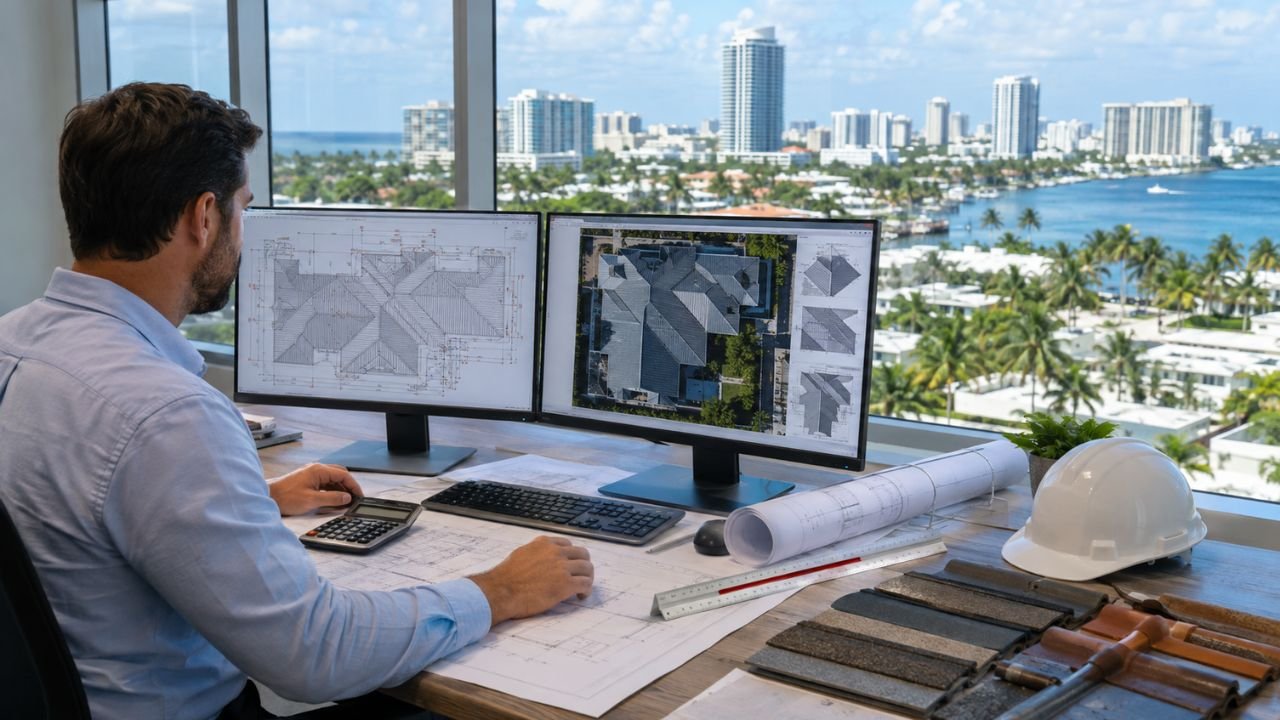
Roofing estimating is the process of turning a set of drawings and specifications into a detailed list of quantities and costs for a roofing scope. It starts with a roofing quantity takeoff — measuring roof area by slope and system, then counting every accessory: ridge caps, drip edge, valleys, penetrations, and flashing. From there, a roofing material takeoff assigns actual products to those quantities — a specific shingle line, a standing seam profile, a TPO membrane thickness — so pricing reflects what’s actually going on the roof rather than a generic allowance.
Labor is calculated separately from material, based on crew productivity rates for the roofing system in question — tear-off and disposal move at a different pace than new tile installation, and steep-slope work is priced differently than low-slope. Equipment costs (cranes for tile delivery, dumpsters for tear-off debris, safety anchor systems) get their own line items. Waste factors are applied by material type, since tile and slate carry higher breakage allowances than membrane roofing.
The result feeds into bid preparation and construction budgeting: a general contractor uses the estimate to evaluate a roofing subcontractor’s bid, a roofing contractor uses it to build their own proposal, and a developer uses it during preconstruction to set a realistic roofing line in the overall project budget.
Why Accurate Roofing Estimating Matters in Fort Lauderdale
An estimate that’s off by a small percentage on a large commercial re-roof can swing profit margin by tens of thousands of dollars. In a competitive market like Fort Lauderdale, where multiple qualified roofing contractors are often bidding the same scope, accuracy affects more than the bottom line — it affects whether a contractor wins the work at all.
Accurate roofing estimates support:
- Competitive bidding — pricing tight enough to win without leaving margin on the table
- Profit margin planning — knowing true cost before committing to a number
- Material purchasing — ordering the right quantities without over- or under-buying
- Labor planning — scheduling crews based on realistic production rates
- Budget control — keeping a project on track through construction
- Project feasibility — helping developers and owners decide whether a roofing scope pencils out
- Risk management — flagging HVHZ compliance costs before they become change orders
- Scope review — catching missing accessories or underlayment before they turn into disputes
- Better bid decisions — knowing which projects are worth pursuing
- Reduced estimating errors — fewer surprises once work is underway
In Fort Lauderdale specifically, accuracy also means correctly pricing HVHZ-compliant fastening, secondary water barrier requirements, and Florida Product Approval or Miami-Dade NOA-rated materials — costs that a generic, non-Florida estimate will almost always understate.
Roofing Estimating Services Offered
Roofing Quantity Takeoff Services
A roofing quantity takeoff measures roof area (in squares and square feet) by slope and roofing system, then quantifies every supporting component: underlayment, insulation, flashing, accessories, penetrations, and waste. Measurements are taken directly from architectural or structural drawings, with roof plans cross-referenced against elevations and details to confirm slope breaks, parapets, and equipment curbs.
Roofing Material Takeoff Services
A material takeoff assigns specific products to the measured quantities — asphalt shingles, metal panels, concrete or clay tile, TPO, PVC, EPDM, modified bitumen, or built-up roofing — along with underlayment, flashing, fasteners, sealants, and insulation. Because Fort Lauderdale sits in the HVHZ, material takeoffs also note the Florida Product Approval or NOA number associated with each specified product where that information is available on the plans.
Roofing Bid Estimating
A bid estimate takes the completed takeoff and applies current pricing to produce a submittable number — the estimate a roofing contractor uses to complete their bid form or a general contractor uses to evaluate subcontractor pricing.
Roofing Budget Estimating
Early in a project, before final drawings exist, a budget estimate uses conceptual roof area and system assumptions to give owners and developers a planning-level number for the roofing line item.
Preliminary Roofing Estimates
A preliminary estimate is built from partial or schematic drawings — useful for feasibility studies or early value engineering conversations before construction documents are complete.
Detailed Roofing Estimates
A detailed estimate is built from full construction documents and specifications, with every line item measured and priced — the level of detail needed for a formal bid submission.
Roof Replacement Estimating
Roof replacement estimates cover the full re-roof scope: existing roof removal (tear-off), disposal, deck inspection and repair allowances, new roofing system, underlayment, flashing, accessories, and labor — priced separately from new-construction roofing since the sequencing and site conditions differ.
Roofing Change Order Estimating
When scope changes mid-project — an owner upgrades from shingle to tile, or a deck repair is discovered during tear-off — a change order estimate quantifies and prices the added or revised scope on its own, so it can be reviewed and approved cleanly.
Roofing Value Engineering
When budgets are tight, a value engineering pass compares the cost implications of alternative roofing systems or materials — for example, comparing a standing seam metal roof against a tile system on the same building — so owners can make an informed cost-versus-performance decision.
Types of Roofing Projects
Estimate Florida prepares roofing estimates across the full range of project types found in the Fort Lauderdale market:
- New construction roofing
- Roof replacement and re-roofing
- Residential roofing (single-family, custom, multifamily)
- Commercial roofing (office, retail, hospitality, healthcare)
- Multifamily and mixed-use developments
- Industrial and warehouse roofing
- Institutional and municipal roofing
- Renovation and restoration roofing scopes
Roofing Systems
Asphalt Shingles
The most common residential steep-slope system, with wind-rated products required to meet Florida’s HVHZ and wind-borne debris standards.
Metal Roofing
Standing seam, exposed-fastener, and snap-lock panel systems — a popular choice for both commercial and high-end residential projects because of their wind performance and longevity.
Tile Roofing
Concrete and clay tile remain a premium residential choice throughout South Florida. Tile can be mortar-set or mechanically attached, with HVHZ-compliant attachment details specified for each.
Low-Slope Roofing
TPO, PVC, EPDM, modified bitumen, and built-up roofing systems cover commercial and multifamily flat and low-slope buildings, typically with tapered insulation for positive drainage.
Roofing Accessories
Underlayment, insulation, flashing, copings, parapets, roof drains, gutters, downspouts, roof curbs, skylights, vents, and penetrations — priced according to what the specific project actually requires, not applied as a blanket assumption.
Not every roof uses every system or every accessory; scope depends entirely on the project’s drawings and specifications.
Residential Roofing Estimating in Fort Lauderdale
Residential roofing estimates cover single-family homes, custom and luxury builds, townhomes, duplexes, and multifamily buildings, as well as additions, roof replacements, and renovation scopes. Fort Lauderdale’s residential roofing market leans heavily toward tile and metal on higher-end homes and asphalt shingle on standard construction, and each carries different waste factors, attachment methods, and labor productivity assumptions. Residential estimates also need to account for existing roof conditions on replacement projects — deck condition, existing flashing, and any hidden repair work that tear-off might reveal.
Commercial Roofing Estimating in Fort Lauderdale
Commercial roofing in Fort Lauderdale spans office buildings, hotels, restaurants, retail centers, warehouses, industrial buildings, healthcare facilities, and mixed-use developments. Commercial estimates typically involve larger, more complex roof areas — multiple roofing systems on a single building, extensive drainage and scupper design, numerous roof penetrations and equipment curbs, and coordination with mechanical equipment placement. Roof access, existing roof condition on re-roof projects, and phasing around an occupied building all factor into the labor side of a commercial estimate.
Roofing Components Included in Takeoffs
A complete roofing takeoff typically accounts for:
- Roof surface area by slope and system
- Roof deck condition and repair allowances
- Underlayment and secondary water barrier
- Roofing material (shingle, tile, metal, membrane)
- Insulation, including tapered insulation for drainage
- Flashing, drip edge, and ridge caps
- Starter materials and fasteners
- Adhesives and sealants
- Vents, penetrations, and curbs
- Skylights
- Gutters, downspouts, and scuppers
- Copings and parapets
- Roof drains and sheet metal
- Tear-off and disposal, where applicable
The exact scope included in any given takeoff depends entirely on the project’s drawings and specifications — a professional estimate never assumes a standard package applies to every roof.
Roofing Quantity Takeoff Process
- Review project documents — drawings, specifications, and any issued addenda
- Review roofing specifications — confirm the specified system, product lines, and attachment method
- Identify roofing assemblies — separate the roof into distinct systems where more than one applies
- Measure roof areas — by slope, in squares and square feet, from the roof plan
- Calculate material quantities — field material, underlayment, insulation, and accessories
- Calculate accessories — flashing, drip edge, valleys, vents, and penetrations by linear foot or each
- Calculate labor — based on system-specific crew productivity rates
- Apply appropriate pricing — current Florida labor and material rates
- Review scope and quantities — a second pass to confirm nothing was missed against the drawings
- Deliver the estimate — formatted for bid submission or internal budgeting
Roofing Estimating Software and Technology
Digital takeoff tools such as PlanSwift, Bluebeam Revu, and STACK, along with spreadsheet-based workflows and construction cost databases, can meaningfully speed up the measurement and organization side of roofing estimating. These platforms allow digital measurement directly from PDF plans, which reduces manual counting errors and makes it easier to revise an estimate when addenda are issued.
That said, software accelerates the process — it doesn’t replace it. Digital takeoff tools measure what’s on the drawings accurately, but professional judgment is still required to interpret ambiguous details, apply the correct waste factors, and catch scope that isn’t clearly called out on the plans. No software guarantees estimate accuracy on its own.
Factors Affecting Roofing Costs in Fort Lauderdale
Roofing costs in Fort Lauderdale are shaped by a combination of project-specific and market factors:
- Roof size and geometry
- Roof pitch and slope complexity
- Roofing system and material selection
- Existing roof condition (on replacement projects)
- Tear-off scope and deck condition
- Insulation type and thickness
- Flashing complexity
- Drainage design
- Number of roof penetrations
- Labor availability and productivity
- Equipment needs (crane, safety systems)
- Site access
- Disposal costs
- Project schedule and phasing
- Weather-dependent scheduling
- HVHZ and Florida Product Approval compliance requirements
- Current material market conditions
Because material and labor pricing shift with market conditions, current project-specific pricing should always be verified against up-to-date supplier and labor data rather than relying on general averages.
South Florida Roofing Considerations
Fort Lauderdale’s roofing environment is shaped by South Florida’s climate and Broward County’s HVHZ designation. Wind exposure is the dominant design factor — Broward County requires roofing systems with a current Florida Product Approval or Miami-Dade Notice of Acceptance rated for the applicable wind pressure zone, and fastening patterns are considerably more rigorous than in non-HVHZ parts of the state.
Heavy seasonal rainfall and tropical storm exposure make drainage design and secondary water barrier compliance especially important — the Florida Building Code requires a secondary water barrier on most roofing installations specifically because wind-driven rain can penetrate a primary roof covering during a storm event even when the roof itself holds. Heat and UV exposure also factor into material selection and expected service life, and coastal proximity introduces additional corrosion considerations for metal components and fasteners.
The HVHZ designation covers Broward and Miami-Dade counties in full, with design wind speeds typically running around 170–180 mph for Risk Category II buildings, and every roofing product installed in the zone must carry a valid Florida Product Approval or Miami-Dade NOA with a design-pressure rating that meets or exceeds the calculated wind pressure for that location. Any code or regulatory figures cited for a specific project should be confirmed against the current Florida Building Code and the local building department, since requirements can vary by site-specific exposure category and jurisdiction.
How Much Does Roofing Estimating Cost?
Roofing estimating fees vary based on project size, roof complexity, the number of drawings and details involved, the roofing system or systems specified, the level of detail required, and turnaround time. A straightforward residential re-roof estimate takes far less time to prepare than a multi-system commercial roof with extensive drainage design and numerous penetrations, so project-specific pricing is generally more useful — and more accurate — than a single universal number. Contact Estimate Florida with your project scope for a flat-fee quote specific to your roof.
Benefits of Outsourcing Roofing Estimating
- Saves in-house estimators significant time on manual takeoffs
- Allows contractors to pursue more bids without adding staff
- Reduces the manual takeoff workload during busy bid seasons
- Improves cost organization with consistent, CSI-formatted deliverables
- Helps identify scope gaps before they become field problems
- Supports material planning and purchasing decisions
- Supports bid preparation with a clean, submittable package
- Frees contractors to focus on field operations instead of spreadsheets
Common Roofing Estimating Mistakes
- Incorrect roof measurements or slope calculations
- Missing waste factor for the specific material type
- Missing flashing, drip edge, or valley quantities
- Missing accessories — vents, curbs, or penetration flashing
- Incorrect material quantities from an outdated takeoff method
- Missing insulation, especially tapered insulation for drainage
- Missing tear-off or disposal costs on replacement projects
- Incorrect labor assumptions that don’t reflect the specific system
- Outdated material or labor pricing
- Missing drawing revisions or issued addenda
- Ignoring roof penetrations and equipment curbs
- Incorrect units (mixing squares, square feet, and linear feet)
Reducing these errors comes down to a disciplined process: reviewing the full, current drawing set, cross-checking measurements against elevations and details, and applying material-specific waste factors rather than a flat assumption across every system.
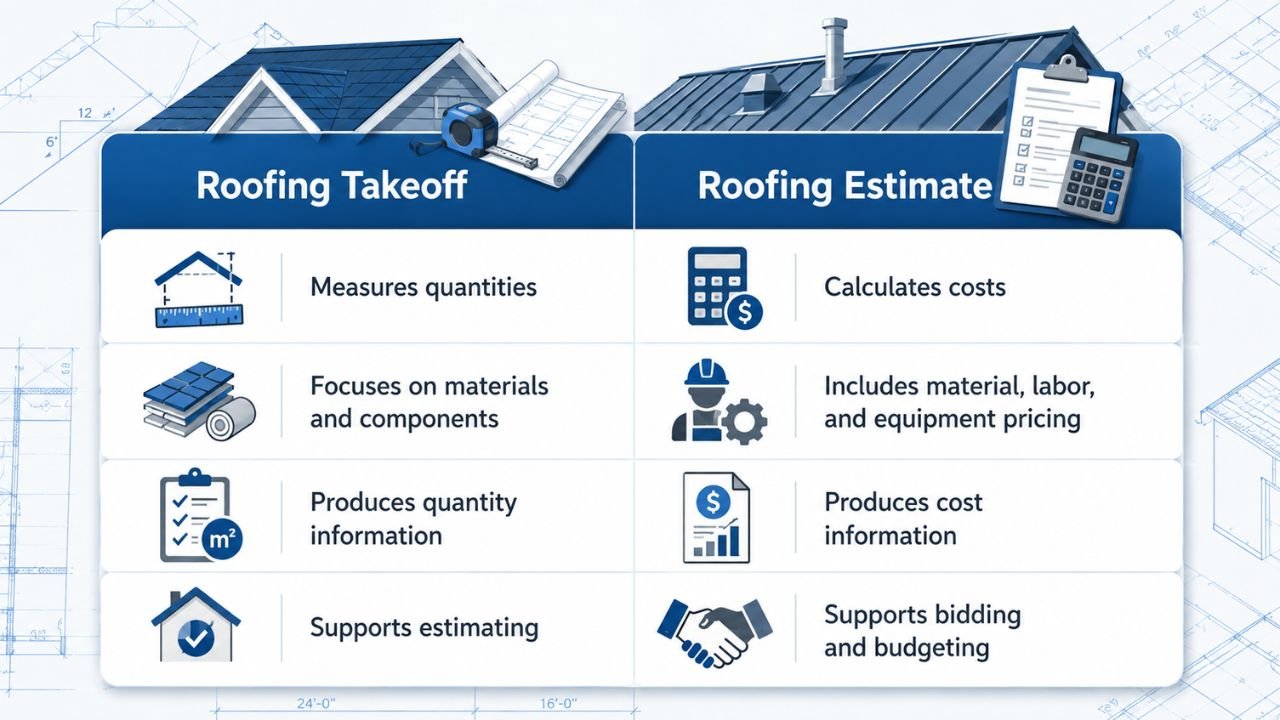
Roofing Takeoff vs. Roofing Estimate
| Roofing Takeoff | Roofing Estimate |
| Measures quantities | Calculates costs |
| Focuses on materials and components | Includes material, labor, and equipment pricing |
| Produces quantity information | Produces cost information |
| Supports estimating | Supports bidding and budgeting |
Who Uses Roofing Estimating Services?
- Roofing Contractors use takeoffs and estimates to prepare competitive, accurate bids without spending weekends doing manual measurements.
- Roofing Subcontractors rely on estimates to price scope quickly enough to pursue multiple bids in parallel.
- General Contractors use roofing estimates to evaluate subcontractor bids and confirm the roofing line item in an overall project budget.
- Builders and Developers use budget and preliminary estimates during preconstruction to confirm roofing costs fit the overall project pro forma.
- Architects and Engineers reference roofing estimates during value engineering discussions when comparing system alternatives.
- Property Owners use estimates to understand roof replacement costs and evaluate contractor bids on their own projects.
- Why Choose Estimate Florida?
Estimate Florida builds every roofing estimate around Florida-specific conditions rather than applying generic national data to a Fort Lauderdale project. That means:
- Detailed, line-item roofing takeoffs organized in CSI MasterFormat
- Florida-specific labor and material pricing rather than national averages
- Working knowledge of HVHZ, Florida Product Approval, and NOA requirements
- Digital takeoff technology paired with experienced review
- Flexible scopes — from a single-trade roofing takeoff to a full multi-trade estimate
- Clear, formatted deliverables — Excel workbook plus PDF summary
- Direct, professional communication throughout the process
Estimate Florida does not claim to be the lowest-priced or highest-ranked roofing estimator in Fort Lauderdale — those are claims that should be independently verified, not asserted. What Estimate Florida can commit to is a professional, Florida-informed estimating process on every project.
How Accurate Estimates Support Better Bids
Complete Plans → Accurate Measurements → Correct Quantities → Appropriate Pricing → Organized Estimate → Better Bid Decisions
A detailed, accurate estimate gives a contractor the information needed to make a smart bid decision — it does not, by itself, guarantee winning the project. Pricing strategy, relationship, schedule, and market conditions all factor into whether a bid is ultimately successful.
Roofing & Broward County Building Codes: What to Know
Every roofing project in Fort Lauderdale falls under Broward County’s HVHZ jurisdiction, which means roof permits require product-specific Notice of Acceptance or Florida Product Approval documentation as part of the application package. The city’s roof permit package requires structural calculations, roof plans, and other project-specific documentation as part of the permitting process. Contractors and property owners planning a re-roof or new roofing installation in the city should confirm current submittal requirements directly with the City of Fort Lauderdale’s Permitting Services division before finalizing a bid or schedule, since documentation requirements can be updated between code cycles.
Frequently Asked Questions
What does a roofing estimator do? A roofing estimator measures roof quantities from project drawings, assigns material and labor pricing, and produces a detailed cost estimate that supports bidding, budgeting, or purchasing decisions.
What is included in a roofing takeoff? A roofing takeoff includes roof area by slope and system, underlayment, insulation, flashing, accessories, penetrations, and applicable waste factors — the exact scope depends on the project’s drawings.
How much does roofing estimating cost? Fees depend on project size, roof complexity, and turnaround needs. Project-specific quotes are more accurate than a flat universal rate.
How long does a roofing estimate take? Most roofing estimates are delivered within 24–48 business hours, with rush turnaround available for tighter bid deadlines.
Do you provide residential roofing estimates? Yes — custom homes, spec homes, townhomes, and multifamily residential roofing scopes are all estimated.
Do you provide commercial roofing estimates? Yes — office, retail, hospitality, healthcare, and warehouse roofing projects are estimated using full CSI-format breakdowns.
Can you estimate roof replacement projects? Yes — roof replacement estimates include tear-off, disposal, deck repair allowances, and the new roofing system as separate, clearly identified line items.
Can you estimate from PDF plans? Yes — PDF, CAD, and scanned plans are all accepted for takeoff and estimating purposes.
Do you estimate roofing materials and accessories? Yes — a full material takeoff includes the roofing system itself along with underlayment, flashing, fasteners, sealants, and insulation.
Can you estimate TPO roofing? Yes — TPO, along with PVC, EPDM, modified bitumen, and built-up roofing systems, are all estimated for low-slope commercial applications.
Can you estimate metal roofing? Yes — standing seam, exposed-fastener, and snap-lock metal panel systems are estimated with Florida-rated clip and fastening details.
Do you estimate roofing labor? Yes — labor is calculated separately from material, based on productivity rates specific to the roofing system.
Can you estimate change orders? Yes — added or revised scope discovered during construction can be quantified and priced as a standalone change order estimate.
What documents are needed for a roofing estimate? Architectural or structural drawings, roofing specifications, any issued addenda, and — for replacement projects — information on the existing roof condition where available.
What factors affect roofing costs in Fort Lauderdale? Roof size and complexity, material selection, existing roof condition, HVHZ compliance requirements, labor and equipment needs, and current market pricing all affect cost.
Why outsource roofing estimating? Outsourcing frees a roofing company’s time for field operations and bid pursuit, while ensuring estimates reflect current Florida-specific pricing and HVHZ requirements.
Key Takeaways
- Roofing estimating combines a quantity takeoff with Florida-specific labor and material pricing to produce a bid-ready cost estimate.
- Fort Lauderdale’s location inside Broward County’s HVHZ makes wind-rated materials and Florida Product Approval or NOA compliance a core part of accurate roofing estimating.
- A roofing takeoff measures quantities; a roofing estimate adds cost — the two serve different purposes in the bidding process.
- Detailed estimates support competitive bidding, accurate budgeting, and reduced risk of costly mid-project surprises.
- Roofing estimating covers residential, commercial, industrial, and civil-adjacent scopes, from single-family re-roofs to multi-system commercial buildings.
- Software speeds up measurement, but professional review remains essential to catching scope that isn’t explicitly called out on the drawings.
- Outsourcing roofing estimating lets contractors pursue more bids without adding in-house estimating staff.
- Accurate estimates support better bid decisions — they don’t guarantee winning a project outright.
Conclusion
Accurate roofing estimating gives Fort Lauderdale contractors, developers, and property owners the information they need to make sound construction decisions — from evaluating a bid to setting a preconstruction budget. A properly detailed roofing takeoff clarifies exactly what a project requires, professional cost estimating reduces the manual workload of building that number from scratch, and understanding Fort Lauderdale’s HVHZ-driven local conditions keeps an estimate grounded in what the project will actually cost to build.
Estimate Florida provides roofing quantity takeoffs, material takeoffs, and full cost estimates for projects throughout Fort Lauderdale and across Florida. Contact Estimate Florida or email your plans to request a project-specific roofing estimating quote.