Steel Erection Cost Breakdown: What Drives the Price Per Ton
Erection cost per ton varies far more than supply cost — driven by crane selection, member group, site access, and safety compliance. Here's how the pieces fit together.
Why Erection Cost Varies So Much
Unlike supply cost, which tracks fairly closely with steel mill pricing, erection cost is dominated by labor and crane time — both of which are extremely sensitive to site conditions. The same tonnage can cost dramatically different amounts to erect depending on crane access, member size (a few very heavy picks vs. many small ones), and how tightly the erection sequence is constrained by other trades.
The Main Cost Drivers
Crane Selection & Mobilization
Tower crane vs. mobile crane, reach and capacity requirements, and mobilization/demobilization cost, which is largely fixed regardless of tonnage.
Member Weight & Count
Fewer, heavier picks (transfer girders) are often more efficient per ton than many small, light members requiring the same rigging setup each time.
Site Access & Sequencing
Tight urban sites, limited crane positions, and coordination with concrete/MEP trades all add time — and time is the primary erection cost driver.
Safety & Compliance
OSHA-compliant erection procedures, controlled decking zones and fall protection are non-negotiable costs, not optional line items to trim.
Typical Relative Cost by Member Group
As a rough planning guide (illustrative Florida market figures, per ton):
| Member Group | Relative Erection Cost / Ton |
|---|---|
| Primary/secondary floor beams | Lower — straightforward, repetitive picks |
| Perimeter & internal columns | Moderate — alignment and plumb tolerance add time |
| Transfer beams / plate girders | Higher — heavy picks need additional crane capacity and temporary shoring |
| Roof trusses | Higher — temporary props and guying until purlins are fixed |
Get Real Erection Rate Line Items
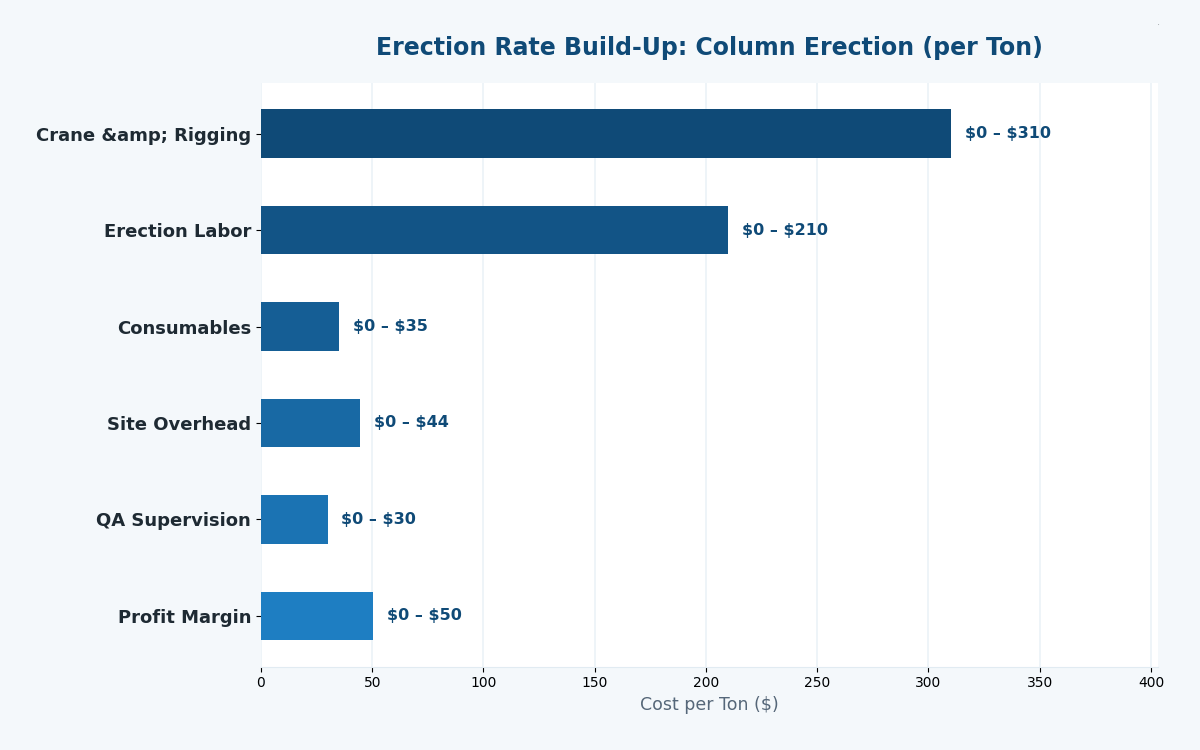
Our template prices erection as its own section (B), separate from supply, with a live rate-analysis example for column erection.
Get the BOQ Template – $49 →Safety Compliance Isn't Optional Cost
All erection work must comply with OSHA 29 CFR 1926 Subpart R — full body harnesses, controlled decking zones, and 100% tie-off above 15 ft are mandatory, not line items to value-engineer out. In Florida, budget separately for a heat-illness prevention program during summer months and for a documented Hurricane/Named-Storm Preparedness Plan covering crane tie-down or jib-lowering procedures.
A Sample Erection Cost Breakdown (Per Ton)
| Component | Amount |
|---|---|
| Crane & rigging cost | $310.00 |
| Erection labor (ironworkers, fitters, bolting crew) | $210.00 |
| Consumables (shims, temp. bracing) | $35.00 |
| Sub-total | $555.00 |
| + Site overheads @ 8% | $44.40 |
| + Safety & QA supervision @ 5% | $29.97 |
| + Profit margin @ 8% | $50.35 |
| Net erection rate per ton | $679.72 |