
Steel Structure Rate Analysis: How Contractors Build Unit Rates
A unit rate that isn't backed by a visible cost build-up is just a guess. Here's the standard methodology for building a defensible $/ton rate for structural steel.
Why Rate Back-Up Matters
A bare $/ton figure with no supporting detail invites two problems: an owner's quantity surveyor has no basis to accept it without negotiation, and the estimator who quoted it has no record of how it was built if costs shift before award. A visible rate analysis solves both — it's the standard quantity-surveying methodology for any BOQ item significant enough to matter.
The Five Cost Components
A structural steel rate analysis builds up in five layers:
1. Raw Material
Steel cost per ton for the specified grade (ASTM A992 Gr.50, A572 Gr.50, etc.), including a cutting/fabrication wastage allowance, typically 3–6%.
2. Labor
Fabrication labor (cutting, fit-up, welding, drilling, cambering) for supply items; erection labor (hoisting, aligning, bolting) for erection items.
3. Consumables & Equipment
Welding electrodes, shielding gas, grinding discs for fabrication; crane/rigging time and temporary bracing materials for erection.
4. Overheads
Factory/works overhead on the fabrication side, site overhead and supervision on the erection side — usually 5–10% each.
5. Profit Margin
Applied last, on top of the fully-loaded cost — commonly 6–10% depending on market conditions and risk.
A Worked Example: Supply Rate for Perimeter Columns
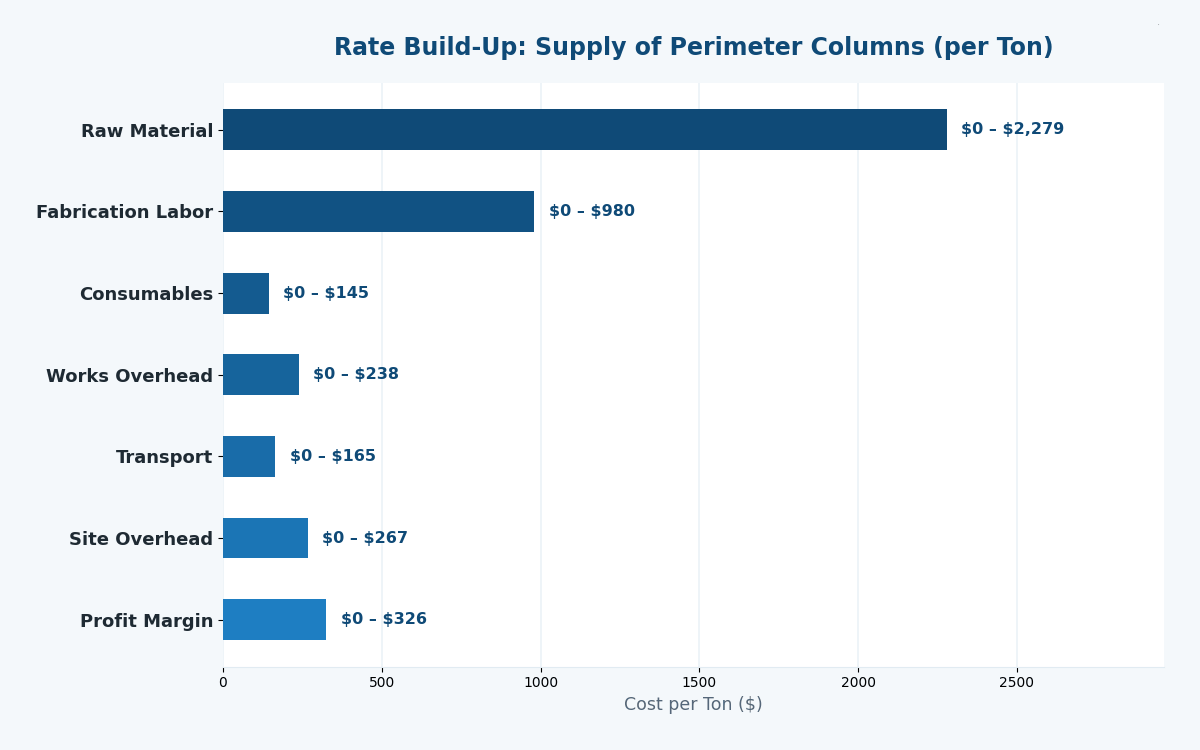
Here's how a real rate build-up reads, using illustrative Florida market figures for supply of perimeter/corner columns (per ton):
| Component | Amount |
|---|---|
| Raw material (incl. 6% wastage) | $2,279.00 |
| Fabrication labor | $980.00 |
| Consumables | $145.00 |
| Sub-total | $3,404.00 |
| + Works overhead @ 7% | $238.28 |
| + Transportation to site | $165.00 |
| + Site overhead @ 7% | $266.51 |
| + Profit margin @ 8% | $325.90 |
| Net rate per ton | $4,399.69 |
This Exact Build-Up, Pre-Built
Our template includes live rate-analysis blocks for 3 key BOQ items, linked directly to the priced BOQ — edit the inputs and the rate updates everywhere automatically.
Get the BOQ Template – $49 →Supply vs. Erection Rates Are Built Differently
Supply rates are material-heavy: raw steel cost dominates, with fabrication labor as a smaller add-on. Erection rates flip that balance — crane and rigging cost plus ironworker labor dominate, with almost no material cost beyond shims and temporary hardware. Blending the two into a single "installed" rate makes it impossible to separately negotiate or benchmark either side, which is why professional BOQs always keep supply and erection as separate line items with separate rate build-ups.
Keeping Rates Current
Steel mill pricing moves. For any contract with an escalation clause, tie rate updates to a published index rather than a subjective adjustment — the U.S. Bureau of Labor Statistics Producer Price Index for steel mill products (Series WPU101) is the standard reference most Florida contracts use.