Florida’s construction market is crowded, fast-moving, and unforgiving of weak bids. If you want to know how to get more construction projects in Florida, the short answer is this: sharpen your bid accuracy, build real relationships with developers and GCs, dominate your local search presence, join the right associations, target growth-heavy project types, and follow up relentlessly. None of these strategies work in isolation. Together, they build a pipeline that keeps your crews busy year-round.
This guide breaks down exactly how to win more construction bids in Florida, where the best opportunities are hiding in 2026, and which habits separate contractors who grow from contractors who stay stuck bidding the same handful of leads every month.
Key Takeaways
- Bid accuracy wins jobs. Florida-specific pricing and detailed line items beat generic, rounded-off numbers almost every time.
- Relationships outperform cold outreach. Developers and GCs give repeat work to contractors they trust, not just the lowest bidder.
- Google Business Profile is a lead-generation engine. Most commercial and residential buyers research online before they ever pick up the phone.
- Local associations open doors. Florida’s regional builder and trade groups are where real project leads get shared first.
- Niche targeting beats chasing everything. Contractors who focus on hurricane-resilient, multifamily, or fast-growth-county work convert more bids.
- Professional estimating is a competitive advantage. Fast, Florida-accurate takeoffs let you submit more bids without sacrificing precision.
- Follow-up systems close the gap. Most lost bids aren’t lost on price — they’re lost on silence after submission.
- Reputation is a sales asset. Reviews, referrals, and case studies do more selling than any ad campaign.
Why Winning More Construction Projects in Florida Takes a Different Playbook in 2026
Florida isn’t a single market. It’s dozens of overlapping ones — coastal, urban, rural, and rapidly suburbanizing — each with its own permitting quirks, labor pool, and buyer expectations. A strategy that works for a Tampa multifamily developer won’t necessarily land you a job with a Panhandle homeowner rebuilding after storm damage.
That’s why generic marketing advice underperforms here. Contractors who consistently grow their construction business in Florida treat lead generation, bidding, and relationship-building as one connected system, not three separate to-do lists.
Population growth is still the backbone of opportunity. Counties like Osceola, Polk, St. Johns, and Sumter continue adding residents faster than most of the country, which means new subdivisions, schools, retail centers, and infrastructure work. At the same time, hurricane-driven rebuilding and Florida Building Code (FBC) upgrades keep steady demand flowing into roofing, impact-window, and structural retrofit work across the entire state.
The contractors who find construction projects in Florida most consistently aren’t necessarily the biggest firms. They’re the ones who’ve built systems for bidding smarter, showing up in the right rooms, and staying visible online long after the first handshake.
Seasonality also plays a bigger role here than in most states. Bid volume tends to climb heading into hurricane season and again in the months after major storms, when insurance claims and rebuilding permits spike demand for roofing, framing, and structural repair trades. Contractors who plan their marketing and bidding cadence around these predictable waves — rather than treating every month the same — tend to stay busier with less scrambling.
Effort vs. Impact: Comparing the Top Strategies to Win More Construction Work
Not every strategy deserves equal time. Use this table to prioritize where your energy goes first.
| Strategy | Effort Required | Impact on Winning Projects | Best For |
| Professional bid estimating | Low (outsourced) | Very High | All contractors, especially those bidding weekly |
| Google Business Profile optimization | Low–Medium | High | Residential contractors, remodelers |
| Networking with local associations | Medium | High | GCs, subs seeking repeat commercial work |
| Direct outreach to developers/GCs | Medium–High | Very High | Subcontractors, specialty trades |
| Targeted project-type specialization | Medium | High | Growing firms ready to niche down |
| Follow-up and CRM systems | Low | Medium–High | Everyone, especially high bid-volume firms |
| Reputation and review management | Low–Medium | Medium–High | Residential and design-build contractors |
| Paid advertising (local search, social) | Medium–High | Medium | Firms with marketing budget and capacity to scale |
The pattern here is clear: some of the highest-impact strategies for construction lead generation in Florida cost the least effort. Estimating support and Google Business Profile work should be first on your list.
Sharpen Your Bid Quality and Accuracy to Win More Construction Bids in Florida
Nothing loses a bid faster than a number that doesn’t hold up. Owners, developers, and GCs in Florida have seen enough bids to spot padding, rounding, and vague scope language instantly — and it costs contractors the job before the conversation even starts.
Why Bid Precision Matters More in Florida
Florida pricing isn’t uniform. Labor rates in Miami-Dade differ substantially from labor rates in the Panhandle. Material costs shift based on hurricane season demand, supply chain timing, and county-specific delivery logistics. A bid built on national averages almost always misses the mark, either scaring off the client with an inflated number or setting your own crew up for a loss on execution.
Detailed, line-item bids do three things generic bids can’t:
- Build instant credibility. A breakdown by CSI division signals you understand the full scope, not just the headline number.
- Reduce change-order disputes later. Clear scope definitions protect both you and the client if conditions shift.
- Make comparison easy for the buyer. GCs reviewing five bids will gravitate toward the one that’s easiest to evaluate line by line.
What a Winning Florida Bid Includes
- Florida-specific material and labor pricing, not national averages
- Full CSI MasterFormat breakdown for larger commercial or multifamily scopes
- Explicit allowances for Florida Building Code requirements, including wind-load and impact-resistant components in HVHZ counties
- County-specific permit fee estimates
- Clear assumptions and exclusions, so nothing is ambiguous later
This is where accurate, Florida-specific estimates become one of the single strongest ways to win more projects. Contractors who use professional Florida construction estimating services consistently submit more competitive, more defensible bids — without burning weekends building takeoffs by hand.
Common Bid Mistakes That Cost Florida Contractors Work
Even experienced contractors lose winnable bids to a handful of repeat mistakes. Watch for these:
- Rounding line items instead of pricing them precisely — reviewers notice, and it signals a rushed estimate
- Skipping permit and impact-fee allowances, which forces awkward renegotiation later if the client assumed they were included
- Reusing pricing from a different county without adjusting for local labor and material differences
- Leaving scope language vague, which invites lowball comparisons from bidders who quietly excluded work you included
Fixing even one or two of these habits can measurably improve win rates, especially on competitively bid commercial and multifamily work where reviewers are comparing several proposals side by side.
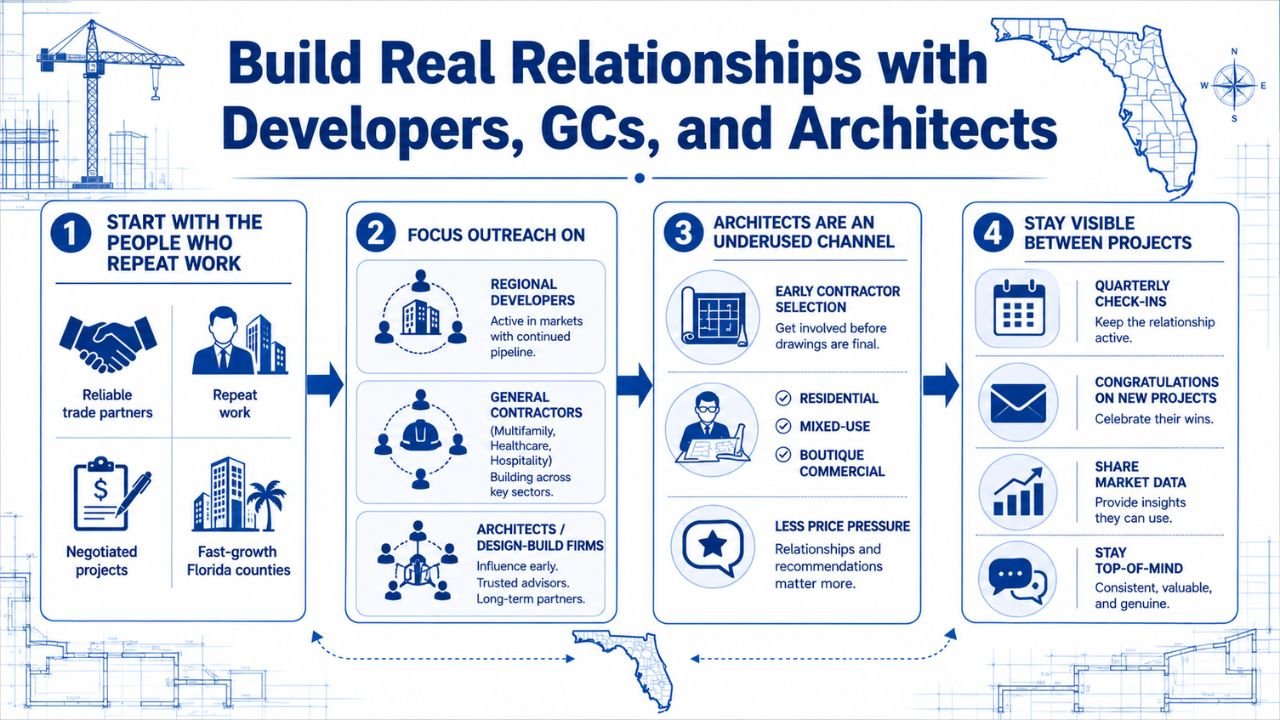
Build Real Relationships with Developers, GCs, and Architects
Bid boards get you into the room. Relationships get you invited back without competing on every job.
Start With the People Who Repeat Work
Developers and GCs who build regularly in Florida — especially in fast-growth counties — need reliable trade partners they don’t have to re-vet every time. Winning one job well with a developer often opens a pipeline of unadvertised, negotiated work that never even hits a public bid list.
Focus outreach on:
- Regional developers active in your target counties
- GCs who consistently win multifamily, healthcare, or hospitality work
- Architecture and design-build firms that influence early contractor selection
A short, specific introduction works better than a generic capabilities email. Mention a completed project similar to their pipeline, your licensing and bonding capacity, and your typical response time on bid requests.
Architects Are an Underused Channel
Architects often get asked for contractor recommendations before a project ever goes to bid. Building relationships with Florida architecture and design firms — especially those active in residential, mixed-use, or boutique commercial work — puts you in front of decision-makers earlier in the process, when there’s less price pressure and more room to demonstrate value.
Stay Visible Between Projects
Relationships fade fast without maintenance. A quarterly check-in, a congratulations note on a new project announcement, or a share of relevant market data keeps you top-of-mind the next time a bid list gets built.
Optimize Your Online Presence and Google Business Profile for Construction Lead Generation
Most residential clients — and a growing share of commercial buyers — research contractors online before ever picking up the phone. If your online presence is thin, you’re losing work to competitors before you even know the project existed.
Google Business Profile Essentials
An optimized Google Business Profile is one of the fastest, lowest-cost wins available for construction lead generation in Florida. At minimum, your profile should include:
- Accurate service categories (general contractor, remodeler, roofing contractor, etc.)
- Every county or city you actively serve
- Recent project photos, ideally geotagged
- A steady stream of new reviews, not just a handful from years ago
- Prompt responses to every review, positive or negative
Website Fundamentals That Convert
Your website doesn’t need to be flashy, but it does need to answer three questions fast: what you build, where you build it, and how someone contacts you. Pages built around specific services — like residential remodeling in a named county, or commercial buildouts in a specific metro — tend to outperform generic “services” pages because they match how people actually search.
Local SEO Signals Worth the Effort
- Consistent business name, address, and phone number across every directory
- Location-specific service pages for major counties or cities you target
- Regular content that answers common buyer questions, like permitting timelines or typical project costs
- Backlinks from local associations, chambers of commerce, and supplier partners
Get Active in Local Associations and Networking Groups
Florida’s builder and trade associations exist specifically to connect contractors with work, workforce, and each other. Skipping them means skipping one of the fastest ways to find construction projects in Florida through word of mouth.
Associations Worth Joining
Statewide and regional groups like the Florida Home Builders Association and Associated Builders and Contractors chapters give members access to project leads, legislative updates, and peer referrals that rarely make it to public bid boards. Many regional chapters — in Orlando, Tampa, South Florida, and the Panhandle — run their own local events and referral networks on top of statewide resources.
How to Actually Get Value From Membership
Paying dues without showing up rarely pays off. Contractors who see real returns tend to:
- Attend events consistently, not just once a year
- Volunteer for committees where developers and GCs are already active
- Sponsor a small event or program rather than staying passive
- Follow up individually with new contacts within a week of meeting them
Beyond Formal Associations
Chambers of commerce, industry-specific meetups, and even supplier-hosted events count. A lumber yard’s contractor appreciation event or a subcontractor mixer hosted by a materials distributor can produce leads just as easily as a formal association dinner.
Target the Right Project Types to Grow Your Construction Business in Florida
Trying to bid on everything spreads your marketing, your estimating time, and your crew’s expertise too thin. Contractors who grow fastest tend to specialize in project types where Florida’s market conditions are actively creating demand.
Where Florida Demand Is Concentrated Right Now
- Hurricane-resilient construction and retrofits — impact windows, roof replacements, and structural upgrades tied to FBC compliance and insurance requirements
- Multifamily and build-to-rent housing — driven by continued population growth in Central and North Florida
- Healthcare and senior living facilities — expanding steadily with Florida’s aging population
- Warehouse and industrial/logistics space — fueled by e-commerce distribution needs near major transit corridors
- Mixed-use and infill development — concentrated in urbanizing suburbs around Tampa, Orlando, and Jacksonville
How to Choose Your Niche
Look at what you already do well, then match it against where demand is growing fastest. A remodeling contractor with strong hurricane-hardening experience, for example, is sitting on a specialty that’s in genuine, sustained demand — not a temporary trend.
Once you’ve picked a lane, build your marketing, your bid templates, and your networking around it. Specialized contractors close bids at higher rates because buyers perceive them as lower-risk than generalists.
Use Professional Estimating to Win More Bids as a Florida Contractor
Time spent building takeoffs by hand is time not spent finding the next opportunity. Contractors who outsource estimating consistently submit more bids, with fewer errors, in less time.
The Real Cost of DIY Estimating
Manual takeoffs are slow, and slow bids miss deadlines. Worse, in-house estimates built under time pressure are more prone to missed line items, outdated pricing, or scope gaps that surface as costly change orders mid-project.
What Professional Florida Estimating Adds
A dedicated estimating partner brings Florida-specific pricing data, CSI MasterFormat structure, and a fast turnaround that keeps your bid volume up without sacrificing accuracy. That combination — speed plus precision — is exactly what wins jobs in a competitive bid environment.
For contractors bidding residential construction projects specifically, having a partner who already understands Florida slab-on-grade construction, CBS block, and county-level permit costs removes an entire layer of guesswork from every bid.
And because Florida construction estimating services cover all 67 counties, contractors expanding into new markets don’t lose accuracy just because they’re bidding somewhere unfamiliar.
Build a Follow-Up System That Turns Bids Into Contracts
A shocking number of construction bids die from silence, not price. The contractor who follows up methodically after submission wins jobs that a stronger competitor loses simply by going quiet.
A Simple Follow-Up Cadence That Works
- Same-day confirmation that the bid was received and reviewed
- Follow-up within 3–5 business days to answer questions and confirm scope understanding
- Check-in near the award date to reiterate availability and interest
- Post-decision outreach, win or lose, to request feedback and stay on the relationship track
Tools That Make This Easier
You don’t need enterprise software to run this well. A simple CRM, a shared spreadsheet, or even calendar reminders tied to each bid submission date will keep opportunities from falling through the cracks. The goal isn’t complexity — it’s consistency.
Manage Your Reputation Like It’s Your Best Sales Tool
Referrals and reviews close more Florida construction bids than any single ad campaign. Buyers — residential and commercial alike — check reputation before they check price.
Where Reputation Shows Up
- Google reviews tied to your Business Profile
- Case studies and before/after project photos on your website
- Testimonials from GCs or developers you’ve worked with repeatedly
- Word-of-mouth referrals within the associations and networks you’re active in
Building It Deliberately
Ask for reviews at the moment satisfaction peaks — typically right after a successful walkthrough or final payment, not weeks later when the memory has faded. Turn strong client feedback into short case studies you can share in bid packages, on your website, and in follow-up emails to prospective developers.
Where the Opportunities Are: Florida’s 2026 Construction Market
Florida’s growth hasn’t slowed evenly across the state. Fast-growth counties in Central Florida and along the I-4 corridor continue to see the heaviest residential and multifamily activity, while South Florida remains a hub for high-value commercial and mixed-use development. The Panhandle and North Florida are seeing steady demand tied to both population growth and ongoing hurricane resilience work.
Contractors serious about how to increase construction projects in Florida in 2026 should track building permit data by county, watch for new infrastructure announcements, and stay alert to insurance and code changes that tend to trigger renovation waves — particularly around roofing, windows, and structural retrofits.
Working across construction estimating coverage in all 67 Florida counties also means you’re never locked out of a new market simply because you lack local pricing data. That flexibility matters when opportunity shifts from one region to another year over year.
Regional Snapshot for 2026 Planning
- Central Florida (Orange, Osceola, Polk, Lake): Sustained residential and multifamily growth, plus continued theme-park-adjacent hospitality and retail buildout.
- Tampa Bay (Hillsborough, Pinellas, Pasco): Strong mixed-use and commercial infill activity, with steady demand for office-to-residential conversions.
- South Florida (Miami-Dade, Broward, Palm Beach): High-value commercial and luxury multifamily work, along with the strictest HVHZ compliance requirements in the state.
- North Florida (Duval, St. Johns, Clay): Industrial and logistics expansion tied to port activity, alongside steady suburban residential growth.
- Panhandle (Escambia, Bay, Okaloosa): Hurricane-resilience rebuilding work remains a consistent driver, alongside military-adjacent construction demand.
Tracking permit activity and project announcements in your target counties — rather than relying on statewide averages — gives you a clearer read on where to focus outreach each quarter.
Frequently Asked Questions
How do I get more construction projects in Florida as a new contractor?
Start by narrowing your focus to one or two project types you can execute well, join a local builders association, and invest in an optimized Google Business Profile. New contractors win faster by being visibly excellent in a niche than by trying to compete broadly against established firms.
What’s the fastest way to win more construction bids in Florida?
Improving bid accuracy tends to produce the fastest results. A detailed, Florida-specific estimate with clear scope and pricing wins jobs that vague or padded bids lose, often within the very next bid cycle.
Do I need to join a builders association to get consistent work?
It’s not mandatory, but it significantly speeds up relationship-building. Associations put you directly in front of developers, GCs, and peer contractors who share leads that never reach public bid boards.
How important is Google Business Profile for commercial contractors?
Very important, even for commercial-focused firms. Developers and GCs increasingly research potential trade partners online before reaching out, and a thin or outdated profile can quietly remove you from consideration.
What construction project types are growing fastest in Florida right now?
Hurricane-resilient retrofits, multifamily and build-to-rent housing, healthcare facilities, and industrial/logistics space are seeing the strongest sustained demand across the state heading into 2026.
Should subcontractors follow the same strategies as general contractors?
Mostly yes, with more emphasis on direct GC relationships. Subcontractors typically win more repeat work through trusted GC relationships and association networking than through public bid boards alone.
How much does professional estimating actually help win more bids?
It helps significantly by letting contractors submit more bids, faster, without sacrificing accuracy. Since bid volume and precision both correlate strongly with win rate, professional estimating support directly increases opportunities to win.
Is it worth targeting hurricane-related construction work specifically?
Yes, for contractors positioned to do it well. Hurricane-resilient construction and rebuilding work is one of the most consistent, code-driven demand sources in Florida and isn’t tied to typical economic cycles the way discretionary renovation work can be.
Final Thoughts and Next Steps
Winning more construction projects in Florida in 2026 comes down to compounding small advantages: sharper bids, stronger relationships, better visibility, and consistent follow-through. No single tactic replaces the others — contractors who combine accurate, Florida-specific estimating with active networking and a real online presence consistently outperform those relying on just one approach.
If bid accuracy and turnaround time are holding back how many projects you can pursue, that’s often the fastest lever to pull first. Fast, Florida-accurate estimates let you bid more often, bid more competitively, and walk into every proposal with numbers that hold up under scrutiny.
Ready to submit stronger bids and win more Florida construction projects? Contact Estimate Florida today for a fast, accurate estimate built specifically for your project and your market.