When planning a new commercial development, whether it is a retail center in Miami or a tilt-wall warehouse along the I-4 corridor, one of the very first questions developers, investors, and business owners ask is: What is the average commercial construction cost per square foot in Florida?
Getting a realistic grasp on initial pricing is the cornerstone of project feasibility. It dictates whether you can secure bank financing, attract investors, and ultimately achieve your desired return on investment (ROI). However, calculating the commercial construction cost per square foot in Florida is never as simple as multiplying a single dollar amount by your desired building size.
 Buy Construction BOQ Template at $97 Only
Florida’s commercial construction market is entirely unique. Construction costs here are heavily driven by regional labor shortages, stringent High-Velocity Hurricane Zone (HVHZ) building codes, challenging sub-surface soil conditions, and volatile material pricing.
In this comprehensive guide, we will break down the average cost ranges across major commercial building categories, analyze the critical factors driving Florida commercial construction costs, walk through real-world budgeting scenarios, and explain how to move beyond basic square-foot averages to create an accurate, contract-ready commercial estimate.
What Does Cost Per Square Foot Mean?
In the commercial construction industry, the “cost per square foot” is a conceptual, high-level metric used primarily during the schematic design and early feasibility phases. It represents the total estimated construction cost divided by the total gross square footage (GSF) of the proposed building.
While it provides a quick baseline for a commercial building budget, relying on it without understanding its limitations is a recipe for financial disaster. It is critical to distinguish between what these averages typically include and what they leave out:
-
Included (Hard Costs): Structural foundations, concrete slabs, masonry or steel framing, roofing systems, exterior cladding, doors, impact windows, basic mechanical, electrical, and plumbing (MEP) rough-ins, drywall, and basic contractor overhead and profit.
-
Excluded (Soft Costs & Site Work): Land acquisition, architectural and structural engineering fees, legal fees, municipal impact fees, environmental studies, site civil work (clearing, grading, retention ponds, paving), utility connection fees, and furniture, fixtures, and equipment (FF&E).
Furthermore, costs vary wildly depending on whether you are estimating a building shell (the weather-tight structural core) versus a turnkey build-out (fully finished interior spaces ready for immediate business operations). Misinterpreting a shell-only cost as a turnkey cost is a common and costly budget error.
Buy Construction BOQ Template at $97 Only
Average Commercial Construction Costs in Florida
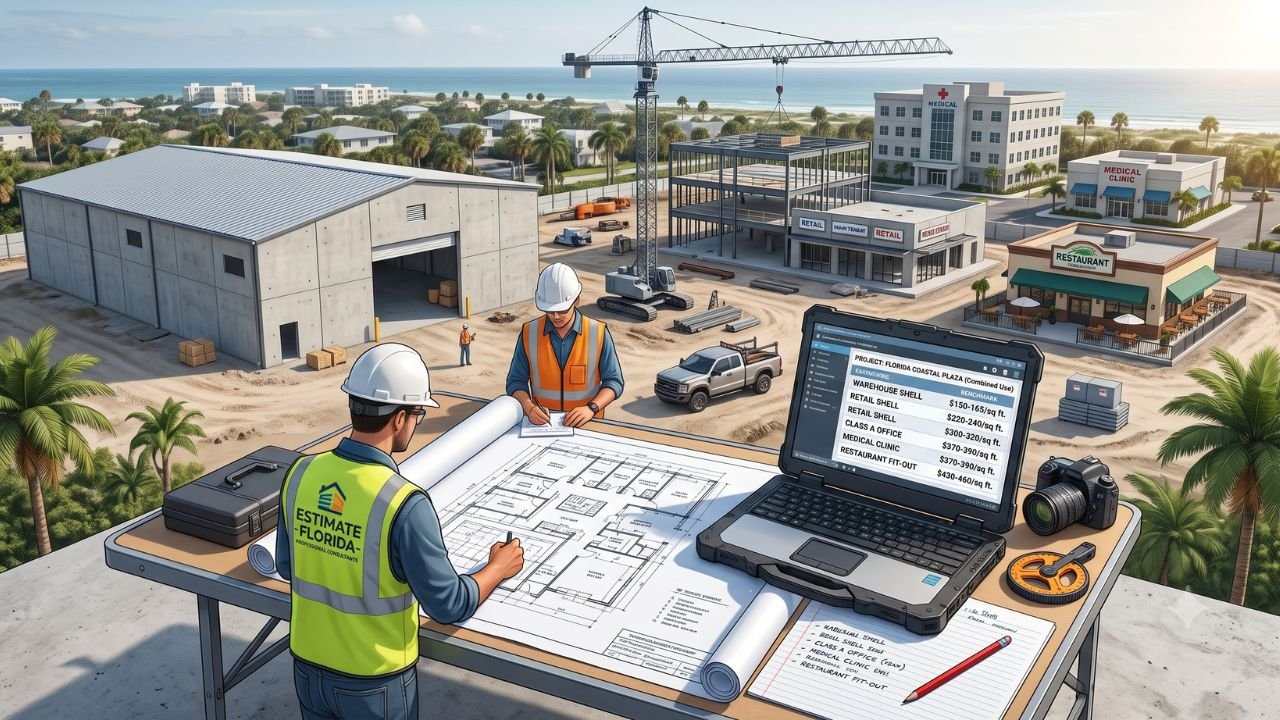
Florida’s commercial building landscape spans a wide variety of property types. Across the Sunshine State, general contractor estimates for ground-up commercial buildings typically range from $110 to $450+ per square foot, depending heavily on the building classification, structural demands, and level of interior finish.
In major urban and coastal hubs such as Miami, Fort Lauderdale, West Palm Beach, Tampa, and Orlando, baseline pricing consistently leans toward the higher end of these ranges. This is due to tighter job sites, higher labor rates, and stricter municipal codes. Inland and panhandle markets often sit toward the lower end of the spectrum.
General Cost Summary by Property Type
-
Warehouse & Industrial (Tilt-Up): $110 – $180 per sq. ft.
-
Commercial Retail Shell: $140 – $240 per sq. ft.
-
Suburban Office Buildings (Class B/C): $180 – $280 per sq. ft.
-
Urban & High-Rise Office Buildings (Class A): $280 – $450+ per sq. ft.
-
Medical Clinics & Urgent Care: $260 – $420 per sq. ft.
-
Restaurants & Commercial Kitchens: $300 – $550+ per sq. ft.
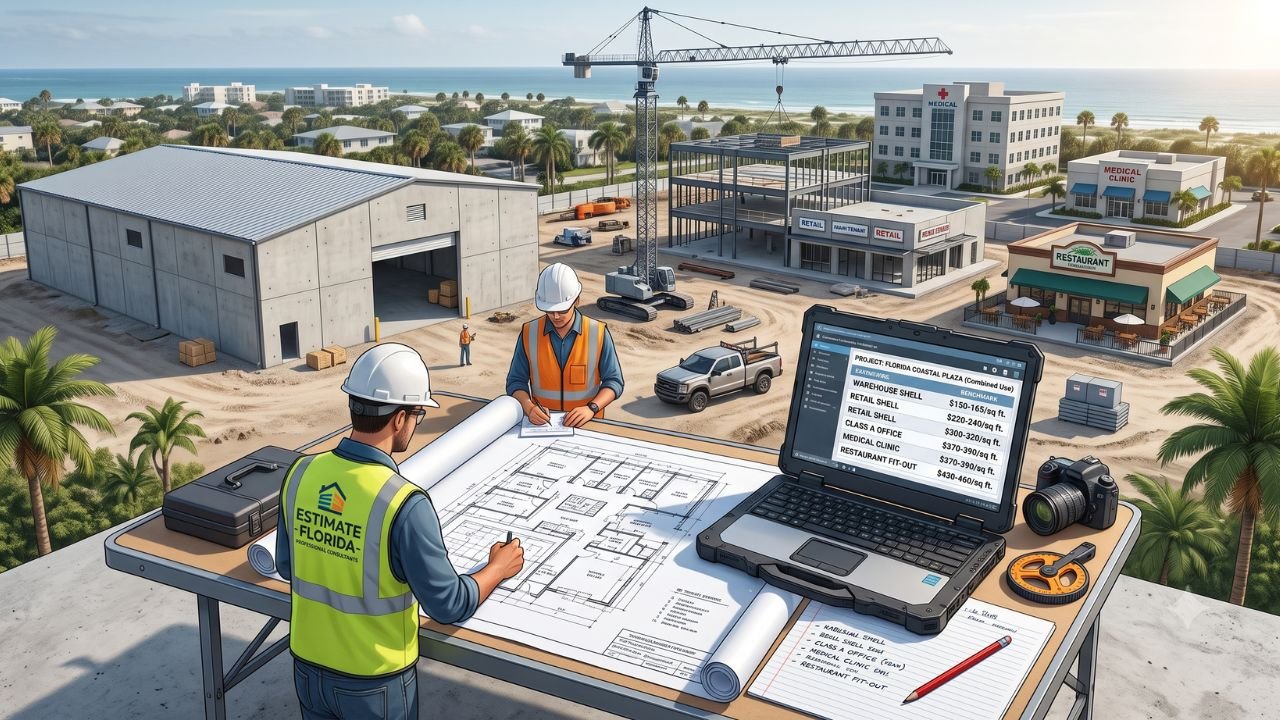
Cost Breakdown by Building Type
To build a reliable Florida contractor estimate, you must evaluate costs based on the specific architectural and functional demands of your project. Below is a detailed breakdown comparing typical price ranges for shell construction versus interior tenant improvements (TI) across key commercial sectors.
| Commercial Building Type | Shell / Basic Structure (/sq.ft.)∣InteriorFit−Out/TI(/sq. ft.) | Total Turnkey Cost Range ($/sq. ft.) |
| Warehouse / Distribution | $80 – $120 | $30 – $60 |
| Retail Strip Center | $110 – $160 | $50 – $100 |
| Single-Story Office (Class B) | $120 – $170 | $60 – $110 |
| Medical / Outpatient Clinic | $150 – $220 | $110 – $200 |
| Class A Office Space | $170 – $250 | $120 – $200+ |
| Full-Service Restaurant | $150 – $220 | $150 – $330+ |
Buy Construction BOQ Template at $97 Only
1. Office Buildings
Office space costs are dictated by classification (Class A vs. Class B) and vertical height. A suburban, single-story concrete block (CMU) office building is far less expensive to construct than a multi-story, steel-frame office building with a glass curtain wall in downtown Tampa. Class A office spaces require high-end lobby finishes, elevated acoustical insulation, sophisticated elevator systems, and advanced HVAC automation.
2. Retail Spaces
Retail building costs differ greatly between multi-tenant strip centers and single-tenant anchor spaces. Developers often build “cold dark shells” (bare stud walls and dirt floors) or “warm vanilla shells” (drywall perimeters, basic lighting, and functioning HVAC), leaving the costly interior tenant improvements to the individual business owners leasing the space.
3. Restaurants & Hospitality
Restaurants represent one of the most expensive commercial building types on a per-square-foot basis. Heavy mechanical requirements—including commercial kitchen hood exhaust systems, grease traps, walk-in coolers, specialized plumbing lines, gas piping, high-capacity electrical panels, and custom interior finishes—drive total project costs rapidly upward.
4. Warehouses & Industrial Facilities
Warehouse and logistics facilities boast some of the lowest commercial building cost Florida numbers per square foot due to their open floor plans, minimal MEP requirements, and simplified exterior envelopes. The majority of Florida industrial buildings utilize highly efficient tilt-up concrete panel construction. Costs only surge when adding cold storage, automated racking infrastructure, or extensive office mezzanine space.
5. Medical & Specialty Facilities
Healthcare facility construction is heavily regulated. Medical offices, ambulatory surgery centers, and dental clinics demand enhanced radiation shielding (X-ray rooms), scrub-sink plumbing, medical gas distribution lines, isolated power systems, and stringent infection control measures, raising the overall construction cost per square foot Florida significantly.
Buy Construction BOQ Template at $97 Only
What Affects Commercial Construction Costs in Florida?
Why does commercial estimating in Florida require such specialized local knowledge? Understanding regional cost drivers helps developers and project managers protect their budgets from surprise overruns.
1. The Florida Building Code (FBC) and Wind-Load Requirements
The Florida Building Code enforces some of the strictest structural regulations in the world. Projects located in designated High-Velocity Hurricane Zones (HVHZ)—particularly in Miami-Dade and Broward counties—must comply with extreme wind-load criteria. Meeting Miami-Dade Notice of Acceptance (NOA) standards requires impact-resistant commercial storefront glazing, heavy-duty structural anchoring, grouted CMU blocks with dense steel rebar layouts, and severe-wind-rated roofing systems.
2. Soil Conditions and Subsurface Challenges
Florida’s geography presents unique earthwork challenges. High water tables, sandy soil, organic muck, and coastal limestone (coral rock) heavily impact foundation costs. Commercial foundations frequently require expensive site stabilization, deep excavation, imported fill dirt, dewatering systems, or specialized piling (like auger cast piles) before a single yard of foundation concrete can be poured.
3. Geographic Location and Market Demand
The construction cost per square foot in Florida varies drastically by zip code. Costs in South Florida are consistently 15% to 25% higher than in Central or North Florida due to a high cost of living for laborers, tight urban site constraints that complicate material staging, and elevated municipal impact fees.
4. MEP System Complexity
In Florida’s relentless heat and humidity, HVAC systems work overtime. Commercial equipment must handle high thermal loads and strict humidity control to prevent indoor air quality and mold issues. Upgrading to high-efficiency VRF (Variable Refrigerant Flow) systems or chilled-water plants increases upfront costs but is often necessary for code compliance and long-term operational savings.
Buy Construction BOQ Template at $97 Only
How to Estimate Total Project Cost
Calculating an initial budget using a cost per square foot metric is a straightforward process, provided you apply the right financial multipliers to capture the total development cost.
The Basic Formula
The Comprehensive Budgeting Framework
-
Determine the Hard Cost Baseline: Multiply your building size by the estimated square-foot range for your specific facility type.
-
Add Site Work and Infrastructure: Site civil work (grading, paving, stormwater retention basins, utilities) typically adds an additional 10% to 20% on top of the building structure cost.
-
Account for Soft Costs: Add 15% to 25% of the hard cost total to cover architectural design, structural engineering, environmental permitting, impact fees, and legal counsel.
-
Include Contingencies and Escalation: Never assume a perfect project. Carry a Design Contingency (5-10%) for scope creep, a Construction Contingency (5-10%) for unforeseen site conditions, and an Escalation Allowance (3-5%) if your project breaks ground several months in the future.
Example Budget Scenarios
To demonstrate how these individual components come together to form a true commercial building budget, let’s look at three realistic scenarios.
Scenario A: 10,000 Sq. Ft. Industrial Warehouse Shell (Polk County, FL)
Project Scope: Tilt-up concrete wall panels, 28-foot clear ceiling height, 6-inch reinforced concrete slab, basic dock-high loading doors, warm shell with a small 1,000 sq. ft. air-conditioned office pod.
-
Warehouse Shell Construction ($130/sq. ft.): $1,300,000
-
Office Pod Fit-Out (1,000 sq. ft. @ $80/sq. ft.): $80,000
-
Site Work & Paving (Heavy truck apron, retention basin): $250,000
-
Soft Costs & Permitting (~ 15%): $244,500
-
Contingency (8%): $149,960
-
Estimated Total Project Budget: $2,024,460 ($202.44/sq. ft. total development cost)
Scenario B: 5,000 Sq. Ft. Suburban Office Building (Orange County, FL)
Project Scope: Single-story, ground-up Class B office building, concrete masonry unit (CMU) exterior, stucco finish, commercial tile roof, fully finished turnkey interior for professional services.
-
Building Construction Cost ($220/sq. ft.): $1,100,000
-
Site Work & Utilities (Paved parking, drainage, utilities): $165,000
-
Soft Costs (Design, permits, impact fees ~ 18%): $227,700
-
Contingency & Escalation (10%): $149,270
-
Estimated Total Project Budget: $1,641,970 ($328.39/sq. ft. total development cost)
Scenario C: 3,000 Sq. Ft. Restaurant Fit-Out (Miami-Dade County, FL – HVHZ)
Project Scope: Turnkey build-out inside an existing commercial retail shell. Includes complete commercial kitchen installation, heavy grease trap, dedicated makeup air, high-end dining room finishes, and HVHZ-compliant impact storefront glazing.
-
Interior Fit-Out & MEP Work ($400/sq. ft.): $1,200,000
-
Kitchen Equipment Allowance (FF&E): $275,000
-
Permitting, Architectural & Impact Fees (~ 16%): $236,000
-
Contingency (10%): $171,100
-
Estimated Total Project Budget: $1,882,100 ($627.36/sq. ft. finished space cost)
Buy Construction BOQ Template at $97 Only
Why a BOQ or Detailed Estimate Is Better Than Square Foot Averages
While average square-foot data is highly valuable for initial feasibility studies, relying on square foot averages to sign contracts, award bids, or secure construction loans is incredibly dangerous.
Square-foot pricing blindly assumes a uniform distribution of cost across every foot of space. In reality, construction costs are concentrated in specific structural elements and specialized trades.
By contrast, utilizing professional commercial estimating services generates a detailed Bill of Quantities (BOQ). A BOQ breaks down the building into exact physical quantities and trade-by-trade line-item costs based on your specific blueprints:
-
Instead of guessing “Concrete floor at $12/sq. ft.”, a BOQ calculates the exact cubic yards of 4,000 PSI concrete, linear feet of grade beams, tons of structural rebar, labor hours for placement, and pump truck rental charges.
-
Instead of estimating “HVAC at $20/sq. ft.”, a BOQ accounts for specific chiller tonnages, linear feet of insulated ductwork, VAV boxes, and automated control systems.
Using a structured framework like a construction BOQ template allows developers and general contractors to control project scope, compare subcontractor tenders evenly, and completely eliminate bidding ambiguity.
How Florida Contractors Can Improve Estimate Accuracy
For builders and project managers operating in Florida, winning profitable projects requires creating competitive, airtight estimates that reflect actual field conditions. Here is how to improve your accuracy:
-
Use Recent Subcontractor Quotes: Material and labor pricing varies significantly between cities like Fort Myers, Jacksonville, and Miami. Always validate your internal databases with current quotes from trade partners local to the job site.
-
Break Down by Trade: Never estimate high-value trades (concrete, steel, MEP) using high-level ratios. Perform precise digital takeoffs to verify exact material volumes.
-
Check Local Code and Wind-Load Requirements: Bidding a commercial glass system designed for a 130 mph wind zone on a project located in a 170 mph coastal zone will cause massive budget overruns once engineering is reviewed. Verify your local codes first.
-
Account for Site Logistics: Review geotechnical soils reports prior to submitting your bid. If sub-surface soil conditions require specialized dewatering permits or deep foundation auger piles, ensure they are explicitly quantified.
-
Include Proper Contingencies: Always carry a dedicated line item for unforeseen conditions and material price escalation.
Final Thoughts
Understanding the commercial construction cost per square foot in Florida is an essential first step for any commercial real estate venture. However, it is vital to remember that these averages are just that—averages. They serve as a highly useful starting point, but they are not the full answer.
Because Florida commercial construction costs vary widely based on hurricane building codes, complex soil conditions, regional labor dynamics, and structural requirements, moving from a conceptual square-foot average to a fully itemized estimate is non-negotiable before breaking ground.
To ensure your next commercial project is budgeted accurately from day one, explore our specialized commercial estimating services or utilize our professional construction BOQ template to streamline your bidding process and protect your bottom line.