
Contractors, site engineers, and project owners often hear terms like “BOQ,” “bill of quantities,” and “estimate” tossed around the job site or in pre-construction meetings. However, many are not entirely sure how they differ or why one might be preferred over the other.
If you are a builder or developer, you might be asking yourself, “what is BOQ in construction exactly?” Simply put, BOQ stands for Bill of Quantities. It is a detailed, itemized list of all the work, materials, and sometimes labor required to complete a construction project.
 Buy Construction BOQ Template at $97 Only
In this comprehensive guide, we will provide a clear BOQ meaning and ensure that the concept of a construction BOQ is fully explained. We will cover why a bill of quantities is so important, who uses it, and when it is needed during the project lifecycle. We will also explore how it fundamentally differs from a simple estimate or a material list.
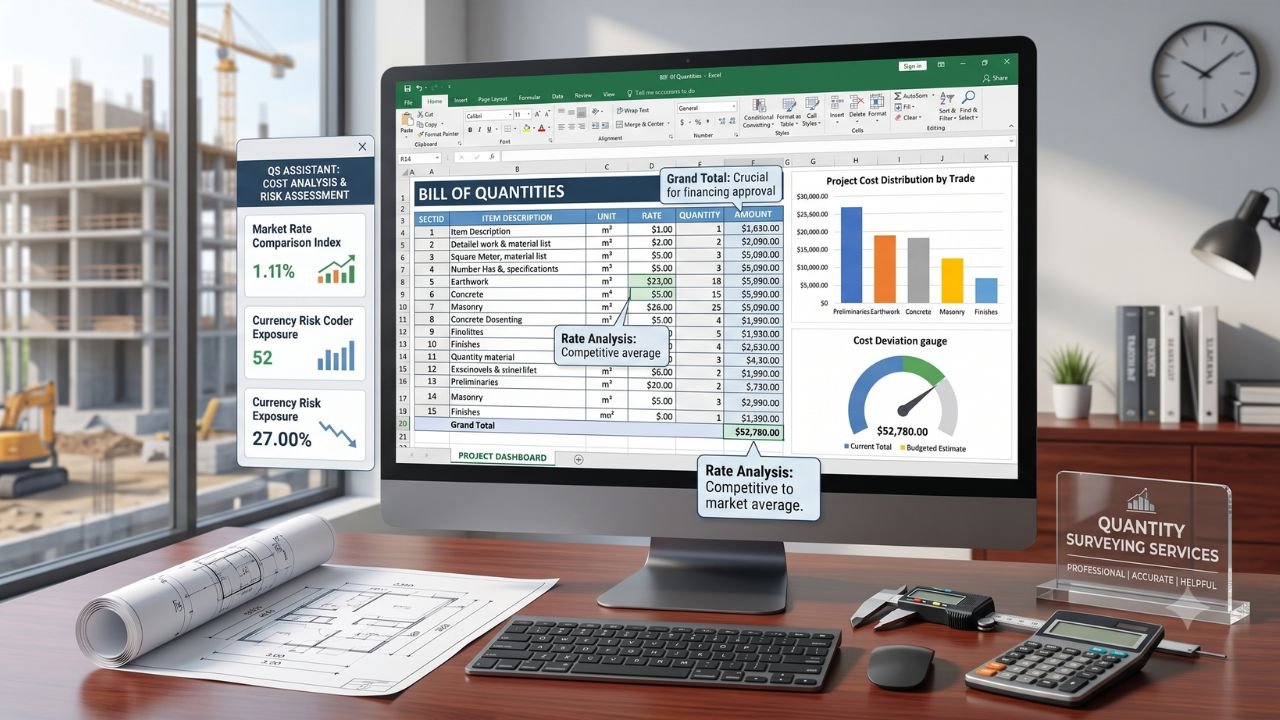
Later in this article, we will look at a simple example of a BOQ for a typical Florida-style home. We will also show you how a ready-made Construction BOQ Template can save you hours of administrative work and improve the accuracy of your bids.
BOQ Full Form and Basic Meaning
Let us start with the absolute basics. The BOQ full form is Bill of Quantities.
When looking at the basic BOQ meaning, think of it as a comprehensive master document that lists every single significant work item required in a project. Whether you are pouring a concrete slab, erecting block walls, installing a tile roof, or laying down tile flooring, every measurable task is accounted for.
For every single item on this list, a standard bill of quantities shows:
-
Description of the work: A clear explanation of what is being built or installed.
-
Unit of measurement: The metric used to measure the work (e.g., Square Feet, Cubic Yards, Linear Feet, or Each).
-
Quantity: The exact amount of that unit required for the project.
-
Rate: The price per unit (usually covering material, labor, and equipment).
-
Total Amount: The final cost for that specific item (Quantity multiplied by the Rate).
A construction BOQ is far more detailed, rigid, and structured than a simple “estimate” or a back-of-the-napkin “quote.” It is usually prepared directly from approved architectural and engineering drawings, as well as project specifications.
To give you a quick idea, a simple illustrative line item in a BOQ might look like this:
“4” concrete slab-on-grade, 3,000 psi – 2,200 Sq.ft – $4.20/Sq.ft – $9,240.”
Buy Construction BOQ Template at $97 Only
What Is BOQ in Construction? A Clear Definition
To provide a formal definition for anyone wondering what is BOQ in construction:
A Bill of Quantities (BOQ) in construction is a structured document that lists all the measurable work items, materials, and associated quantities required to complete a project, along with unit rates and total costs.
This document is typically prepared by a quantity surveyor, a professional estimator, or a general contractor. Because it requires a high degree of precision, a bill of quantities is based on final or near-final design drawings and specifications.
Throughout the lifecycle of a build, the construction BOQ serves several core functions. It is used extensively for tendering (bidding), establishing a baseline budget, and maintaining strict cost control once ground is broken.
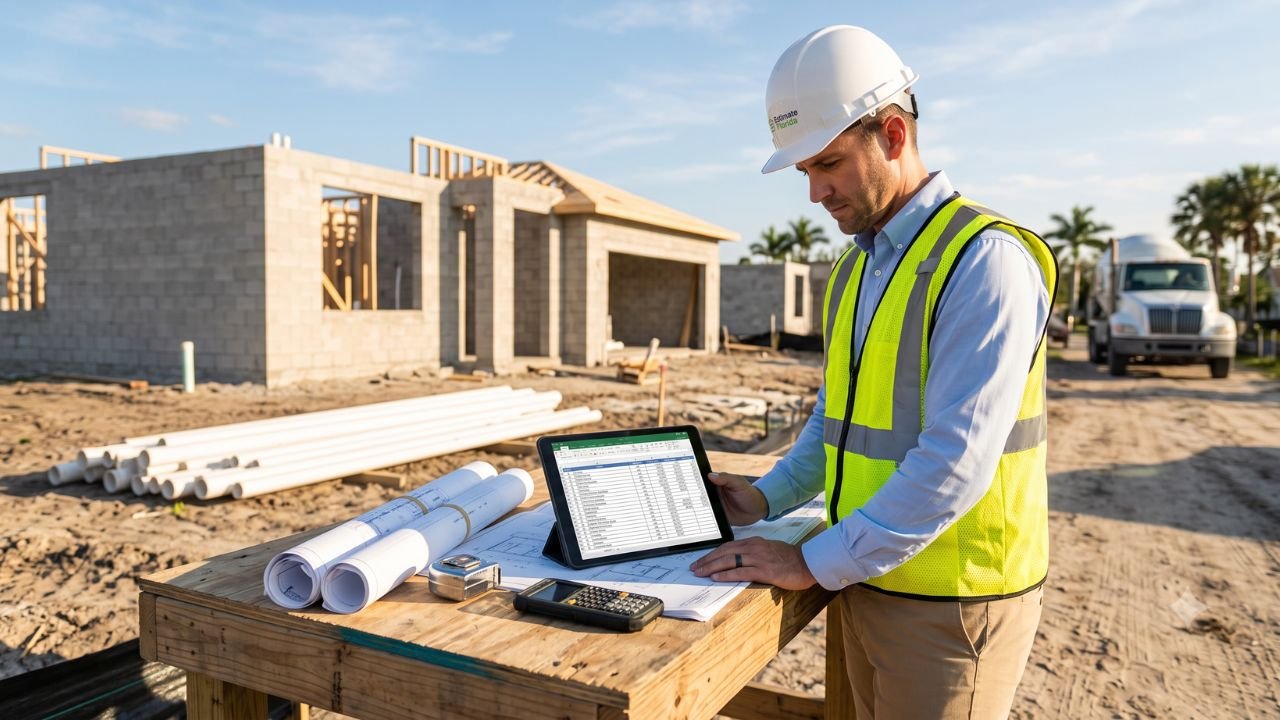
It is important to highlight that a BOQ focuses on measured work. This means you are not just counting raw materials; you are measuring installed assemblies. For example, instead of just listing “bags of cement,” a BOQ measures “Cubic yards of poured concrete footings.” Depending on how it is structured, the unit rates in a bill of quantities can include labor, materials, equipment, overhead, and profit.
Buy Construction BOQ Template at $97 Only
Why Is a Bill of Quantities Used in Construction Projects?
Understanding what is a bill of quantities is only half the battle; knowing why it is used is crucial for improving your project management. A BOQ brings structure and transparency to what can otherwise be a chaotic bidding and building process.
Here are the primary reasons a construction BOQ is utilized:
-
Standardized tendering: When a developer sends out a BOQ to multiple general contractors, all contractors price the exact same quantities. This makes comparing bids fair, transparent, and strictly apples-to-apples.
-
Accurate budgeting: A detailed bill of quantities helps project owners, developers, and lenders understand exactly where their money is going, line item by line item.
-
Clear scope definition: Having a highly detailed list reduces ambiguity. It creates a clear boundary regarding what is included in the contractor’s scope of work and what is excluded.
-
Progress billing and valuations: During construction, a BOQ is heavily used to measure the work done to date. This makes preparing and approving interim payment applications (draw requests) much easier.
-
Change order pricing: Construction is unpredictable. A BOQ provides a pre-agreed schedule of rates. If additional work is needed or scope is omitted, the unit rates in the BOQ dictate the cost of those changes.
-
Cost control: Project managers use the BOQ to track actual quantities and costs against the original plan, catching budget overruns before they spiral out of control.
In Florida, where lenders, banks, and private owners often require heavily detailed estimates before financing single-family homes or small commercial buildings, having a standardized BOQ brings an extra layer of clarity and professionalism to your proposals.
Who Prepares a BOQ and When?
A common question surrounding BOQ in construction explained is who actually takes the time to write this document, and at what stage of the project does it happen?
Who Typically Prepares It?
-
Quantity Surveyors (QS) / Cost Consultants: On large commercial or public projects, an independent professional handles the BOQ.
-
General Contractors / Estimators: In the US, especially on residential and mid-sized commercial projects, the GC’s in-house estimating team often prepares the BOQ.
-
Architects or Engineers: Occasionally, on smaller, specialized projects, the design team might provide a basic bill of quantities.
Buy Construction BOQ Template at $97 Only
When Is It Prepared?
A BOQ is generated after the design drawings and project specifications are sufficiently developed. You cannot accurately measure quantities if the plans are still in the schematic phase. It is usually finalized before or during the tender/bidding stage, and it is updated or refined as formal design changes occur.
Who Uses It?
-
Owners and Developers: To understand costs and evaluate bids.
-
General Contractors and Subcontractors: To accurately price their work and manage their budgets.
-
Lenders and Banks: To approve financing and release construction draws based on completed percentages.
-
Project Managers: For ongoing cost control during the construction phase.
Even on projects that do not have a formal, independent Quantity Surveyor, a well-prepared BOQ generated by the General Contractor can greatly improve trust, clarity, and financial control.
What Does a Typical BOQ Include?
To fully grasp the BOQ meaning, you need to understand how the document is organized. A professional bill of quantities is logically grouped by trade or work section. This makes it incredibly easy to read, price, and manage.
A typical BOQ is broken down into the following components:
Project Information
-
Project name, address, and client details.
-
General contractor or consultant information.
-
BOQ reference number, date, and revision tracking.
Itemized Work Sections (CSI Divisions or Trade-Based)
-
Sitework and earthwork: Clearing, grading, excavation, and backfill.
-
Concrete and foundations: Footings, stem walls, and slab-on-grade.
-
Masonry or framing: Concrete block (CMU) walls, structural steel, or timber framing.
-
Roofing: Trusses, decking, underlayment, and roof coverings (tile, metal, shingle).
-
Exterior finishes: Stucco, siding, exterior paint.
-
Doors, windows, and glazing: Including Florida-specific impact windows and sliding glass doors.
-
Interior finishes: Drywall, flooring, baseboards, and interior painting.
-
Basic MEP: Mechanical (HVAC), Electrical, and Plumbing rough-ins and trims.
-
Site improvements: Driveways, landscaping, and external works.
Buy Construction BOQ Template at $97 Only
Columns for Each Item
For every single task within those work sections, the BOQ provides:
-
Description of work: Detailed text describing the assembly.
-
Unit: Sq.ft, Cu.yd, LF, Each, etc.
-
Quantity: The measured takeoff amount.
-
Rate: Price per unit in dollars.
-
Amount: The total cost (quantity × rate).
-
Remarks/notes: Assumptions, exclusions, or drawing references.
Buy Construction BOQ Template at $97 Only
BOQ vs Estimate vs Material List: What’s the Difference?
When having a construction BOQ explained, it is incredibly important to clarify common industry confusions. Many people use the terms BOQ, estimate, and material list interchangeably, but they serve very different purposes.
-
BOQ (Bill of Quantities): This is a detailed, itemized list of measured work items. It includes quantities, units, rates, and total amounts. A BOQ accounts for the finished assembly (e.g., a finished block wall including mortar, rebar, and labor) rather than just the raw parts. It is used for tendering, budgeting, progress billing, and strict cost control.
-
Estimate: An estimate is an overall cost projection for the project. While an estimate may be based on a BOQ, it can also be very high-level. For example, a conceptual estimate might just project a cost per square foot based on historical data. An estimate is focused on the total final cost rather than a highly detailed, contractual item breakdown.
-
Material List (or BOM – Bill of Materials): A material list is exactly what it sounds like: a list of raw materials and components needed. It will list the exact number of bags of cement, tons of rebar, or boxes of nails. It is highly focused on materials for procurement and ordering purposes, not necessarily on measured work or labor costs.
Ultimately, a BOQ is much more structured and contract-oriented than a simple estimate. While a material list is incredibly useful for purchasing, it simply cannot replace a BOQ when it comes to tendering, submitting bank draws, and overall project cost control.
Simple Example: BOQ for a Florida Single-Family Home
To make the concept of what is BOQ in construction more concrete, let us look at a highly simplified illustrative example.
Imagine you are a general contractor building a standard single-family home in Florida. Your BOQ would have dozens, if not hundreds, of lines. Here is a small sample of what those line items might look like:
-
Site clearance and grubbing – 3,500 Sq.ft – $0.45/Sq.ft – $1,575
-
4” concrete slab-on-grade, 3,000 psi – 2,200 Sq.ft – $4.20/Sq.ft – $9,240
-
8” CMU exterior walls, grouted and reinforced – 3,800 Sq.ft – $9.50/Sq.ft – $36,100
-
Clay tile roof system, including underlayment & flashings – 2,600 Sq.ft – $6.50/Sq.ft – $16,900
-
Hurricane impact aluminum sliding glass doors (8’x8′) – 3 Each – $3,200/Each – $9,600
Note: This is only a sample to show how BOQ items look. Rates and quantities will vary significantly by exact project specifications and location within Florida.
A full bill of quantities will have many more items, covering deep foundations, interior partitions, fine finishes, painting, site work, and full MEP layouts.
Buy Construction BOQ Template at $97 Only
Benefits of Using a BOQ on Your Construction Projects
Why should a busy general contractor or developer bother with a BOQ? Adopting this standard brings immense value to your construction business.
-
Fair and comparable bids: By having all subcontractors or general contractors price the same exact quantities, you make it drastically easier to compare offers and spot pricing anomalies.
-
Transparent costing: Owners and developers can see exactly what they are paying for. This builds a massive amount of trust.
-
Better financing discussions: Lenders and banks deeply appreciate detailed, itemized estimates. A BOQ makes the loan approval and draw-release processes much smoother.
-
Reduced disputes: Because the scope and quantities are clearly documented in black and white, it severely reduces arguments over what is or isn’t included in the contract.
-
Easier change management: When a client wants to add a room or upgrade a finish, the additional or omitted work can be easily priced using the established BOQ rates.
-
Improved cost control: Project managers can track actual installed quantities and costs against the original BOQ throughout the duration of the project.
For Florida contractors working closely with private owners, regional developers, and local banks, utilizing a proper BOQ adds a massive level of professionalism and trustworthiness to your brand.
How Estimate Florida’s Construction BOQ Template Helps
We know that building a comprehensive bill of quantities from scratch for every single project can be incredibly tedious and time-consuming.
If you want a ready-to-use BOQ structure instead of building one from a blank spreadsheet, you can use our Construction BOQ Template, available here: https://estimateflorida.com/construction-boq-template/
Designed specifically for US and Florida residential and small commercial projects, this template is provided in a structured, easy-to-use format. It comes with pre-defined, logically ordered sections for:
-
Sitework and earthwork
-
Concrete and foundations (slab, footings, stem walls)
-
Masonry or framing (tailored for Florida CMU and wood frame)
-
Roofing (tile, metal, shingle)
-
Exterior and interior finishes
-
Doors, windows, and basic MEP
-
Site improvements and external works
The Estimate Florida template includes all necessary fields: Item No., Description, Unit, Quantity, Rate ($), Amount ($), and Remarks. It uses built-in formulas for the automatic calculation of line item amounts, trade subtotals, and the final grand total.
The benefits of using this template include:
-
Saves hours of setup time for each new project you bid.
-
Reduces the risk of missing critical items, using the wrong units, or making formula calculation errors.
-
Provides a consistent, lender- and owner-ready BOQ structure that looks highly professional.
-
Makes it exceptionally easy to update quantities or rates without breaking the sheet.
This template is built from real Florida projects and has been refined over years of estimating work in the state. Estimate Florida is dedicated to providing practical tools that help contractors win more bids and manage their margins effectively.
Buy Construction BOQ Template at $97 Only
Common Questions About BOQ in Construction
To ensure the topic of what is a bill of quantities is fully covered, let’s address a few frequently asked questions.
Is a BOQ mandatory for all projects?
No, it is not legally mandatory. However, it is highly recommended for any project where cost clarity, strict budgeting, and fair comparison of subcontractor bids matter. Most commercial lenders will require something very similar to a BOQ before releasing funds.
Can small contractors use a BOQ?
Absolutely. Even for small residential custom homes, additions, or major renovation jobs, a simplified BOQ improves clarity and professionalism. It protects the contractor just as much as it protects the homeowner.
Do I need a quantity surveyor to prepare a BOQ?
Not necessarily. While large civil projects require dedicated QS professionals, experienced GCs and estimators can prepare highly accurate BOQs for residential and commercial builds using standard templates and good takeoff practices.
Can a BOQ be used for renovations and additions?
Yes. A BOQ can be prepared for any scope of work, including complex renovations, provided the work can be measured and priced item by item.
Final Thoughts: Understand BOQ to Improve Your Project Control
If you have ever asked, “what is BOQ in construction,” you now know that a BOQ is a detailed, itemized list of measured work items, quantities, and costs necessary for a construction project.
It standardizes the tendering process, significantly improves initial budgeting, and supports far better cost control during the actual construction phase. By transitioning from rough estimates to structured bills of quantities, contractors and developers can protect their profit margins and reduce costly disputes.
Estimate Florida is proud to be a partner that truly understands Florida and US construction estimating. We know the practical, day-to-day challenges of pricing out everything from a concrete slab-on-grade to impact windows and stucco finishes. If you need help with broader construction estimating, Estimate Florida also provides concrete estimating services Florida, electrical estimating services, structural steel estimating services, and general estimating services for contractors across the state. (Feel free to reach out via our contact page to learn more).
We highly encourage you to use the explanations and examples in this article as a foundational starting point. To instantly upgrade your bidding process, consider adopting a standardized framework like our Construction BOQ Template to create professional, accurate, and highly detailed BOQs quickly and efficiently.