How to become a contractor in Florida involves more than field skills or years on job sites. The state requires a formal combination of verified construction experience, education or training options, state examinations, proof of financial responsibility, insurance, background screening, and approval by the Construction Industry Licensing Board under the Florida Department of Business and Professional Regulation. Whether you are a carpenter ready to step into leadership, a project supervisor planning to start your own company, a construction management graduate, or an experienced tradesperson expanding into broader work, understanding the correct licensing path is essential. Florida offers different contractor classifications depending on the type of projects you want to manage—residential, building, or general contracting—and the process is designed to protect the public while allowing qualified professionals to operate legally across the state. This detailed guide walks through every major step so you can prepare thoroughly, avoid common delays, and move from applicant to licensed contractor with confidence.
What Type of Contractor License Do You Need?
Florida regulates structural construction contractors through several Division I license categories. Choosing the right classification early determines the experience you must document, the examination you will take, and the legal scope of work you can perform.
A Residential Contractor license limits the holder to the construction, remodeling, repair, or improvement of one-family, two-family, or three-family residences that are not more than two stories in height, along with related accessory structures such as garages, sheds, and carports. This path is well suited to builders who focus exclusively on single-family homes, duplexes, and townhouses.
A Building Contractor license expands authority. It permits construction of commercial and residential buildings up to three stories in height and allows non-structural remodeling or improvement of buildings of any size, provided the work does not affect structural elements. Many contractors who handle light commercial projects, mixed-use buildings, or larger residential developments choose this classification.
A General Contractor license provides the broadest authority. Services are unlimited as to the type of building or structure. Applicants for this license typically need to demonstrate experience with larger or taller construction, which is why the experience requirements are more rigorous than those for residential or building contractor licenses.
The correct choice depends entirely on the projects you intend to pursue. Selecting a broader license than necessary can make the experience and exam requirements harder to satisfy. Selecting a narrower license can limit future growth and bidding opportunities. Review the official scope descriptions carefully and match them to your long-term business goals before investing time and money in preparation.
Certified vs Registered Licenses
Florida operates two parallel licensing systems that applicants often confuse.
A certified license is issued by the state after the applicant passes the statewide examination administered under the Construction Industry Licensing Board. Once issued, the license is valid in every county in Florida. You can pull permits and perform work anywhere in the state without taking additional local competency exams. Most contractors who plan multi-county operations, public projects, or long-term regional growth pursue certified status because it provides maximum flexibility.
A registered license begins with a local certificate of competency issued by a city or county building department. The holder then registers that local license with the state. Work is limited to the jurisdiction or jurisdictions where the local competency is recognized. Expanding into a new county generally requires obtaining additional local registration. Registered licenses can serve as a practical entry point for contractors who intend to stay in one market, but they restrict geographic mobility and can complicate growth.
In practical terms, a certified license equals statewide authority after the state exam, while a registered license equals local authority after local qualification and state registration. Confirm which route aligns with your business plan before beginning exam preparation or gathering documentation. Working across county lines without the proper license can result in serious compliance problems.
Here you can know about How to become a builder in Florida.
Experience and Education Requirements
Most applicants qualify through a combination of documented field experience and, in some cases, formal education. The standard requirement for a certified contractor license is four years of proven construction experience in the category being sought, with at least one of those years spent in a supervisory role such as foreman, superintendent, or equivalent.
Several routes are accepted:
- Four years of hands-on experience, including at least one year as a foreman or supervisor.
- A four-year construction-related bachelor’s degree from an accredited college (treated as three years of experience) plus one additional year of applicable field experience.
- Combinations of college-level credits and field experience that total the required years, always including at least one year of supervisory responsibility.
Experience must be relevant and verifiable. For residential contractor applicants, the work should involve one- and two-family dwellings and related structures. For building and general contractor applicants, the experience must include commercial or larger-scale construction. General contractor candidates often need documented work on structures of significant height or complexity.
Documentation is one of the most common sources of delay. The Construction Industry Licensing Board requires verification forms completed by licensed contractors under whom you worked. Forms filled out by the applicant are typically rejected. Keep detailed personal records of projects, dates, duties, crew sizes, and supervisory responsibilities. Understanding the full construction process strengthens both your application and your professional competence—resources such as what are the 7 stages of construction and residential construction estimating help candidates organize their experience descriptions accurately and demonstrate broader industry knowledge.
Military service and certain college credits can sometimes be substituted for portions of the field experience requirement. Always check the current official guidelines, because the exact combinations and acceptable coursework are defined by rule and can be updated.
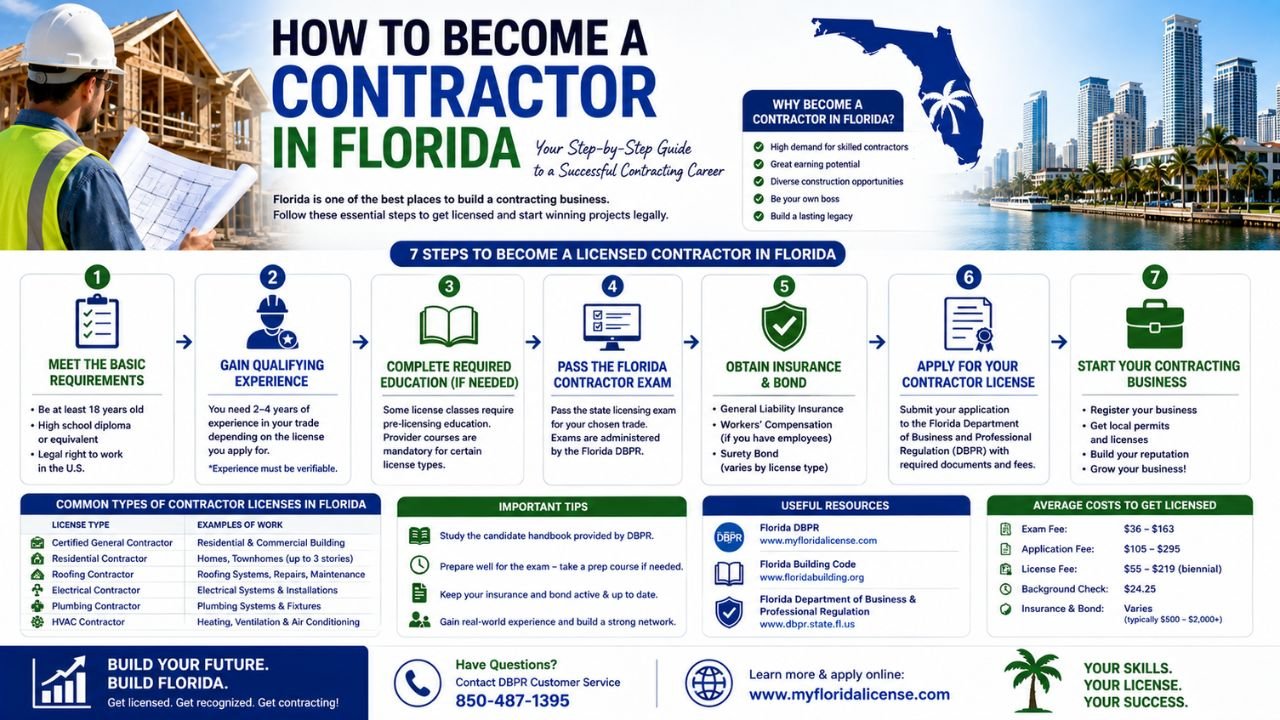
Exam and Application Process
The examination is a major milestone. For certified licenses, applicants must pass both a Business and Finance exam and a trade-specific knowledge exam. The Business and Finance portion covers contracts, financial management, project estimation, lien law, safety regulations, insurance, and related business topics. The trade exam tests knowledge of building codes, construction methods, plan reading, materials, and technical practices specific to the license category.
Most successful candidates study for several months. Effective preparation usually includes:
- Official candidate information bulletins that list content areas and recommended reference materials.
- Practice exams and study guides focused on Florida codes and business practices.
- Formal prep courses when self-study alone is insufficient.
- Consistent review of the Florida Building Code and related standards.
- Focused study of estimating, scheduling, and project management principles.
Once prepared, candidates register for the exams through the testing provider contracted by the state. A passing score is generally 70 percent or higher on each required section. Exam scores are typically valid for a limited period, so applicants should coordinate exam timing with their overall application schedule.
After passing the exams, the formal application is submitted through the Florida Department of Business and Professional Regulation online portal. The complete package usually includes:
- Completed application forms for the chosen license category.
- Official proof of exam passage.
- Experience verification forms signed by licensed contractors.
- A current credit report.
- Fingerprint results and background check clearance.
- Application and related fees.
- Supporting documentation for any name changes, legal matters, or special circumstances.
Fees vary depending on the timing of the application within the license cycle, but applicants should budget several hundred dollars for application, exam, and related costs. Processing times can range from a few weeks to several months depending on the completeness of the package and current board workload. Incomplete applications are the most frequent cause of delay.
Financial, Insurance, and Background Requirements
Florida places strong emphasis on financial responsibility and consumer protection.
Applicants must submit a credit report from a nationally recognized credit reporting agency. A FICO score of 660 or higher is commonly accepted as meeting the financial responsibility threshold. Scores below that level often require additional steps, such as completing a board-approved financial responsibility course or obtaining a surety bond. Bond amounts for Division I contractors can reach $20,000.
Active licensees must maintain general liability insurance. Minimum coverage amounts are higher for general and building contractors (commonly $300,000 public liability and $50,000 property damage) than for some specialty categories. Workers’ compensation coverage is also required unless a legally valid exemption applies. The licensing board must be listed as a certificate holder on the insurance policies.
Fingerprinting and a background check are mandatory. Prints are submitted electronically through an approved Livescan provider and processed in coordination with the Florida Department of Law Enforcement. The board reviews moral character as part of every application. Any criminal history, unpaid judgments, liens, or prior disciplinary actions must be disclosed and may require supporting explanations or documentation.
These requirements exist to protect consumers and the public. Official information, current forms, and application portals are available through the Florida Department of Business and Professional Regulation and the Construction Industry Licensing Board. Fingerprinting details are coordinated with the Florida Department of Law Enforcement. Always verify the most recent rules, coverage amounts, and procedures before submitting, because requirements can be updated.
Business Setup After Licensure
Receiving the license is a significant achievement, but it is only the beginning of operating as a professional contractor. To work legally and sustainably you will need to:
- Form or register a business entity (sole proprietorship, limited liability company, corporation, or other structure) with the appropriate state agencies.
- Obtain an Employer Identification Number if required for tax and banking purposes.
- Maintain continuous general liability and workers’ compensation insurance.
- Establish reliable accounting, bookkeeping, and tax reporting systems.
- Develop clear written contracts, change-order procedures, and project documentation practices.
- Create systems for accurate estimating, competitive bidding, scheduling, and project management.
- Comply with continuing education requirements for license renewal.
- Follow local permitting rules in every jurisdiction where you perform work.
How to Prepare as an Aspiring Contractor
Preparation should begin well before the formal application for most candidates. Practical steps that strengthen both qualifications and future business readiness include:
- Seeking employment under licensed contractors so that experience is fully verifiable.
- Requesting detailed experience verification forms at the end of each major project or on a regular schedule.
- Maintaining personal records of projects, dates, responsibilities, crew oversight, and decision-making authority.
- Pursuing formal training, apprenticeships, or college coursework when it strengthens qualifications or fills knowledge gaps.
- Studying estimating, scheduling, blueprint reading, codes, and project management.
- Building and protecting a clean credit history while resolving any outstanding financial issues.
- Networking with licensed professionals who can later serve as references or experience verifiers.
Candidates who treat experience documentation as an ongoing professional practice rather than a last-minute scramble generally face fewer delays. Supervisors and project managers should ensure their roles clearly demonstrate authority over crews and project decisions, because the board looks for genuine supervisory experience rather than purely technical labor.
Costs and Time to Become Licensed
Total costs vary based on individual circumstances. Exam preparation courses can range from a few hundred dollars to more than a thousand dollars depending on format and depth. Application and examination fees add several hundred dollars. Fingerprinting, credit reports, and initial insurance setup create additional expenses. If a surety bond or financial responsibility course is required, those costs increase the overall investment. Once licensed, ongoing insurance premiums, business registration, and startup operating expenses must also be planned for.
Timelines depend heavily on readiness. Applicants who already possess the required experience, have clean and complete documentation, and are well prepared for the examinations can sometimes complete the process in a few months. Those still accumulating experience, improving credit, or studying part-time may need a year or longer. The two most common sources of delay are incomplete or slow experience verification from former employers and under-preparation for the state examinations.
After licensure, long-term success depends on both technical competence and disciplined business practices. Understanding real-world project economics and documentation standards—supported by resources such as how much does it cost to build a house in Florida, sample BOQ for house construction excel complete format with example, and how much does it cost to build a warehouse in Florida—helps new contractors compete effectively and manage risk.
| License Category | Typical Project Scope | Experience Emphasis | Geographic Reach (Certified) |
|---|---|---|---|
| Residential Contractor | 1–3 family homes, maximum 2 stories | Residential construction and supervision | Statewide |
| Building Contractor | Buildings up to 3 stories + non-structural work | Commercial and residential up to 3 stories | Statewide |
| General Contractor | Unlimited building types and heights | Broader commercial and taller structures | Statewide |
| Registered License | Same scopes limited by local rules | Local competency requirements | Local jurisdiction only |
Final Thoughts
Becoming a contractor in Florida is a structured, multi-step process that rewards careful preparation. You must select the correct license category, document the required experience, pass the state examinations, demonstrate financial responsibility, obtain the necessary insurance, complete a background check, and establish a compliant business. The system exists to ensure that only qualified individuals manage construction projects that affect public safety and consumer protection.
The most successful applicants treat the process like a professional project: they choose the right path early, keep meticulous records, study thoroughly, organize financial documents, and verify every current requirement on the official state websites before submitting. Once licensed, continuous attention to insurance, contracts, estimating accuracy, scheduling, and project documentation separates sustainable businesses from those that struggle.
Start by confirming the license classification that matches the work you want to perform, then begin assembling experience verification forms and study materials. With disciplined planning and accurate information from the Florida Department of Business and Professional Regulation and the Construction Industry Licensing Board, the path to becoming a licensed contractor in Florida is clear, structured, and achievable.