If you want to know how to become a pool builder in Florida, you must navigate a structured state licensing framework designed to protect homeowners, commercial property owners, and public safety. Swimming pool construction is one of the most heavily regulated sectors within Florida’s building industry due to complex excavation, structural concrete work, high-pressure hydraulics, and electrical bonding requirements. Learning how to become a pool builder in Florida requires a clear combination of verified field experience, technical exam mastery, background screening, and demonstrated financial stability.
Whether you are a pool service technician looking to transition into full-scale construction, a jobsite foreman, a project supervisor, or a construction management graduate, this comprehensive guide details every step required to earn your Florida pool builder license and launch a compliant, profitable contracting firm.
What Type of Pool License Do You Need?
Before submitting an application to the state, you must select the specific license category that aligns with your trade experience and business goals. The State of Florida, through the Florida Construction Industry Licensing Board (CILB), categorizes pool and spa contractors into primary distinct scopes.
Choosing the right path depends entirely on the types of projects you plan to design, excavate, and construct. It is critical to note that holding a basic pool service or maintenance card is not the same as holding a full pool construction license.
1. Residential Pool/Spa Contractor (Class B – CPC / RP)
A Residential Swimming Pool/Spa Contractor is authorized to construct, repair, replace, or resurface residential swimming pools, hot tubs, and spas. This license applies to single-family homes, duplexes, and triplexes (structures not exceeding two stories).
Residential pool builders can perform all necessary layout, excavation, structural steel placement, gunite/shotcrete application, tile, coping, plumbing, and equipment installation on residential jobsites. They can also perform non-structural repair and resurfacing work on commercial pools, but they are prohibited from building new commercial pools.
2. Commercial Pool/Spa Contractor (Class A – CPC / RP)
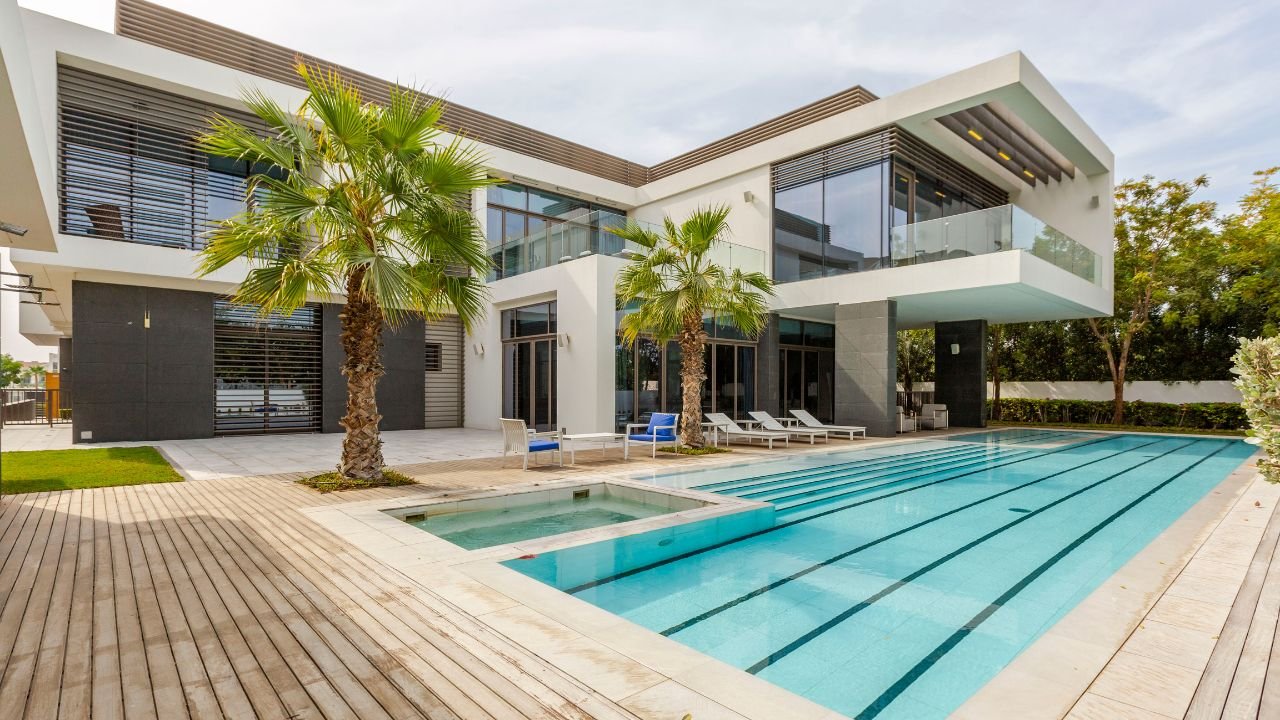
A Commercial Swimming Pool/Spa Contractor holds the highest pool-building authority in Florida. This license grants unlimited authority to construct, repair, resurface, and alter any public, commercial, or private swimming pool, spa, or interactive water display, regardless of size or property type.
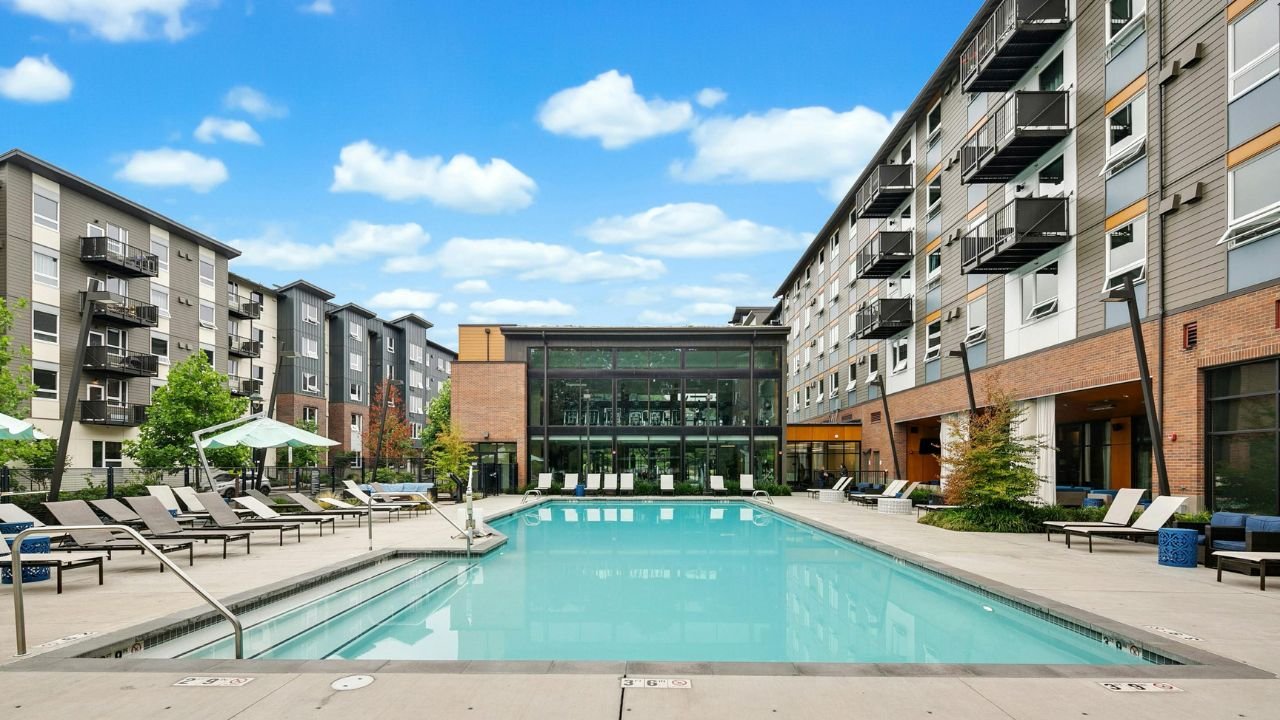
Commercial pool contractors build aquatic facilities for hotels, resorts, apartment complexes, water parks, municipalities, and high-end private residences. If you intend to target large-scale commercial developments, pursue municipal bids, or build multi-family aquatic centers, this is the license tier required.
3. Swimming Pool/Spa Servicing Contractor (Class C)
A Swimming Pool/Spa Servicing Contractor is limited to servicing, non-structural repairs, equipment replacement (pumps, filters, heaters, chemical feeders), and interior resurfacing of residential and commercial pools.
Important Difference: A pool service contractor cannot build a new swimming pool from the ground up, excavate for a shell, or alter the primary structural shell of an existing pool. Service techs who want to build new pools must upgrade their credentials to a Residential or Commercial Pool/Spa Contractor license.
Certified vs. Registered Licenses
Florida offers two state-level licensing formats for pool builders:
-
Certified Pool/Spa Contractor (CPC): A state-certified license earned by passing the Florida state contractor examination. Certified pool builders can pull permits and construct pools in any city or county across the entire state of Florida without taking local competency exams. Certified license numbers begin with CPC (e.g., CPC1234567).
-
Registered Pool/Spa Contractor (RP): A locally registered license tied to a specific city or county competency card. Registered pool contractors are limited to operating solely within the local jurisdiction that issued their certificate of competency. Registered license numbers begin with RP (e.g., RP1234567).
| License Category | Operational Scope | Can Build New Pools? | Geographic Coverage |
| Certified Commercial (CPC – Class A) | Any private, public, or commercial pool/spa; unlimited scale | Yes (Commercial & Residential) | Statewide across all 67 Florida counties |
| Certified Residential (CPC – Class B) | Residential pools/spas; non-structural commercial repairs | Yes (Residential only) | Statewide across all 67 Florida counties |
| Certified Servicing (CPC – Class C) | Equipment replacement, plumbing repairs, resurfacing | No (Non-structural work only) | Statewide across all 67 Florida counties |
| Registered Contractor (RP) | Determined by local county/city competency card | Subject to local jurisdiction approval | Restricted to issuing city/county |
Experience and Education Requirements
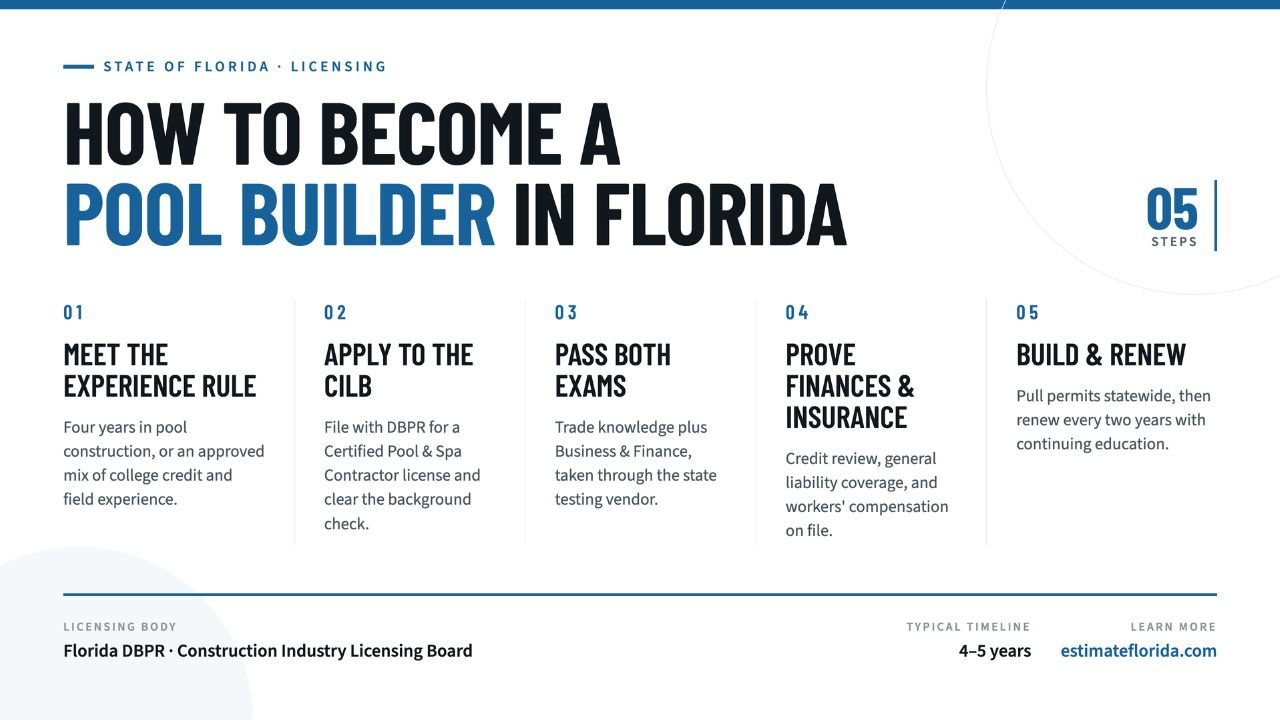
To earn a Florida pool contractor license, candidates must demonstrate hands-on industry expertise to the CILB. The board requires a minimum of four (4) years of combined construction experience and education, with at least one (1) year serving as a foreman or supervisor.
The state evaluates pool building experience through three main qualification routes:
1. The Field Experience Route
This is the standard path for trade professionals. You must prove four years of active experience in swimming pool construction under the direct supervision of a licensed pool contractor. At least one of these four years must be documented as a foreman or supervisor managing field crews.
Your experience must include specific structural pool-building tasks, such as:
-
Excavation, grading, and site layout.
-
Formwork and steel rebar grid placement.
-
Gunite or shotcrete application for concrete pool shells.
-
Rough plumbing, hydraulic loop design, and main drain installation.
-
Tile, coping, perimeter deck construction, and interior surface plastering.
-
Equipotential bonding, electrical grounding, and equipment pad setup.
2. The College Degree Route
Applicants holding a four-year accredited degree in building construction, civil engineering, or architecture from an institution recognized under academic frameworks—such as those monitored via the Florida Department of Education—can substitute three years of academic study for general trade experience. Candidates must still demonstrate at least one year of hands-on field supervisory experience under a licensed contractor.
3. The Combined Route
You can blend college credits from an accredited institution with active jobsite field work. For instance, two years of accredited college construction courses plus two years of field experience (including one year as a foreman) satisfy the state’s four-year requirement.
Bridging General Construction Knowledge to Pool Building
Pool building requires combining several sub-trades into a single coordinated effort. Aspiring builders who understand what are the 7 stages of construction are better equipped to sequence excavation, steel, shotcrete, tile, and deck pours without costly delays. Furthermore, gaining expertise in residential construction estimating is vital for calculating concrete volumes, pipe friction losses, and earthwork expenses before submitting bids.
Exam and Application Process: Step-by-Step
Passing the official state examination is a critical milestone when discovering how to become a pool builder in Florida. The examination process is rigorous, testing technical trade knowledge, plan reading, building codes, and state business regulations.
[Select License Category] ➔ [Pass State Exams] ➔ [Submit DBPR Application] ➔ [Undergo Background & Credit Checks] ➔ [Board Approval & License Issuance]
Step 1: Select Your License Category
Decide whether you meet the experience guidelines for a Residential Pool/Spa Contractor or a Commercial Pool/Spa Contractor license.
Step 2: Register for and Pass the State Exams
Florida contractor examinations are open-book, timed, computer-based tests administered by the state’s testing vendor (Pearson VUE). To become a certified pool builder, you must pass three exam modules:
-
Business and Finance Exam: Covers Florida Lien Law (Chapter 713, Florida Statutes), workers’ compensation, tax filings, financial management, bookkeeping, OSHA regulations, and employment law.
-
Contract Administration Exam: Tests project management, contract execution, plan reading, scheduling, cost controls, and code compliance.
-
Project Management (Trade Knowledge) Exam: Focuses specifically on pool and spa construction technology. Questions cover the Florida Building Code (Building and Residential volumes), Florida Public Pool Code (64E-9 FAC for commercial pools), ANSI/APSP pool standards, soil excavation, structural steel reinforcement, gunite placement, hydraulics, water circulation, chemical disinfection systems, and electrical bonding.
Tip: Successful candidates typically spend 80 to 120 hours tabbing reference manuals, practicing code lookups, and taking simulated practice exams prior to test day.
Step 3: Complete the DBPR Application Packet
Once you pass all three portions of the exam, compile your initial license application through the Florida Department of Business and Professional Regulation (DBPR) portal. The application requires:
-
Official exam score reports showing passing grades.
-
Verified work experience affidavits signed by licensed contractors who directly supervised your work.
-
Personal financial documentation and credit reports.
-
Proof of business entity registration if qualifying a company.
-
State application processing fees.
Financial, Insurance, and Background Requirements
To safeguard consumers and maintain accountability within the building trades, Florida enforces strict financial, background, and insurance standards prior to active license issuance.
Credit Score and Financial Responsibility
Applicants must submit a personal credit report showing a FICO score of 660 or higher. A credit report must also be submitted for the business entity being qualified.
If your credit score is below 660, you can still meet state financial responsibility criteria by:
-
Completing a board-approved 14-hour financial responsibility training course.
-
Obtaining a financial responsibility bond or irrevocable letter of credit ($10,000 to $20,000 depending on license division) to guarantee obligations.
General Liability and Property Damage Insurance
Before an active license is granted, pool contractors must present proof of public liability and property damage insurance with minimum policy limits based on their license classification:
-
Commercial Pool/Spa Contractor: Minimum $300,000 public liability and $50,000 property damage coverage.
-
Residential Pool/Spa Contractor: Minimum $100,000 public liability and $25,000 property damage coverage.
Additionally, contractors must carry Workers’ Compensation insurance for employees or hold an official state-issued Workers’ Comp exemption card before pulling construction permits.
Electronic Fingerprinting and Background Clearance
All applicants must undergo a criminal background check. You must schedule an electronic fingerprinting appointment with a Livescan vendor approved by the Florida Department of Law Enforcement (FDLE). Fingerprint results are transmitted directly to the DBPR for board review. Prior convictions do not automatically result in denial, but full honesty and disclosure on your application are mandatory.
Business Setup After Licensure
Passing your exams and obtaining your CILB approval letter means you are officially licensed. However, launching an operational pool construction business requires completing key organizational steps:
1. Business Registration (Sunbiz)
Register your business structure—such as an LLC (Limited Liability Company) or Corporation—with the Florida Division of Corporations via Sunbiz.org.
2. Qualifying Your Business Entity
Submit a DBPR application to link your personal contractor license number to your business entity as the “Qualifying Agent”. As the qualifier, you assume legal responsibility for all construction activities, permits, contracts, and code compliance performed under the company name.
3. Tax Setup and Local Licensing
Obtain a Federal Employer Identification Number (FEIN) from the IRS, register for sales tax collection with the Florida Department of Revenue, and apply for a local Business Tax Receipt in your home county and municipality.
4. Operational Systems: Contracts, Bidding, and Estimating
Pool building requires precise job-cost control. Your business infrastructure should include:
-
Compliant Consumer Contracts: Contracts must contain mandatory statutory warnings, including Florida Construction Lien Law notices (Chapter 713) and the Florida Homeowners’ Construction Recovery Fund disclosure.
-
Estimating and Material Procurement Templates: Utilizing structured estimating tools helps maintain target profit margins. Aspiring builders can download a sample BOQ for house construction excel complete format with example to adapt standardized Bill of Quantities formulas for pool excavations, concrete yardage, steel rebar tonnage, and equipment packages.
-
Subcontractor Management: Establish agreements with specialized trade partners for excavation, shotcrete shooting, electrical hookups, and screen enclosure installations.
How to Prepare as an Aspiring Pool Builder: Practical Guidance
Whether you are starting out or upgrading your credentials, here is how to position yourself for success when learning how to get a pool contractor license in Florida:
For Pool Service Techs Moving Up
If you currently service pools, focus on gaining structural construction experience. Seek employment with a licensed residential or commercial pool builder who performs complete custom installs. Keep a record of project addresses where you assist in steel placement, plumbing rough-ins, gunite application, and equipment wiring.
For Foremen and Jobsite Supervisors
If you are already managing crews on pool sites, start keeping a formal project log immediately. Document:
-
Exact dates of employment and jobsite addresses.
-
The licensed qualifier’s name and license number supervising the work.
-
Specific supervisory tasks performed (e.g., overseeing excavation, managing concrete pours, inspecting hydraulic pressure tests).
-
W-2 forms or tax records verifying full-time employment.
For Construction Management Graduates
If you hold a construction degree, take steps to acquire your required one year of supervisory field experience. Work alongside experienced pool builders to learn pool-specific hydraulics, turnover rate calculations, soil stabilization techniques, and water chemistry dynamics.
Costs and Time to Become Licensed as a Pool Builder in Florida
Estimating your startup timeline and financial budget prevents unexpected delays during the application process.
Breakdown of Licensing and Startup Expenses
-
Pearson VUE Exam Fees: ~$215 to $300 (covers all exam modules).
-
Code Books and Exam Prep Courses: ~$1,000 to $2,200 (includes official code references and practice exams).
-
DBPR Application Fee: ~$205 to $305.
-
Livescan Electronic Fingerprinting: ~$50 to $85.
-
Initial General Liability & Credit Reporting Fees: ~$1,000 to $3,500+.
Timeline Expectations
-
Gaining Experience: 4 years (unless substituting an accredited construction degree).
-
Exam Prep & Testing: 2 to 4 months of study prior to passing all three exam sections.
-
Application Review & Board Approval: 30 to 90 days after submitting all paperwork to the DBPR.
Practical Market Financial References
As you launch your pool building enterprise, understanding broad construction cost structures across Florida provides valuable market context during client discussions:
-
Homeowners often evaluate pool construction alongside total property builds; reviewing how much does it cost to build a house in Florida helps you understand overall residential development budgets.
-
If you expand into commercial pool building for industrial complexes or business parks, evaluating how much does it cost to build a warehouse in Florida gives you insight into commercial site development costs and utility infrastructure bidding.
Final Thoughts
Discovering how to become a pool builder in Florida requires clear goal-setting, dedicated study, and strict adherence to state regulatory standards. By identifying the correct license category early—whether Residential Pool/Spa Contractor or Commercial Pool/Spa Contractor—you can intentionally document your supervisory trade experience and build a clean credit history.
Gather your work experience affidavits, invest in high-quality code reference books, prepare thoroughly for the state examinations, and establish compliant business systems. With proper preparation, earning your Florida pool contractor license opens the door to running a profitable, respected pool construction business in one of the fastest-growing aquatic markets in the nation.