In 2026, the total development cost for a 20-unit apartment complex in Florida ranges from $4.2 million to $8.2 million, which translates to $210,000 to $410,000 per door. These figures include horizontal site work, vertical construction, impact fees, and soft costs. While national averages often suggest lower per-unit pricing, those benchmarks are typically derived from 100+ unit projects that benefit from massive economies of scale.
The reality for a 20-unit developer is a “scale penalty.” At this size, you are forced to absorb fixed costs—such as stormwater systems, utility lift stations, and professional design fees—that do not scale down linearly with unit count. You are essentially paying for “large project” infrastructure but spreading that bill over only 20 rent checks.
Key Takeaways for 2026
- The Scale Penalty: Cost-per-door at 20 units is typically 15–20% higher than at 100 units due to fixed site and design costs.
- Form Factor is King: A 2-story garden walk-up is the most cost-effective path; moving to 4 stories triggers elevator and fire-safety thresholds that significantly alter the pro forma.
- Impact Fee Heavyweight: In many Florida counties, impact fees are assessed per dwelling unit and can represent $15,000 to $25,000 in immediate “soft cost” per door.
- HVHZ Premium: Projects in Miami-Dade or Broward must account for High-Velocity Hurricane Zone (HVHZ) requirements, adding 8–10% to the total shell and opening budget.
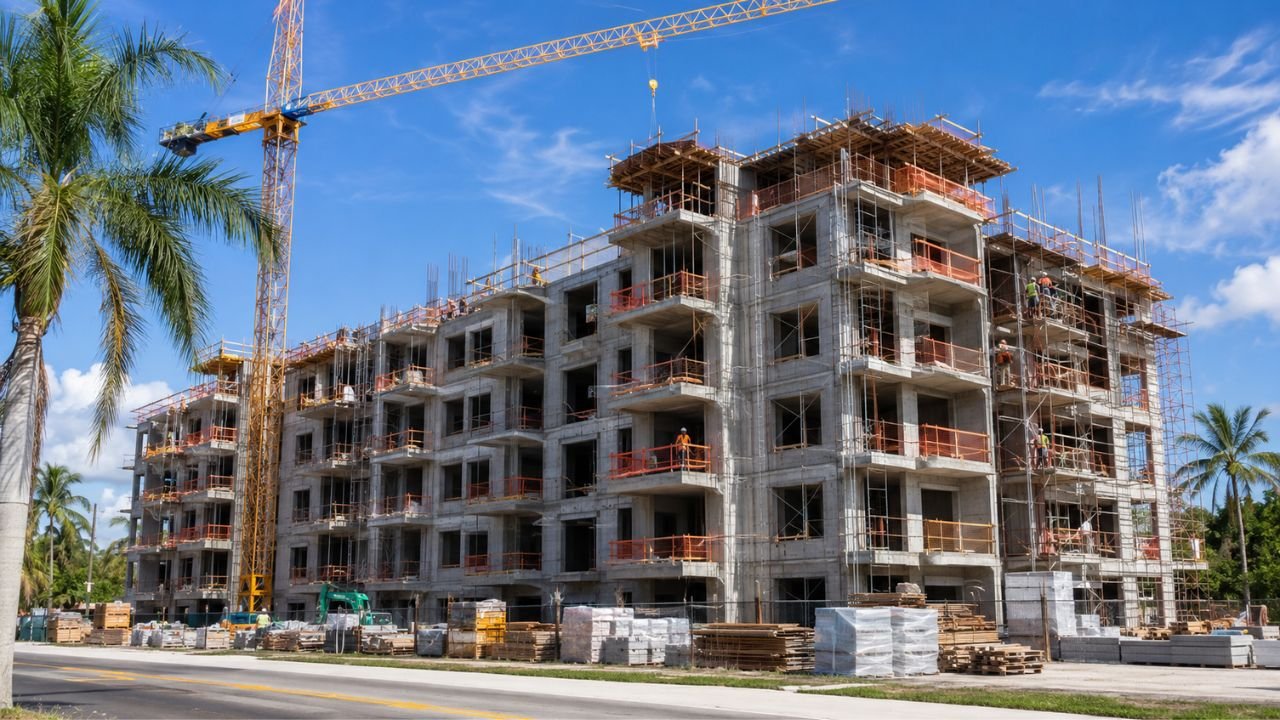
20-Unit Total Project Cost by Form Factor and Finish (Florida 2026)
Estimates based on an average unit size of 950 sq. ft..
| Form Factor | Finish Tier | Cost Per Door | Total Project Cost |
|---|---|---|---|
| 2-Story Garden Walk-up | Workforce | $210,000 – $245,000 | $4.2M – $4.9M |
| 2-Story Garden Walk-up | Market Rate | $250,000 – $290,000 | $5.0M – $5.8M |
| 3-Story Walk-up | Market Rate | $275,000 – $315,000 | $5.5M – $6.3M |
| 3-Story Walk-up | Class A / Luxury | $320,000 – $365,000 | $6.4M – $7.3M |
| 4-Story w/ Elevator | Class A / Luxury | $375,000 – $410,000 | $7.5M – $8.2M |
The 20-Unit Scale Penalty: Why Small Projects Cost More Per Door
Most developers testing a 20-unit deal make the mistake of using line-item construction cost estimates pulled from larger projects. This is a dangerous underwriting error. A 20-unit project is often an “awkward” scale where you lose the simplicity of a fourplex but haven’t yet reached the efficiency of a mid-rise complex.
Fixed Costs That Don’t Shrink
- Site Work and Utilities: Whether you build 20 units or 60, Florida’s high water table usually requires a dedicated stormwater retention pond and specialized drainage. The cost to clear the land, grade it, and run utility taps to the main line does not drop by 60% just because your unit count did.
- Design and Entitlement: A civil engineer, architect, and MEP engineer will charge nearly the same for a 20-unit set of plans as they would for a 40-unit set. The geotech report, traffic study, and survey requirements remain largely identical.
- General Conditions: You still need a site supervisor, a temporary construction trailer, fencing, and insurance for the duration of the build. On a 100-unit job, these “GCs” might be 6% of the budget; on a 20-unit job, they often climb to 10% or more.
The Scale-Penalty Table (Estimated Cost Per Door Comparison)
Assuming 3-story walk-up, Market Rate finishes in Central Florida.
| Cost Category | 20-Unit Project | 50-Unit Project | 100-Unit Project |
|---|---|---|---|
| Site Work / Horizontal | $35,000 / door | $22,000 / door | $14,000 / door |
| Vertical Construction | $185,000 / door | $175,000 / door | $170,000 / door |
| Soft Costs / Design | $25,000 / door | $12,000 / door | $7,000 / door |
| Impact Fees | $20,000 / door | $20,000 / door | $20,000 / door |
| Total Per Door | $265,000 | $229,000 | $211,000 |
Form Factor: Garden-Style vs. Walk-up vs. Elevator
At 20 units, the physical shape of the building is your biggest budget lever.
- 2-Story Garden Style: Typically Type V-B wood frame. These are the cheapest to build because they avoid the Florida Building Code requirements for elevators and complex fire-rated stairwells.
- 3-Story Walk-up: This is the “sweet spot” for many Florida developers. You maximize land density without the $150,000–$250,000 expense of an elevator system.
- 4-Story with Elevator: Once you hit the fourth floor, the project’s economic profile changes entirely. You trigger requirements for elevators and more stringent fire protection systems. For a deep dive into the structural shifts required for higher builds, see our construction estimating guide library.
Full Development Budget for a 20-Unit Florida Project
Based on a $6.0M total budget (Market Rate, 3-Story).
| Budget Category | % of Budget | Estimated Dollar Amount |
|---|---|---|
| Land Acquisition | 15% | $900,000 |
| Hard Costs (Vertical) | 55% | $3,300,000 |
| Site Work (Horizontal) | 10% | $600,000 |
| Impact & Permit Fees | 7% | $420,000 |
| Soft Costs (Design/Eng) | 5% | $300,000 |
| Financing / Carry / Legal | 3% | $180,000 |
| Contingency (2026) | 5% | $300,000 |
Regional Multipliers and 2026 Market Volatility
Construction costs are not uniform across the 67 counties of Florida. According to the BLS PPI for nonresidential construction, material and labor escalation must be accounted for in every 2026 pro forma.
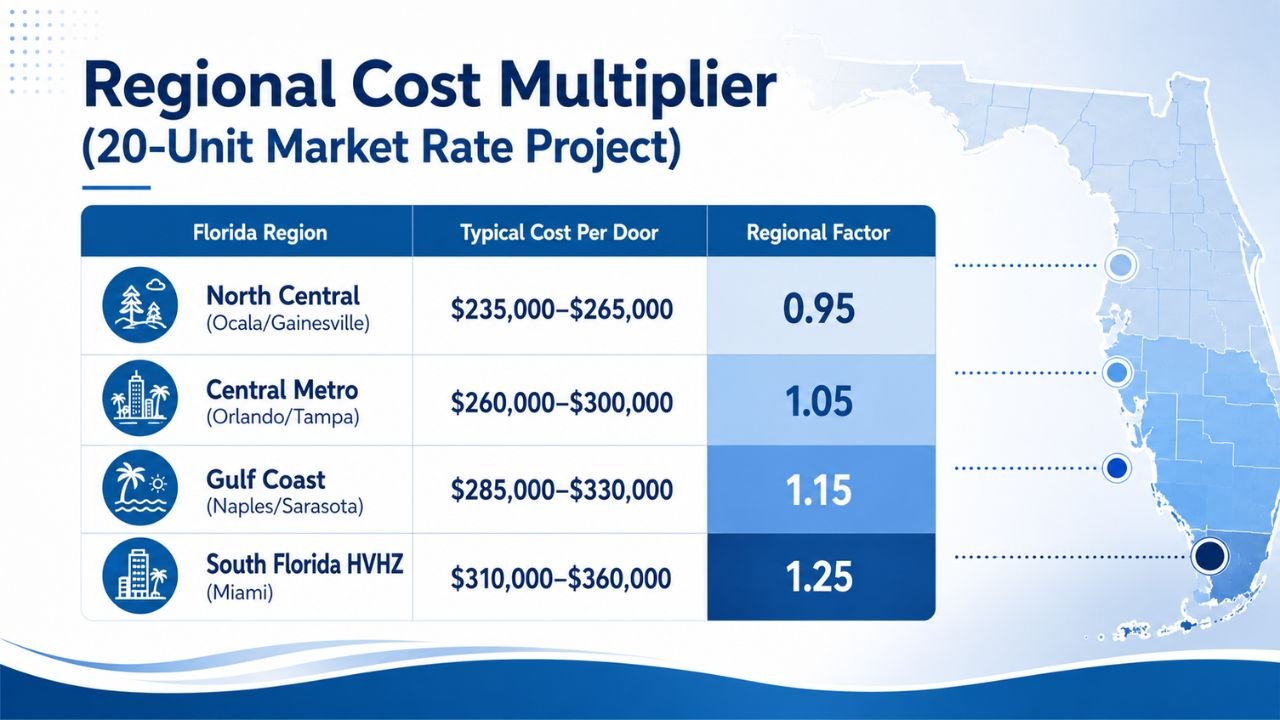
In South Florida, specifically Miami-Dade and Broward, the HVHZ (High-Velocity Hurricane Zone) requirements mandate impact-rated glass and reinforced masonry that can add $20,000 to $30,000 per unit compared to an identical build in the Panhandle.
Regional Cost Multiplier (20-Unit Market Rate Project)
| Florida Region | Typical Cost Per Door | Regional Factor |
|---|---|---|
| North Central (Ocala/Gainesville) | $235,000 – $265,000 | 0.95 |
| Central Metro (Orlando/Tampa) | $260,000 – $300,000 | 1.05 |
| Gulf Coast (Naples/Sarasota) | $285,000 – $330,000 | 1.15 |
| South Florida HVHZ (Miami) | $310,000 – $360,000 | 1.25 |
Unit Mix Impact on Cost Per Door
Kitchens and bathrooms are the most expensive rooms to build. A “20-unit” building made of studios is vastly different than 20 three-bedroom units.
| Unit Type | Avg. Sq. Ft. | Construction Cost Range |
|---|---|---|
| Studio | 550 – 650 | $110,000 – $160,000 |
| 1-Bedroom | 800 – 950 | $140,000 – $210,000 |
| 2-Bedroom | 1,050 – 1,200 | $185,000 – $280,000 |
| 3-Bedroom | 1,300+ | $230,000 – $350,000 |
Site Requirements: Land, Parking, and Stormwater
You cannot build 20 units on a quarter-acre lot in most Florida jurisdictions. Parking requirements [VERIFY: typically 1.5 to 2.25 stalls per unit] and stormwater retention mandates often dictate your maximum density more than zoning does.
Site Requirements for 20 Units
| Form Factor | Est. Land Needed | Parking Stalls (Min) | Stormwater Footprint |
|---|---|---|---|
| 2-Story Garden | 1.5 – 2.0 Acres | 40 – 50 | 15% – 20% of site |
| 3-Story Walk-up | 1.0 – 1.25 Acres | 40 – 50 | 15% – 20% of site |
| 4-Story w/ Elevator | 0.75 – 1.0 Acre | 40 – 50 | High (unless vault) |
Is a 20-Unit Project Profitable? The Honesty Check
A 20-unit deal is one of the hardest to make “pencil” in high-cost Florida markets. If you are paying $1 million for the land and another $500,000 in impact fees, you are starting the race $75,000 per door in the hole before you pour a yard of concrete.
For a 20-unit project to work, you generally need one of the following to be true:
- Low Land Basis: You already own the land or acquired it well below market.
- Premium Rents: You are building Class A luxury units in a supply-constrained “micro-market” where tenants will pay a massive premium.
- Low Impact Fee Jurisdiction: You are building in a county with lower-than-average impact fees under Florida Statute 163.31801.
Underwriting a 20-unit deal using national averages or “100-unit scale” benchmarks is the fastest way to a failed capital call. Precision matters at this scale more than any other.
Before you close on land or submit to a lender, you need a site-specific, line-item budget that accounts for local labor volatility and current FBC 8th Edition requirements. For an accurate multifamily estimating in Florida, ensure your takeoff counts every foot of rebar and every square foot of impact glass.
FAQ
How much land does a 20-unit apartment complex need in Florida?
Depending on local zoning and parking requirements, a 20-unit project typically requires 1.25 to 2.0 acres. While you can build on less land by using a 4-story “podium” design with parking underneath, this significantly increases structural costs and may not be feasible for a 20-unit budget.
What are impact fees for multifamily in Florida?
Impact fees vary wildly by county but generally range from $15,000 to $25,000 per dwelling unit. These fees are set by Florida Statute 163.31801 and cover roads, schools, and parks. They are often the largest single soft cost for small developers.
How long does it take to build a 20-unit apartment complex?
The typical construction timeline for a 20-unit building is 12 to 16 months from groundbreaking to Certificate of Occupancy. This does not include the 6–12 months usually required for site plan approval, permitting, and horizontal site development.
Is it cheaper per unit to build 20 units or 50 units?
It is almost always cheaper per unit to build 50 units. A 50-unit project spreads fixed costs (civil engineering, site work, general conditions) across more doors, typically reducing the cost per unit by 10–15% compared to a 20-unit build.
How much parking is required for 20 units?
Most Florida municipalities require between 1.5 and 2.25 parking spaces per unit, meaning a 20-unit complex needs 30 to 45 parking stalls plus ADA-accessible spaces. Local “transit-oriented” codes may allow for fewer spaces if the project is near a major bus or rail line.
What contingency should a 20-unit developer carry in 2026?
Due to ongoing labor shortages and material volatility, we recommend a minimum 5% to 7% construction contingency and a 10% “owner’s contingency” for soft costs and carrying fees. This buffer protects the project from unexpected code-compliance costs during inspection.
Ready to see if your deal pencils?
Avoid the scale-penalty trap with a bid-ready budget. Send us your site plan today for a professional, 24-48 hour construction estimate.