Takeoff, BOQ, estimate and scope sheet get used interchangeably, but they’re different documents that do different jobs. Knowing which one you need, and how they fit together, makes flooring bids faster to prepare and easier for a GC or owner to compare. This guide explains each document in plain English, shows the same flooring scope written all four ways, covers how estimates mature from budget to bid, and points you to a free template for each.
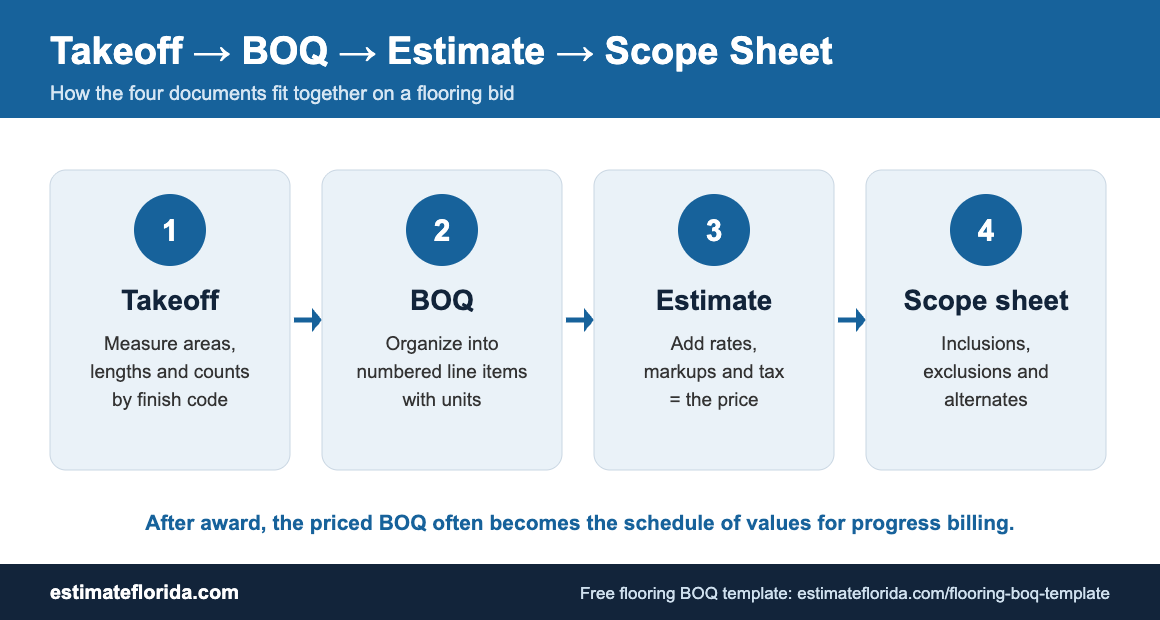
At a glance
| Document | What it answers | Includes prices? | Who uses it |
|---|---|---|---|
| Takeoff | How much of each item is there? | No | Estimators, contractors |
| BOQ (bill of quantities) | What are all the items, in what units and quantities? | Optional (priced BOQ) | Contractors, GCs, owners, quantity surveyors |
| Estimate | What will it cost? | Yes | Contractors, GCs, owners |
| Scope sheet | What’s included, excluded or an alternate? | Sometimes | Subcontractors and GCs on bid day |
Takeoff: measuring the quantities
A takeoff is the measurement step. The estimator goes through the finish plans and room finish schedule and measures areas, lengths and counts for each finish code: square feet of LVT, square yards of carpet tile, linear feet of base, the number of stair treads. Today most takeoffs are done on PDF drawings with takeoff software, but the output is the same: a list of measured quantities, usually without prices.
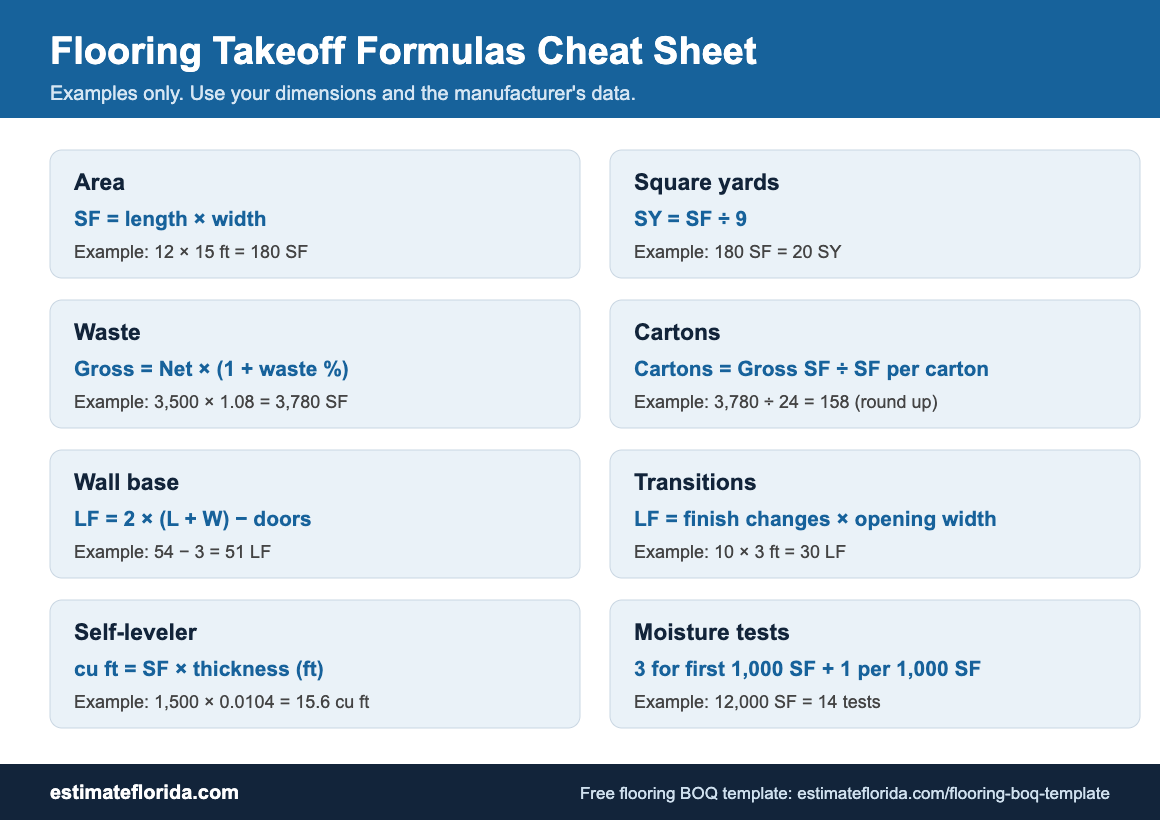
A good takeoff is organized by finish code and by area or floor, so it can be checked and reused. It records net quantities, with waste and attic stock added as separate, visible steps. For the math, see our flooring takeoff formulas.
Example takeoff line: LVT-1, Level 2 open office, 2,140 SF net.
BOQ: organizing quantities into line items
A bill of quantities takes the takeoff and organizes it into numbered line items with clear descriptions and units, grouped into sections such as general, floor prep, moisture, flooring, base and stairs. When everyone prices the same BOQ, bids can be compared line by line. Add rates and it becomes a priced BOQ.
The term is used most in the UK, the Middle East, Asia and international projects, where a quantity surveyor often prepares the BOQ and contractors price it. In the US, the same idea shows up as an itemized bid, a bid form with unit prices, or a schedule of values after award.
Example BOQ line: D.2 — LVT-1 luxury vinyl tile per spec 09 65 19, glue-down, including adhesive — SF — 3,500.
Learn how to prepare a flooring BOQ, download our free flooring BOQ template, or see a full sample BOQ for house construction.
Estimate: the cost
An estimate puts a price on the work: material, labor, equipment, prep, markups and any tax. A priced BOQ is one form of detailed estimate. Estimates can also be much simpler, such as a cost per square foot for early budgeting before detailed drawings exist.
Example estimate line: LVT-1, 3,500 SF at your material and labor rate, plus prep, with overhead and profit on the summary.
Scope sheet: what’s in and what’s out
A scope sheet, also called an inclusions and exclusions sheet or bid qualifications, tells the GC exactly what a flooring bid covers: which finish codes, floor prep, moisture testing and mitigation, base, transitions, furniture moving, after-hours work and attic stock. GCs use it to level bids from different subcontractors, so two prices are compared on equal terms.
Example scope sheet lines: Moisture mitigation — Alternate. Furniture moving — Excluded. Attic stock 2% — Included.
Download our free flooring scope sheet template.
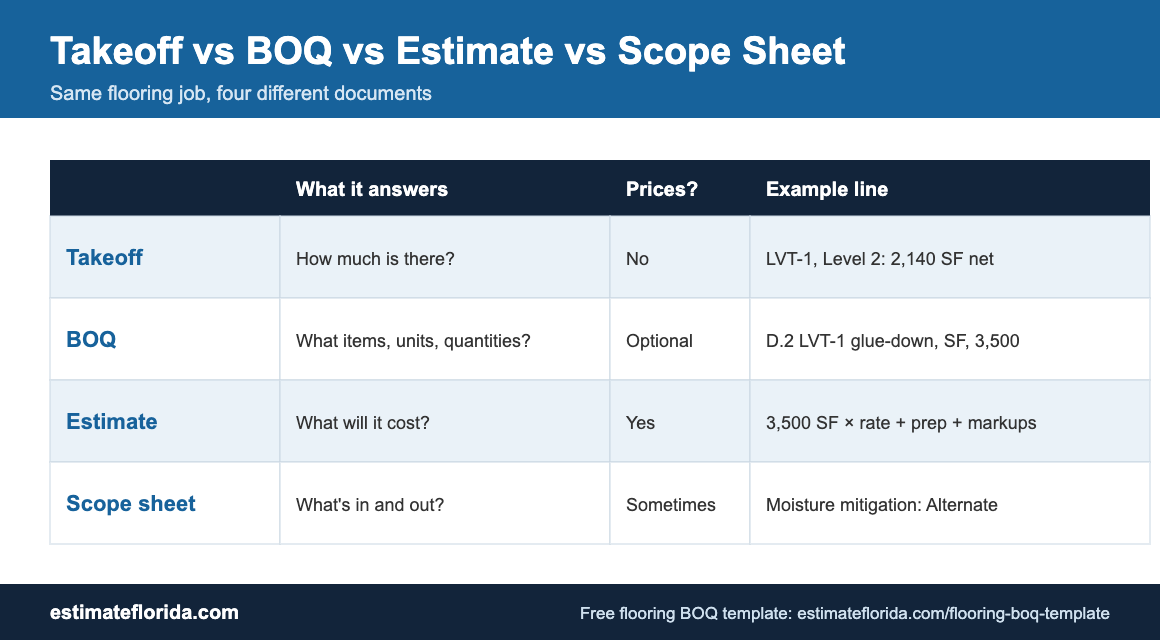
How they fit together on a flooring bid
- Take off the drawings by finish code.
- Organize the quantities into a BOQ.
- Price the BOQ to produce your estimate.
- Send the price with a scope sheet so the GC can level it.
After award, the priced BOQ often becomes the schedule of values, the breakdown used for monthly progress billing, and its unit rates help price change orders.
Estimates get more accurate as the design develops
Not every estimate is a detailed BOQ. AACE International’s Recommended Practice 18R-97 groups estimates into five classes based on how complete the project definition is. As drawings develop, the expected accuracy range narrows:
| Class | Project definition | Typical use | Expected accuracy range |
|---|---|---|---|
| Class 5 | 0% to 2% | Concept screening | Low: −20% to −50%; High: +30% to +100% |
| Class 4 | 1% to 15% | Study or feasibility | Low: −15% to −30%; High: +20% to +50% |
| Class 3 | 10% to 40% | Budget authorization | Low: −10% to −20%; High: +10% to +30% |
| Class 2 | 30% to 75% | Control or bid | Low: −5% to −15%; High: +5% to +20% |
| Class 1 | 65% to 100% | Check estimate or bid | Low: −3% to −10%; High: +3% to +15% |
For flooring, an early budget might use cost per square foot by space type, while a bid uses a full takeoff and BOQ from finish plans and specs. Be clear about which one you’re giving, especially to owners. Read more about what a Class 4 estimate is.
Same scope, four documents
Here’s a single break room with LVT, rubber base and one transition, shown four ways:
- Takeoff: Break room 101: LVT-1 320 SF; RB-1 base 68 LF; transition LVT-1 to CPT-1, 3 LF.
- BOQ: D.2 LVT-1 glue-down incl. adhesive, SF, 320. E.1 RB-1 rubber base 4 in, LF, 68. E.4 Transition strip, LF, 3.
- Estimate: the same three lines with rates and amounts, plus prep, markups and tax on the summary.
- Scope sheet: LVT-1 and RB-1 included; floor leveling carried as an allowance; moisture mitigation excluded, alternate price provided.
Who prepares each document?
- Takeoff: the estimator at the flooring contractor or GC, or an outside estimating service working from the bid drawings.
- BOQ: on many international and public projects, a quantity surveyor or cost consultant prepares the BOQ for the owner and contractors price it. On most US private work, each bidder builds its own itemized breakdown from its own takeoff.
- Estimate: the bidder, using its own rates, production and markups. Owners also commission independent estimates to set budgets or check bids.
- Scope sheet: the bidding subcontractor writes it; the GC compares scope sheets from several subs on a bid leveling sheet.
What to send with a flooring bid
A flooring bid that’s easy to accept usually includes:
- A cover letter or proposal with the project name, the drawings and addenda you priced, the bid validity period and your contact details.
- The price, either a lump sum with a breakdown by finish code or a priced BOQ.
- A scope sheet listing inclusions, exclusions, alternates and allowances.
- Unit prices for likely changes, such as extra leveling per square foot or moisture mitigation per square foot.
- Product information if you’re proposing a substitution or an equal product.
This gives the GC everything needed to level your bid without calling you, which matters on a busy bid day.
How owners and property managers use a BOQ
A BOQ isn’t only for contractors. Owners and property managers use one to:
- Set a realistic budget before asking for quotes.
- Send every installer the same scope, so quotes come back in the same format.
- Spot gaps, such as a quote that leaves out prep, base or transitions.
- Negotiate on facts, line by line, instead of on the bottom number.
If you’re comparing installer quotes now, our guide on how to compare commercial flooring quotes walks through what to check.
Which one do you need?
- Flooring contractor bidding a GC: a takeoff, a priced BOQ for your own use, and a scope sheet with your bid.
- GC comparing flooring subs: a BOQ for subs to price, or a scope sheet to level their bids.
- Owner or property manager budgeting: a priced BOQ or estimate to set the budget and check quotes.
- Apartment unit turns: a standard spec and tracker. See our unit turn flooring checklist.
Tools: software or spreadsheet?
Most flooring estimators measure on PDF drawings with on-screen takeoff software, which records areas, lengths and counts by finish code and exports them. The BOQ, pricing and summary are often built in a spreadsheet, because it’s flexible, easy to share with GCs and owners, and doesn’t require the other party to own the same software. Larger flooring contractors may use estimating software that links takeoff, pricing and proposals in one place.
Whatever you use, keep three things consistent: the same finish codes as the drawings, the same units throughout, and a clear trail from each BOQ quantity back to the takeoff. A spreadsheet template is the easiest place to start; our free flooring BOQ template already has the sections, formulas and summary set up, so you only enter your items, quantities and rates.
Mistakes when these documents get mixed up
- Sending a takeoff as a bid. Quantities without a scope sheet leave the GC guessing what’s included.
- A lump sum with no breakdown. It’s hard to level and easy to cut. A priced BOQ shows where the money is.
- A scope sheet that doesn’t match the estimate. If prep is “included” on the scope sheet, it needs to be priced in the BOQ.
- Treating a budget as a bid. A cost-per-square-foot budget isn’t a commitment to a detailed scope.
Free flooring templates
- Flooring BOQ template: line items, units, rates, subtotals and summary.
- Flooring scope sheet template: takeoff by finish code and inclusions and exclusions.
- Unit turn flooring checklist: for apartment property managers.
Want it done for you?
We prepare flooring takeoffs, priced BOQs and estimates from your plans. Flat fee from $750 (large commercial projects from $1,400), usually in 24 to 48 hours. Get a flooring estimate quote. Need the flooring installed? We can connect you with an installation partner.
Frequently asked questions
Is a BOQ the same as an estimate?
Not exactly. A BOQ lists items, units and quantities. Once rates are added, a priced BOQ is a detailed estimate. An estimate can also be a higher-level number, such as cost per square foot.
What comes first, the takeoff or the BOQ?
The takeoff. You measure the quantities first, then organize them into BOQ line items.
What is a scope sheet in a flooring bid?
A list of what the bid includes and excludes, such as prep, moisture mitigation, base and furniture moving, so the GC can compare bids on equal terms.
What is a schedule of values?
A breakdown of the contract price by work item, used for monthly progress billing after award. It’s often based on the priced BOQ.
How accurate is a flooring estimate?
It depends on how complete the drawings and specs are. Early budgets have wide ranges; bid estimates from complete finish plans and specs are much tighter. AACE International’s 18R-97 classes describe typical ranges.
Sources
- AACE International, Recommended Practice No. 18R-97, Cost Estimate Classification System as Applied in Engineering, Procurement, and Construction for the Process Industries
- CSI MasterFormat, Division 09 (Finishes) and Division 03 (Concrete)