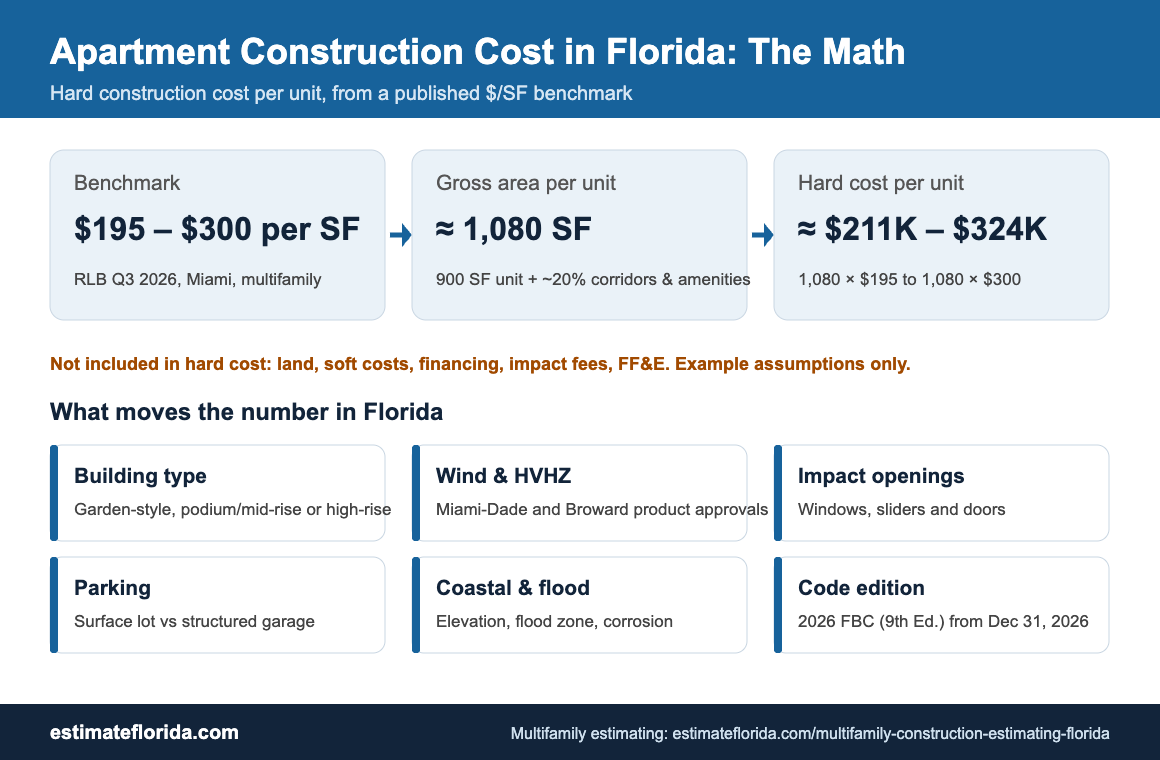
The cost to build an apartment complex in Florida starts with one benchmark: hard construction cost per square foot. Rider Levett Bucknall’s Q3 2026 North America report puts multifamily construction in Miami at about $195 to $300 per square foot of gross floor area. That’s the building itself, before land, design fees, financing, impact fees and furniture. This guide shows how to turn that number into a cost per unit and a project budget, explains what moves the price in Florida, and links to detailed guides for 10, 20, 50, 100 and 500-unit projects.
Florida apartment construction cost at a glance
| Measure | Benchmark | Notes |
|---|---|---|
| Hard cost per SF (multifamily, Miami) | $195 – $300 | RLB, Q3 2026; gross floor area |
| Example gross area per unit | ≈ 1,080 SF | 900 SF average unit + about 20% for corridors, lobbies and amenities |
| Example hard cost per unit | ≈ $211,000 – $324,000 | 1,080 SF × $195 to $300 |
| Miami construction cost change | +4.55% year over year | RLB, Q3 2026 (national: +4.45%) |
The per-unit figures are a worked example, not a quote. Your unit mix, building type, parking and site will change them. Total development cost is higher than hard cost because it adds land and soft costs.
How to calculate cost per unit
- Start with the average unit size from your unit mix. A mix of studios, one-bedrooms and two-bedrooms might average 800 to 1,000 SF.
- Add common area. Corridors, stairs, elevators, lobbies, leasing offices, mechanical rooms and amenities add to the gross floor area. The share depends on the building type: garden-style buildings with exterior breezeways need less interior circulation than double-loaded corridor mid-rises.
- Multiply by a cost per SF that fits the building type and location.
- Add site work and parking if they aren’t in your $/SF figure. Structured parking in particular can add a large amount per space.
- Add soft costs and land to get the total development cost: design and engineering, permits, impact fees, insurance, financing, legal, marketing and developer fee.
For a full worked budget, our apartment building construction estimate template walks through each line.
Cost guides by project size
Larger projects spread fixed costs like site work, amenities and design over more units, but they also tend to be taller and use more expensive structural systems. See the detailed guide for your size:
- Cost to build a 10-unit apartment complex in Florida
- Cost to build a 20-unit apartment complex in Florida
- Cost to build a 50-unit apartment complex in Florida
- Cost to build a 100-unit apartment complex in Florida
- Cost to build a 500-unit apartment complex in Florida
- Cost to build a 20-story apartment building in Florida
- Cost to build a multifamily home (duplex to fourplex) in Florida
Cost by building type
Garden-style apartments
Two- and three-story buildings, often wood-frame or concrete block, with surface parking and exterior stairs or breezeways. They’re usually the lowest cost per square foot because the structure is simple and parking is on grade, but they need more land per unit. Common in suburban Central and North Florida.
Mid-rise and podium buildings
Four to seven stories, often with residential floors over a concrete podium that holds parking, retail or amenities. Elevators, fire protection, interior corridors and structured parking raise the cost per square foot compared with garden-style, but more units fit on a smaller site. Common in growing urban areas such as Orlando, Tampa and St. Petersburg.
High-rise towers
Concrete towers with structured parking, high-capacity elevators, complex MEP systems and curtain wall or window wall facades. They carry the highest cost per square foot, especially on the coast where wind loads and product approvals are strictest. Common in Miami, Fort Lauderdale and downtown Tampa.
What drives apartment construction cost in Florida
- Wind design and the High-Velocity Hurricane Zone. In Miami-Dade and Broward, the HVHZ requires stricter product approvals for windows, doors, roofing and other envelope components.
- Impact-rated openings. Windows, sliding doors and entry doors rated for wind-borne debris are a significant share of the envelope budget on coastal projects.
- Parking. Surface parking is the cheapest per space; structured garages cost far more per space and can drive the whole project budget.
- Flood zones and coastal exposure. Elevated finished floors, flood-resistant materials and corrosion protection add cost near the coast.
- Code changes. Permit applications submitted on or after December 31, 2026 fall under the 9th Edition (2026) Florida Building Code, which adds requirements such as corrosion-resistant fasteners and connectors within 3,000 feet of saltwater. See our 2026 code cost impact guide.
- Labor and material markets. Construction costs in Miami rose about 4.55% year over year in RLB’s Q3 2026 report. Lock pricing as late as is practical and carry escalation in early budgets.
- Insurance and financing. Builder’s risk insurance on coastal projects and interest during construction are significant soft costs.
Hard costs vs soft costs
Hard costs are the physical construction: site work, foundations, structure, envelope, interiors, MEP, elevators, fire protection and parking. Soft costs are everything else needed to deliver the project: architecture and engineering, surveys and geotechnical reports, permits and impact fees, insurance, financing and interest, legal and accounting, marketing and leasing, and the developer fee. Land is usually tracked separately. Lenders and investors look at all three, so a construction estimate should make clear which costs it includes.
Florida programs that can affect the budget
Florida’s Live Local Act (2023) created incentives for multifamily projects that include affordable units, including allowing multifamily development in some commercial and industrial zones when a set share of units is affordable, and certain property tax exemptions. Eligibility and local rules vary and the law has been amended, so confirm the current requirements with your land use attorney and the local government before you rely on it in a pro forma.
How to budget an apartment project, step by step
- Feasibility: use $/SF and $/unit benchmarks to test the deal before design starts.
- Schematic design: update the estimate with the actual building type, unit mix, parking count and site.
- Design development: move to an estimate by CSI division with quantities for the major systems.
- Construction documents: prepare a detailed takeoff and BOQ to check GC bids.
- Construction: track costs against the estimate and price change orders from unit rates.
Each stage narrows the expected accuracy range. Our guide to estimate types and accuracy classes explains how this works.
Common budgeting mistakes
- Using a single national $/SF figure instead of a Florida, building-type-specific number.
- Leaving parking out of the cost per unit.
- Confusing hard cost with total development cost.
- Ignoring the code edition the permit will fall under.
- No escalation allowance on long pre-development schedules.
- Not checking whether amenities, FF&E and site utilities are in the number.
Get an apartment estimate from your drawings
We prepare multifamily estimates for Florida developers, owners and contractors, from early budgets to bid-level BOQs by CSI division, with hard and soft costs clearly separated. See multifamily estimating or upload your plans for a flat-fee quote. Want to see the format first? Download our free sample BOQ.
Frequently asked questions
How much does it cost to build an apartment complex in Florida?
Rider Levett Bucknall’s Q3 2026 report puts multifamily hard construction costs in Miami at about $195 to $300 per square foot. With an example of about 1,080 gross square feet per unit, that’s roughly $211,000 to $324,000 per unit in hard cost, before land and soft costs.
What is the cost per unit to build apartments in Florida?
It depends on unit size, building type, parking and location. Multiply the gross floor area per unit, including common areas, by a cost per square foot for your building type, then add parking, site work, soft costs and land.
Is it cheaper to build garden-style or mid-rise apartments?
Garden-style buildings usually cost less per square foot because the structure is simpler and parking is on grade, but they need more land per unit. Mid-rise buildings cost more per square foot but fit more units on a smaller site.
Why are construction costs higher in South Florida?
Miami-Dade and Broward are in the High-Velocity Hurricane Zone, with stricter product approvals for the building envelope, and coastal projects add flood and corrosion requirements. Land, labor and insurance costs are also higher in dense coastal markets.
What is included in soft costs?
Design and engineering, surveys and geotechnical reports, permits and impact fees, insurance, financing and interest, legal and accounting, marketing and leasing, and the developer fee.
Sources
- Rider Levett Bucknall, North America Quarterly Construction Cost Report, Q3 2026 (Miami multifamily cost per square foot and cost index)
- Florida Building Code, 9th Edition (2026)
- Florida Live Local Act, Chapter 2023-17, Laws of Florida, as amended