St. Petersburg is one of the busiest construction markets on Florida’s Gulf Coast. New waterfront condos are rising along Beach Drive, retail centers are being redeveloped in the Edge District and Grand Central, and single-family neighborhoods from Old Northeast to Shore Acres are seeing steady renovation and new-build activity. Behind nearly every one of these projects, whether it’s a custom home on Snell Isle or a mixed-use building downtown, is a number that determines whether the project happens at all: the estimate.
Getting that number wrong is expensive. A construction estimator’s job is to make sure it’s not wrong — or at least not wrong by much. A professional construction estimator in St. Petersburg takes a set of drawings and specifications and turns them into a defensible dollar figure, broken down by trade, material, and labor, that a contractor can bid with confidence and a property owner can budget around.
St. Petersburg brings its own set of estimating challenges. The city sits in a High-Velocity Hurricane adjacent wind zone, so structural and envelope costs often run higher than statewide averages. Much of the buildable land near the waterfront falls in a flood zone, which affects foundation design and elevation requirements. Downtown infill lots are frequently tight, driving up costs for staging, logistics, and site work. And Pinellas County’s permitting and inspection process has its own timelines and documentation requirements that a local estimator learns to anticipate.
This page explains what a construction estimator actually does, walks through the estimating services available for residential, commercial, and industrial work in St. Petersburg, and covers the trades, software, and process behind an accurate estimate. Whether you’re a general contractor preparing a bid, a developer running feasibility numbers, or a homeowner planning a renovation, you’ll leave with a clear picture of what to expect from a professional estimate — and how to get one.
What Does a Construction Estimator Do?
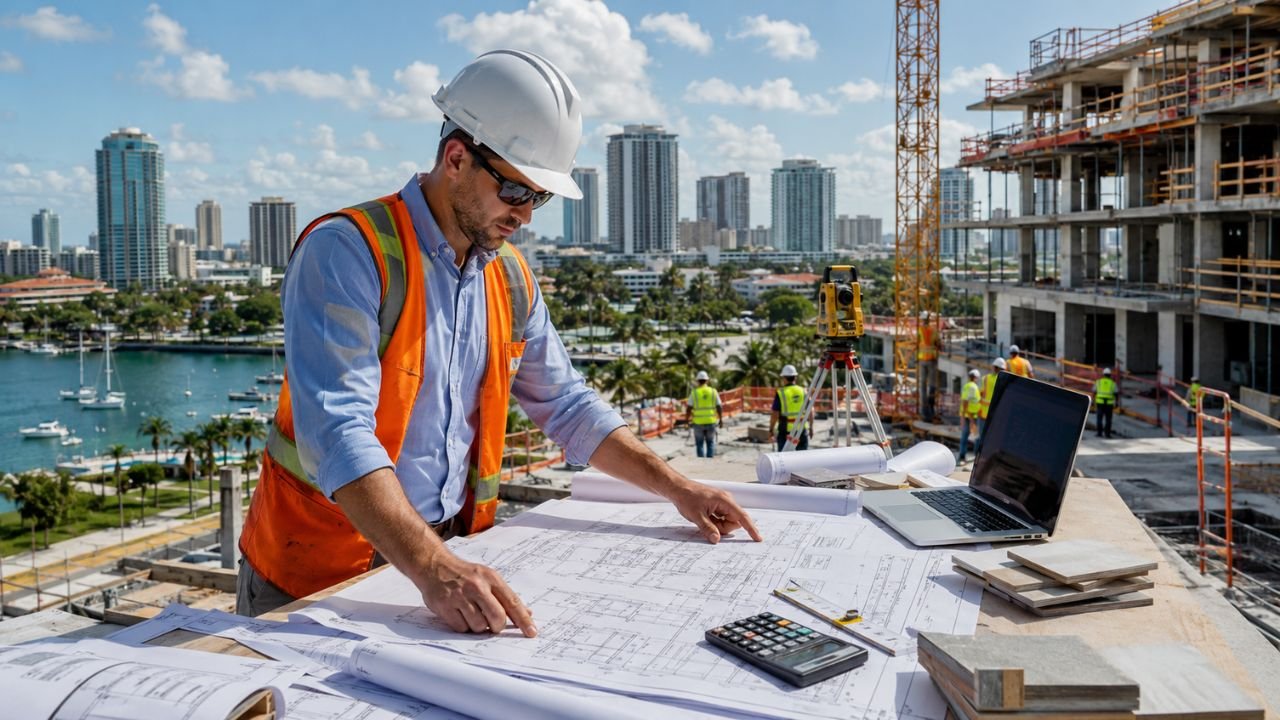
A construction estimator translates a design into a cost. That sounds simple, but the process behind it has several distinct pieces.
Quantity takeoffs come first. The estimator reviews architectural, structural, and MEP drawings and measures or counts every quantifiable item in the project — square footage of flooring, linear feet of framing, number of doors and windows, cubic yards of concrete, and so on. This is the foundation of the estimate; if the takeoff is wrong, everything built on top of it is wrong too.
Material estimating applies current pricing to those quantities. Material costs shift with supply chain conditions, tariffs, and regional demand, so an estimator working in the St. Petersburg market needs current, local pricing rather than national averages.
Labor cost estimating accounts for local wage rates, crew productivity, and the labor intensity of each trade. Labor in the Tampa Bay area has its own rate structure that differs from other parts of Florida, and a good estimate reflects that.
Equipment cost estimating covers the cranes, lifts, generators, and other equipment a project needs, along with rental duration and mobilization costs — often significant on tight urban St. Petersburg lots where staging space is limited.
Bid preparation packages all of this into a document a contractor can submit, formatted the way owners and general contractors expect to see it, organized by CSI division.
Budget planning and cost forecasting extend the estimate across the life of the project, giving owners and developers a tool for tracking spend against plan and anticipating cash flow needs.
Risk management means flagging the line items most likely to move — long-lead materials, trades in short supply, scope that isn’t fully defined yet — so decision-makers aren’t blindsided later.
Project budgeting ties the estimate to financing. Lenders, investors, and owners all rely on the estimate to size a construction loan or capital raise appropriately.
Professional estimating matters because construction is unforgiving of guesswork. Underestimate a bid and a contractor loses money on a job they’re contractually obligated to finish. Underestimate a budget and a developer runs out of capital mid-project. A detailed, trade-by-trade estimate built by someone who understands both the drawings and the local market is what stands between a project and a costly surprise.
There’s also a difference between an estimate built from national cost data and one built for the local market. Material availability, freight costs, and labor rates all vary regionally, and Tampa Bay’s construction labor market has its own supply-and-demand dynamics that shift over time. An estimator who works in St. Petersburg regularly develops a feel for which trades are running tight, which materials are seeing longer lead times, and how local permitting timelines affect a project’s overall cost — context that a generic, software-only estimate won’t capture.
Construction Estimating Services We Offer
Estimate Florida provides a full range of estimating services for St. Petersburg projects, covering every stage from early feasibility through change order management.
Quantity Takeoff Services. Precise measurement and counting of materials directly from drawings, organized by CSI division and ready to price.
Material Takeoff Services. A focused breakdown of material quantities and specifications, useful for procurement planning and supplier quotes independent of a full cost estimate.
Residential Construction Estimating. Detailed estimates for single-family homes, custom builds, renovations, and multifamily residential projects.
Commercial Construction Estimating. Cost estimates for retail, office, hospitality, healthcare, and other commercial building types.
Industrial Construction Estimating. Estimating for warehouses, distribution centers, and light industrial facilities.
Budget Estimates. Early-stage, order-of-magnitude figures used for feasibility studies and initial financing conversations.
Bid Estimates. Detailed, bid-ready estimates contractors use to submit competitive proposals.
Preliminary Estimates. Estimates prepared once schematic design is available, before construction documents are complete.
Design Estimates. Cost estimates that track a project through the design development phase, helping architects and owners make cost-informed design decisions.
Conceptual Estimates. High-level estimates based on project type and square footage, used before detailed drawings exist.
Change Order Estimates. Cost analysis for scope changes that arise mid-construction, priced consistently with the original estimate.
Value Engineering. Identifying alternative materials, systems, or methods that reduce cost without compromising design intent or performance.
Cost Management. Ongoing tracking of actual costs against the estimate throughout construction.
CPM Scheduling Support. Estimate data structured to feed into critical path method scheduling, connecting cost and time on a single project timeline.
Residential Construction Estimator St. Petersburg
St. Petersburg’s residential market spans a wide range, from modest bungalows in older neighborhoods to elevated waterfront estates on Snell Isle and Coffee Pot Bayou. A residential estimator working in this market needs to be comfortable with all of it.
Estimating coverage includes:
- Single-Family Homes
- Custom Homes
- Luxury Homes
- Waterfront Homes
- Condominiums
- Apartments
- Duplexes
- Townhomes
- Home Renovations
- Home Additions
- Multifamily Developments
Waterfront and near-coastal homes in St. Petersburg often require elevated foundations, impact-rated windows and doors, and flood-resistant construction methods, all of which carry distinct cost implications that a generic estimate would miss. Renovation and addition projects bring their own complexity: existing conditions are rarely fully known until demolition begins, and older homes in neighborhoods like Kenwood or Historic Old Northeast may involve permitting considerations tied to historic district guidelines.
Accurate residential estimating gives homeowners and builders a realistic number to work from before a shovel goes in the ground. It supports informed conversations with lenders, prevents mid-project budget surprises, and gives homeowners a clear basis for comparing contractor bids apples-to-apples.
Multifamily residential projects — small-lot townhome developments, duplex conversions, or larger apartment buildings — bring an added layer of complexity, since unit mix, shared systems, and phasing all affect the estimate. A multifamily estimate typically breaks costs down both by trade and by unit type, so a developer can see how per-unit costs shift with finish level or floor plan changes before those decisions are locked in. For builders working across several St. Petersburg neighborhoods at once, having estimates prepared to a consistent format also makes it easier to compare project economics side by side.
Commercial Construction Estimator St. Petersburg
Downtown St. Petersburg and the surrounding commercial corridors are in active build-out, with new retail, hospitality, and mixed-use projects reshaping the waterfront and the EDGE District. Commercial estimating covers:
- Office Buildings
- Retail Stores
- Shopping Centers
- Restaurants
- Hotels
- Healthcare Facilities
- Schools
- Warehouses
- Industrial Buildings
- Mixed-Use Developments
Commercial projects in St. Petersburg typically involve more complex MEP systems, life-safety requirements, and ADA compliance than residential work, along with tighter coordination between trades. Mixed-use buildings in particular require estimates that account for different construction types and finish levels stacked within a single structure — retail or hospitality space at grade, residential or office above. A commercial estimator needs to price all of it consistently, with enough detail that a general contractor can bid the work and a developer can secure financing against it.
Healthcare and hospitality projects add further complexity: healthcare facilities carry specialized mechanical and infection-control requirements, while hotels and restaurants involve extensive finish-out and equipment packages that need to be priced separately from base building costs. Retail and shopping center estimates, meanwhile, often need to account for tenant improvement allowances and core-and-shell versus tenant fit-out scope, since these are frequently budgeted and bid separately even within the same project. A commercial estimate that clearly separates these categories gives developers, general contractors, and property owners a much clearer picture of where costs sit and where there’s room to adjust.
CSI Trades We Estimate
Estimates are built out by CSI division, covering every trade involved in a St. Petersburg construction project.
Concrete. Foundations, slabs, tilt-up panels, and elevated decks — often a larger share of the budget on St. Petersburg projects that require elevated foundations for flood compliance.
Masonry. Block walls, brick veneer, and stone finishes, priced by unit count and labor intensity.
Structural Steel. Framing, connections, and structural members for commercial and mid-rise projects.
Metals. Miscellaneous metals, railings, stairs, and structural accessories.
Lumber & Framing. Wood framing packages for residential and light commercial construction, priced by board footage and labor.
Roofing. Materials and installation, with attention to wind-uplift rating requirements common in the St. Petersburg area.
Drywall. Hanging, taping, and finishing across interior partitions and ceilings.
Flooring. Tile, hardwood, carpet, vinyl, and polished concrete, priced by material grade and square footage.
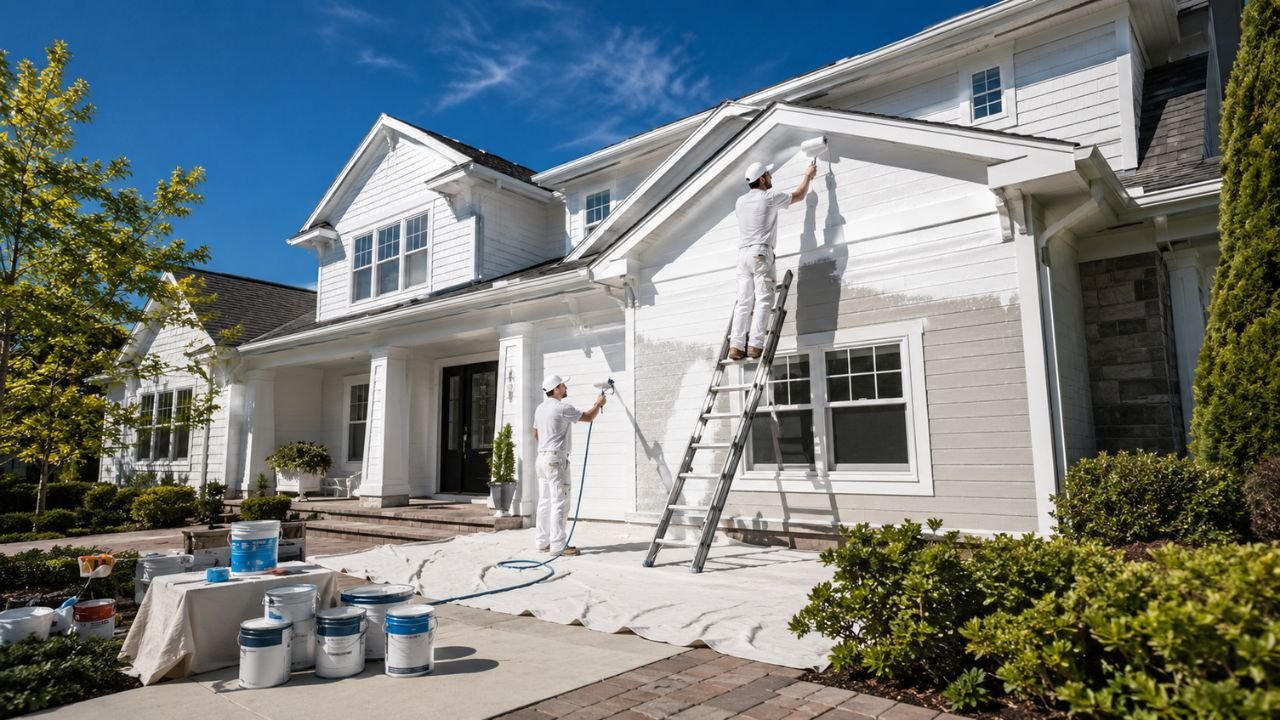
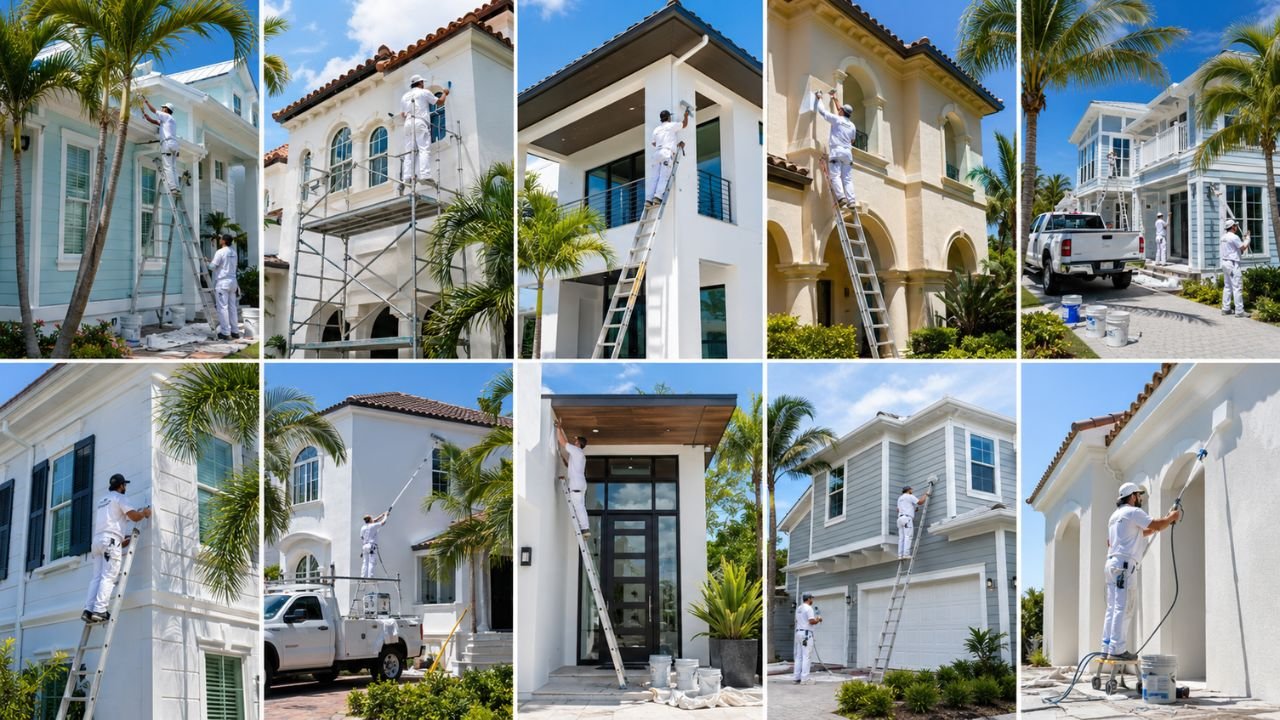
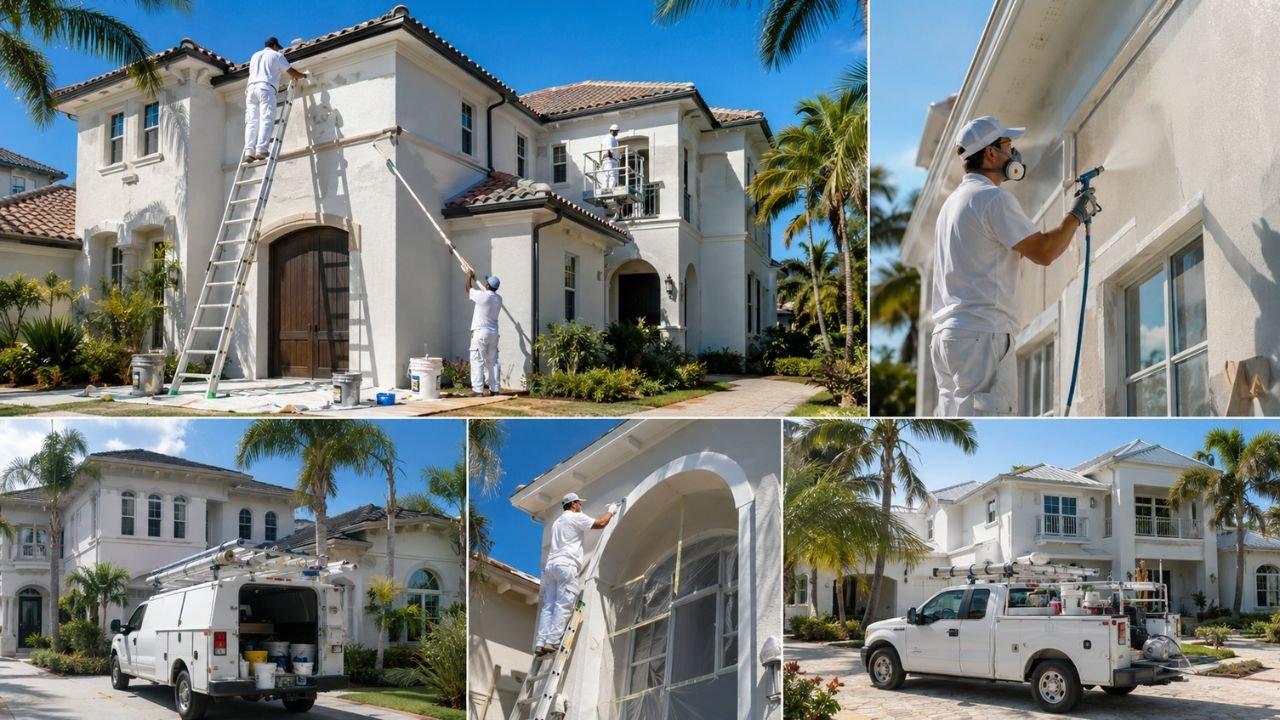
Painting. Interior and exterior coatings, including surface prep.
HVAC. Equipment, ductwork, and controls, sized to Florida’s cooling-load requirements.
Plumbing. Rough-in, fixtures, and water/sewer connections.
Electrical. Service, distribution, lighting, and low-voltage systems.
Fire Protection. Sprinkler systems and fire alarm infrastructure, particularly for commercial and multifamily projects.
Doors & Windows. Including impact-rated products where required by wind zone and flood elevation.
Finishes. Millwork, cabinetry, and interior trim.
Earthwork. Grading, excavation, and soil work, which in St. Petersburg often involves managing high water tables.
Demolition. Selective and full demolition scope for renovation and redevelopment projects.
Site Work. Utilities, paving, and site preparation.
Landscaping. Planting, irrigation, and hardscape.
Trade-by-trade breakdowns matter because they let contractors solicit and compare subcontractor bids against a known baseline, and they let owners see exactly where their money is going rather than accepting a single lump-sum number.
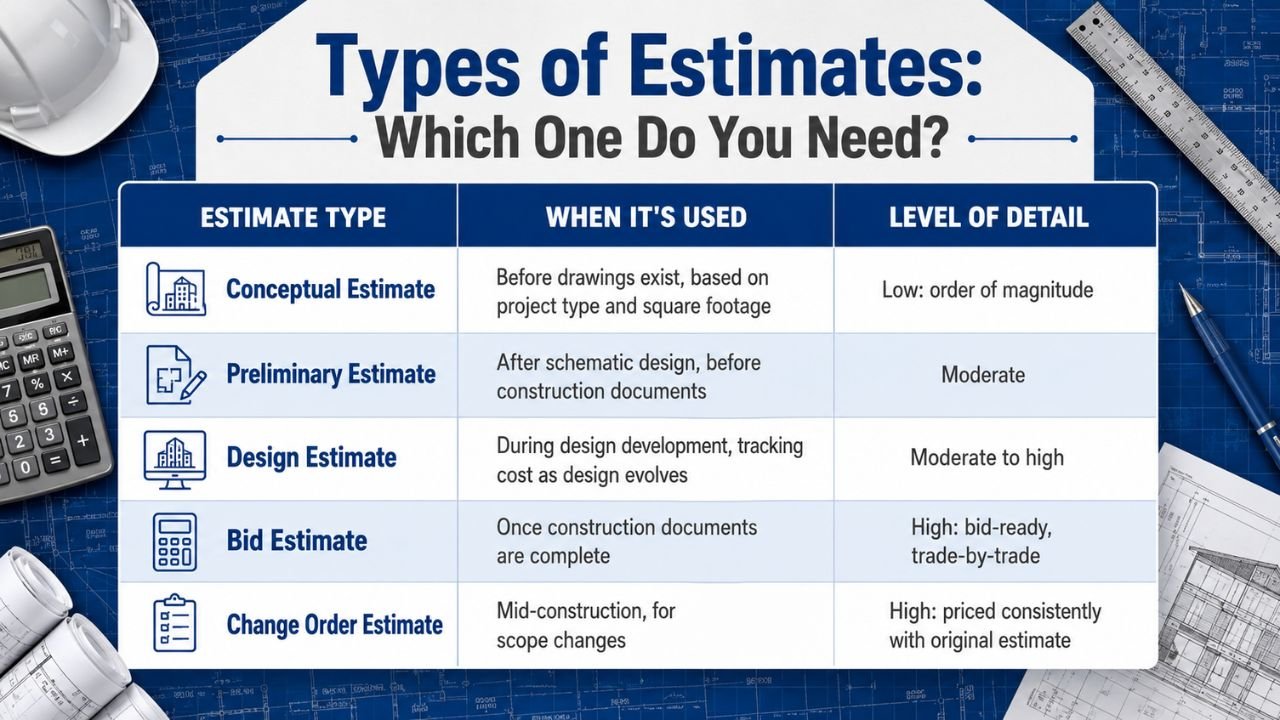
Types of Estimates: Which One Do You Need?
| Estimate Type | When It’s Used | Level of Detail |
| Conceptual Estimate | Before drawings exist, based on project type and square footage | Low — order of magnitude |
| Preliminary Estimate | After schematic design, before construction documents | Moderate |
| Design Estimate | During design development, tracking cost as design evolves | Moderate to high |
| Bid Estimate | Once construction documents are complete | High — bid-ready, trade-by-trade |
| Change Order Estimate | Mid-construction, for scope changes | High — priced consistently with original estimate |
Factors That Affect Construction Costs in St. Petersburg
No two estimates look the same, even for similar-sized projects, because construction costs are shaped by a combination of variables:
- Project scope and building type — a ground-up custom home and a commercial tenant buildout have very different cost structures even at similar square footage.
- Materials and finish level — standard versus high-end finishes can shift a budget significantly, especially in flooring, cabinetry, and exterior cladding.
- Labor rates — Tampa Bay area labor rates fluctuate with regional demand and the availability of skilled trades.
- Permits and fees — Pinellas County and City of St. Petersburg permitting costs and requirements vary by project type and location.
- Design complexity — irregular building footprints, custom architectural details, and complex MEP systems all add cost.
- Site conditions — flood zone elevation requirements, soil conditions, and tight urban lots all affect site work and foundation costs.
- Current market conditions — material pricing and labor availability shift over time, which is why estimates should be based on current data rather than historical averages.
Because of these variables, an accurate estimate has to be built project by project rather than pulled from a generic per-square-foot rule of thumb.
Why Choose Estimate Florida?
- Experienced professional estimators familiar with the St. Petersburg and broader Tampa Bay construction market
- Accurate quantity takeoffs built directly from your project drawings, not rough guesses
- Fast turnaround times so estimates don’t hold up your bid deadlines or financing timelines
- Detailed estimating reports organized by CSI division, ready for bidding or budgeting
- Competitive pricing on estimating services themselves
- Florida construction market expertise, including local labor rates and material availability
- Industry-standard estimating software paired with experienced review, not automated output alone
- Confidential project handling for sensitive bid and financial information
- Responsive customer support throughout the estimating process
Estimating Software We Use
Estimate Florida uses a combination of industry-standard software to prepare accurate, well-documented takeoffs and estimates:
- PlanSwift — digital takeoff measurement directly from drawings
- Bluebeam Revu — markup, review, and collaboration on construction documents
- CostX — 2D and 3D takeoff with integrated cost estimating
- STACK — cloud-based takeoff and estimating
- Autodesk Construction Cloud — document management and coordination across project teams
- Trimble — takeoff and estimating tools used across commercial and industrial projects
- Microsoft Excel — final estimate formatting, cost breakdowns, and reporting
Software speeds up measurement and reduces manual error, but it doesn’t replace judgment. Every estimate produced is reviewed by an experienced estimator who checks quantities against the drawings, confirms pricing reflects current market conditions, and catches the kind of scope gaps that software alone won’t flag.
Industries We Serve
- Residential
- Commercial
- Industrial
- Hospitality
- Healthcare
- Retail
- Government
- Education
- Infrastructure
- Multifamily Construction
Benefits of Hiring a Professional Construction Estimator
Accurate budgeting. A detailed estimate gives owners and developers a realistic number to plan and finance around, rather than a rough guess that shifts once construction starts.
Better bid success. Contractors bidding with a well-prepared, trade-by-trade estimate can price competitively without leaving money on the table or bidding themselves into a loss.
Lower financial risk. Catching pricing gaps and scope issues before a contract is signed is far cheaper than discovering them mid-construction.
Reduced material waste. Precise quantity takeoffs mean ordering closer to what’s actually needed, cutting down on costly overage.
Improved cost control. A detailed baseline estimate makes it possible to track actual spend against plan throughout the project.
Increased profitability. For contractors, accurate estimating protects margin on every job. For developers, it protects overall project returns.
Better project planning. Cost data tied to a timeline supports smarter sequencing and phasing decisions.
Faster estimating process. Working with an experienced estimating partner is typically faster than building an in-house estimate from scratch, especially for firms without a dedicated estimating department.
Our Construction Estimating Process
- Receive project drawings and specifications. We start with whatever documentation is available — from full construction documents to early schematic drawings.
- Review project scope. We confirm what’s included, what’s excluded, and flag anything ambiguous before takeoff begins.
- Perform quantity takeoffs. Every material, assembly, and system is measured and quantified by CSI division.
- Apply current labor and material pricing. Pricing reflects current Tampa Bay area rates and market conditions.
- Conduct quality assurance checks. Estimates are reviewed for accuracy, completeness, and consistency before delivery.
- Deliver a detailed construction estimate. You receive a bid-ready estimate organized by trade, formatted for bidding, budgeting, or financing use.
Areas We Serve Around St. Petersburg
In addition to St. Petersburg proper, estimating services extend across the surrounding Pinellas County and Tampa Bay area, including Clearwater, Largo, Pinellas Park, Seminole, Gulfport, Treasure Island, Madeira Beach, Redington Beach, St. Pete Beach, Safety Harbor, Dunedin, and Tampa.
Frequently Asked Questions
- What does a construction estimator in St. Petersburg do? A construction estimator reviews project drawings and specifications, performs quantity takeoffs, and calculates material, labor, and equipment costs to produce a detailed cost estimate for bidding, budgeting, or financing.
- How much does a construction estimate cost? Estimate pricing depends on project size, scope, and complexity. Contact us for a quote specific to your project.
- How long does it take to receive an estimate? Turnaround time depends on project size and how complete your drawings are. Smaller residential projects are typically turned around faster than large commercial or multifamily projects.
- What information do I need to provide to get an estimate? At minimum, architectural drawings or plans. Structural, MEP, and specification documents allow for a more detailed and accurate estimate.
- Do you provide estimates for both residential and commercial projects in St. Petersburg? Yes. Estimating services cover residential, commercial, and industrial projects throughout St. Petersburg and the surrounding area.
- What is included in a quantity takeoff? A quantity takeoff lists every measurable material and assembly in the project — concrete volume, framing lumber, roofing area, door and window counts, and more — organized by CSI division.
- Can you estimate a renovation or addition, not just new construction? Yes. Renovation and addition estimating accounts for existing conditions in addition to new work, which requires a different approach than a ground-up estimate.
- Do estimates account for St. Petersburg’s flood zone and wind requirements? Yes. Projects in flood zones or requiring wind-rated construction have their cost impacts reflected in the estimate where applicable to the specific project.
- What estimating software do you use? PlanSwift, Bluebeam Revu, CostX, STACK, Autodesk Construction Cloud, Trimble, and Microsoft Excel, depending on the project.
- Is every estimate reviewed by a person, or is it automated? Every estimate is reviewed by an experienced estimator, regardless of which software tools were used to prepare the takeoff.
- Can you provide a bid estimate I can submit for a project? Yes. Bid estimates are formatted to be submission-ready, broken down by CSI division.
- Do you handle change order estimates during construction? Yes. Change order estimates are priced consistently with the original project estimate.
- What’s the difference between a preliminary estimate and a bid estimate? A preliminary estimate is prepared early, often before construction documents are finalized, and gives a directional number for planning. A bid estimate is detailed and based on complete documents, ready for contractors to submit.
- Do you serve areas outside St. Petersburg? Yes. Estimating services extend to Clearwater, Largo, Pinellas Park, Seminole, Gulfport, Treasure Island, Madeira Beach, Redington Beach, St. Pete Beach, Safety Harbor, Dunedin, Tampa, and the surrounding area.
- How do I get started? Send your project drawings and specifications through our contact page, and we’ll follow up with a scope review and quote.
Key Takeaways
- A construction estimator turns project drawings into a detailed, trade-by-trade cost estimate used for bidding, budgeting, and financing.
- St. Petersburg’s coastal location, flood zones, and wind requirements make local market knowledge important for accurate estimating.
- Estimating services cover residential, commercial, and industrial projects, from conceptual budgets through bid-ready estimates and change orders.
- Every CSI trade is estimated in detail — from earthwork and concrete through finishes and landscaping.
- Estimates are built using industry-standard software and reviewed by experienced estimators before delivery.
- Construction costs vary based on project scope, materials, labor rates, permits, design complexity, and current market conditions.
Conclusion
Whether you’re a general contractor preparing a bid, a developer running feasibility numbers on a new mixed-use project, or a homeowner planning a renovation on Snell Isle, an accurate estimate is the foundation everything else gets built on. St. Petersburg’s coastal building requirements, active permitting environment, and competitive bidding market make working with an estimator who understands the local landscape especially valuable.
Estimate Florida provides detailed, trade-by-trade construction estimates for residential, commercial, and industrial projects throughout St. Petersburg and the surrounding Tampa Bay area. Contact us today with your project drawings to request a quote and get a construction estimate you can bid, budget, or finance with confidence.