A single missed conduit run or underpriced panelboard can turn a profitable electrical bid into a loss. In a market like Jacksonville, where commercial development, industrial expansion, and residential growth are all happening at once, electrical contractors don’t have the luxury of guessing at numbers. Every bid has to be accurate enough to win the job and tight enough to protect the margin.
Jacksonville has spent the last several years adding warehouses along the I-95 and I-295 corridors, expanding healthcare campuses, building out mixed-use developments downtown and in the Riverside and Brooklyn neighborhoods, and absorbing a steady wave of new residential subdivisions in areas like St. Johns County and Nassau County. That growth means more bid opportunities for electrical contractors — but also more competition, tighter timelines, and less room for pricing mistakes.
Electrical Estimating Services Jacksonville from Estimate Florida gives electrical contractors, subcontractors, and general contractors a reliable way to price projects accurately without pulling estimators off billable field work. Estimating a mid-size commercial building by hand — counting every receptacle, fixture, panel, and foot of conduit off a drawing set — takes time that many contractors simply don’t have between bid deadlines.
Common estimating challenges electrical contractors run into include incomplete or revised drawing sets, tight bid windows that don’t allow for a careful second pass, difficulty keeping labor and material pricing current as costs shift, and the risk of missing scope items buried in specifications. Professional electrical estimating addresses each of these directly, giving contractors a detailed, organized takeoff and a bid-ready cost estimate they can submit with confidence — which, over time, tends to translate into a better bid-to-win ratio and fewer costly surprises once a project is underway.
What Are Electrical Estimating Services?
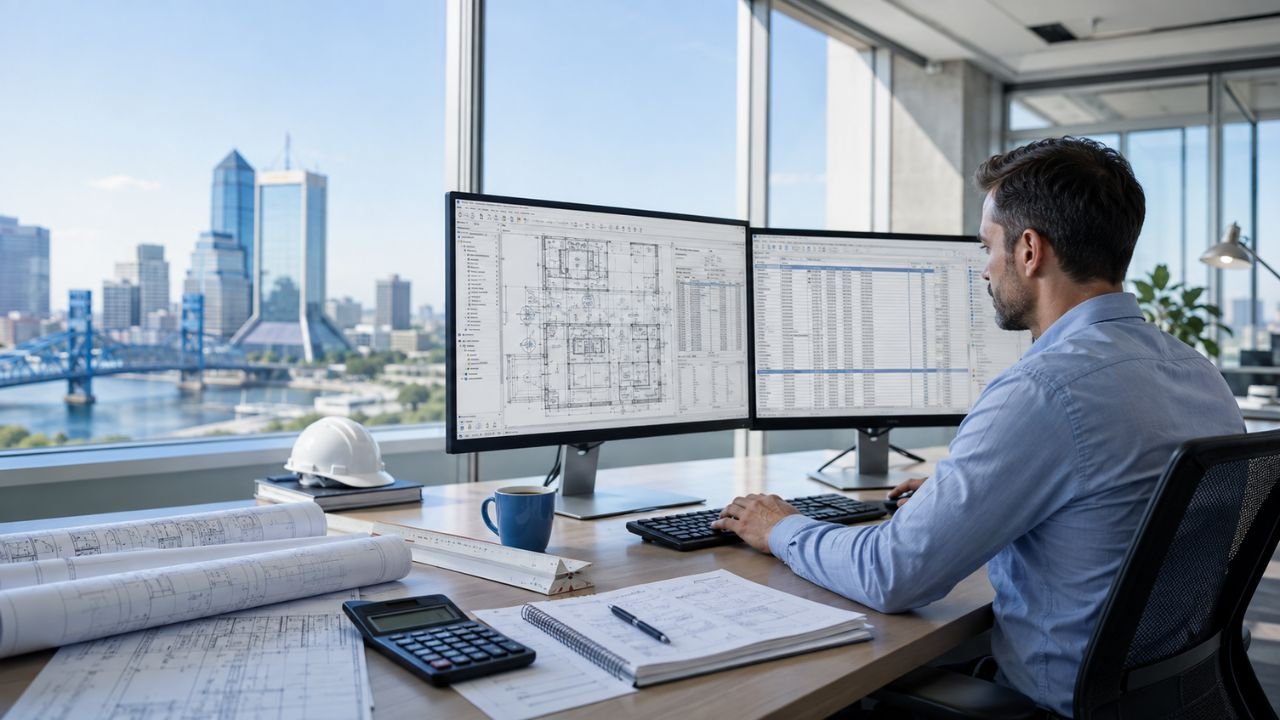
Electrical estimating is the process of calculating the total material, labor, and equipment cost required to complete the electrical scope of a construction project — before a single wire is pulled. It’s a distinct discipline from general construction estimating because electrical systems involve their own code requirements, material categories, and labor productivity rates.
A complete electrical estimate typically includes:
- Electrical quantity takeoffs — counting and measuring every item shown on the electrical drawings, from receptacles and switches to conduit runs and cable tray.
- Material takeoffs — pricing every component needed to complete the installation, from wire and conduit to panels, breakers, and fixtures.
- Labor calculations — estimating installation hours based on industry-standard labor units, crew productivity, and project conditions.
- Equipment pricing — costing out switchgear, transformers, generators, and other major electrical equipment.
- Bid preparation — assembling the takeoff and pricing into a clear, submittable bid package.
- Budget planning — providing early-stage cost projections before drawings are complete.
- Cost forecasting — anticipating how material and labor costs may shift over the life of a project.
- Value engineering — identifying alternative materials or methods that reduce cost without compromising performance or code compliance.
Professional electrical estimating matters because the margin for error in electrical work is small. Under-counting a run of branch circuits, missing a fire alarm device count, or using outdated material pricing can erase profit on an otherwise well-run job. An experienced estimator catches these details before the bid goes out — not after the contract is signed.
Our Electrical Estimating Services
Electrical Quantity Takeoff
A detailed, itemized count of every electrical component shown on the drawings — devices, fixtures, conduit, wire, panels, and equipment — organized by area, system, and CSI division so it’s easy to review and cross-check against the drawings.
Electrical Material Takeoff
Material takeoffs price out everything the quantity takeoff identifies, using current supplier pricing where available so contractors aren’t bidding against yesterday’s numbers.
Bid Estimates
A complete, bid-ready cost estimate built for submission on competitively bid projects, formatted to match how general contractors and owners expect to see electrical pricing broken down.
Budget Estimates
Early, conceptual-stage cost projections for owners, developers, and design teams who need a realistic number before drawings are finished.
Design Estimates
Estimates prepared at various design stages — schematic, design development, and construction documents — so cost stays visible as the project evolves.
Design-Build Estimates
Support for design-build delivery, where the electrical estimate needs to track alongside design decisions rather than a single fixed drawing set.
Design-Assist Estimates
Collaborative estimating for design-assist delivery, helping contractors provide meaningful cost input while the design team is still finalizing scope.
Change Order Estimates
Fast, accurate pricing for scope changes that come up mid-project, so contractors aren’t guessing at change order value under deadline pressure.
Value Engineering
Identifying opportunities to substitute materials, adjust methods, or refine scope to bring a project within budget without sacrificing code compliance or performance.
Cost Management
Ongoing cost tracking support that helps contractors stay ahead of budget throughout construction rather than discovering overruns at closeout.
Budget Control
Structured cost oversight that flags variances early, giving project teams time to react before small overages become large ones.
Residential Electrical Estimating
Residential electrical scope looks straightforward on paper, but the details matter just as much as they do on a commercial job. Estimate Florida provides electrical estimating for:
- Single-family homes
- Custom homes
- Luxury homes
- Apartments
- Condominiums
- Townhomes
- Home renovations
- Home additions
- Multifamily projects
An accurate residential electrical estimate accounts for panel sizing, branch circuiting, service entrance requirements, lighting packages, and any low-voltage or smart-home wiring specified. For renovation and addition work, the estimate also has to account for tie-ins to existing systems, which is often where unexpected costs show up if it isn’t scoped carefully.
Change orders are one of the biggest profit killers on residential electrical work, and most of them trace back to items that were missed or under-scoped at the estimating stage — a fixture allowance that didn’t match the spec, a subpanel that wasn’t accounted for, or a run length that was eyeballed instead of measured. A careful, itemized takeoff at the front end reduces how often those gaps show up mid-build.
Commercial Electrical Estimating
Commercial electrical projects carry more system complexity, more code requirements, and more coordination with other trades. Estimate Florida’s commercial electrical estimating covers:
- Office buildings
- Hospitals
- Hotels
- Restaurants
- Retail stores
- Shopping centers
- Schools
- Universities
- Warehouses
- Industrial facilities
- Mixed-use developments
Each building type carries its own electrical demands. A hospital estimate has to account for emergency power, isolated power systems, and life-safety branch circuiting. A warehouse estimate is often driven by lighting layout, power distribution to equipment, and EV charging infrastructure for fleet vehicles. A hotel involves guest room circuiting, low-voltage systems, and life-safety devices across dozens or hundreds of repeated units. Estimate Florida’s estimators build each takeoff around the specific systems and code requirements that apply to the building type, rather than applying a generic template across every project.
Electrical Systems We Estimate
| System Category | What’s Included |
| Power Distribution Systems | Feeders, branch circuits, switchboards, distribution panels |
| Lighting Systems | Interior, exterior, emergency, and site lighting |
| Emergency Power | Life-safety branch circuiting, automatic transfer switches |
| Generator Systems | Standby and emergency generators, fuel systems, ATS coordination |
| Switchgear | Medium- and low-voltage switchgear |
| Transformers | Dry-type and liquid-filled transformers |
| Panelboards | Distribution and lighting panelboards |
| Conduit & Raceway Systems | EMT, rigid, PVC, cable tray |
| Wiring | Branch circuit wiring, feeders, service conductors |
| Fire Alarm Systems | Devices, panels, notification appliances |
| Security Systems | Cameras, intrusion detection, access panels |
| Data & Communications | Structured cabling, network infrastructure |
| Low Voltage Systems | Nurse call, intercom, paging, AV rough-in |
| Access Control Systems | Card readers, electric locks, controllers |
| EV Charging Stations | Level 2 and DC fast charging infrastructure |
| Solar Electrical Systems | PV rough-in, inverters, interconnection equipment |
All estimates reference applicable NEC (National Electrical Code) requirements to make sure quantities and system design assumptions align with what will actually pass inspection.
Why Choose Estimate Florida?
- Experienced electrical estimators who understand both the trade and the estimating process, not just how to run takeoff software.
- Accurate quantity takeoffs built directly from your drawings and specifications, cross-checked before delivery.
- Fast turnaround times so estimates are ready in time for your bid deadline, not after it.
- Detailed, bid-ready reports formatted for direct submission or easy internal review.
- Competitive, transparent pricing with no hidden fees.
- Florida construction expertise, including familiarity with Jacksonville-area permitting and code considerations.
- Industry-standard estimating software paired with experienced human review of every estimate.
- Confidential project handling for sensitive bid information and drawing sets.
- Responsive customer support throughout the estimating process.
Electrical Estimating Software We Use
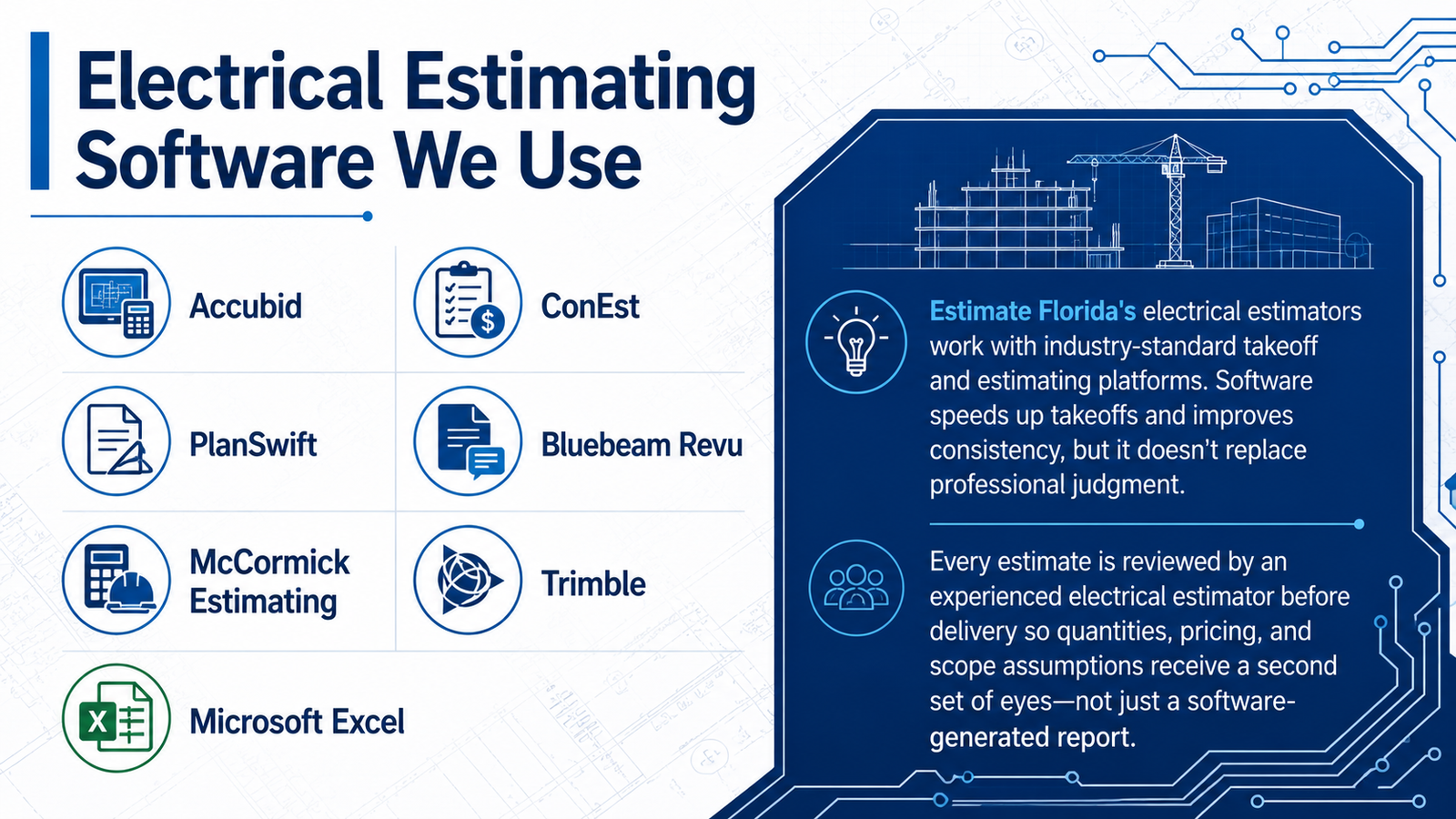
Estimate Florida’s electrical estimators work with industry-standard takeoff and estimating platforms, including:
- Accubid
- ConEst
- PlanSwift
- Bluebeam Revu
- McCormick Estimating
- Trimble
- Microsoft Excel
Software speeds up the takeoff process and improves consistency, but it doesn’t replace judgment. Every estimate that comes out of Estimate Florida is reviewed by an experienced electrical estimator before it’s delivered, so quantities, pricing, and scope assumptions all get a second set of eyes — not just a software-generated report.
Industries We Serve
- Residential
- Commercial
- Industrial
- Healthcare
- Government
- Hospitality
- Education
- Retail
- Manufacturing
- Infrastructure
Benefits of Professional Electrical Estimating
- More accurate bids based on a complete, verified takeoff instead of a rough count.
- Better bid-win ratio from pricing that’s competitive without leaving money on the table.
- Reduced estimating time for in-house teams who need to focus on active projects, not bid prep.
- Improved budgeting for owners and developers planning early-stage projects.
- Lower financial risk from catching scope gaps before the contract is signed.
- Reduced material waste through accurate, right-sized material takeoffs.
- Better cost control throughout construction, not just at the bid stage.
- Increased profitability from bids that are priced to protect margin from day one.
Our Electrical Estimating Process
- Receive electrical drawings and specifications. Send over your plan set, specs, and any addenda — PDF, CAD, or hard copy.
- Review project scope. Our estimators review the full scope, note any ambiguities, and flag questions before starting the takeoff.
- Complete electrical quantity takeoffs. Every device, fixture, run, and piece of equipment is counted and measured directly from the drawings.
- Apply labor and material pricing. Current material pricing and industry-standard labor units are applied to the takeoff.
- Perform quality assurance review. A second review checks the estimate for accuracy, completeness, and consistency before it’s finalized.
- Deliver the final estimate. You receive a bid-ready report, formatted and organized for submission or internal review.
Areas We Serve Around Jacksonville
Estimate Florida provides electrical estimating services throughout the greater Jacksonville area, including Jacksonville Beach, Atlantic Beach, Neptune Beach, Orange Park, Fleming Island, Ponte Vedra Beach, St. Johns, Yulee, Fernandina Beach, Amelia Island, Middleburg, and Green Cove Springs — as well as projects located anywhere else in Florida.
Frequently Asked Questions
- What is included in an electrical estimating service? An electrical estimate typically includes a full quantity takeoff, material pricing, labor calculations, and a bid-ready cost report covering all electrical systems shown on the drawings.
- How much does electrical estimating cost in Jacksonville? Pricing depends on project size, scope complexity, and system count. Estimate Florida provides flat-fee, project-based pricing after reviewing your drawings.
- How long does it take to receive an electrical estimate? Turnaround time depends on project size and complexity, but Estimate Florida works to deliver estimates within your bid deadline whenever possible.
- Do you estimate both residential and commercial electrical projects? Yes. Estimate Florida provides electrical estimating for residential, commercial, industrial, and institutional projects throughout Jacksonville and the rest of Florida.
- What file formats do you accept for drawings? PDF and CAD files are preferred, but Estimate Florida can also work from scanned or hard-copy drawing sets when needed.
- Do you provide material takeoffs separately from full estimates? Yes. Material takeoffs can be provided on their own or as part of a complete bid estimate, depending on what you need.
- Can you estimate change orders on projects already under construction? Yes. Estimate Florida provides change order estimating for projects currently in construction, with fast turnaround to keep your schedule on track.
- What estimating software do you use? Our estimators work with Accubid, ConEst, PlanSwift, Bluebeam Revu, McCormick Estimating, Trimble, and Microsoft Excel, depending on the project.
- Do you estimate low-voltage and fire alarm systems? Yes. Estimates can include low-voltage systems, fire alarm, security, data and communications, and access control alongside standard power and lighting scope.
- Is my project information kept confidential? Yes. All drawings, specifications, and project details are handled confidentially throughout the estimating process.
- Do you serve areas outside of Jacksonville? Yes. In addition to Jacksonville and the surrounding areas, Estimate Florida provides electrical estimating services throughout Florida.
- What’s the difference between a budget estimate and a bid estimate? A budget estimate is an early, conceptual cost projection used for planning purposes, while a bid estimate is a detailed, final number prepared for competitive bid submission.
- Do you work with general contractors or only electrical subcontractors? Both. Estimate Florida works with electrical contractors, subcontractors, general contractors, developers, architects, engineers, and property owners.
- What factors affect the accuracy of an electrical estimate? Accuracy depends on the completeness of the drawings and specifications provided, as well as current material pricing and labor rates at the time the estimate is prepared.
- How do I get started with a free quote? Send your electrical drawings and project details through our contact page, and our team will follow up to discuss scope, timeline, and pricing.
Key Takeaways
- Electrical estimating includes quantity takeoffs, material pricing, labor calculations, and bid preparation.
- Estimate Florida serves residential, commercial, industrial, and institutional electrical projects throughout Jacksonville and Florida.
- Estimates cover power distribution, lighting, fire alarm, security, low voltage, EV charging, solar, and more.
- Industry-standard software (Accubid, ConEst, PlanSwift, Bluebeam, McCormick, Trimble, Excel) is paired with experienced estimator review.
- Electrical construction costs vary based on project scope, systems required, labor rates, material pricing, code requirements, and market conditions.
- Professional estimating improves bid accuracy, reduces change orders, and supports better project profitability.
Conclusion
Winning electrical bids in Jacksonville takes more than a fast turnaround — it takes numbers you can trust. Whether you’re an electrical contractor preparing a competitive bid, a general contractor coordinating multiple trades, or a developer planning an early-stage budget, a detailed and accurate electrical estimate is what stands between a profitable project and a costly guess.
Estimate Florida provides electrical estimating services in Jacksonville built around detailed quantity takeoffs, current material pricing, and estimator-reviewed accuracy — delivered in a bid-ready format you can submit with confidence. Contact Estimate Florida today for a free quote on your next Jacksonville electrical project.