For Florida property owners and contractors, severe weather is not an “if” but a “when.” From the high-velocity hurricane zones of Miami-Dade to the sudden, intense hailstorms of Central Florida, the structural integrity of a roof is constantly under siege. When a major weather event strikes, obtaining a professional Roof Storm Damage Estimate Florida becomes the critical first step in the recovery and rebuilding process. However, a simple visual inspection is rarely enough to provide a defensible budget for complex restoration projects.
Accurate construction estimating and detailed quantity takeoffs are essential to ensure that every square foot of underlayment, every linear foot of flashing, and every bundle of shingles is accounted for before work begins. This guide explores the complexities of estimating roofing costs following storm damage in Florida, the specific factors that influence project pricing, and how professional quantity takeoff services support successful project planning and bid preparation for residential and commercial roofing scopes.
What Is a Roof Storm Damage Estimate in Florida?
A roof storm damage estimate is a professional projection of the total costs required to return a roof to its pre-storm condition or to replace it entirely in accordance with current Florida Building Codes. Unlike a quick “ballpark” price given by a salesperson, a professional construction estimate is a data-driven document. It relies on precise measurements and a detailed breakdown of materials, labor, equipment, and overhead.
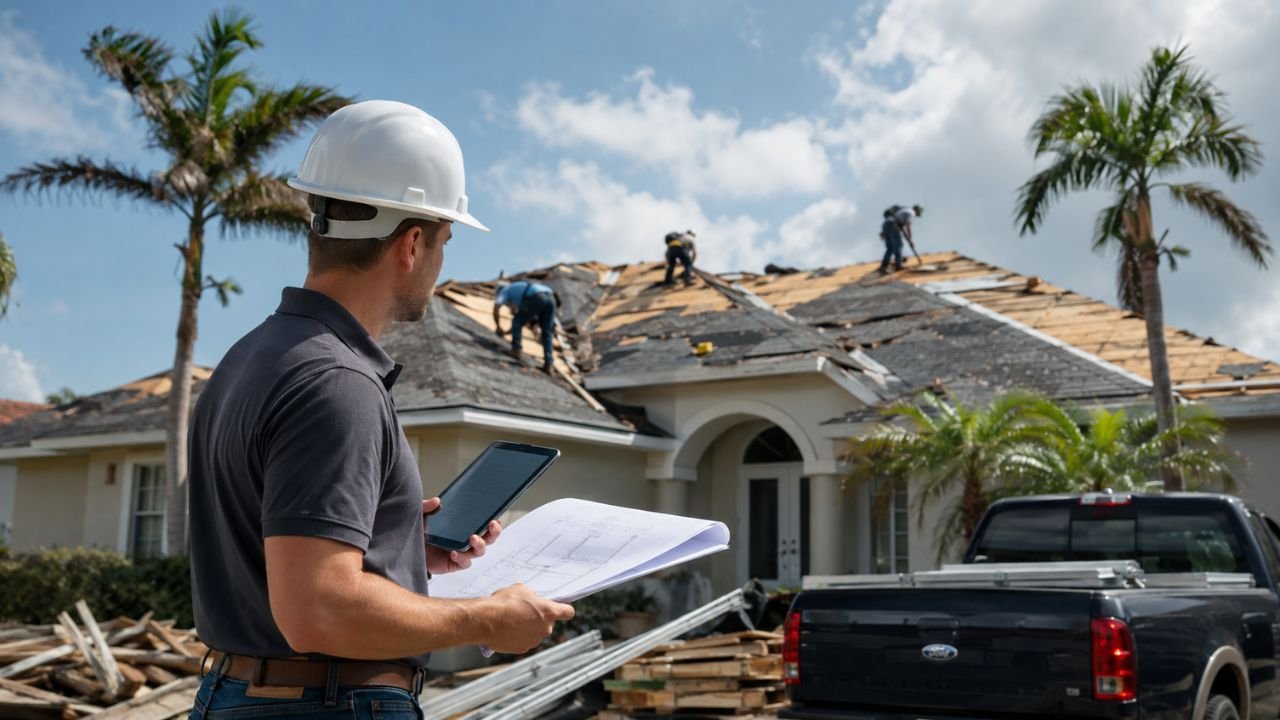
In the Florida market, these estimates are used by general contractors to prepare bids, by developers to budget for large-scale renovations, and by property owners to understand the financial scope of their repairs. A comprehensive estimate bridges the gap between identifying visible damage and understanding the actual logistical requirements of the construction project. It provides a roadmap for material procurement and project scheduling, ensuring that the project remains financially viable from start to finish.
Why Accurate Roof Storm Damage Estimates Matter in Florida
Florida’s exposure to extreme weather is unique in the United States. The state’s building codes are among the most stringent in the world, particularly regarding wind resistance and water intrusion. An inaccurate estimate doesn’t just lead to budget overruns; it can result in project delays or non-compliance with local building authorities.
- Wind and Hurricane Loads: Florida roofs must be estimated to withstand specific wind speeds, which often require specialized fasteners, reinforced underlayments, and specific installation patterns that increase labor and material quantities.
- The 25% Rule: According to the Florida Building Code, if more than 25% of a roof section is damaged or being repaired within a 12-month period, the entire roof section may need to be replaced to meet current code requirements. An accurate estimate is the only way to determine if this threshold has been met.
- Material Planning: In the wake of a major storm, material supply chains often tighten. Knowing exactly how much material is needed through a professional quantity takeoff allows for early ordering and prevents costly mid-project shortages.
- Project Planning: For commercial property managers or multi-family developers, accurate estimates are necessary for fiduciary responsibility and long-term capital planning.
Common Types of Storm Damage to Florida Roofs
Different weather events produce different types of structural failure. Understanding these helps in developing a more precise storm damage roofing estimate.
Wind Damage
High winds can create “uplift” pressure, which can peel back shingles, lift metal panels, or loosen tile attachments. Estimating wind damage requires looking beyond the missing materials; one must also account for the damage to the underlying decking and the compromise of the secondary water barrier.
Hurricane Damage
Hurricanes combine sustained high winds with massive amounts of rain. This often leads to structural damage from flying debris and catastrophic water intrusion. Estimates for hurricane damage frequently involve “tear-off” and replacement of the entire roofing system, including insulation and structural components on commercial buildings.
Hail Damage
While less frequent than wind, hail can devastate roofing materials. On asphalt shingles, it causes granule loss and bruising; on metal, it causes denting; and on tile, it can lead to fractures. Because hail damage is often widespread but subtle, a detailed material takeoff is necessary to quantify the total affected area.
Heavy Rain and Water Damage
Florida’s tropical downpours can find the smallest weakness in a roof. If a storm compromises the flashing or the ridge caps, water can saturate the insulation and damage the interior of the building. Estimating these repairs must include the “soft costs” of moisture detection and related interior restoration.
Falling Tree and Debris Damage
Large storms often result in impact damage from falling limbs or wind-borne debris. These estimates are highly specific and often require a structural review to ensure the roof trusses have not been compromised along with the roofing membrane.
Common Storm Damage Types and Estimating Considerations
| Storm/Damage Type | Common Roof Impact | Typical Estimating Considerations |
|---|---|---|
| High Winds | Shingle blow-offs, lifted flashing, loosened tiles. | Fastener patterns, adhesive requirements, decking inspection. |
| Hurricane | Structural failure, widespread membrane loss. | Full tear-off, disposal fees, HVHZ code compliance. |
| Hail | Granule loss, fractured tiles, dented metal. | Square footage of impact, ridge cap replacement. |
| Heavy Rain | Underlayment failure, saturated insulation. | Interior repairs, moisture barriers, flashing seals. |
| Debris Impact | Punctures, truss damage, crushed drainage. | Structural repair, localized decking replacement. |
What Is Included in a Roof Storm Damage Estimate?
A professional estimate is far more than a single line item for “roof replacement.” It is an itemized inventory of every component required for the project. Key components include:
- Roof Area and Complexity: Measured in “squares” (100 square feet), accounting for the pitch (slope) and the number of valleys, hips, and ridges.
- Primary Roofing Material: Whether shingles, tiles, metal panels, or a flat roof membrane (TPO/PVC).
- Underlayment: Specifically, the type required by Florida code, such as “peel and stick” secondary water barriers.
- Flashing and Drip Edge: Critical for preventing water intrusion at the edges and transitions.
- Accessories: Pipe boots, vents (off-ridge or ridge vents), and bird stops for tile roofs.
- Logistics and Labor: This includes the “tear-off” of the old roof, disposal of debris (dumpster fees), and the specialized labor required for the specific material type.
- Permitting and Inspections: Costs associated with local Florida building department requirements.
How Professionals Calculate Roof Storm Damage
The process of creating a Roof Storm Damage Estimate Florida follows a systematic approach to ensure no costs are overlooked.
- Project Review: Estimators review available project data, which may include architectural drawings, site measurements, or high-resolution damage photographs.
- Dimension Analysis: Using digital takeoff software, the estimator determines the exact geometry of the roof, including the area of every slope.
- Quantity Calculation: Every material component is quantified. For example, the total linear footage of the ridge determines the number of ridge caps needed.
- Waste Factor Application: Professionals apply a “waste factor” (typically 10-15% depending on complexity) to ensure enough material is ordered for cuts and overlaps.
- Labor and Market Pricing: Current Florida labor rates and material prices are applied. These rates vary significantly between regions like Miami and Jacksonville.
- Final Report Generation: The data is compiled into a formatted report, often organized by CSI MasterFormat, for clarity and professional presentation.
Factors That Affect Roof Storm Damage Estimate Costs in Florida
No two roofing projects are identical. Several variables can cause a Florida roof damage estimate to fluctuate:
- Roof Pitch: Steeper roofs require more safety equipment and specialized labor, increasing the cost per square.
- Accessibility: A three-story commercial building with limited parking access will have higher staging and equipment costs than a single-story residence.
- Material Type: The cost of clay tile is significantly higher than asphalt shingles, both in terms of material price and the labor required for installation.
- Code Compliance: Projects in the High-Velocity Hurricane Zone (HVHZ) must meet stricter standards, often requiring more expensive materials and more frequent inspections.
- Current Market Conditions: The price of petroleum-based products (shingles) and metals can change weekly based on global supply chains.
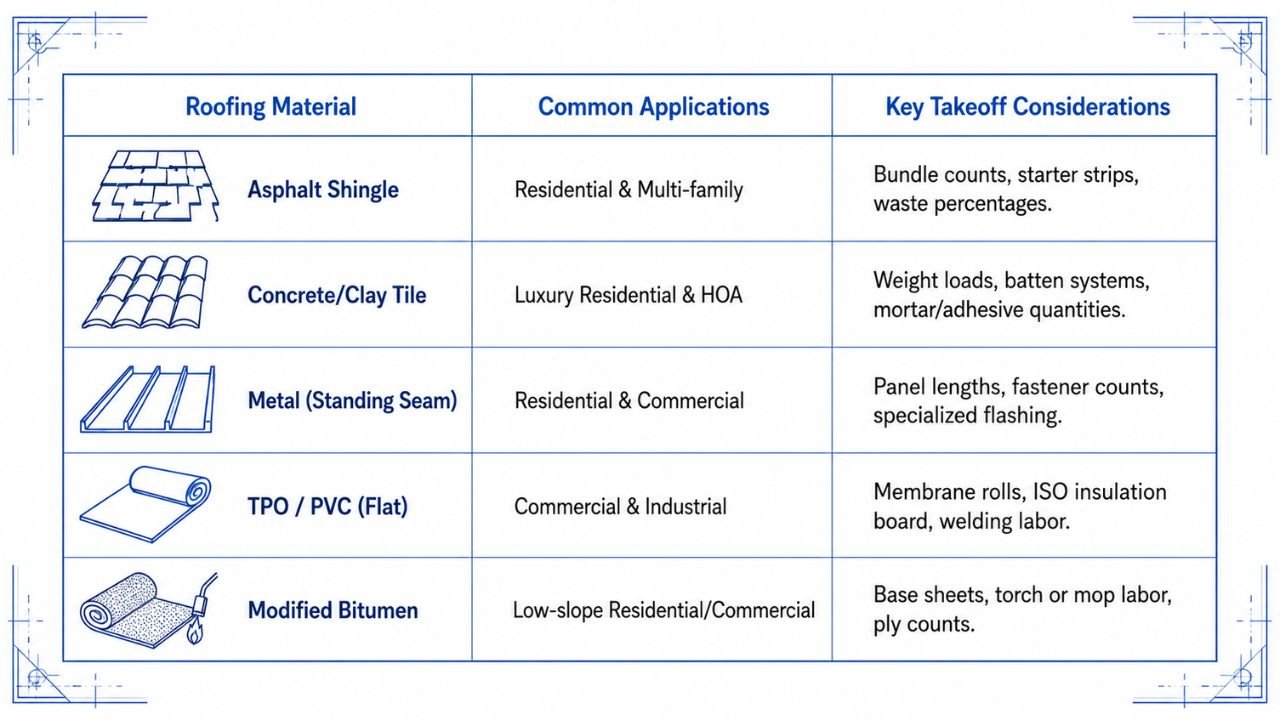
Roofing Material and Estimating Factors
| Roofing Material | Common Applications | Key Takeoff Considerations |
|---|---|---|
| Asphalt Shingle | Residential & Multi-family | Bundle counts, starter strips, waste percentages. |
| Concrete/Clay Tile | Luxury Residential & HOA | Weight loads, batten systems, mortar/adhesive quantities. |
| Metal (Standing Seam) | Residential & Commercial | Panel lengths, fastener counts, specialized flashing. |
| TPO / PVC (Flat) | Commercial & Industrial | Membrane rolls, insulation board (ISO), welding labor. |
| Modified Bitumen | Low-slope Residential/Comm | Base sheets, torch or mop labor, ply counts. |
Roof Repair Estimate vs. Roof Replacement Estimate
One of the most frequent questions is whether a roof can be repaired or if it must be replaced. An estimate for a roof repair estimate Florida focuses on localized damage, such as a few missing shingles or a leak at a chimney flashing.
Conversely, a roof replacement estimate Florida covers the removal of all existing materials down to the deck. The decision often hinges on the age of the roof and the extent of the damage. In Florida, if a roof is nearing the end of its functional life (e.g., 15-20 years for shingles), a storm often makes a full replacement the more cost-effective long-term solution. A professional estimator provides the data needed to make this distinction, quantifying the “cost of repair” versus the “value of replacement.”
Residential vs. Commercial Roof Storm Damage Estimates
While the principles of estimating remain the same, the scale and complexity differ greatly between sectors.
- Residential Roofing: Estimates focus on aesthetics, shingle/tile types, and residential-scale logistics. The goal is often speed and minimizing disruption to the homeowner.
- Commercial Roofing: These estimates involve large-scale flat roof systems, significant drainage considerations (tapered insulation), and complex equipment requirements (cranes, safety rails). Documentation for commercial projects is often more extensive, requiring detailed cost-coding for corporate budgeting.
What Is a Roofing Quantity Takeoff?
A quantity takeoff is the core of any accurate estimate. It is the process of “taking off” the measurements from a set of plans or a physical roof to determine the exact amount of material needed.
Instead of saying “the roof looks like it needs about 30 squares,” a professional quantity takeoff provider will measure the exact square footage, add the linear footage of eaves, rakes, hips, and valleys, and calculate the precise number of bundles, rolls, and accessories. This precision prevents “over-ordering,” which wastes money, and “under-ordering,” which stops production and increases labor costs.
How Florida Location Can Affect Roofing Estimates
Labor and material markets are hyper-local. A roofing cost estimate Florida will look different depending on the city:
- Miami and Fort Lauderdale: Higher labor rates and strict HVHZ requirements often lead to higher overall project costs.
- Orlando and Tampa: These markets are highly competitive, but logistics can be impacted by heavy traffic and inland storm patterns.
- Jacksonville and the Panhandle: Coastal vs. inland differences are significant here, with different wind speed requirements affecting material choices.
- Naples and Sarasota: High-end materials (tile and metal) are more common, shifting the focus of the takeoff toward specialized accessories.
Common Mistakes When Estimating Storm-Damaged Roofs
- Using “Rule of Thumb” Pricing: National averages don’t work for Florida’s specific code environment.
- Ignoring the Waste Factor: Failing to account for the material lost during cutting leads to shortages.
- Missing Accessories: Forgetting the drip edge, flashing, or specialized fasteners can lead to “change order” friction later.
- Underestimating Labor: Storm restoration often requires more labor for the “tear-off” and cleaning of the site than a standard new-build project.
- Ignoring Building Code Updates: Estimates must account for modern code requirements, even if the original roof was built to an older standard.
Roof Storm Damage Estimate Florida: How Estimate Florida Can Help
Estimate Florida provides professional construction estimating and quantity takeoff services for roofing projects throughout the state. We specialize in transforming complex roof damage data into clear, itemized estimates that contractors and property owners can trust.
Our services include:
- Roofing Quantity Takeoffs: Precise measurements for shingles, tile, metal, and flat roof systems.
- Material Takeoffs: Detailed lists of all components, from underlayment to fasteners.
- Construction Cost Estimates: Comprehensive reports including labor, equipment, and overhead.
- Bid Estimates: Professional documentation to help contractors submit competitive, accurate bids.
- Budget Planning: Helping developers and owners understand the financial scope of storm restoration.
By utilizing professional estimating services, you gain a clear view of your project’s financial requirements, reducing the risk of unexpected costs and ensuring your Florida roofing project is built on a foundation of accurate data.
Frequently Asked Questions
- What is a roof storm damage estimate in Florida?
It is a detailed projection of all costs (materials, labor, and overhead) required to repair or replace a roof damaged by weather events, calculated in accordance with the Florida Building Code. - How is roof storm damage measured?
Professionals use a combination of physical measurements, digital drawings, and aerial imagery to calculate the square footage (area), pitch (slope), and linear footage of all roof transitions. - Does roof material affect storm damage costs?
Yes. Tile and metal roofs generally have higher material and labor costs than asphalt shingles. The type of material also dictates the type of underlayment and fasteners required by code. - What is included in a roofing quantity takeoff?
A takeoff includes the exact count of all materials needed, such as squares of roofing membrane, linear feet of flashing, number of vents, bundles of shingles, and the required amount of fasteners and adhesives. - How long does it take to prepare a roof damage estimate?
While simple residential estimates can be turned around quickly, complex commercial or large-scale residential takeoffs typically take 24 to 48 hours to ensure every detail is captured. - Can a roof estimate be prepared from plans and photos?
Yes. Experienced estimators use high-resolution photos and architectural plans to perform digital takeoffs, though on-site verification of the roof deck condition is often recommended during the construction phase. - Why are Florida-specific costs important?
Florida has unique building codes (like HVHZ) and regional labor market fluctuations. Using national averages often leads to under-estimating the actual cost of compliance and local labor. - Can Estimate Florida provide roofing quantity takeoffs for commercial projects?
Yes. Estimate Florida provides detailed takeoffs for all scales of construction, from custom homes to large-scale industrial and commercial roofing systems. - What is the difference between a repair and a replacement estimate?
A repair estimate focuses on fixing specific, localized damage. A replacement estimate covers the full removal and installation of a new roofing system, often triggered by age or the “25% rule” in the Florida Building Code. - How much does a storm damage roof estimate cost?
The fee for a professional estimate or takeoff depends on the complexity and size of the roof. Estimate Florida provides flat-fee quotes based on the project scope provided.
Conclusion
Navigating the aftermath of a storm in Florida requires more than just a hammer and nails; it requires a precise understanding of the numbers. A Roof Storm Damage Estimate Florida serves as the essential link between a damaged property and a completed, code-compliant roof. By focusing on accurate quantity takeoffs and localized cost data, contractors can bid with confidence and property owners can plan their recovery with clarity. If you need a detailed roofing quantity takeoff or construction estimate for a Florida project, Estimate Florida can help you organize project quantities and cost information for better budgeting and bidding.