In Florida, the concrete slab under a new floor often decides whether the flooring lasts. Slab moisture can break down adhesives and lead to cupping, bubbling, lifting tiles, odors and failed warranties. This guide explains the two common moisture tests, ASTM F2170 and ASTM F1869, when to run them, and how to handle moisture in a flooring bid or budget.
Why slab moisture is a bigger issue in Florida
- Slabs on grade everywhere. Most Florida commercial buildings, apartments and homes sit on slabs on grade, with high water tables in many areas.
- Heat and humidity. New concrete dries slowly in humid air, and buildings are often not air-conditioned until late in construction.
- Tight schedules. Flooring is near the end of the job, when the schedule pressure is highest and the slab may not have had time to dry.
- Moisture-sensitive products. Glue-down LVT, sheet vinyl, carpet tile, wood and many adhesives have strict moisture limits set by the manufacturer.
ASTM F2170: in-situ relative humidity (RH) testing
F2170 measures relative humidity inside the slab using probes placed in drilled holes. It shows what moisture conditions the flooring will see once the floor is sealed over.
- Hole depth: typically 40% of slab thickness for a slab drying from the top only (such as a slab on grade), and 20% for a slab drying from both top and bottom.
- Timing: the building should be at service conditions (the temperature and humidity it will have in use) for at least 48 hours before testing, and readings are taken after the probe equilibrates. The current edition allows a 24-hour equilibration.
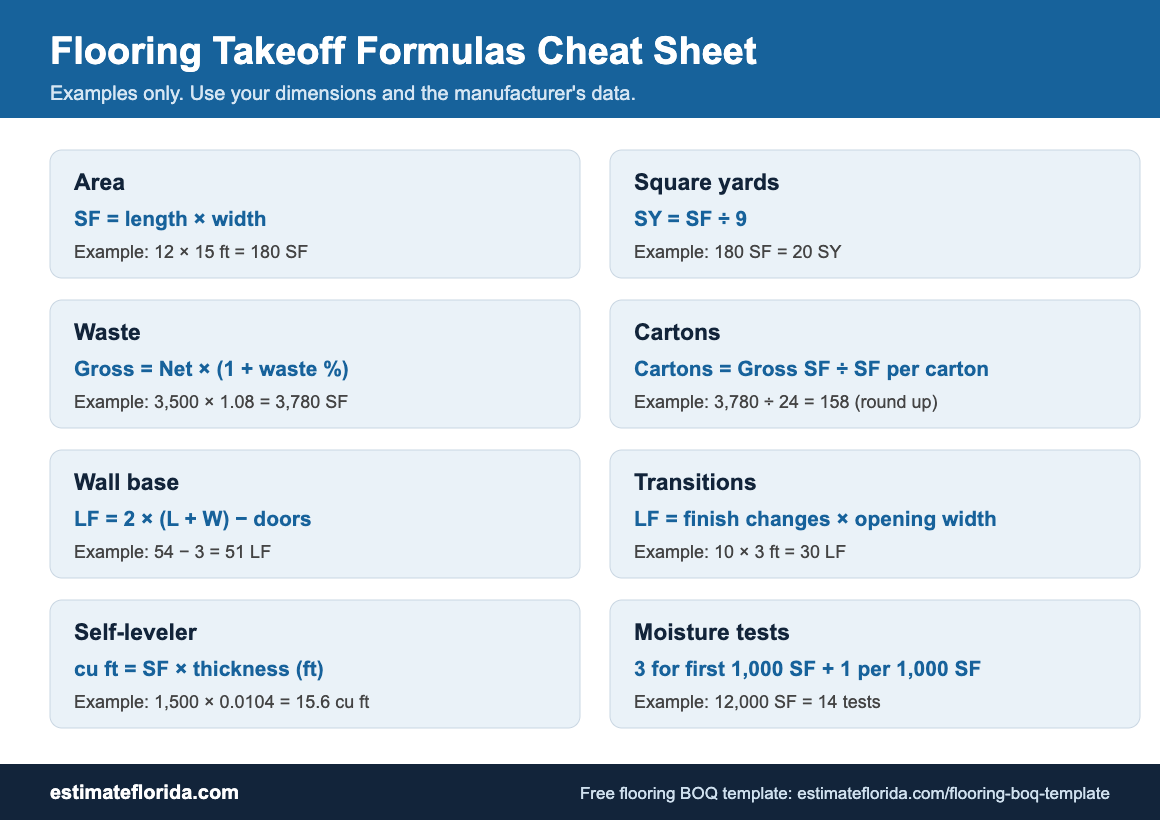
- Number of tests: three tests for the first 1,000 square feet, plus one more for each additional 1,000 square feet.
- Result: a percent RH, compared with the limit published by the flooring and adhesive manufacturer.
Many flooring and adhesive manufacturers now prefer or require RH testing.
ASTM F1869: calcium chloride (MVER) testing
F1869 places a dish of calcium chloride under a sealed dome on the slab surface for about 60 to 72 hours, then weighs how much moisture it absorbed. The result is a moisture vapor emission rate (MVER) in pounds per 1,000 square feet per 24 hours.
- It measures moisture coming off the surface, mainly from the top portion of the slab, so it says less about moisture deeper in the slab.
- It uses the same service-condition requirement and test count as F2170.
- Some manufacturers still list MVER limits; others accept only RH results. Check the product data and warranty for the exact products specified.
F2170 vs F1869 at a glance
| ASTM F2170 (RH probes) | ASTM F1869 (calcium chloride) | |
|---|---|---|
| What it measures | Relative humidity inside the slab | Moisture emitted from the surface |
| Result | % RH | lbs / 1,000 SF / 24 hrs |
| Test duration | Probe equilibration, 24 hours under the current edition | About 60 to 72 hours |
| Test count | 3 for the first 1,000 SF, +1 per additional 1,000 SF | Same |
| Manufacturer acceptance | Widely preferred | Accepted by some; check product data |
Other checks that matter before flooring
- Surface pH (alkalinity): many adhesives have pH limits. ASTM F710, the standard practice for preparing concrete floors to receive resilient flooring, covers pH testing and surface preparation.
- Flatness: large-format tile and plank products need a flat substrate, which may mean grinding or self-leveling underlayment.
- Existing adhesives and coatings: curing compounds, old adhesive and sealers can interfere with new adhesives and usually need removal.
- Vapor retarder under the slab: on new construction, whether a vapor retarder was placed under the slab affects long-term moisture. Ask the design team.
Who should do the testing
Testing should follow the ASTM method exactly, including the conditioning period, so results are valid for the manufacturer’s warranty. Many projects use an independent testing agency or a technician certified in slab moisture testing (for example, through the International Concrete Repair Institute’s slab moisture testing certification). Record the date, location, method, building conditions and results for each test. Our free scope sheet template includes a log for this.
What to do when the slab is too wet
- Wait and condition the building: running HVAC at service conditions lets the slab keep drying, if the schedule allows.
- Moisture-tolerant adhesive: some adhesives are rated for higher RH. Confirm the flooring manufacturer accepts the pairing.
- Moisture mitigation system: a coating, often epoxy-based, applied over the slab to control vapor before the flooring goes down. It adds material, labor and time.
- Change the flooring product: some floating or less moisture-sensitive products may suit the conditions. Check with the design team and owner.
How to handle moisture in a flooring bid or budget
Moisture is one of the biggest unknowns at bid time, because the slab usually can’t be tested until the building is conditioned. To keep it from becoming a dispute:
- Read the specs for the required test method, who performs and pays for testing, and the acceptance limits.
- Price testing as its own line if it’s in your scope.
- Carry mitigation as an alternate or a defined unit-price allowance if the documents don’t settle it, and say so in your exclusions.
- Owners and GCs: put the testing responsibility and timing in the schedule, so results come in before flooring starts.
For the full flooring bid process, see our commercial flooring takeoff checklist.
Need help with a flooring project?
- Estimating a flooring job? We take off flooring by finish code and carry prep, testing and mitigation as clear line items. Flat fee from $750 (large commercial projects from $1,400), usually in 24 to 48 hours. Get a flooring estimate.
- Need flooring installed? For commercial and multifamily projects, we can connect you with a flooring installation partner anywhere in Florida.
Frequently asked questions
What is the difference between ASTM F2170 and F1869?
F2170 measures relative humidity inside the slab with probes placed in drilled holes. F1869 measures the moisture vapor emission rate from the slab surface using calcium chloride under a sealed dome. Many manufacturers now prefer F2170 because it reflects conditions within the slab.
How many moisture tests are needed?
Both methods call for three tests in the first 1,000 square feet and one more for each additional 1,000 square feet.
When should slab moisture testing be done?
After the building has been at service conditions, meaning its normal operating temperature and humidity, for at least 48 hours. Testing earlier can give results that don’t reflect installation conditions.
What is an acceptable moisture level for flooring?
It depends on the flooring and adhesive. Use the limit published by the manufacturer for the exact products being installed, because warranties are tied to it.
Who pays for moisture mitigation?
It depends on the contract. If the documents don’t say, flooring bidders should carry it as an alternate or allowance and state it in their exclusions so the owner or GC can decide.
Sources
- ASTM International: F2170 (relative humidity in concrete floor slabs using in-situ probes), F1869 (moisture vapor emission rate of concrete subfloor using anhydrous calcium chloride) and F710 (preparing concrete floors to receive resilient flooring). Check the current edition of each standard and the product manufacturer’s requirements.
- International Concrete Repair Institute (ICRI), Concrete Slab Moisture Testing certification program