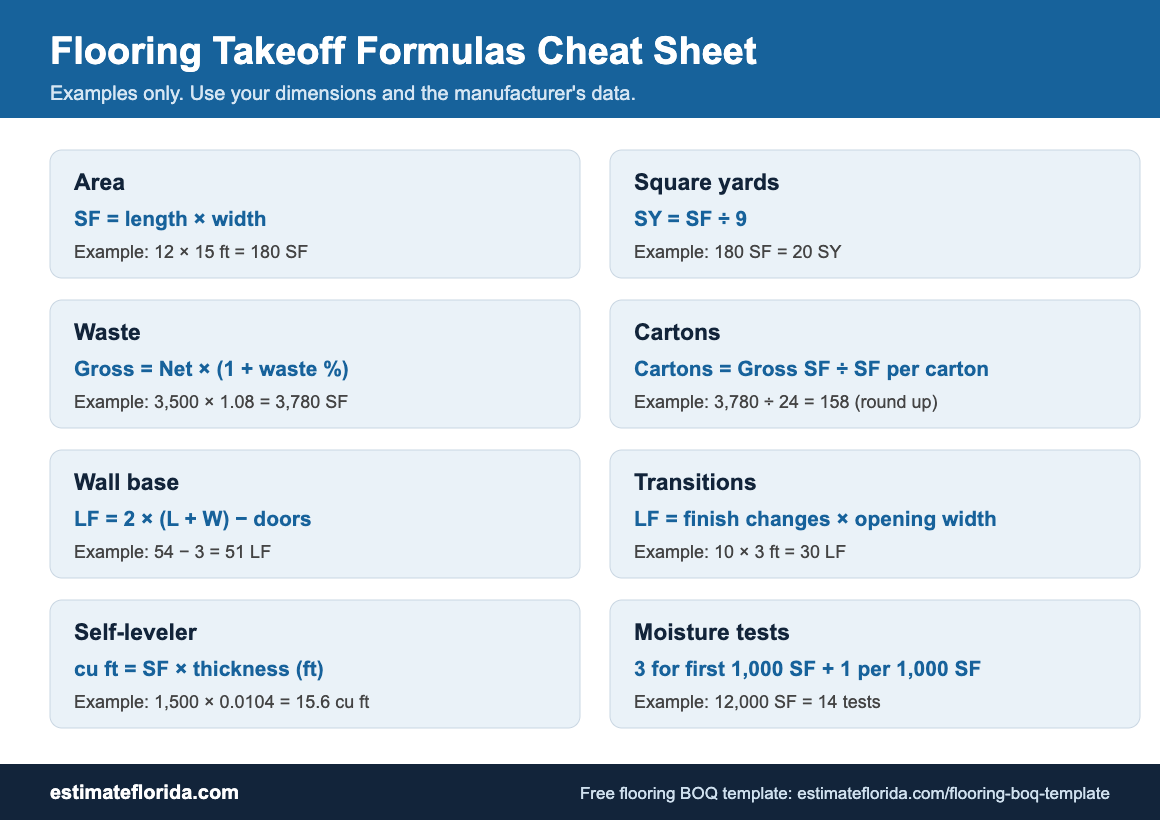
Every flooring BOQ starts with quantities, and quantities come from a few simple formulas. This guide covers the math flooring contractors and estimators use to turn drawings into square feet, square yards, cartons, linear feet and bags, with a worked example for each, a full example for a small office suite, and the mistakes that most often throw a takeoff off. All numbers below are examples to show the method; use your project’s dimensions and the manufacturer’s carton and yield data.
Before you measure: set up the drawings
- Check the scale. On PDFs, calibrate your takeoff software against a known dimension on each sheet. Sheets in the same set can use different scales, and enlarged plans often do.
- Use the finish plans, not the architectural floor plans. The finish plans and room finish schedule tell you what goes where.
- Color-code by finish code. Give each finish code its own color in your takeoff so missed rooms stand out.
- Measure net, add waste later. Record the net quantity first, then add waste and attic stock as separate steps so you can see and adjust them.
Unit conversions you’ll use
| Convert | Formula |
|---|---|
| Square feet to square yards | SF ÷ 9 |
| Square yards to square feet | SY × 9 |
| Square meters to square feet | m² × 10.764 |
| Square inches to square feet | sq in ÷ 144 |
| Inches to feet | in ÷ 12 (1/8 in = 0.0104 ft) |
| Cubic feet to cubic yards | cu ft ÷ 27 |
1. Floor area (square feet)
Area (SF) = length × width
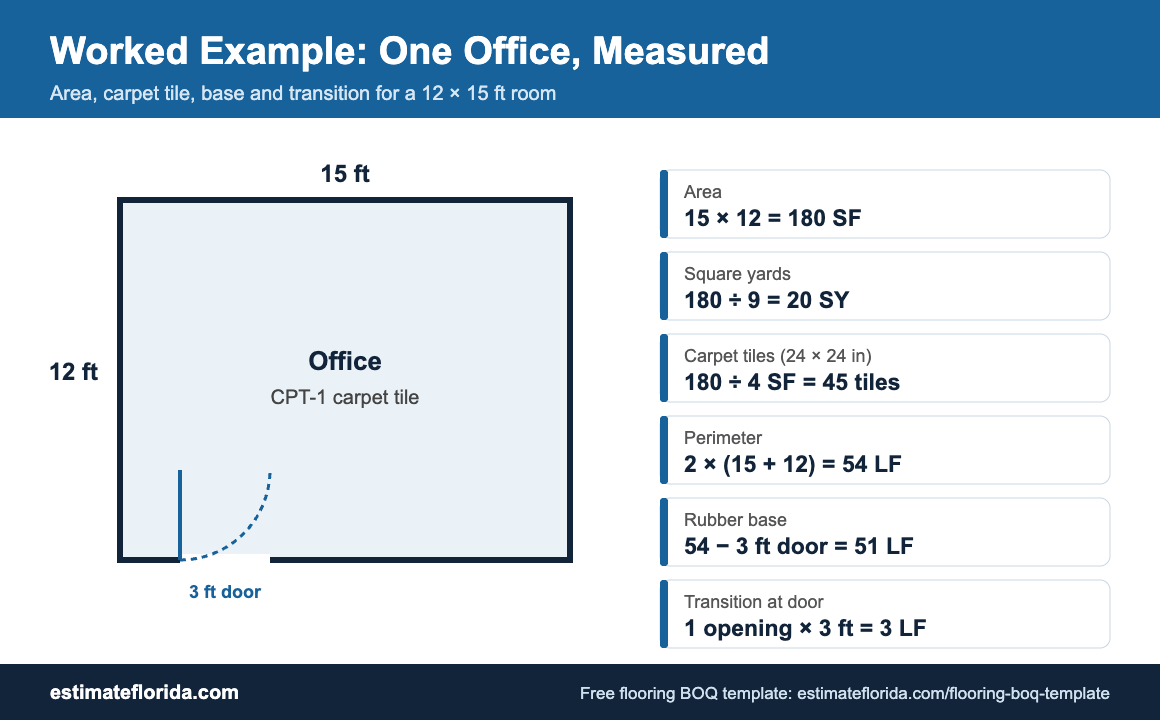
Split L-shaped or irregular rooms into rectangles and add them up. Example: a 12 ft × 15 ft office = 180 SF. Measure each finish code separately, and check whether flooring runs under casework or fixed equipment before you subtract those areas. For curved walls, approximate with several short straight segments or use the area tool in your takeoff software.
2. Square feet to square yards (carpet)
SY = SF ÷ 9
Carpet and carpet tile are usually priced by the square yard. Example: 180 SF ÷ 9 = 20 SY. Going the other way, 900 SY × 9 = 8,100 SF.
3. Carpet tile count and cartons
Tiles = area (SF) ÷ area of one tile (SF)
Cartons = tiles ÷ tiles per carton, rounded up
A 24 in × 24 in tile covers 4 SF; an 18 in × 36 in plank covers 4.5 SF. Example: 8,100 SF ÷ 4 = 2,025 tiles. If a carton holds 12 tiles, 2,025 ÷ 12 = 168.75, so order 169 cartons before waste. Always check the carton count on the product data sheet.
4. Waste
Gross quantity = net quantity × (1 + waste %)
Waste depends on room shapes, pattern, plank or tile size and layout direction, so set it per product and per job rather than using one number for everything. Things that push waste up include small or irregular rooms, diagonal or herringbone patterns, large-format tile and planks with a strong direction. Example with an assumed 8% waste on 3,500 SF of LVT: 3,500 × 1.08 = 3,780 SF.
5. LVP / LVT cartons
Cartons = gross SF ÷ SF per carton, rounded up
Example: 3,780 SF ÷ 24 SF per carton = 157.5, so 158 cartons. Use the carton coverage printed on the product data sheet, since it varies by product and plank size.
6. Broadloom carpet and sheet vinyl: lay out the rolls
Broadloom carpet and sheet vinyl come in rolls of fixed width, so the quantity depends on how the rolls are laid out, not just on floor area. Broadloom carpet is commonly 12 ft wide, and sheet vinyl rolls are often around 6 ft wide; check the product. Steps:
- Decide the roll direction for each room, following the specs and seam requirements.
- Divide the room width by the roll width and round up to get the number of drops.
- Multiply the number of drops by the room length plus trim allowance, and add pattern repeat where it applies.
- Convert the total to SY (carpet) or SF (vinyl).
Example: a 20 ft × 30 ft room with 12 ft carpet laid along the 30 ft length needs 20 ÷ 12 = 1.67, so 2 drops of 30 ft plus trim. Two drops × 12 ft × about 30.5 ft ≈ 732 SF ≈ 81 SY, compared with 600 SF (67 SY) of floor area.
7. Attic stock
Attic stock = installed quantity × spec %, rounded up to full cartons
Specs often require extra material handed over to the owner. Example: if the spec calls for 2% of 3,500 SF, that’s 70 SF. At 24 SF per carton, 70 ÷ 24 = 2.9, so carry 3 cartons. Check the spec; requirements vary.
8. Wall base (linear feet)
Base (LF) = room perimeter − door openings
Perimeter = 2 × (length + width). Example: the 12 × 15 office has a perimeter of 2 × (12 + 15) = 54 LF. Minus one 3 ft door = 51 LF. Add the faces of columns and returns, and measure integral cove the same way. Base usually comes in rolls or set lengths, so round up to full units when ordering.
9. Transitions
Transitions (LF) = number of finish changes at doorways × opening width
Count every doorway or opening where one flooring meets another. Example: 10 doorways × 3 ft = 30 LF. Wider openings and long runs where finishes meet in open areas need measuring separately. Check the transition type for each change, since a carpet-to-LVT reducer is different from a tile-to-LVT strip.
10. Self-leveling underlayment
Volume (cubic feet) = area (SF) × thickness (ft)
Bags = volume ÷ yield per bag, rounded up
1/8 in = 0.0104 ft. Example: 1,500 SF × 0.0104 = 15.6 cubic feet. If one bag yields 0.45 cubic feet, 15.6 ÷ 0.45 = 34.7, so 35 bags. Yields differ by product, so use the manufacturer’s figure. Average thickness is often hard to know before the slab is surveyed, so carrying leveling as an allowance is common.
11. Tile setting materials and grout
Bags of setting material = area ÷ coverage per bag for the trowel size used
Coverage depends on the trowel notch, tile size and substrate, and large-format tile often needs a larger trowel and more material. Grout quantity depends on tile size, joint width and tile thickness. Use the manufacturer’s coverage charts for both.
12. Stairs
Treads = steps per flight × number of flights; risers usually equal treads; landings are measured as area
Example: 2 stairs × 2 flights × 8 treads = 32 treads and 32 risers. Check whether treads have integral nosings or need separate nosings, and whether the specs call for contrasting visual strips.
13. Moisture tests
ASTM F2170 and F1869 both call for three tests in the first 1,000 SF plus one for each additional 1,000 SF. Example: a 12,000 SF floor = 3 + 11 = 14 tests (round up partial thousands). See our slab moisture testing guide.
Full worked example: small office suite
A 2,400 SF suite has six private offices of 12 × 15 ft (carpet tile), an open area and corridors of 1,000 SF (LVT) and a 320 SF break room (LVT). Example assumptions: 5% waste on carpet tile, 8% on LVT, 24 SF LVT cartons and 12-tile carpet cartons.
| Item | Calculation | Result |
|---|---|---|
| Carpet tile, net | 6 × 180 SF = 1,080 SF ÷ 9 | 120 SY |
| Carpet tile, gross | 1,080 × 1.05 = 1,134 SF ÷ 4 SF per tile = 283.5 tiles ÷ 12 | 24 cartons |
| LVT, net | 1,000 + 320 | 1,320 SF |
| LVT, gross | 1,320 × 1.08 = 1,425.6 SF ÷ 24 | 60 cartons |
| Base in offices | 6 × (54 − 3) | 306 LF |
| Transitions at offices | 6 doors × 3 ft | 18 LF |
| Moisture tests | 3 + 2 (for 2,400 SF) | 5 tests |
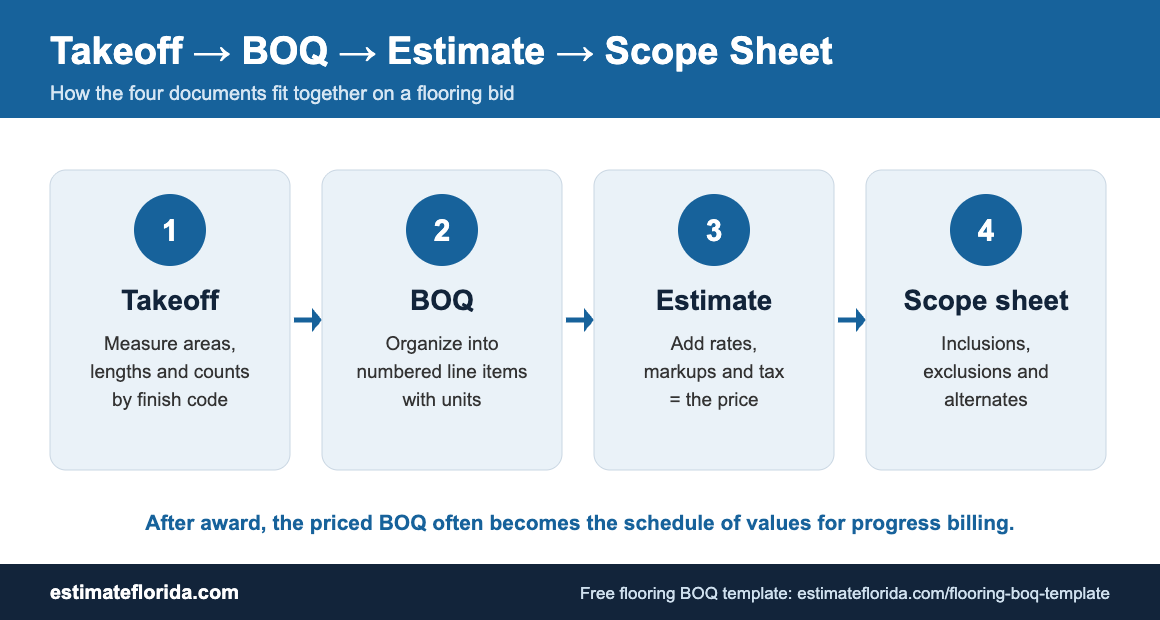
Put these into the free flooring BOQ template, add rates, and the template totals the job.
Rounding rules that save reorders
- Round up to full selling units at the end: cartons, rolls, bags, pails and base lengths. Never round down.
- Round each product separately. Rounding each room up and then adding the rooms overstates the quantity; add the rooms first, then round.
- Order one dye lot. For carpet tile, LVT and tile, ordering the full quantity plus attic stock at once helps keep color consistent.
- Keep the math visible. Show net quantity, waste %, gross quantity and units ordered in separate columns so anyone can check them.
Quick takeoff checklist
- Every room on the finish schedule has a finish code and a measured area.
- Carpet is in SY; other flooring in SF; base and transitions in LF.
- Waste is set per product and shown separately.
- Broadloom and sheet goods are based on a roll layout.
- Attic stock follows the specs.
- Prep, leveling and moisture tests are counted.
- Stairs, thresholds and mats are counted.
- Everything is rounded up to full selling units.
Common takeoff mistakes
- Measuring from the wrong scale, or a sheet that isn’t to scale.
- Missing closets, alcoves and small rooms.
- Using the floor plan instead of the finish plan.
- Applying one waste factor to every product.
- Pricing broadloom or sheet vinyl by floor area instead of roll layout.
- Forgetting base at columns and returns, or transitions at every finish change.
- Not rounding up to full cartons, rolls and bags.
Putting it into a BOQ
Once you have quantities, list them in the BOQ by section with clear descriptions and units, add rates, and total each section. Our guide on how to prepare a flooring BOQ walks through it, and the free flooring BOQ template does the math.
Need the takeoff done for you?
We take off flooring by finish code from your plans and deliver quantities and a priced BOQ. Flat fee from $750 (large commercial projects from $1,400), usually in 24 to 48 hours. Get a flooring takeoff quote.
Frequently asked questions
How do you convert square feet to square yards for carpet?
Divide square feet by 9. For example, 180 square feet is 20 square yards.
How do you calculate how many boxes of flooring you need?
Multiply the net area by one plus the waste percentage, then divide by the square feet per carton and round up. For example, 3,500 square feet with 8% waste is 3,780 square feet; at 24 square feet per carton that’s 158 cartons.
How do you calculate wall base?
Measure the room perimeter, which is two times length plus width, then subtract door openings and add column faces and returns.
How much self-leveler do I need?
Multiply the area by the thickness in feet to get cubic feet, then divide by the yield per bag from the manufacturer and round up.
Why does broadloom carpet need more material than the floor area?
Because it comes in fixed-width rolls. The number of drops is set by the room width and the roll width, and seams, trim and pattern repeat add more, so the order is usually larger than the floor area.