Choosing the best construction estimating software for small business in Florida comes down to three things: cost, ease of use, and how well the tool handles Florida-specific pricing and code requirements. Small contractors don’t have time to learn bloated enterprise platforms. They need something fast, affordable, and accurate enough to win bids without eating up a week of unbilled hours.
This guide breaks down the top options for 2026, compares them side by side, and explains when it actually makes more sense to skip the software entirely and hand your takeoffs to a professional estimating service instead.
- The best construction estimating software for small business in Florida typically costs between $50 and $400 per month, depending on features and number of users.
- Cloud-based, mobile-friendly tools work best for small teams juggling multiple job sites.
- Florida-specific factors — HVHZ wind requirements, hurricane strapping, county permitting fees — are rarely built into national software databases.
- Most small contractors underestimate the time cost of learning new software, not just the license fee.
- For one-off or highly technical estimates, outsourcing to a Florida-based estimating service is often cheaper than a software subscription plus staff hours.
- No single tool wins every category — your best fit depends on trade, project size, and how many estimates you run per month.
What Small Florida Construction Businesses Really Need From Estimating Software
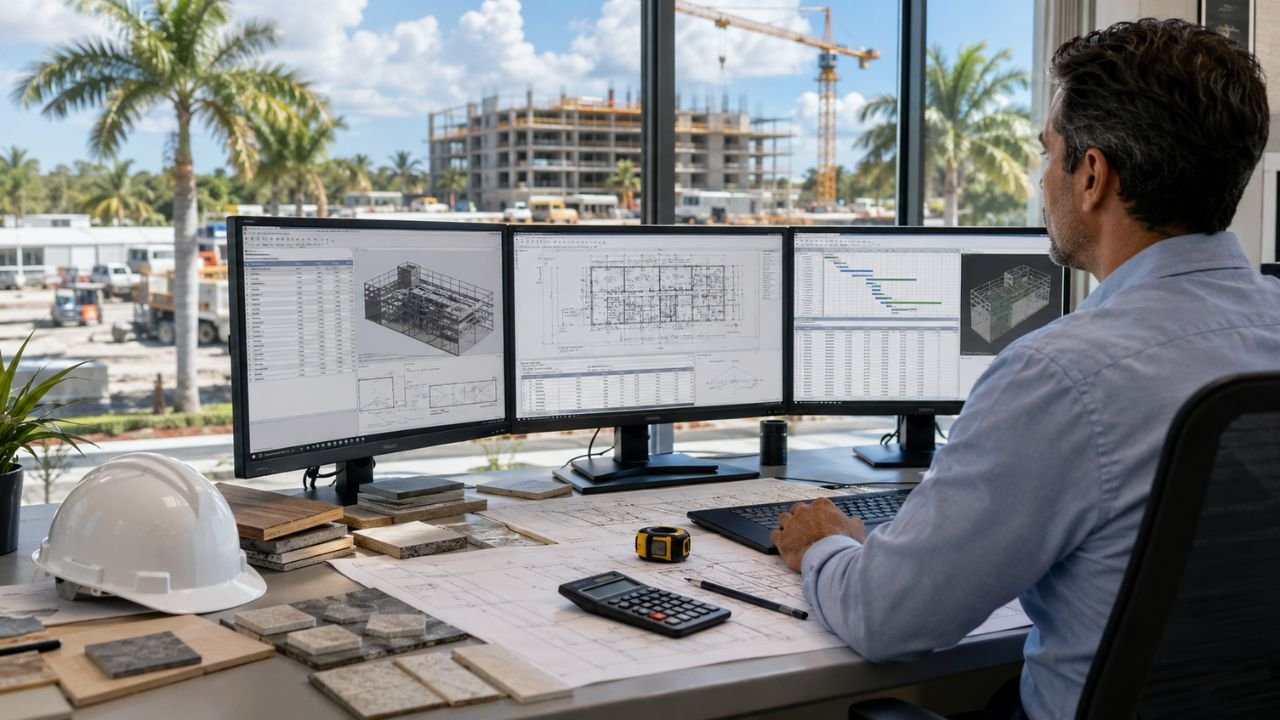
Small general contractors and subcontractors don’t need everything a national enterprise platform offers. They need software that gets an accurate number out the door fast, on a laptop or phone, without a training course.
A one- or two-person estimating operation in Tampa or Orlando is competing against firms with dedicated estimating staff. Speed matters as much as accuracy. If a tool takes three hours to learn per feature, it isn’t built for a small business.
Florida adds another layer. Wind-load requirements in High-Velocity Hurricane Zones (Miami-Dade and Broward counties) change material specs and costs. A national software database that doesn’t reflect Florida Building Code pricing will produce numbers that look reasonable but miss the mark on bid day.
Small teams also need software that works offline or on spotty job-site Wi-Fi, syncs across devices, and doesn’t require a dedicated IT person to maintain. That’s a very different priority list than what a 200-person commercial GC needs from construction estimating tools for small Florida companies.
The Core Requirements List
- Fast learning curve (days, not weeks)
- Mobile or tablet access for field measurements
- Reasonable monthly or annual pricing with no long-term lock-in
- Digital takeoff from PDF plans
- Basic cost database, even if it needs local adjustment
- Exportable, professional-looking proposals for clients
- Room to grow as the business adds staff or project volume
Top Picks: Best Estimating Software for Small Contractors in Florida (2026)
Here are the tools small Florida businesses turn to most often, based on ease of use, pricing, and how well they adapt to local pricing realities.
STACK
STACK is a cloud-based takeoff and estimating platform built with smaller teams in mind. It runs entirely in a browser, so there’s nothing to install, and plans sync automatically across devices.
Small GCs and subs like STACK because the digital takeoff process is visual and intuitive — you trace quantities directly on uploaded plans. The learning curve is shorter than most competitors, which matters for a solo estimator with no time to spare.
Pricing scales with the number of users and project volume, making it one of the more affordable construction estimating software for small business options on this list, especially at the entry tier.
PlanSwift
PlanSwift has been a favorite among small and mid-sized contractors for years, largely because of its straightforward digital takeoff tools. It’s desktop-based rather than fully cloud-native, which some small teams actually prefer for offline reliability.
It handles area, count, and linear takeoffs well, and it integrates with a range of third-party cost databases. The interface feels dated next to newer cloud tools, but the core functionality remains solid for simple quantity takeoff software for Florida small business needs.
Clear Estimates
Clear Estimates targets residential remodelers and small home builders specifically. It ships with a built-in cost database that can be localized, which helps offset the lack of Florida-specific pricing in more generic platforms.
For a small residential contractor who mostly needs fast, professional-looking proposals rather than complex commercial takeoffs, Clear Estimates hits a comfortable middle ground on price and simplicity.
Contractor Foreman
Contractor Foreman is less a pure estimating tool and more an all-in-one small-business management platform that includes estimating, invoicing, scheduling, and daily logs. For a small GC who wants one system instead of five, that consolidation has real value.
Estimating features are solid but not as deep as dedicated takeoff software. It’s a strong fit for best estimating software for small subcontractors Florida searches where the buyer wants project management bundled in.
Buildertrend
Buildertrend is widely known in the residential space and includes estimating alongside scheduling, client communication, and change-order management. It’s priced higher than pure estimating tools, but small residential builders often justify the cost through the client-facing features.
The estimating module itself is functional rather than best-in-class, so contractors who need heavy commercial takeoff work usually pair it with a dedicated takeoff tool.
ProEst
ProEst leans slightly more commercial but has a tier structured for smaller operations. It includes built-in cost databases and integrates with several accounting platforms, which appeals to small businesses trying to keep bookkeeping and estimating connected.
The pricing sits at the higher end for a true small-business budget, so it’s worth comparing carefully against low-cost construction estimating programs 2026 before committing.
RSMeans Online (Data Reference, Not Standalone Software)
RSMeans Online isn’t standalone estimating software — it’s a cost database that many of the tools above pull from, or that you can reference manually. National RSMeans data does not fully reflect Florida-specific material and labor pricing, especially in HVHZ counties, so it works best as a cross-check rather than a primary source for Florida bids.
Comparison Table: Best Estimating Software for Small Contractors Florida
– $
| Software | Best For | Approx. Monthly Cost | Ease of Use | Florida Pricing Accuracy | Mobile Access |
| STACK | Digital takeoffs, small GCs/subs | $ – $$ | Easy | Requires local adjustment | Yes |
| PlanSwift | Desktop takeoffs, offline work | $ – $$ | Moderate | Requires local adjustment | Limited |
| Clear Estimates | Residential remodelers | $ | Easy | Localizable database | Limited |
| Contractor Foreman | All-in-one small-business management | $ – $$ | Easy | Requires local adjustment | Yes |
| Buildertrend | Residential builders, client management | Moderate | Requires local adjustment | Yes | |
| ProEst | Small-to-mid commercial | $$$ | Moderate | Requires local adjustment | Yes |
| RSMeans Online | Cost data reference | $$ | Moderate | National data, not Florida-specific | Limited |
Pricing tiers are relative ($ = lower cost, $$$ = higher cost). Confirm current pricing directly with each vendor before purchasing, as rates change frequently.
Key Features That Matter Most for Small Teams
Not every feature on a vendor’s marketing page matters to a five-person crew. Here’s what actually moves the needle for small Florida contractors evaluating best estimating software for small contractors Florida.
- Digital takeoff from PDF plans — measuring on-screen instead of printing and using a scale ruler saves hours per bid.
- Editable cost databases — you need to plug in your own material and labor rates, since national averages rarely match Florida markets.
- Proposal and bid templates — a clean, branded output matters when you’re competing against larger firms.
- Cloud sync or mobile access — small crews move between job sites constantly and need estimates accessible from a phone.
- Low seat-count pricing — many platforms charge per user; make sure the pricing tier matches a one- or two-person team, not a department.
- Simple onboarding — video tutorials and live chat support matter more than an extensive feature list you’ll never use.
Affordable Construction Estimating Software for Small Business: Pricing Considerations
Price is usually the deciding factor for a small Florida contractor comparing tools. Most affordable construction estimating software for small business options fall into a few pricing patterns worth understanding before you commit.
Subscription-based cloud tools typically charge monthly or annually, with the price scaling by number of users or active projects. Entry tiers aimed at solo estimators or two-person teams are usually the most cost-effective starting point.
Desktop software like PlanSwift often uses a one-time license fee instead of a subscription, which can be cheaper long-term but comes with a bigger upfront cost and no automatic updates.
All-in-one platforms like Buildertrend and Contractor Foreman bundle estimating with other features, so the sticker price looks higher, but you may be replacing two or three separate subscriptions.
Watch for hidden costs: training fees, per-project overage charges, and required annual contracts that lock you in before you’ve confirmed the tool fits your workflow. A short free trial or month-to-month plan is worth prioritizing over a discounted annual rate you haven’t tested.
Simple Quantity Takeoff Software for Florida Small Business: Ease of Use and Learning Curve
Ease of use is where small businesses lose or win the most time. A tool that saves two hours per estimate but takes ten hours to learn isn’t a win in month one.
Cloud-based tools like STACK generally have the shortest learning curve because the interface mirrors familiar drawing and measuring tools. Desktop software tends to have a steeper initial curve but can feel faster once mastered.
For a solo estimator or a small crew without dedicated admin staff, prioritize easy estimating software for small GCs Florida searches that emphasize onboarding support, video walkthroughs, and responsive customer service over raw feature count.
A practical test: request a free trial and run one real estimate from a recent project through the software before buying. If it takes longer than doing the same takeoff by hand, the tool isn’t right for your team yet.
Limitations of Estimating Software for Small Construction Teams
Software solves speed and organization, but it has real limits for small Florida businesses, and it’s worth being honest about them before budgeting for a subscription.
- National pricing databases rarely reflect Florida-specific costs. Material and labor rates in Miami differ significantly from rates in Ocala or Pensacola, and most built-in databases average nationally.
- HVHZ and wind-load requirements aren’t automatically factored in. Software won’t know that a Broward County roof needs different fastening specs than one in Tallahassee unless you manually adjust it.
- Learning curves cost real money. Time spent training staff on new software is unbilled time, and small businesses feel that cost more than large firms do.
- Complex commercial or specialty estimates often exceed software capabilities. MEP systems, sitework, and large multi-phase projects frequently need expert judgment that automated takeoffs can’t fully replace.
- Subscription costs add up. A $150-per-month tool is $1,800 a year — real money for a business running a handful of bids per month.
When Outsourcing Estimating Is More Cost-Effective Than Software
For many small Florida contractors, the honest answer isn’t “which software should I buy” — it’s “should I buy software at all.” Outsourcing estimating work makes more financial sense in several common situations.
Low bid volume. If you’re submitting two or three bids a month, a monthly software subscription plus the hours spent learning it can cost more than simply paying per estimate.
Specialty or high-stakes projects. A five-story mixed-use building or a commercial buildout with complex MEP scope benefits from an experienced estimator’s judgment, not just software output.
HVHZ and code-heavy jobs. Projects in Miami-Dade, Broward, or other wind-load counties need estimators who already understand Florida Building Code compliance rather than a generic database.
No dedicated estimating staff. A small GC juggling job supervision, sales, and paperwork often doesn’t have the bandwidth to also become a software power-user.
Bid-day time pressure. When a bid is due in 48 hours and the software learning curve isn’t done, a professional estimating service can turn around numbers faster than a first-time software user.
How Estimate Florida Helps Small Businesses Win More Bids Without Heavy Software Investment
This is exactly the gap Estimate Florida fills for small contractors who don’t want the cost or time commitment of enterprise-grade software. Instead of buying, learning, and maintaining a subscription, small businesses get professional quantity takeoffs and cost estimates built on Florida-specific pricing from the start.
Every estimate reflects local material and labor rates across all 67 Florida counties, along with full Florida Building Code compliance, including HVHZ requirements where they apply. There’s no software fee, no training time, and no guessing whether the numbers hold up against local reality.
Turnaround runs 24 to 48 hours on most projects, which beats the time most small businesses would spend getting comfortable with a new software platform. For residential construction estimating or commercial estimating projects, a small contractor gets bid-ready numbers without adding a recurring line item to the budget.
For small businesses that bid occasionally, or that want backup accuracy on their biggest jobs, pairing simple internal software for everyday estimates with a professional service for complex or high-value bids is often the most cost-effective setup of all.
Florida-Specific Considerations: Building Code, HVHZ, and Local Pricing
Florida’s construction market has quirks that generic, nationally-built software simply doesn’t account for well, and small businesses pay the price when estimates come in low.
High-Velocity Hurricane Zone requirements in Miami-Dade and Broward counties mandate specific wind-resistant materials and installation methods that carry a real cost premium over standard construction elsewhere in the state.
County-level permitting fees vary widely, and they’re rarely built into a software database at all. A small contractor bidding across multiple counties needs to manually track these differences or work with someone who already does.
Material costs also shift with Florida’s supply chain realities — hurricane season demand spikes, transportation costs to coastal areas, and regional labor availability all move pricing in ways a national average misses. This is why even the top takeoff software for small builders in Florida typically needs local calibration to be bid-ready.
Frequently Asked Questions
What is the best construction estimating software for small business in Florida?
There’s no single best answer — STACK and PlanSwift are strong choices for digital takeoffs, Clear Estimates suits residential remodelers, and Contractor Foreman works well for small businesses wanting estimating bundled with project management.
How much does construction estimating software cost for a small business?
Most small-business-friendly tools range from roughly $50 to $400 per month depending on features, number of users, and whether it’s a standalone tool or an all-in-one platform.
Is free construction estimating software worth using?
Free tools can work for very basic takeoffs, but they typically lack Florida-specific cost data, mobile access, and professional proposal templates that paid options include.
Does estimating software account for Florida Building Code requirements?
Most national software platforms don’t automatically factor in Florida-specific code requirements like HVHZ wind-load standards, so manual adjustment or local expertise is still necessary.
What’s the easiest estimating software to learn for a small GC?
Cloud-based tools like STACK generally have shorter learning curves than desktop software, since the interface mirrors familiar drawing and measuring tools.
Should a small subcontractor use the same software as a general contractor?
Not necessarily. Subcontractors often need lighter, trade-specific tools, while GCs managing multiple scopes may benefit from all-in-one platforms with broader project management features.
When should a small business outsource estimating instead of buying software?
Outsourcing usually makes sense for low bid volume, complex or code-heavy projects, or when there’s no dedicated staff time to learn and maintain a new software platform.
Can estimating software replace a professional estimator entirely?
For simple, repetitive residential jobs, often yes. For complex commercial work, HVHZ compliance, or high-value bids, professional judgment still outperforms automated takeoffs alone.
Does STACK or PlanSwift work better for Florida contractors?
Both work well; STACK’s cloud-based, browser-first design suits teams needing mobile access, while PlanSwift’s desktop approach appeals to contractors who prefer working offline.
How do I know if estimating software is actually saving my small business money?
Compare the total annual subscription cost plus staff training hours against what you’d pay per estimate through a professional estimating service — for many small businesses, the numbers are closer than expected.
Final Recommendations
For small Florida construction businesses, the right choice usually comes down to volume and complexity. High-volume, straightforward residential work often justifies a software subscription like STACK or Clear Estimates. Lower-volume, complex, or code-sensitive projects usually make more financial sense with a professional estimating partner.
Many successful small contractors use both: everyday software for quick internal numbers, and a trusted estimating service for the bids that matter most.
If you’re ready to skip the software learning curve and get accurate, Florida-specific numbers on your next bid, contact Estimate Florida for a fast, professional quote built for how small businesses actually operate.