Miami’s construction market moves fast, and the margin for error on a bid is thin. A missed line item, an outdated material price, or a rushed takeoff can turn a winning bid into a losing project. That is the reality general contractors, subcontractors, developers, and property owners across South Florida deal with on every job.
Construction estimating services in Miami exist to close that gap. A professional estimate gives you a clear, itemized picture of what a project will actually cost before the first shovel hits the ground — labor, materials, equipment, and overhead, broken down by trade and backed by current local pricing.
Miami adds its own layer of difficulty. Contractors here have to account for hurricane-resistant construction requirements, strict wind-load standards, coastal flood zone rules, and a permitting process that varies by municipality — Miami-Dade County, the City of Miami, and each surrounding jurisdiction all have their own quirks. A generic, national-average estimate rarely holds up against that kind of local complexity.
This page walks through what construction estimating actually involves, the services available for residential and commercial projects in Miami, the trades and CSI divisions covered, the software estimators rely on, and what to expect from working with a professional estimating team. By the end, you will have a clear framework for evaluating estimating support for your next Miami project — whether that is a custom home in Coral Gables or a mixed-use development in Doral.
What Are Construction Estimating Services in Miami?
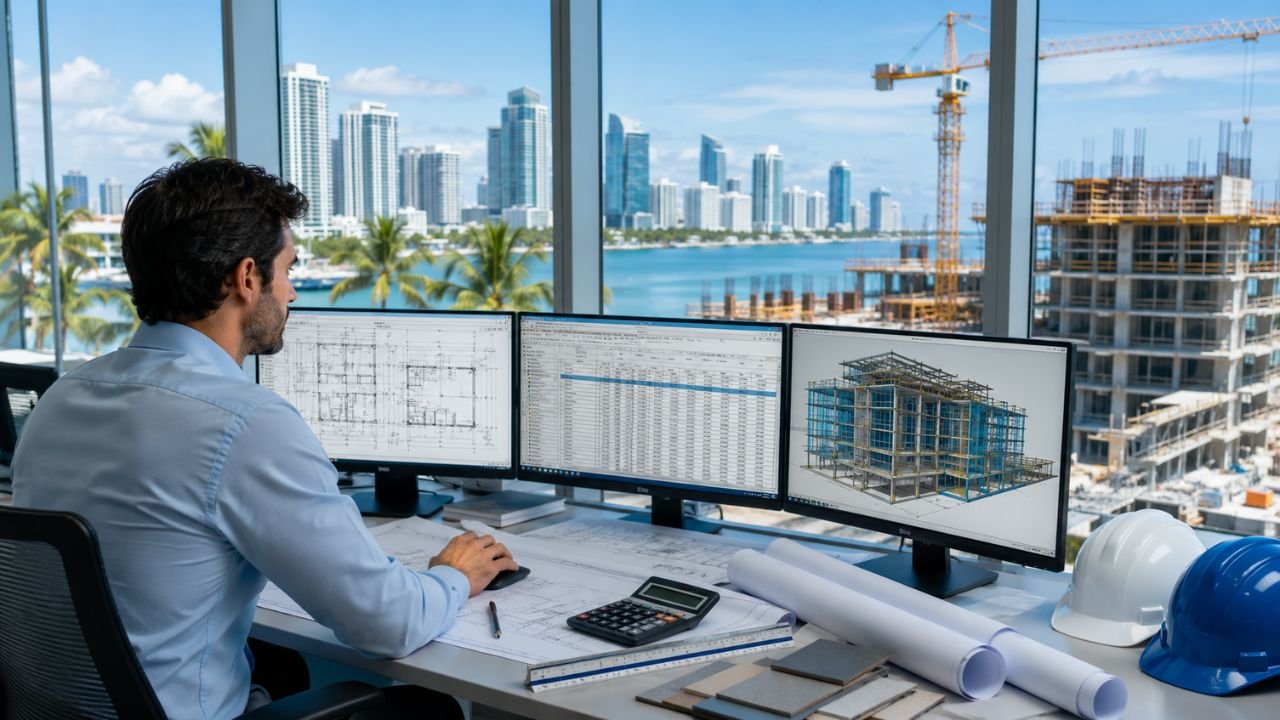
Construction estimating is the process of calculating the total projected cost of a construction project before work begins. It starts with a detailed review of construction drawings, blueprints, and specifications, then moves into quantity takeoffs — counting and measuring every material, assembly, and unit of labor the project requires.
An estimator translates plans into numbers: how many cubic yards of concrete, how many linear feet of framing, how many square feet of drywall, how many hours of electrical labor. Those quantities are then priced using current material costs and local labor rates, and organized into a structured estimate — typically following the CSI (Construction Specifications Institute) MasterFormat divisions that the industry uses to keep estimates consistent and comparable.
Why Accurate Estimates Matter
An estimate is only useful if it is accurate. A contractor who underbids a project because of a flawed estimate is stuck absorbing the difference out of profit — or worse, out of the project’s ability to finish. A contractor who overbids loses the job to a competitor with a tighter number. Either way, the estimate is the foundation everything else sits on: the budget, the schedule, the financing, the subcontractor agreements, and the bid itself.
In Miami specifically, accuracy also has to account for:
- Hurricane and wind-load construction requirements that add cost to structural systems, roofing, and window/door assemblies
- Flood zone classifications that affect foundation design and site work
- Fluctuating material costs, particularly for lumber, steel, and concrete, which can shift significantly between the bid date and the build date
- Labor availability, which tightens during Miami’s peak construction seasons and pushes wages up
- Permitting requirements that differ across Miami-Dade’s many municipalities
Benefits of Outsourcing Construction Estimating
Many contractors handle estimating in-house, but outsourcing to a dedicated estimating service has become common for a few practical reasons:
- Time savings. Preparing a detailed takeoff for a mid-size commercial project can take a full-time estimator days. Outsourcing frees that time for running active jobs.
- Consistency. A dedicated estimator applies the same rigorous process to every project, reducing the risk of missed scope.
- Bid capacity. Contractors can pursue more bids simultaneously without needing to hire additional in-house estimating staff.
- Specialized tools. Professional estimating services use industry-standard software for digital takeoffs, which improves both speed and accuracy compared to manual measurement.
- Objective numbers. An outside estimator has no incentive to pad or shave numbers to make a bid “look right” — the estimate reflects what the project actually costs.
Professional estimators also improve project success beyond the bid stage. A well-structured estimate becomes the baseline for cost control throughout construction, making it easier to track spending, evaluate change orders, and catch scope creep before it erodes profit.
Our Construction Estimating Services
Estimate Florida provides a full range of estimating services for contractors, developers, and property owners working on projects throughout Miami and the surrounding areas.
Quantity Takeoff Services
A quantity takeoff is the measurement backbone of any estimate — the process of extracting exact quantities of materials from construction drawings. This includes concrete volumes, masonry unit counts, steel tonnage, lumber board footage, drywall square footage, and every other measurable component of the project. Digital takeoff software is used to measure directly from PDF or CAD drawings, which improves accuracy over manual scaling and ruler measurements.
Material Takeoff Services
Material takeoffs go a step further than quantity takeoffs by breaking materials down into a purchasable, trade-specific list — the exact items a contractor or supplier would need to order. This is particularly useful for procurement planning, since it helps contractors lock in material pricing and lead times before construction starts.
Residential Estimating
Detailed cost estimates for single-family homes, custom homes, home additions, renovations, townhouses, and multi-family residential buildings throughout Miami-Dade County.
Commercial Estimating
Cost estimates for office buildings, retail centers, restaurants, hotels, warehouses, healthcare facilities, educational buildings, and mixed-use developments — sized and scoped for Miami’s commercial construction market.
Industrial Estimating
Estimates for industrial and light-manufacturing facilities, warehouses, and distribution centers, accounting for specialized structural, electrical, and mechanical requirements.
Bid Estimates
Detailed, bid-ready estimates formatted for submission to general contractors or project owners, broken down by CSI division so every trade’s scope is transparent.
Budget Estimates
High-level cost projections used early in project planning — before final drawings are complete — to help owners and developers understand whether a project is financially feasible.
Preliminary Estimates
Rough-order-of-magnitude estimates based on conceptual drawings or project descriptions, useful for early feasibility and financing discussions.
Design Estimates
Estimates prepared alongside the design process, helping architects and owners understand the cost impact of design decisions before drawings are finalized.
Conceptual Estimates
Early-stage estimates based on square footage, building type, and general specifications — useful when detailed drawings do not yet exist.
Change Order Estimates
Cost estimates for scope changes that arise during construction, giving contractors and owners a clear, documented basis for negotiating change order pricing.
Cost Management
Ongoing cost tracking support throughout construction, comparing actual spending against the original estimate to flag overruns early.
Value Engineering
Analysis of alternative materials, methods, or systems that can reduce project cost without compromising function or quality — a service particularly valuable on tight-budget projects.
CPM Scheduling Support
Cost data structured to support critical path method (CPM) scheduling, helping project managers align budget and timeline planning.
Residential Construction Estimating in Miami
Miami’s residential market spans everything from modest renovations to high-end custom builds, and estimating needs vary accordingly.
- Single-family homes — Ground-up estimates covering foundation, framing, roofing, MEP (mechanical, electrical, plumbing), and finishes.
- Custom homes — Detailed estimates for architect-designed homes with unique specifications, high-end finishes, and custom structural elements.
- Home additions — Estimates that account for tying new construction into existing structures, including matching materials and systems.
- Renovations — Cost breakdowns for kitchen, bathroom, and whole-home renovations, including demolition and disposal.
- Multi-family buildings — Estimates for duplexes, triplexes, and small multi-family properties.
- Townhouses — Unit-based estimates for townhouse developments, accounting for shared walls and repeated unit types.
- Apartments — Estimates for apartment buildings, scaled to unit count and building class.
Residential estimates in Miami also need to factor in Florida Building Code requirements for wind resistance, impact-rated windows and doors in coastal zones, and elevated foundation requirements in flood-prone areas — all of which add cost compared to non-coastal markets.
Commercial Construction Estimating in Miami
Commercial projects carry more complexity — more trades, tighter specifications, and higher financial stakes if the estimate is off.
- Office buildings — Core and shell, tenant improvement, and full build-out estimates.
- Retail stores — Estimates for standalone retail and shopping center buildouts.
- Restaurants — Estimates that account for kitchen equipment, ventilation, and specialized MEP requirements.
- Hotels — Estimates covering guest room units, common areas, and hospitality-specific systems.
- Warehouses — Large-span structural estimates with a focus on steel, roofing, and site work.
- Healthcare facilities — Estimates accounting for the specialized mechanical, electrical, and finish requirements healthcare construction demands.
- Educational buildings — Estimates for schools and educational facilities, including code-driven life-safety systems.
- Mixed-use developments — Combined estimates spanning residential, retail, and commercial components within a single project.
CSI Trades We Estimate
Estimate Florida prepares trade-by-trade estimates organized around CSI MasterFormat divisions, so every party reviewing the estimate — a lender, an owner, a subcontractor — can see exactly where the cost comes from.
Concrete. Covers foundations, footings, slabs on grade, elevated slabs, and structural concrete, along with site concrete such as sidewalks, curbs, and pads. Concrete takeoffs account for formwork, reinforcing steel, and mix design, all of which affect cost.
Masonry. CMU block walls, brick veneer, and stone veneer are quantified by wall area and unit count, with allowances for mortar, reinforcing, and grout fill where required by structural design.
Metals. Miscellaneous metals such as railings, stairs, ladders, and structural connections that fall outside the primary structural steel package.
Structural Steel. Framing members, beams, columns, connections, and erection labor for steel-framed structures, priced by tonnage and connection complexity.
Lumber. Framing lumber, engineered wood products (LVL, glulam, I-joists), and rough carpentry, quantified by board footage and piece count.
Roofing. Shingle, tile, metal, and flat or membrane roofing systems, with particular attention in Miami to wind-uplift-rated assemblies required under the Florida Building Code’s high-velocity hurricane zone provisions.
Drywall. Gypsum board installation, taping, and finishing across walls and ceilings, quantified by square footage and finish level.
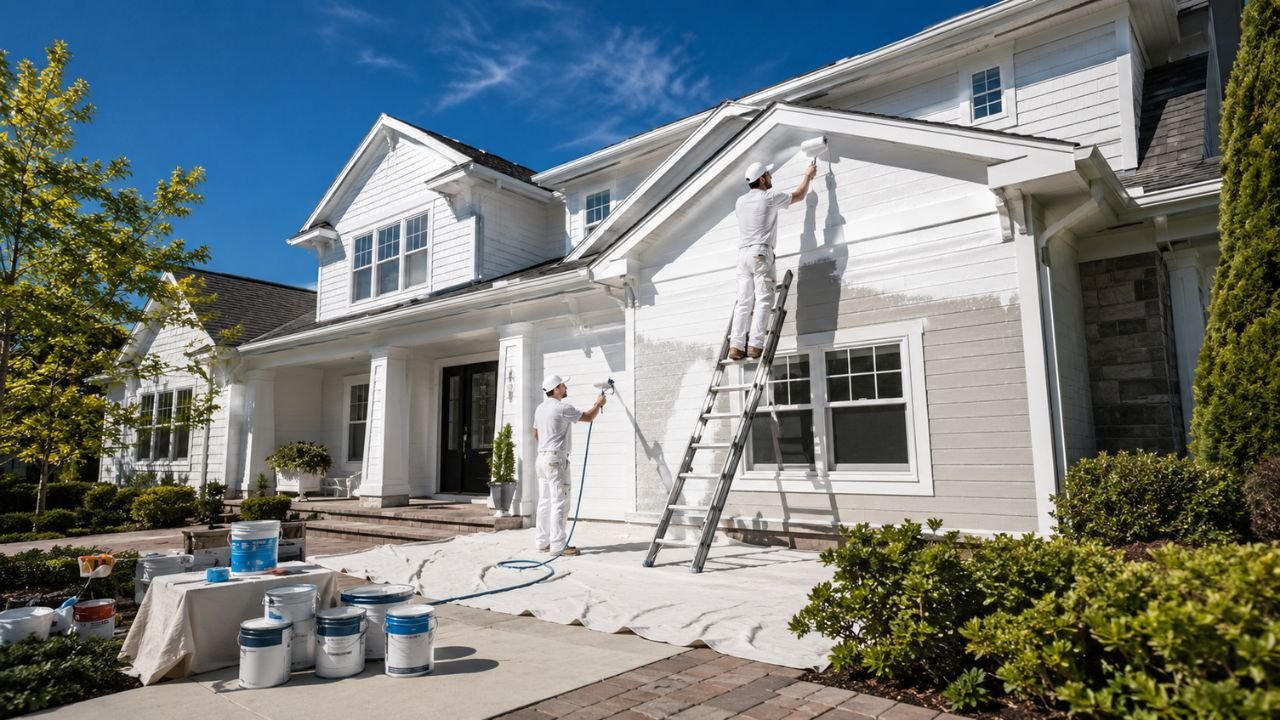
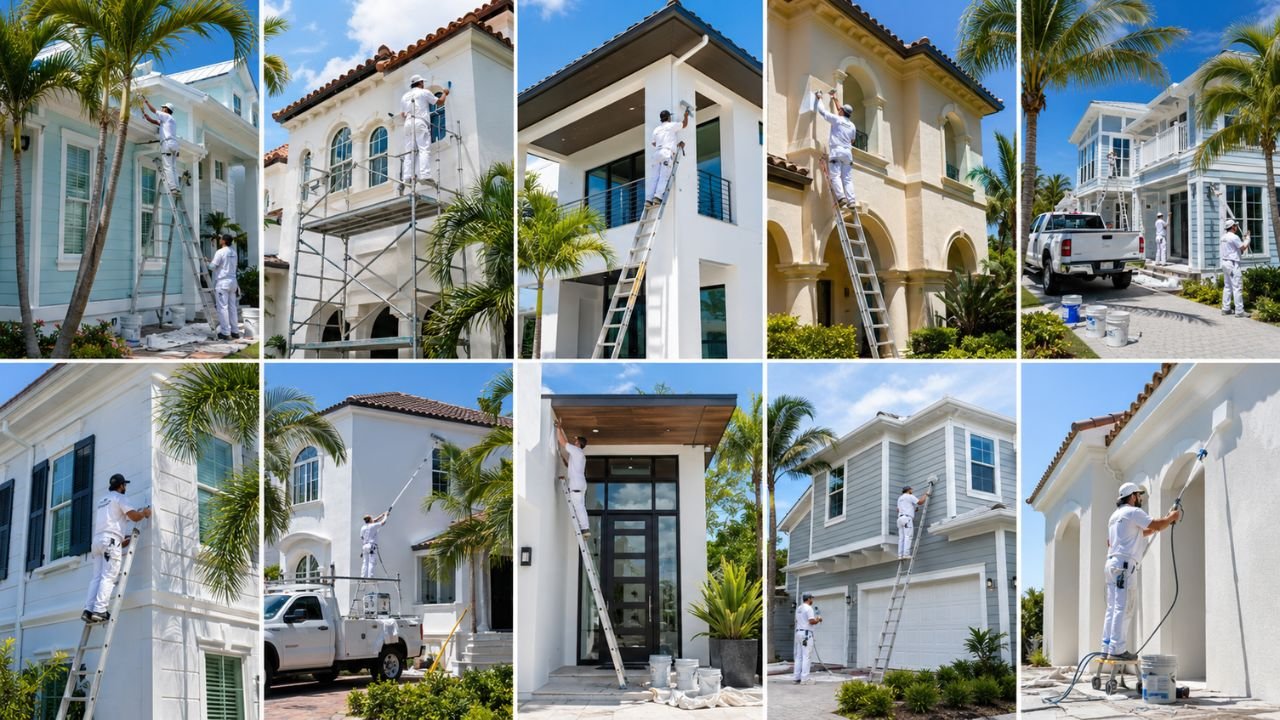
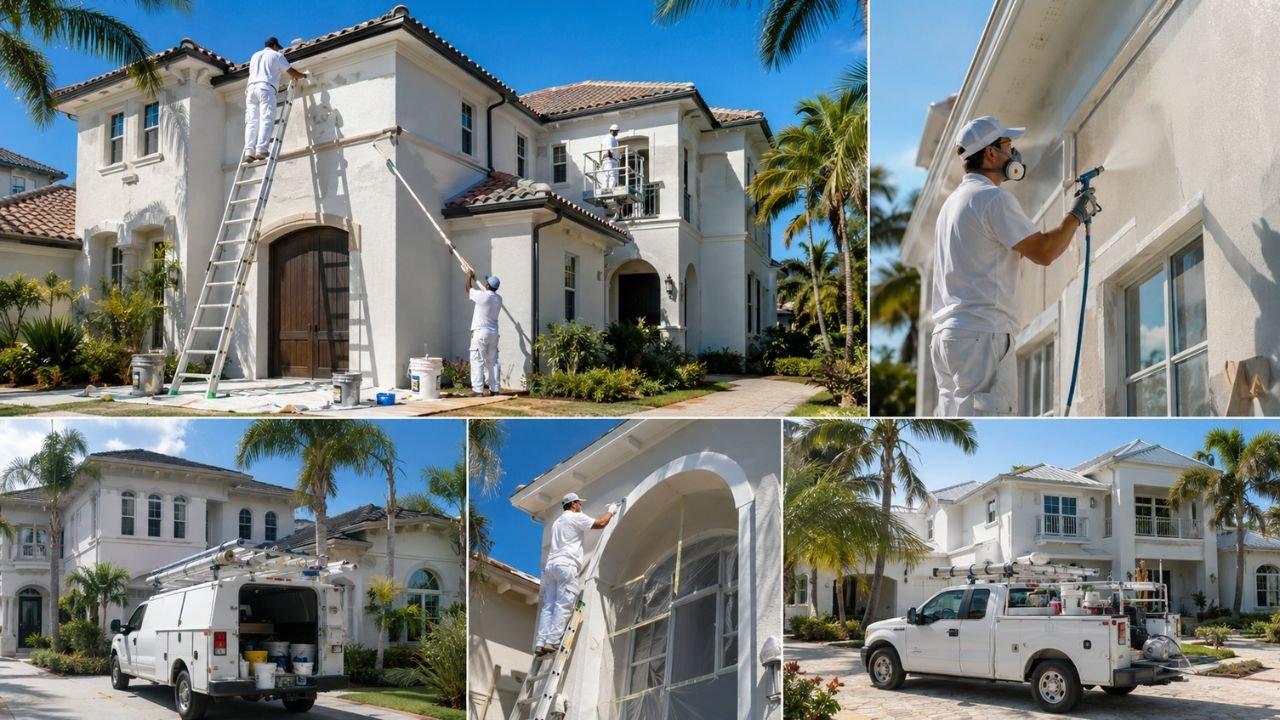
Painting. Interior and exterior painting and coatings, including surface prep, priming, and finish coats.
Flooring. Tile, hardwood, carpet, vinyl, and epoxy flooring systems, quantified by square footage and material grade.
HVAC. Mechanical equipment, ductwork, and controls, sized to building load and quantified by equipment count and duct linear footage.
Plumbing. Rough-in piping, fixtures, and water heating systems, quantified by fixture count and pipe run length.
Electrical. Rough-in wiring, panels, fixtures, and low-voltage systems, quantified by device count and circuit runs.
Fire Protection. Sprinkler systems and fire suppression equipment, sized to occupancy classification and code requirements.
Doors & Windows. Standard and hurricane-impact-rated doors and windows — a significant cost driver on Miami projects, where impact-rated glazing is required in most coastal and high-velocity hurricane zones.
Finishes. Millwork, cabinetry, and interior finish carpentry, quantified by linear footage and unit count.
Earthwork. Grading, excavation, and soil work, quantified by cubic yardage and equipment hours.
Demolition. Selective demolition for renovations and full-structure demolition for teardown projects, including debris removal and disposal.
Site Work. Underground utilities, paving, and site concrete, quantified by linear footage and area.
Landscaping. Planting, irrigation systems, and hardscape elements, quantified by area and plant/material count.
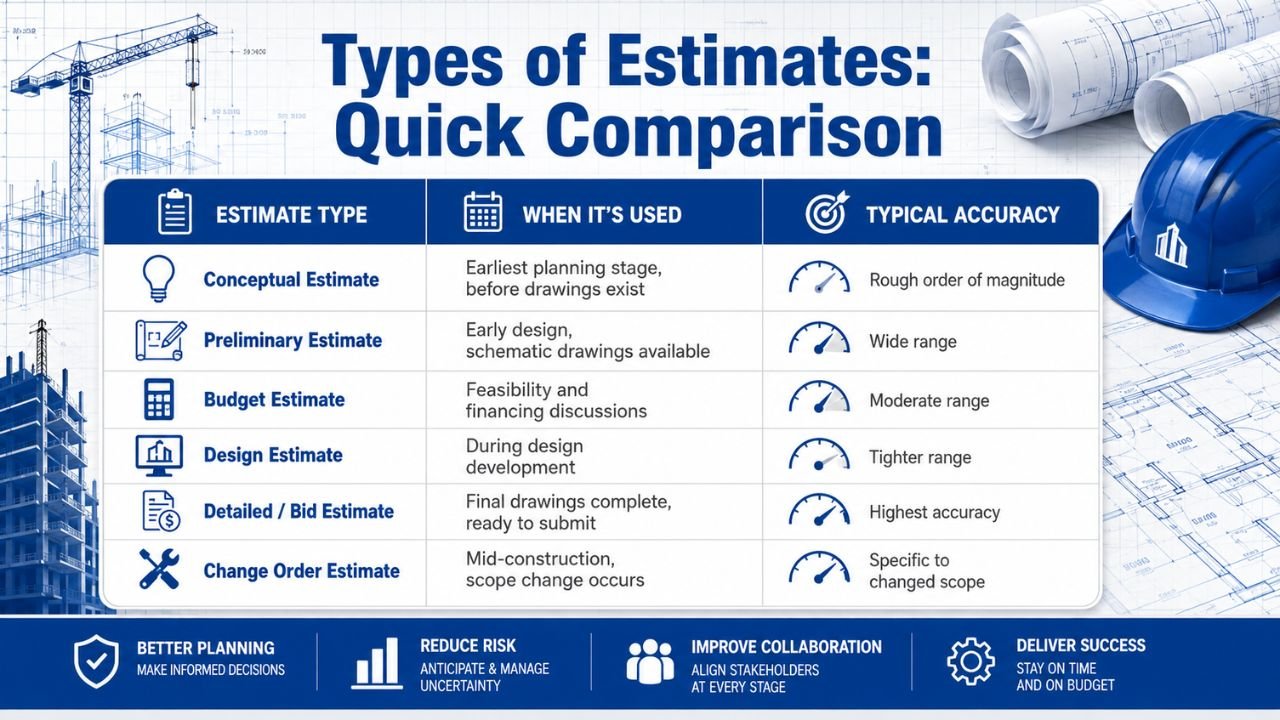
Types of Estimates: Quick Comparison
| Estimate Type | When It’s Used | Typical Accuracy |
| Conceptual Estimate | Earliest planning stage, before drawings exist | Rough order of magnitude |
| Preliminary Estimate | Early design, schematic drawings available | Wide range |
| Budget Estimate | Feasibility and financing discussions | Moderate range |
| Design Estimate | During design development | Tighter range |
| Detailed / Bid Estimate | Final drawings complete, ready to submit | Highest accuracy |
| Change Order Estimate | Mid-construction, scope change occurs | Specific to changed scope |
Why Choose Estimate Florida?
- Experienced estimators familiar with Florida Building Code and Miami-Dade’s high-velocity hurricane zone (HVHZ) requirements
- Fast turnaround on bid-ready estimates, so tight bid deadlines aren’t a barrier to bidding
- Accurate quantity takeoffs built from digital measurement, not manual scaling
- Industry-standard estimating software used across every project
- Florida market knowledge, including regional material and labor pricing trends
- Competitive, transparent pricing with no hidden fees
- Confidential service — project details and drawings are handled discreetly
- Detailed, well-organized reports broken down by CSI division for easy review
- Reliable customer support throughout the estimating process and after delivery
Construction costs vary depending on project scope, materials, labor conditions, site specifics, and current market pricing — every estimate is prepared to reflect the actual conditions of the project rather than generic averages.
Contractors and developers work with Estimate Florida because the estimating process is treated as a core deliverable, not an afterthought. Estimates are prepared by people who understand how Miami-Dade’s building requirements translate into real line-item costs, not by applying a national cost database and adjusting for a regional multiplier. That distinction matters most on the projects where it’s easy to get wrong — coastal renovations, high-rise multi-family buildings, and anything sitting in a designated flood zone.
Estimating Software We Use
Professional estimating relies on purpose-built software to measure and price projects accurately and efficiently. Estimate Florida’s team works with:
| Software | Primary Use |
| PlanSwift | Digital quantity takeoffs from PDF and CAD drawings |
| Bluebeam Revu | Plan markup, measurement, and collaborative review |
| CostX | 3D takeoff and cost estimating |
| STACK | Cloud-based takeoff and estimating |
| Trimble | Construction estimating and project data management |
| Autodesk Construction Cloud | Drawing management and collaborative estimating |
| Excel | Custom estimate formatting, calculations, and reporting |
These tools speed up the takeoff process and reduce measurement error, but software alone doesn’t produce a reliable estimate. Every quantity and price generated through these platforms is reviewed and verified by an experienced estimator before it goes into a final report — software supports the process, it doesn’t replace professional judgment.
Industries We Serve
- Residential
- Commercial
- Industrial
- Government
- Hospitality
- Healthcare
- Retail
- Education
- Multifamily
- Infrastructure
Benefits of Professional Construction Estimating
- Improved bid accuracy — fewer surprises between the bid and the build
- Reduced project risk — cost issues are identified before construction, not during
- Better budgeting — owners and developers can plan financing with confidence
- Lower material waste — accurate takeoffs mean ordering the right quantities
- Higher bid success rate — competitive, well-supported numbers win more work
- Better planning — accurate costs support better scheduling and phasing decisions
- Faster project execution — fewer estimate-related delays once construction starts
- Improved profitability — margin is protected when the estimate reflects real costs
Our Construction Estimating Process
- Receive project drawings. Plans, blueprints, and specifications are submitted for review.
- Review plans and specifications. The estimating team studies scope, materials, and structural details.
- Perform quantity takeoffs. Every material and assembly is measured using digital takeoff software.
- Apply current labor and material pricing. Quantities are priced using up-to-date, market-relevant rates.
- Quality review. Estimates go through an internal review to catch errors or omissions before delivery.
- Deliver a detailed estimate. The final estimate is delivered in a clear, organized, CSI-divided format ready for bidding or budgeting.
Areas We Serve Around Miami
Estimate Florida provides construction estimating services throughout Miami and the surrounding communities. Coverage includes Miami Beach, where coastal construction and renovation projects face some of the strictest wind and flood requirements in the county; Coral Gables, known for custom home and historic renovation work; Hialeah and Miami Gardens, both active markets for residential and light commercial construction; Doral, a hub for commercial and mixed-use development; Kendall and Pinecrest, largely residential markets with steady renovation and addition activity; Homestead, where new residential development continues to expand; Aventura and Sunny Isles Beach, dense high-rise and multi-family markets; North Miami; and Cutler Bay. Wherever the project sits within Miami-Dade County, estimates are prepared with that municipality’s specific permitting and code requirements in mind.
Frequently Asked Questions
- What is included in a construction estimating service? A construction estimate typically includes a full quantity takeoff, material and labor pricing, and a detailed cost breakdown organized by CSI division, covering everything from site work to finishes.
- How long does it take to get an estimate for a Miami project? Turnaround depends on project size and complexity, but most residential estimates are completed faster than large commercial or industrial projects, which involve more trades and documentation.
- Do you provide estimates for both residential and commercial projects? Yes. Estimating services cover single-family homes, custom homes, renovations, and multi-family residential projects, as well as commercial, industrial, and mixed-use developments.
- What information do you need to prepare an estimate? Construction drawings, blueprints, and project specifications are the minimum needed. The more complete the plans, the more accurate the resulting estimate.
- How do you account for Miami’s hurricane and wind-load building requirements? Estimates for Miami projects factor in Florida Building Code requirements, including high-velocity hurricane zone standards, impact-rated windows and doors, and reinforced structural systems where applicable.
- What is the difference between a quantity takeoff and a full estimate? A quantity takeoff measures and counts materials from drawings. A full estimate applies current pricing to those quantities and organizes them into a complete, cost-ready document.
- Can you provide a bid-ready estimate for submission to a general contractor? Yes. Bid estimates are formatted specifically for submission, broken down by trade so scope and pricing are clear to the reviewing party.
- Do construction costs in Miami differ from the rest of Florida? Yes. Miami-Dade’s coastal building requirements, permitting processes, and labor market conditions can affect pricing compared to other parts of the state.
- What estimating software do you use? The team works with industry-standard platforms including PlanSwift, Bluebeam Revu, CostX, STACK, Trimble, Autodesk Construction Cloud, and Excel.
- Do you handle change order estimates during construction? Yes. Change order estimates provide a documented cost basis for scope changes that come up mid-project.
- Can you estimate a project that only has conceptual or early-stage drawings? Yes. Preliminary and conceptual estimates are available for projects that haven’t reached final design, useful for early feasibility and financing decisions.
- Is estimating service pricing based on project size? Pricing generally reflects project scope, size, and complexity, since larger and more complex projects require more detailed takeoff and review work.
- Do you offer value engineering as part of the estimating process? Yes. Value engineering analysis can be included to identify alternative materials or methods that reduce cost without sacrificing project quality.
- Which areas around Miami do you serve? Coverage includes Miami Beach, Coral Gables, Hialeah, Doral, Kendall, Homestead, Aventura, North Miami, Miami Gardens, Sunny Isles Beach, Pinecrest, and Cutler Bay.
- How accurate are professional construction estimates? Accuracy depends on the completeness of the drawings provided and current market pricing at the time of the estimate. Detailed, final drawings generally produce the most accurate results, while conceptual estimates carry wider margins by nature.
Conclusion
A construction project in Miami succeeds or struggles based on the accuracy of the numbers behind it. Whether you’re a general contractor preparing a competitive bid, a developer evaluating a new site, or a homeowner planning a custom build, a detailed, professionally prepared estimate gives you the clarity to move forward with confidence.
Estimate Florida provides construction estimating services built around Miami’s specific building requirements, market conditions, and permitting landscape — covering residential, commercial, and industrial projects from initial takeoff through bid-ready delivery.
Request a construction estimate for your Miami project today and get a detailed, accurate cost breakdown you can build on.