The 9th Edition (2026) Florida Building Code takes effect on December 31, 2026. Permit applications submitted on or after that date must comply with it. For commercial estimators, the question isn’t “what’s new in the code book” but “which line items change on my next bid.” This guide covers the changes in the Florida Building Code, Building volume that are most likely to show up in a commercial takeoff, based on the Florida Building Commission’s official Analysis of Changes.
Last reviewed: October 2026. This is a summary for estimating, not a code interpretation. Confirm requirements with the adopted code text and your building department.
When the 9th Edition applies to your project
- Effective date: December 31, 2026.
- The trigger is the permit application date, not the bid date or construction start. Miami-Dade County, for example, states that all permit applications and plans submitted on or after December 31, 2026 must comply with the new edition. Online submissions there after 4 PM on December 30, 2026 fall under the 2026 code.
- Applications filed under the 8th Edition generally continue under it. If an application expires, Miami-Dade may grant an extension, but only if it’s requested in writing within 180 days of expiration and the applicant shows it was being pursued in good faith. Otherwise the plans must be redone to the 2026 code.
- Base model code: the 9th Edition updates the 8th Edition (2023) FBC using the 2024 International Building Code, plus Florida-specific amendments. Not every 2024 IBC change was adopted.
What this means for bids right now
Any bid you price this fall for a project that won’t be permitted until 2027 should be priced to the 9th Edition. If the permit timing is uncertain, state in your proposal which code edition you priced, and carry an allowance or exclusion for code-driven changes if the application slips past December 30.
Changes most likely to affect commercial estimates
1. Corrosion-resistant fasteners within 3,000 ft of saltwater (new Section 1711)
This is the change most likely to move numbers on coastal jobs. A new Section 1711 sets corrosion-resistance requirements for fasteners and metal connectors/plates located within 3,000 feet of a saltwater coastline. It sets criteria for stainless steel, enhanced galvanizing and standard galvanizing, with a new table assigning the required level by distance from the coast and exposure to salt-laden air.
The roofing chapter points nails, screws and clips to Section 1711, and so do the High-Velocity Hurricane Zone (HVHZ) roofing provisions.
Estimating impact: on coastal projects, check the spec and structural notes for the fastener and connector finish required by the site’s distance and exposure. Upgrading from standard galvanized to enhanced coatings or stainless affects roofing, framing connectors, and other exposed metal attachments. Price them as separate line items rather than burying them in a generic “fasteners” allowance.
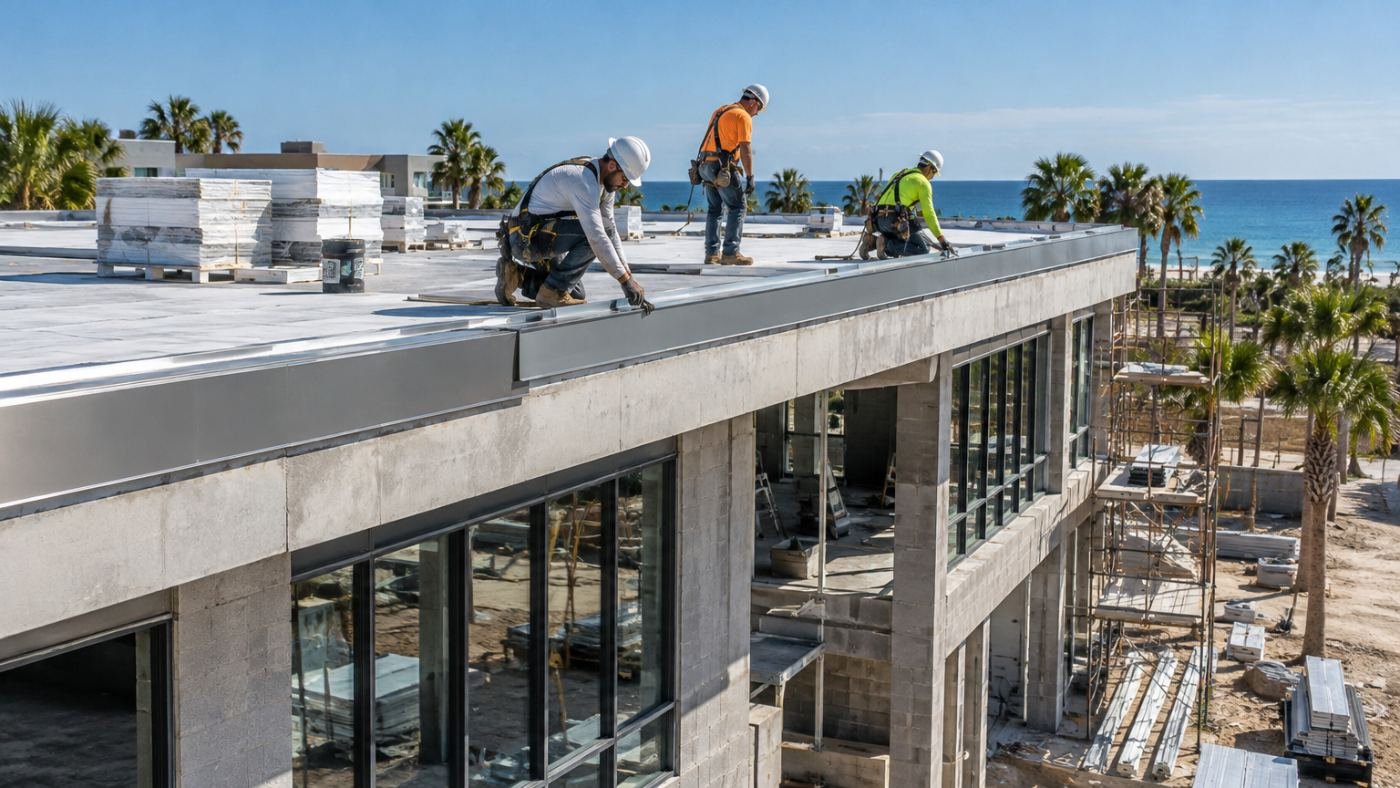
2. Roofing: drip edge, flashing, underlayment and hip/ridge wind resistance
- Drip edge is now required on roof slopes 2:12 and greater for metal panels, metal shingles, slate, mineral-surfaced roll roofing, photovoltaic shingles, wood shingles and shakes, and tile. For most of these it goes over the underlayment and is fastened at a maximum of 4 inches on center; tile drip edge follows the FRSA/TRI Florida High Wind installation manual. Asphalt shingle drip edge must also be fastened at 4 inches on center, for any wind speed.
- New flashing sections apply to built-up, modified bitumen, single-ply, metal, vegetative and PV roof systems, requiring flashing per the chapter and the manufacturer’s instructions.
- Underlayment must lap over hips and ridges at least 6 inches, except where ventilation openings are provided.
- Hip and ridge asphalt shingles must be tested to a modified UL 2375 at 110 mph and labeled, or attached with a prescriptive method that adds roof cement spots in addition to fasteners.
- Metal hip and ridge covers must be tested for uplift (ANSI/MCA FTS-1).
- Tile underlayment in the HVHZ must meet the component and cladding loads of ASCE 7. Its uplift resistance must be determined by FM 4474 or UL 1897 and shown on the Product Approval.
- Lightning protection attached to or through metal edge systems, gutters or roof coverings must be designed by a registered design professional to resist design wind loads.
- PVC single-ply (ASTM D4434) has been added as a listed single-ply material.
Estimating impact: mostly small quantities, but they add up across a commercial roof. Count drip edge LF by slope, add fastening labor at 4″ o.c., and confirm that the specified underlayment and hip/ridge products carry the required testing. Add design fees where a lightning protection system attaches to edge metal.
3. Structural loads and risk category
- Risk Category IV now covers more facilities: buildings where loss of function represents a substantial hazard, most Group I-3 detention occupancies (formerly Risk Category III), and public utility facilities for power generation, potable water treatment and wastewater treatment.
- Support spaces for a Risk Category IV building must also be designed as Risk Category IV if they house electrical, communications, mechanical, plumbing or conveying systems that serve it.
- Live loads: projection, control and follow-spot rooms are now listed at 50 psf. Public restrooms take the live load of the area they serve, up to 60 psf. Forklifts, moveable equipment and fire trucks now have specific load references. Partition loads can no longer be reduced.
- Parking garages: both garage floors and portions of other floors used for vehicle storage must be designed for the garage live loads.
- Crane loads are now determined by ASCE 7 Section 4.9 instead of the code’s own provisions.
- Vehicle access doors (formerly “garage and rolling doors”): the simplified design wind pressure tables were revised to correlate with ASCE 7-22.
Estimating impact: for public utility, detention and essential-facility work, confirm the risk category early, because it drives structural sizing, connections and wind-borne debris protection. For warehouses and industrial buildings, forklift and crane loads may change slab and framing design. Ask the engineer of record whether the design is complete to the 2026 code before you lock in quantities.
4. Flood: certificates and dry floodproofing testing
- Commercial plan review now requires base flood elevations, “proposed” lowest floor elevations, and dry floodproofing design certification on a FEMA Dry Floodproofing Certificate or equivalent.
- A new Section 1612.4.3 requires dry floodproofing measures to be tested. Passive systems must meet ANSI/FM 2510, TAS 204 or another approved standard; active systems must meet ANSI/FM 2510 or another approved standard.
- Final inspection requires an as-built FEMA Dry Floodproofing Certificate where applicable.
- Elevators, escalators and conveying systems in flood hazard areas must also comply with ASME A17.1/CSA B44.
Estimating impact: on floodproofed commercial buildings, confirm that the flood barriers and shields specified are tested to an accepted standard, and carry surveyor and certification costs for both design and as-built certificates.
5. Windows and doors: water testing under overhangs
The exception that let doors under an overhang skip water-intrusion testing has been narrowed. Those doors now need a Limited Water (LW) rating, and the overhang must extend beyond each side of the door as well as out from it.
Estimating impact: check storefront and entrance door submittals for an LW rating. Products without it may need substitution.
6. Fire protection, alarms and lithium-ion batteries
- Where a sprinkler waterflow switch must be electrically supervised, it must be powered by a fire alarm control unit or fire alarm system. A visual waterflow device is also required.
- New fire alarm requirements, using air-sampling or radiant-energy detection, apply where lithium-ion or lithium metal batteries are manufactured, researched or tested, or stored in Group M (mercantile) spaces where the Fire Prevention Code requires it.
- Battery manufacturing, energy storage systems, and vehicles powered by lithium-ion batteries are now classified as Group F-1. Battery storage and repair garages for those vehicles are Group S-1.
- Hospitals operating outpatient surgical, pain management or cardiac catheterization centers must provide sprinkler coverage in those areas consistent with the ambulatory surgical center provisions.
- High-rise buildings: the code now spells out riser requirements separately for buildings over and under 420 feet. A single standpipe or sprinkler express riser can serve all sprinkler systems in a vertical water supply zone.
Estimating impact: for EV service, battery storage, distribution centers handling batteries, and retail selling them, confirm the occupancy classification and detection type with the fire protection designer. Air-sampling detection is a different price than spot smoke detectors.
7. Administration and permitting
- Building officials may require construction documents in digital form.
- A dollar threshold in Section 105.3.1.2 (Issuance of permits) rises from $5,000 to $15,000.
- Temporary structures designed under Section 3103.5 are limited to one year of service unless an extension is granted.
What isn’t covered here
This guide covers the Building volume only. Energy requirements sit in a separate Florida Building Code, Energy Conservation volume, and there are separate volumes for plumbing, mechanical, fuel gas, existing buildings and accessibility. The Building volume’s Chapter 13 (Energy Efficiency) shows no changes because it points to the energy volume. Check each volume that applies to your scope.
Bid checklist for projects that straddle December 31, 2026
- Confirm the expected permit application date and which code edition the drawings are designed to.
- State the code edition priced in your proposal, with an exclusion for redesign if the permit date moves.
- Coastal sites: get the distance to saltwater and exposure condition, then price fasteners and connectors to the Section 1711 table.
- Roofing: add drip edge at 4″ o.c., hip/ridge underlayment laps, and confirm product testing and approvals.
- Confirm the risk category for public, utility and essential facilities.
- Flood zones: confirm tested dry floodproofing products and include certification costs.
- Storefronts and entrances: confirm LW ratings for doors under overhangs.
- Battery-related uses: confirm occupancy and detection type with the fire designer.
Need your bid priced to the 2026 code?
Estimate Florida prices commercial and trade estimates for all 67 Florida counties to the code edition your permit will fall under, with code-driven items broken out as separate line items. Upload your plans for a flat-fee quote, or call 561-530-2845 if your bid is due this week.
Related: 8th Edition FBC estimating guide (for permits filed before December 31, 2026) · Commercial construction estimating · Roofing & waterproofing estimating · Fire protection estimating · Windows & doors estimating
Frequently asked questions
When does the 2026 Florida Building Code take effect?
December 31, 2026. Permit applications submitted on or after that date must comply with the 9th Edition.
Does my project fall under the 8th or 9th Edition?
It depends on when the permit application is submitted, not when the contract is signed or construction starts. Applications submitted before December 31, 2026 generally continue under the 8th Edition. Confirm with your building department.
What model code is the 9th Edition based on?
The 2024 International Building Code, applied to the 8th Edition (2023) FBC with Florida-specific amendments. Not all 2024 IBC changes were adopted.
What’s the biggest cost change for coastal commercial projects?
New Section 1711 requires corrosion-resistant fasteners and metal connectors within 3,000 feet of a saltwater coastline, with the required protection level based on distance and exposure.
Sources
- Florida Building Commission, Analysis of Changes for the 9th Edition (2026) Florida Building Code, Building
- Miami-Dade County Permitting and Inspection Center, Florida Building Code 9th Edition Code Change notice
- Florida Building Commission: floridabuilding.org