In 2026, the total development cost for a 100-unit apartment complex in Florida typically ranges from $20 million to $45 million. This translates to an average construction cost of $200,000 to $350,000 per unit. While economy-of-scale efficiencies lower the “per-door” cost compared to smaller builds, high-rise luxury developments in urban cores like Miami can easily exceed $50 million due to land scarcity and stringent hurricane codes.
2026 Florida 100-Unit Project Summary
| Metric | Estimate Range |
|---|---|
| Total Project Budget | $20M – $45M+ |
| Cost Per Square Foot | $160 – $350 (Standard) |
| Cost Per Unit (Door) | $200,000 – $350,000 |
| Horizontal Site Work | $3M – $6M |
| Impact & Permit Fees | $1.5M – $2.5M |
| Construction Timeline | 18 – 24 Months |
Macro Overview: 100 Unit Apartment Building Cost Florida
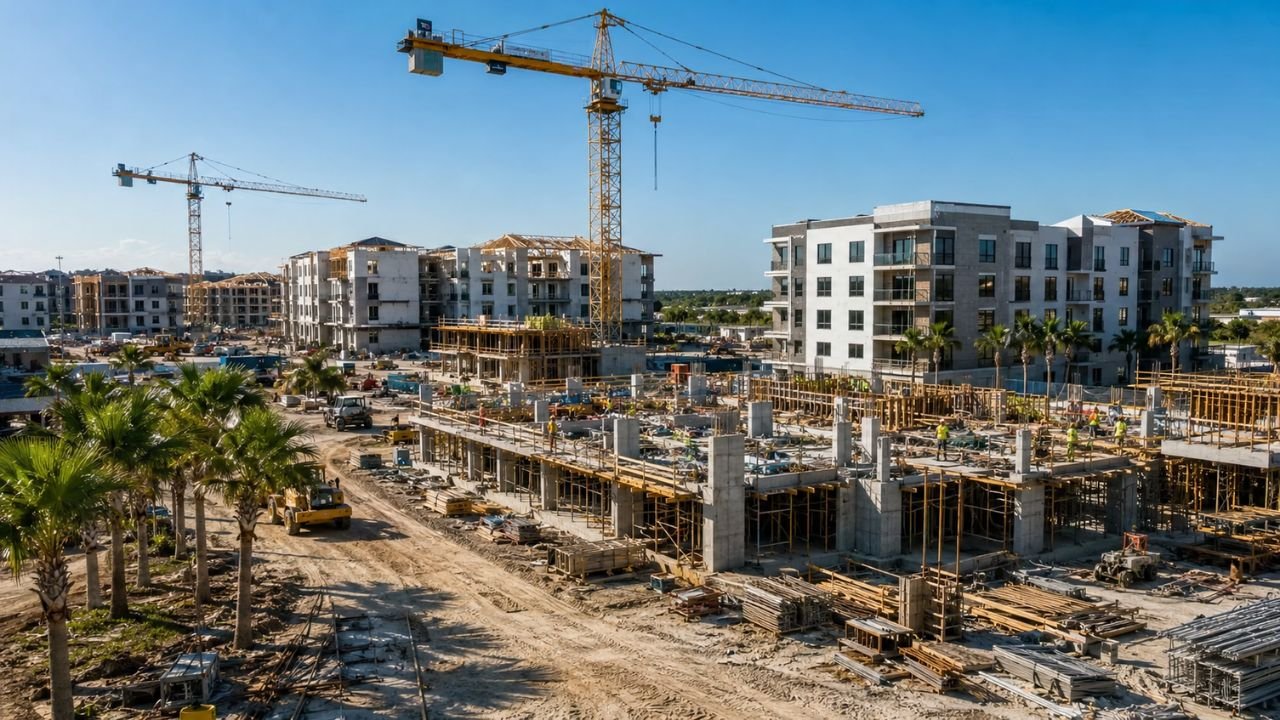
Building at the 100-unit scale in Florida represents a significant threshold for developers. At this volume, you move beyond the “scale penalty” seen in 10- or 20-unit projects where fixed costs are spread thin. A 100-unit project allows for more efficient deployment of site supervisors, temporary facilities, and bulk material purchasing.
However, a 100 unit apartment complex construction budget Florida must account for massive horizontal infrastructure. Unlike smaller projects, 100 units require substantial road networks, extensive utility runs, and high-capacity stormwater systems.
Average Construction Cost Per Unit by Type (2026)
Unit mix significantly alters the budget. Kitchens and bathrooms are the most expensive spaces to build per square foot.
| Unit Type | Target Size (Sq. Ft.) | Construction Cost Range (Per Unit) |
|---|---|---|
| Studio Apartment | 500 – 700 | $110,000 – $160,000 |
| 1-Bedroom Apartment | 800 – 1,000 | $140,000 – $210,000 |
| 2-Bedroom Apartment | 1,050 – 1,200 | $185,000 – $280,000 |
| 3-Bedroom Apartment | 1,300+ | $230,000 – $350,000 |
Regional Cost to Develop 100 Unit Apartments: South vs. Central Florida
Construction costs in the “Sunshine State” are not uniform. Geography is your primary budget driver, influenced by labor availability and hurricane exposure.
South Florida (Miami, Fort Lauderdale, West Palm Beach)
South Florida is the most expensive region. Every 100-unit build must comply with the High-Velocity Hurricane Zone (HVHZ) standards. This mandates impact-resistant glazing and reinforced masonry, adding 8% to 10% to the shell cost.
Central Florida (Orlando, Tampa)
Central Florida offers a balance of moderate land costs and high demand. While still subject to rigorous wind-load codes, it generally avoids the extreme HVHZ premiums of the coast.
North Florida (Jacksonville, Panhandle)
Jacksonville typically offers the lowest per-square-foot rates in the state due to more affordable labor and land.
Regional Cost Multipliers for 100-Unit Projects
| City | Cost per Square Foot (Standard) | Luxury Cost per Sq. Ft. |
|---|---|---|
| Miami | $300 – $500 | $540 – $720 |
| Orlando | $200 – $350 | $420 – $600 |
| Tampa | $180 – $300 | $360 – $540 |
| Jacksonville | $160 – $280 | $300 – $480 |
Hard Cost Breakdown: Where the Money Goes
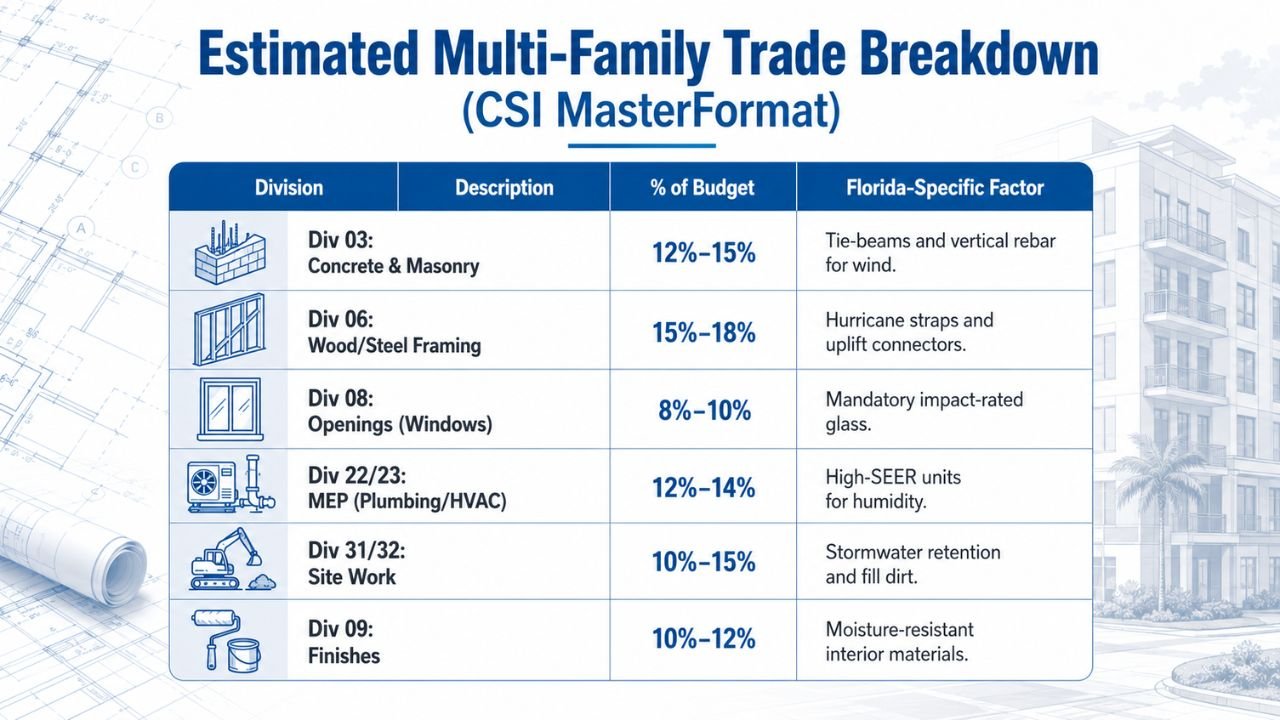
For a cost to build 100 unit multifamily complex Florida, hard costs (vertical construction) typically consume 55% to 65% of the total budget. Utilizing Florida construction estimating services is essential to track these trade-specific allocations.
Estimated Multi-Family Trade Breakdown (CSI MasterFormat)
| Division | Description | % of Budget | Florida-Specific Factor |
|---|---|---|---|
| Div 03 | Concrete & Masonry | 12% – 15% | Tie-beams and vertical rebar for wind. |
| Div 06 | Wood/Steel Framing | 15% – 18% | Hurricane straps and uplift connectors. |
| Div 08 | Openings (Windows) | 8% – 10% | Mandatory impact-rated glass. |
| Div 22/23 | MEP (Plumbing/HVAC) | 12% – 14% | High-SEER units for humidity. |
| Div 31/32 | Site Work | 10% – 15% | Stormwater retention and fill dirt. |
| Div 09 | Finishes | 10% – 12% | Moisture-resistant interior materials. |
Florida-Specific Cost Drivers for Large-Scale Projects
Large complexes in Florida face unique environmental and regulatory hurdles that can inflate a 100 unit apartment complex construction budget Florida.
1. 9th Edition Florida Building Code (2026)
Compliance with the latest Florida Building Code is non-negotiable. The 2026 edition emphasizes higher energy efficiency and enhanced wind resistance.
2. Stormwater Management and Land Use
Florida’s flat topography requires massive stormwater retention ponds. For 100 units, these systems can take up 15% to 20% of your total land area. If land is tight, expensive underground “vault” systems may be required.
3. Parking Ratios
Most Florida municipalities require 1.5 to 2.25 parking spaces per unit. For 100 units, this means constructing 150 to 225 parking stalls. A surface lot is the cheapest option, but urban sites may require a parking podium, which adds millions to the budget.
4. High Water Table and Soil Conditions
Sandy soil and high water tables often necessitate specialized foundations or massive amounts of fill dirt to reach the required flood-plane elevation. This can add $20 to $50 per square foot to site costs.
Soft Costs and Impact Fees
Developers must account for the “invisible” costs of construction. In Florida, soft costs typically represent 15% to 20% of the overall budget.
- Impact Fees: These cover roads, schools, and parks. Under Florida Statute 163.31801, these can range from $15,000 to $25,000 per door. For 100 units, this is a $1.5M to $2.5M Day 1 expense.
- Architecture & Engineering (A&E): Professional design fees for a complex of this size usually range from $500,000 to $1.5 million.
- Financing and Legal: Interest carry, loan origination, and legal fees add significant weight to the pro forma.
Strategies for Cost Control in 2026
To maintain a healthy ROI, developers should leverage statewide Florida estimating coverage to identify regional pricing advantages.
- Value Engineering: Grouping plumbing stacks back-to-back can save thousands on MEP costs.
- Form Factor Choice: A 3-story garden-style walk-up is often the most cost-effective model, avoiding the $150,000+ cost of elevator systems required for higher builds.
- Precision Takeoffs: Using detailed apartment complex cost estimates ensures you aren’t over-ordering materials in a volatile market where concrete costs have risen 9% to 12%.
FAQ: Large-Scale Florida Apartment Construction
How many acres do I need for a 100 unit apartment building?
Depending on zoning, parking, and stormwater requirements, you typically need 5 to 8 acres for a garden-style layout. Urban “podium” designs can fit on 1.5 to 3 acres but have much higher structural costs.
Is it cheaper per unit to build 100 units versus 20 units?
Yes. Building 100 units spreads fixed costs (civil engineering, site supervision, mobilize fees) across more doors. This typically reduces the cost-per-unit by 10% to 15% compared to a 20-unit build.
How long does it take to build a 100-unit complex in Florida?
Most 100-unit projects take 18 to 24 months from groundbreaking to the Certificate of Occupancy. This excludes the 6–12 months usually required for site plan approval and permitting.
Do I need impact windows for a 100-unit project in Florida?
In coastal regions and HVHZ zones, impact-resistant glazing is mandatory for all windows and glass doors. In other areas, it is highly recommended to lower insurance premiums and improve tenant safety.
Conclusion: Start with an Accurate Number
Building a 100-unit apartment complex in Florida is a high-stakes investment. In the 2026 market, success depends on navigating rigorous building codes and managing a budget against volatile labor and material rates.
Don’t rely on generic national averages. Partner with Estimate Florida for bid-ready budgets. We provide localized data across all 67 counties, ensuring your project remains viable from the first bid to the final inspection.
Ready to see the real numbers for your 100-unit project?
- Email: info@estimateflorida.com
- Website: estimateflorida.com