The skyline of Florida is rapidly evolving. From the luxury high-rises in Brickell to the sprawling garden-style communities in Central Florida, the demand for multi-family housing has never been higher. However, for developers and investors, the primary question remains: how much does it cost to build a 500 unit apartment complex in Florida in today’s volatile market? In 2026, the intersection of specialized building codes, skyrocketing insurance premiums, and labor shifts has made precision estimation a non-negotiable requirement for project viability.
In 2026, the average cost to build a 500 unit apartment complex in Florida ranges from $135 million to $235 million. This translates to a benchmark of $270,000 to $470,000 per unit, or roughly $210 to $340 per square foot, depending on the construction type, finishes, and specific Florida region.
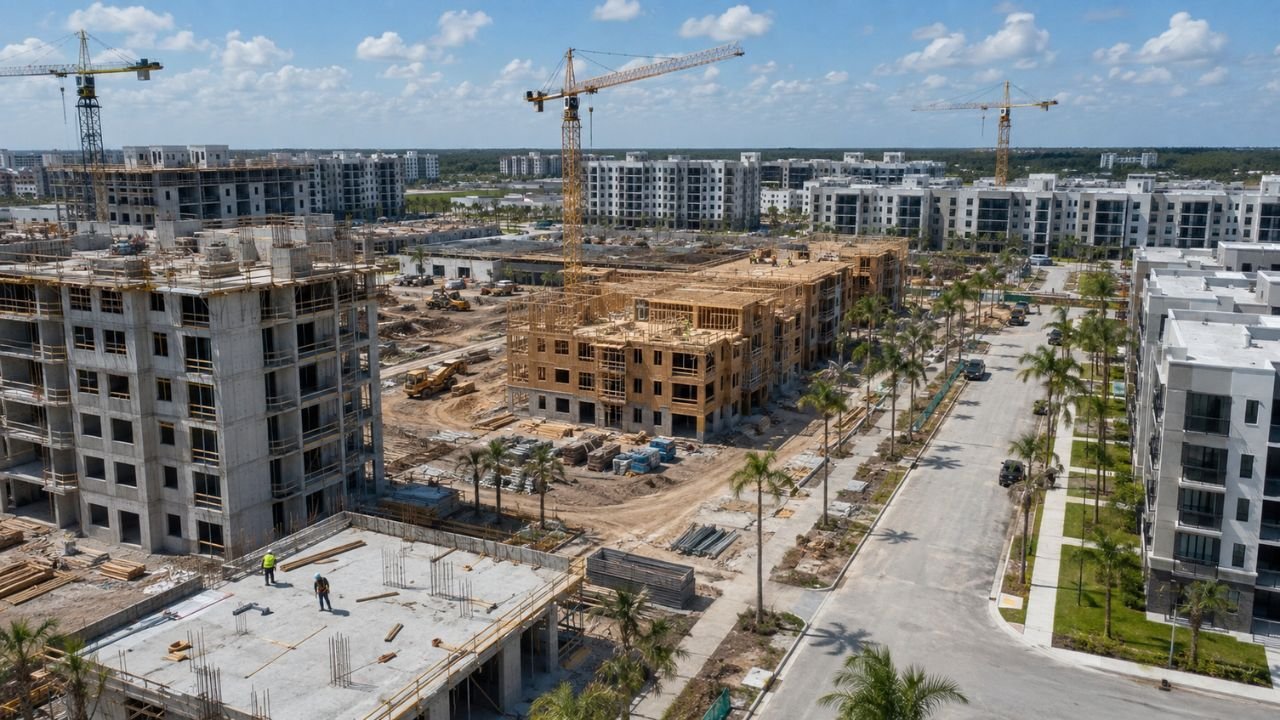
2026 Florida 500-Unit Construction Cost Snapshot
| Metric | Range (Mid-Range to Luxury) |
|---|---|
| Total Project Cost | $135M – $235M+ |
| Cost Per Unit | $270,000 – $470,000 |
| Cost Per Square Foot | $210 – $340 |
| Primary Drivers | Hurricane codes, insurance, labor, and unit mix. |
For accurate cost estimation of a 500-unit apartment complex, detailed BOQ, or professional estimation support, WhatsApp or call us today at +91 8630676890.
Average Cost to Build a 500 Unit Apartment Complex in Florida (2026)
Building at a scale of 500 units moves a project into the “Institutional Grade” category. At this level, you are likely looking at a mix of multiple 3–4 story buildings (garden-style) or a large mid-rise structure. According to the latest 2026 multifamily construction cost trends in the United States, Florida remains one of the most active but complex states for development.
We at Estimate Florida have observed that “base costs” no longer exist in Florida. Every project is “site-specific.” For a 500-unit complex, the economies of scale start to kick in regarding material procurement, but these are often offset by the sheer volume of “High-Velocity Hurricane Zone” (HVHZ) requirements.
In 2026, a standard mid-range 500-unit project will rarely fall below the $135 million mark when including land and soft costs. High-end developments in South Florida can easily exceed $250 million.
Cost Per Unit and Square Foot Benchmarks
When evaluating 500 unit apartment construction cost Florida 2026, metrics are vital for initial feasibility.
- Cost Per Unit: This is the most common metric used by investors. In North Florida, you might see $270k–$310k per unit. In Miami-Dade or Palm Beach, $400k per unit is becoming the baseline for new Class-A developments.
- Cost Per Square Foot: This typically covers the “Hard Costs” of the building. With the current apartment construction cost benchmarks for Florida projects, residential square footage costs have stabilized but remain elevated due to specialized glazing and roofing requirements.
| Project Grade | Cost Per Unit | Cost Per Sq. Ft. |
|---|---|---|
| Affordable/Standard | $250,000 – $290,000 | $190 – $220 |
| Mid-Range/Market Rate | $300,000 – $380,000 | $230 – $280 |
| Luxury/High-Rise | $400,000 – $550,000+ | $300 – $450+ |
Detailed Cost Breakdown: From Land to Contingency
A 500-unit project is a massive financial engine. Understanding where the capital is allocated is the first step in professional house construction estimation services.
1. Land Acquisition (10–15%)
In Florida, land cost varies wildly. In rural parts of Pasco County, it might be $15k per unit. In downtown Tampa or Orlando, land can easily cost $60k–$100k per door.
2. Site Development (8–12%)
Florida’s topography (or lack thereof) presents unique challenges. This includes drainage systems (retention ponds), utility hookups, paving 500+ parking spots, and environmental mitigation.
3. Shell and Core / Hard Costs (55–65%)
This is the bulk of your budget. It covers the foundation, framing, roofing, and MEP (Mechanical, Electrical, Plumbing) systems. In Florida, the shell must adhere to the Florida Building Code and multifamily construction requirements regarding wind load.
4. Finishes and Interiors (10–15%)
Kitchens, flooring, paint, and cabinetry for 500 kitchens and 700+ bathrooms.
5. Soft Costs and Fees (15–20%)
Architectural fees, legal, insurance (the biggest Florida variable), and municipal impact fees.
6. Contingency (5–10%)
Essential for a project of this scale to handle price fluctuations in TMT steel or concrete.
For accurate cost estimation of a 500-unit apartment complex, detailed BOQ, or professional estimation support, WhatsApp or call us today at +91 8630676890.
Key Factors Affecting Florida Construction Costs
Why does it cost so much to build in the Sunshine State? The factors are unique to the peninsula.
- Hurricane Requirements: Everything from the roof tie-downs to the impact-resistant windows must withstand 140–170 MPH winds. This adds roughly 15–20% to the shell cost compared to inland states.
- Insurance Crisis: In 2026, Builder’s Risk and General Liability insurance in Florida have reached record highs. This often adds $5,000 to $10,000 per unit to the soft costs.
- Labor Market: While Florida has a large construction workforce, the demand is so high that “trade premiums” are common. Specialized HVAC and electrical contractors are in high demand.
- Impact Fees: Florida counties use impact fees to fund schools, roads, and parks. For a 500-unit project, these fees alone can exceed $5 million in certain jurisdictions.
Wood-Frame vs. Concrete vs. Steel: The Structural Price Gap
The construction method significantly alters the cost to build apartments in Florida.
- Wood-Frame (Type V): The most common for garden-style (3-story) apartments. It is the most cost-effective but faces the highest insurance premiums in Florida.
- Concrete Block / Post-Tensioned Concrete: Standard for mid-rise (5–8 stories). It offers superior hurricane resistance and lower insurance costs, but higher material and specialized labor costs.
- Steel Frame: Less common for residential but used in high-density urban “podium” designs.
| Feature | Wood Frame | Concrete | Steel |
|---|---|---|---|
| Cost | Lowest | Medium-High | Highest |
| Insurance Cost | Very High | Low | Low |
| Build Speed | Fast | Moderate | Moderate |
| Wind Resistance | Standard | Excellent | Excellent |
Hard Costs vs. Soft Costs Explained
Understanding this distinction is critical when using house construction cost estimation services.
Hard Costs are the tangible assets: the concrete, the steel, the drywall, and the labor that physically assembles them. For a 500-unit project, this is the “sticks and bricks” budget.
Soft Costs are the intangible but mandatory expenses. In Florida, these include:
- Architecture & Engineering: 3–6% of total cost.
- Permitting & Impact Fees: Can be up to 10% in high-growth areas.
- Financing Costs: Interest on a $150M loan during a 24-month build.
- Marketing & Leasing: Budget for the “lease-up” phase of 500 units.
Regional Variations Within Florida
The multifamily construction cost Florida depends heavily on the zip code.
| Region | Primary Hubs | Estimated Cost Per Unit (2026) |
|---|---|---|
| South Florida | Miami, Ft. Lauderdale, Palm Beach | $420,000 – $550,000 |
| Central Florida | Orlando, Tampa, St. Petersburg | $320,000 – $410,000 |
| Northeast Florida | Jacksonville, St. Augustine | $270,000 – $340,000 |
| Florida Panhandle | Pensacola, Tallahassee | $250,000 – $320,000 |
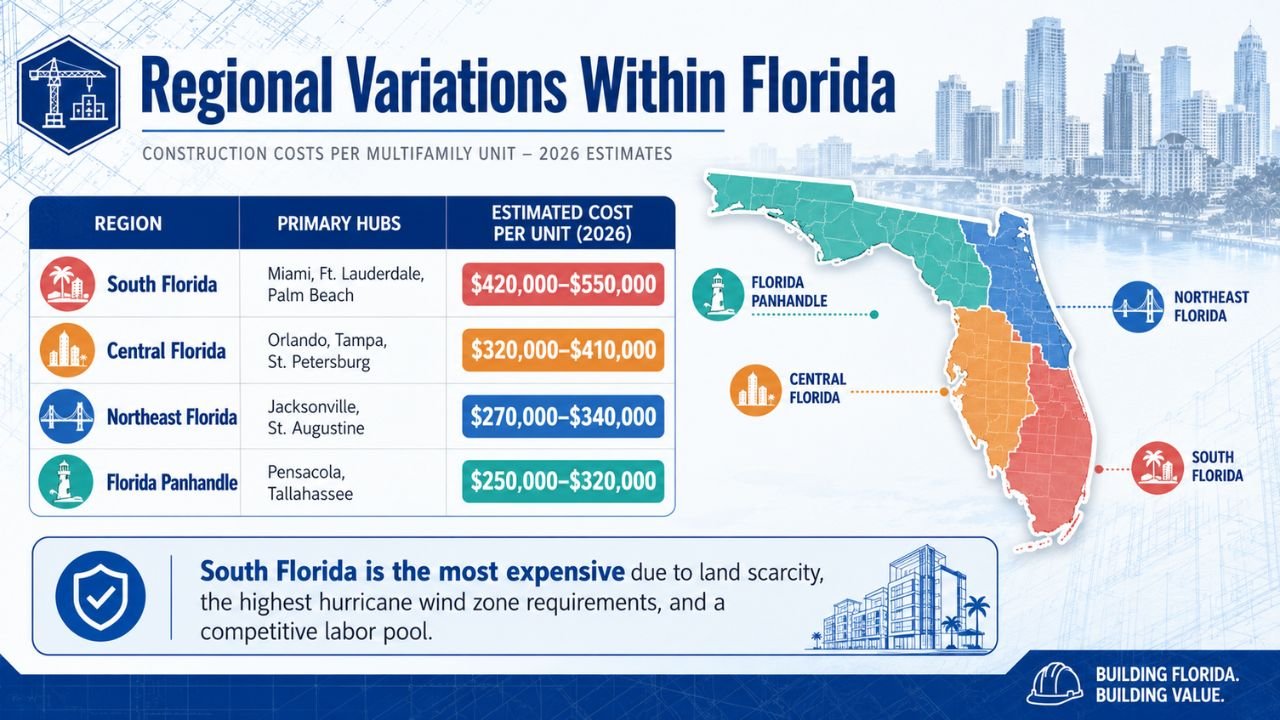
South Florida is the most expensive due to land scarcity, the highest hurricane wind zone requirements, and a competitive labor pool.
Preparing an Accurate BOQ for Large Multi-Family Projects
For a 500-unit project, a standard “guesstimate” is a recipe for bankruptcy. You need a detailed Bill of Quantities (BOQ). We at Estimate Florida utilize our our 10+ years of construction estimating expertise to provide international-grade quantity takeoffs.
An accurate BOQ for a 500-unit complex includes:
- Civil Takeoffs: Exact cubic yardage of concrete for foundations and parking.
- Structural Quantities: Tonnage of reinforcement steel and framing lumber.
- MEP Schedules: Detailed counts of every HVAC unit, water heater, and electrical panel.
- Finish Schedules: Thousands of square yards of carpet, tile, and paint.
By breaking the project down into its atomic units, we eliminate the “buffer” that contractors often add to cover their own uncertainty.
Common Cost Overruns and How to Avoid Them
Large-scale multifamily development cost Florida projects often bleed money through three main avenues:
- Scope Creep: Changing floor plans or amenity finishes (e.g., upgrading the clubhouse pool) mid-construction.
- Unforeseen Soil Conditions: Florida’s limestone and high water table can lead to massive foundation surcharges if not caught during pre-construction.
- Material Lead Times: In 2026, specialized electrical switchgear and elevators have long lead times. Delays in delivery result in “carrying costs” of millions per month.
The Solution: Professional pre-construction estimation. Getting a detailed cost analysis before you break ground allows you to “value engineer” the project early.
How Estimate Florida Supports Your Project
While we are rooted in Florida, our estimation team provides specialized support for the US market, particularly Florida. We understand the international standards required for multi-family developments.
- Fast Quantity Takeoffs: We process massive architectural sets to provide quantities in record time.
- BOQ Services: We provide tender-ready BOQs that you can send to general contractors in Florida for bidding.
- 3D Renderings: Visualize your 500-unit complex to attract investors and pre-leasing.
- Global Expertise: We bridge the gap between architectural vision and financial reality.
For accurate cost estimation of a 500-unit apartment complex, detailed BOQ, or professional estimation support.
Frequently Asked Questions (FAQ)
- How long does it take to build a 500-unit apartment complex in Florida?
Typically, 20 to 30 months from groundbreaking. This includes site work, shell construction, and interior finishing. Permitting can add another 6–12 months. - What is the biggest hidden cost in Florida construction?
Impact fees and insurance. Developers often underestimate these by millions of dollars. In 2026, insurance premiums alone can make a project unbankable if not estimated correctly. - Does 500 units qualify for “Institutional” pricing?
Yes. At this volume, you can negotiate directly with manufacturers for items like appliances, flooring, and windows, often saving 10–15% on material costs. - Why is concrete preferred over wood for Florida mid-rises?
Durability and insurance. While concrete is more expensive to build, the savings in annual insurance premiums and the marketing value of “hurricane-proof” construction often outweigh the initial cost. - How much should I budget for amenities (Clubhouse, Pool, Gym)?
For a 500-unit community, expect to spend $5 million to $10 million on high-end amenities to remain competitive in market-rate developments. - Can Estimate Florida provide estimates for US-based codes?
Absolutely. Our team is trained in international quantity takeoff standards and can provide the data required for US-based contractors to price their labor and materials.
Conclusion: Securing Your Investment with Precision
Building a 500-unit apartment complex in Florida is a high-stakes endeavor. In 2026, the margin for error is razor-thin. Whether you are dealing with apartment building cost per square foot Florida variations or navigating the complex multifamily construction cost Florida landscape, your success depends on the accuracy of your initial estimate.
Don’t leave your multi-million dollar investment to chance. By partnering with experts who provide professional house construction estimation services, you gain the clarity needed to secure financing, win over investors, and ensure your project is completed profitably.
For accurate cost estimation of a 500-unit apartment complex, detailed BOQ, or professional estimation support,