Understanding labor expenses is the most critical element of planning any residential or commercial painting project in Sunshine State properties. Because labor represents 60% to 80% of the overall painting project price in Florida, knowing how daily labor rates are calculated helps property owners, builders, and general contractors make informed budgeting decisions.
Painter Daily Rates in Florida
If you are asking how much should I pay a painter per day in Florida, the customer-facing billing rate for a professional painter typically ranges between $300 and $600 per day for direct labor, or $350 to $800+ per day per worker when hiring a licensed painting contractor crew. Individual apprentice painters or helpers may cost $200 to $300 per day, while specialized lead painters can command $450 to $700+ per day. Exact rates depend on experience, geographic market, surface prep requirements, and whether materials and equipment overhead are included.
Painter Day Rates in Florida (Approximate 2026 Labor Rates)
To help visualize how painter rates vary across skill levels and project roles, the following table details approximate customer-facing daily rates for standard 8-hour workdays across Florida.
| Painter Type | Approximate Daily Rate (Customer Price) | Key Factors Affecting Cost |
|---|---|---|
| Painter Helper / Laborer | $180 – $280 | Basic setup, masking, moving ladders, site cleanup, low skill requirements. |
| Apprentice Painter | $220 – $320 | Entry-level painting, basic surface preparation, sanding, caulking support. |
| General Residential Painter | $300 – $420 | Standard wall/ceiling painting, brush & roller work, standard interior repaints. |
| Experienced Journeyman Painter | $380 – $520 | High-efficiency spraying, fine trim work, detailed cut-ins, exterior stucco coatings. |
| Lead Painter / Crew Supervisor | $450 – $650 | On-site crew management, quality control, client communication, complex prep supervision. |
| Specialized Coating Applicator | $500 – $850+ | Epoxy floor systems, elastomeric waterproofing, multi-story scaffolding, historic restoration. |
| Fully Burdened Contractor Billing Rate (Per Painter) | $350 – $750+ | Includes direct worker pay, payroll taxes, workers’ compensation, liability insurance, overhead, and profit margin. |
Note: All listed rates represent approximate customer-facing costs per standard 8-hour workday and do not constitute fixed quotes. Actual rates vary based on scope, location, and site conditions.
Painter Wage vs. Painter Day Rate vs. Contractor Price
A frequent source of confusion when evaluating painting labor costs is conflating an individual worker’s wage with the amount a customer pays to hire that painter or contractor. Understanding these three distinct cost tiers is essential for accurate budgeting:
1. The Painter’s Take-Home Wage
This is the direct hourly or daily rate earned by the individual employee or tradesperson. According to industry labor market data, an employed residential painter in Florida typically earns between $18 and $28 per hour (translating to roughly $144 to $224 per day before taxes). This amount represents raw earnings and excludes employer burden or operating costs.
2. Direct Labor-Only Billing Day Rate
When hiring an independent tradesperson directly for a labor-only arrangement (where the client supplies all paint, primer, tape, and scaffolding), the daily labor rate typically ranges from $250 to $450 per day. This rate covers the worker’s personal time, basic hand tools, and self-employment taxes, but does not include corporate overhead or broader liability protections.
3. Fully Burdened Painting Contractor Price
When hiring an established, insured painting contractor, the customer price charged per worker per day ranges from $350 to $750+ per day. This price reflects the complete cost of doing business in Florida, encompassing:
- Direct Employee Compensation & Benefits: Base wage, health benefits, and overtime reserves.
- Payroll Taxes & Workers’ Compensation: Florida workers’ compensation insurance rates for painting trades are substantial due to ladder and scaffolding risks.
- General Liability & Commercial Auto Insurance: Essential protection against property damage, water intrusion, or storm exposure.
- Equipment & Consumables: Sprayers, pressure washers, ladders, staging, drop cloths, tape, and masking materials.
- Administrative Overhead & Supervision: Project managers, estimators, administrative staff, and vehicle fuel.
- Business Operating Margin: Net profit required to maintain a sustainable trade enterprise.
How Much Does a Painter Make Per Day in Florida?
When analyzing how much does a painter make in Florida, it is helpful to convert hourly wage figures published by authoritative sources like the U.S. Bureau of Labor Statistics (BLS) into daily earnings.
For illustrative purposes:
- Entry-Level Painter: $18/hour × 8 hours = $144/day direct wage.
- Mid-Level Journeyman: $23/hour × 8 hours = $184/day direct wage.
- Master / Lead Painter: $30/hour × 8 hours = $240/day direct wage.
However, a contractor billing a client $400 to $500 per day for that same journeyman painter is not earning a $300 daily profit. After accounting for statutory labor burden (payroll taxes, workers’ comp, unemployment insurance) which typically adds 25% to 40% to base wages, alongside operating overhead (20% to 30%) and material waste, the contractor’s net profit margin usually falls between 10% and 20%.
Regional Cost Differences Across Florida
Painter daily rates are not uniform across the state. Regional cost-of-living metrics, local construction demand, property values, and municipal regulatory requirements drive significant pricing variances between metropolitan areas:
- South Florida (Miami, Fort Lauderdale, Boca Raton, West Palm Beach): Daily rates trend higher ($400 – $750+ per day) due to elevated living expenses, strict coastal building standards, High-Velocity Hurricane Zone (HVHV) considerations, and high demand for luxury finishes.
- Southwest Florida (Naples, Fort Myers, Sarasota): High concentration of luxury residential communities and HOA developments yields daily billing rates ranging from $380 to $650 per day.
- Central Florida (Orlando, Tampa, St. Petersburg, Daytona Beach, Melbourne): Strong commercial growth and suburban residential expansion create steady labor demand, with typical daily rates of $320 to $550 per day.
- North Florida & Panhandle (Jacksonville, Pensacola, Tallahassee): Highly competitive regional labor markets generally reflect daily rates ranging from $280 to $480 per day.
Local market density and property access also influence rates; dense urban high-rises in downtown Miami demand specialized logistics that increase daily billing compared to single-story suburban tracts in Ocala.
Florida Climate Factors Affecting Painting Labor
Florida’s tropical climate impacts paint chemistry, surface longevity, and labor requirements. Painters in Florida face unique environmental challenges that directly affect daily productivity and job complexity:
High Humidity and Rain Windows
High humidity slows paint drying and curing times. In Florida’s summer rainy season (June through October), afternoon thunderstorms cut workday application windows short. Painters must structure daily schedules around surface dryness to prevent bubbling, surfactant leaching, or premature coating failure.
Intense Sun and UV Degradation
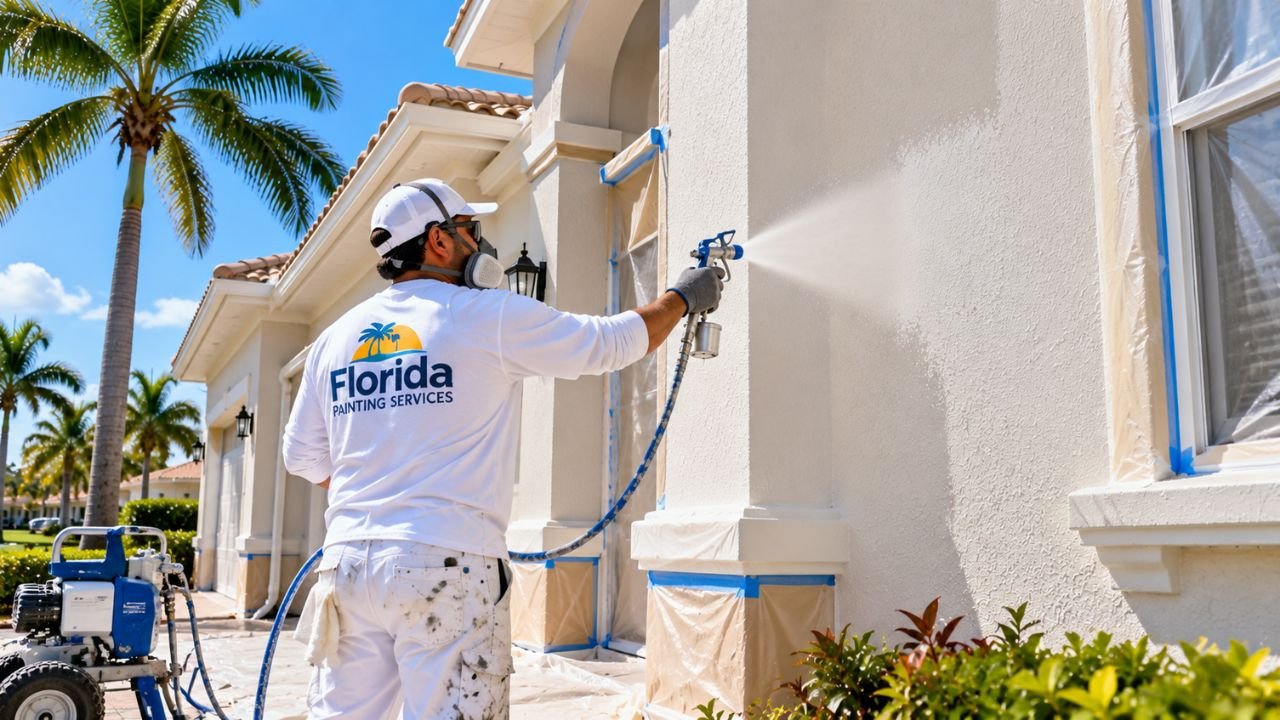
Extremely strong UV radiation breaks down chemical paint binders rapidly, resulting in severe surface “chalking”. Florida painters spend significantly more labor hours pressure washing and scraping chalky residues off stucco walls before applying topcoats than painters in milder climates.
Coastal Salt Air
Properties located within five miles of the Atlantic or Gulf coasts accumulate salt deposits that destroy paint adhesion. Labor required to thoroughly wash, neutralize, and prime salt-exposed masonry or metal surfaces increases daily labor time.
Stucco Substrates and Moisture Trapping
Over 80% of Florida homes utilize concrete block and stucco construction. Highly textured stucco (such as lace or knockdown) absorbs up to 25% more material and requires slower, back-rolling labor methods to ensure complete void coverage compared to smooth drywall.
How Much Can a Painter Paint in One Day? (Productivity Standards)
Understanding daily labor productivity allows contractors and property owners to convert daily painter rates into realistic project schedules. Painter output varies widely depending on application method, surface texture, prep intensity, and spatial layout:
| Surface / Task | Average Daily Production (1 Painter, 8-Hour Day) | Key Assumptions |
|---|---|---|
| Interior Walls (Roller & Brush) | 800 – 1,200 sq. ft. (1 coat) | Standard 8 ft. ceilings, minimal furniture moving, simple cut-in. |
| Interior Walls (Repaint, 2 Coats) | 400 – 600 sq. ft. (2 coats) | Standard prep, edge masking, minor nail hole patching. |
| Interior Ceilings (Rolling) | 500 – 800 sq. ft. (1 coat) | Open room, standard height, drop cloth protection. |
| Exterior Stucco Walls (Airless Spray + Back-Roll) | 1,200 – 2,000 sq. ft. (1 coat) | Fully masked windows/doors, straightforward access, smooth to medium stucco. |
| Exterior Stucco Prep & Repair | 600 – 1,000 sq. ft. of wall area | Pressure washing, scraping chalk, caulking hairline cracks. |
| Baseboards & Trim (Hand Brush) | 300 – 500 linear feet | Pre-installed, standard profile, single coat application. |
| Doors (Doors & Frames) | 8 – 12 doors (both sides) | Semi-gloss finish, sanding, double coat application. |
Note: Productivity numbers represent net paintable surface area, not home floor square footage. A 2,000 sq. ft. living area home often contains 2,500 to 3,500 sq. ft. of paintable wall surface.
How to Calculate Painter Labor Costs
To estimate total labor expenditure for a painting scope using daily rates, estimators utilize a standard labor formula:Total Labor Cost = (Number of Painters) × (Daily Labor Rate) × (Estimated Working Days)
Additional Labor Factors to Consider
A complete labor estimate must also factor in:
- Site Preparation & Setup: Masking floors, masking windows, hanging plastic sheeting, laying drop cloths.
- Surface Prep Time: Scraping, wire-brushing, pressure washing, patching, caulking joints.
- Daily Cleanup & Material Handling: Cleaning spray lines, washing brushes, storing ladders, disposing of hazardous waste.
- Height Overhead: Working from extension ladders, rolling scaffolding, or aerial boom lifts reduces hourly application speeds by 15% to 30%.
Illustrative Calculation Examples
The following examples illustrate how painter daily rates and productivity standards translate into total project labor costs.
Example 1: Small Interior Bedroom Repaint
- Scope: 12′ × 14′ bedroom (400 sq. ft. wall area), 8 ft. ceiling, 1 door, 2 windows, baseboards. Two coats of latex eggshell paint.
- Labor Required: 1 General Residential Painter for 1 day (8 hours).
- Day Rate: $350/day.
- Labor Calculation: 1 Painter × $350/day × 1 Day = $350 Total Labor.
- Note: Includes 2 hours of masking/prep, 4 hours of wall rolling (2 coats), and 2 hours of trim cut-in/cleanup.
Example 2: Whole-House Interior Painting
- Scope: 2,200 sq. ft. home (living area) needing walls, doors, and trim repainted. Total wall/ceiling paintable surface area: 4,800 sq. ft.
- Crew Size: 3 Painters (1 Lead Painter @ $500/day, 2 Journeymen @ $380/day = $1,260 total daily crew cost).
- Estimated Duration: 4 Working Days.
- Labor Calculation: $1,260 crew daily cost × 4 Days = $5,040 Total Labor.
Example 3: Exterior Stucco Home Repaint
- Scope: Two-story Florida stucco residence with 3,000 sq. ft. of exterior wall surface area. Includes pressure washing, elastomeric crack patching, full priming, and 2 finish coats.
- Crew Size: 3 Painters ($1,300 total daily crew cost including equipment allowances).
- Duration Breakdown:
- Day 1: Pressure washing, chemical mildew treatment, 24-hour drying period setup.
- Day 2: Masking windows, scraping chalk, elastomeric caulking, spot priming.
- Days 3–4: Airless spraying and back-rolling 2 full coats of 100% acrylic exterior paint.
- Day 5: Painting fascia, soffits, front entry door, site breakdown, final walk-through.
- Labor Calculation: $1,300 crew cost × 5 Days = $6,500 Total Labor.
Day Rate vs. Alternative Painting Pricing Methods
Choosing the right contractual pricing structure depends on project clarity, scope stability, and job size:
| Pricing Method | Advantages | Potential Drawbacks | Best Used For |
|---|---|---|---|
| Day Rate (Per Diem) | Simple structure; flexible for open-ended scopes or punch lists. | Total cost can inflate if workers lack efficiency or encounter unexpected delays. | Small repairs, touch-up work, multi-trade punch lists, custom accent work. |
| Hourly Rate | Highly precise for short-duration tasks; pay only for exact time worked. | Requires close monitoring of active working hours; zero cost caps. | Hourly service calls, diagnostic moisture testing, emergency storm prep. |
| Square Foot Pricing | Fast, standardized estimating; clear benchmarking based on physical area. | Doesn’t account easily for extreme prep needs, intricate trim, or custom colors. | New construction drywall painting, large open commercial spaces. |
| Fixed Project Price (Lump Sum) | Maximum budget certainty; contractor absorbs risk of minor labor overruns. | Higher initial contractor contingency markup included in bid. | Complete house repaints, full commercial renovations, defined architectural plans. |
| Cost-Plus (Time & Materials) | Full financial transparency; ideal when hidden structural damage is likely. | Final price is uncertain until work is complete; requires meticulous auditing. | Historic restorations, extensive wood rot or stucco repair projects. |
When Should You Pay a Painter by the Day?
Paying a painter or small crew on a daily rate basis makes practical sense under specific project conditions:
- Uncertain Scope of Work: Projects where full prep needs cannot be determined until furniture is moved or wallpaper is stripped.
- Punch-List and Detail Touch-Ups: Finalizing multi-room residential remodels or commercial tenant build-outs where minor touch-ups are scattered across multiple areas.
- Owner-Managed Renovations: Real estate investors or general contractors who manage site logistics directly and supply all coatings and materials.
- Specialty Accent or Artisan Work: Custom murals, faux finishes, or decorative Venetian plaster where application speed varies by artistic complexity.
Conversely, for large-scale exterior repaints or full interior projects, a fixed project price based on a thorough quantity takeoff provides far better financial protection.
16 Factors That Increase Daily Painter Costs
When budgeting painter labor, consider these 16 project variables that drive daily rates upward:
- Level of Surface Preparation: Heavy scraping, chemical stripping, extensive caulking, or wide crack repair adds days of labor before painting begins.
- Height and Vertical Accessibility: Multi-story homes requiring tall extension ladders, staging, or articulating boom lifts reduce daily production speeds.
- Substrate Condition & Porosity: Rough knockdown stucco or weathered wood siding absorbs significantly more coating and requires intensive back-rolling.
- Intricate Architectural Trim: Detailed crown molding, coffered ceilings, wainscoting, and multi-pane window grids require meticulous hand brushing.
- Color Changes & Transitions: Transitioning from dark wall colors to light shades requires extra primer applications and precise cut-in lines.
- Specialized Performance Coatings: Applying two-part epoxies, elastomeric membranes, or high-performance industrial coatings demands specialized applicator training.
- Occupied Space vs. Vacant Site: Working in occupied homes requires extensive furniture moving, double drop-cloth coverage, and daily equipment storage.
- Site Access Constraints: Limited property line clearance in dense urban areas (e.g., downtown Miami) complicates ladder placement and material movement.
- Urgent or Off-Hours Scheduling: Nighttime, weekend, or holiday commercial schedules trigger overtime wage rates.
- Geographic Location & Cost of Living: High-cost coastal markets command elevated hourly labor rates compared to rural inland areas.
- Safety and Hazardous Material Handling: Lead-based paint abatement on pre-1978 structures requires EPA RRP containment protocols and specialized safety gear.
- High Moisture / Mildew Contamination: Severe algae or mold buildup requires multi-stage pressure washing with chemical treatments.
- Crew Certification and Training: High-end contractors employing OSHA-certified, background-checked painters charge higher daily labor rates.
- Equipment and Lift Requirements: Specialized equipment rentals (scaffolding, scissor lifts) are billed as additional daily line items.
- Travel Distance and Mobilization: Remote job sites incur daily travel allowances and mobilization fees for crews.
- Commercial Compliance Requirements: Commercial sites demanding specialized safety plans, badging, or drug testing carry higher administrative overhead.
Interior vs. Exterior Painter Labor Rates
While general labor rates per hour remain similar, interior and exterior painting projects differ significantly in labor distribution, risk factors, and equipment requirements:
Interior Painting Dynamics
- Focus Areas: Cleanliness, edge masking, crisp line cut-ins, drywall patching, and protecting flooring/furniture.
- Climate Impact: Climate-controlled indoor environments eliminate weather delays, allowing steady, predictable 8-hour workdays.
- Equipment: Standard ladders, step stools, extension poles, rollers, and hand brushes.
Exterior Painting Dynamics
- Focus Areas: Surface prep (pressure washing, scraping chalk, sealing stucco cracks), weatherproofing, and coating adhesion.
- Climate Impact: Rain, high humidity, and direct sun exposure restrict daily application windows, requiring flexible labor management.
- Equipment: Heavy-duty airless sprayers, 32+ ft. extension ladders, scaffolding, aerial boom lifts, and pressure washers.
- Cost Variance: Exterior labor costs per square foot are typically 15% to 35% higher than basic interior wall painting due to rigorous prep and height risks.
Residential vs. Commercial Painter Labor Rates
Comparing residential and commercial painting projects highlights substantial differences in project execution, pricing models, and crew sizing:
| Factor | Residential Painting | Commercial Painting |
|---|---|---|
| Typical Project Scope | Single-family homes, condos, HOA repaints. | Office buildings, retail centers, hotels, warehouses, healthcare facilities. |
| Working Hours | Standard daytime hours (8:00 AM – 5:00 PM). | Flexible schedules; frequent night, weekend, or phased swing-shift work. |
| Access & Staging | Residential ladders, standard drop cloths. | Articulating boom lifts, scissor lifts, swing stages, containment rigging. |
| Surface Square Footage | 1,500 – 5,000 sq. ft. of paintable surface. | 10,000 – 100,000+ sq. ft. of paintable surface. |
| Crew Sizing | Small crews (2 to 4 painters). | Large crews (5 to 15+ painters) led by dedicated safety directors. |
| Estimating Precision | Standard room counts or manual measurements. | Digital blueprint takeoffs, plan specifications, RSMeans pricing integration. |
Why Quantity Takeoffs Matter When Estimating Painter Labor
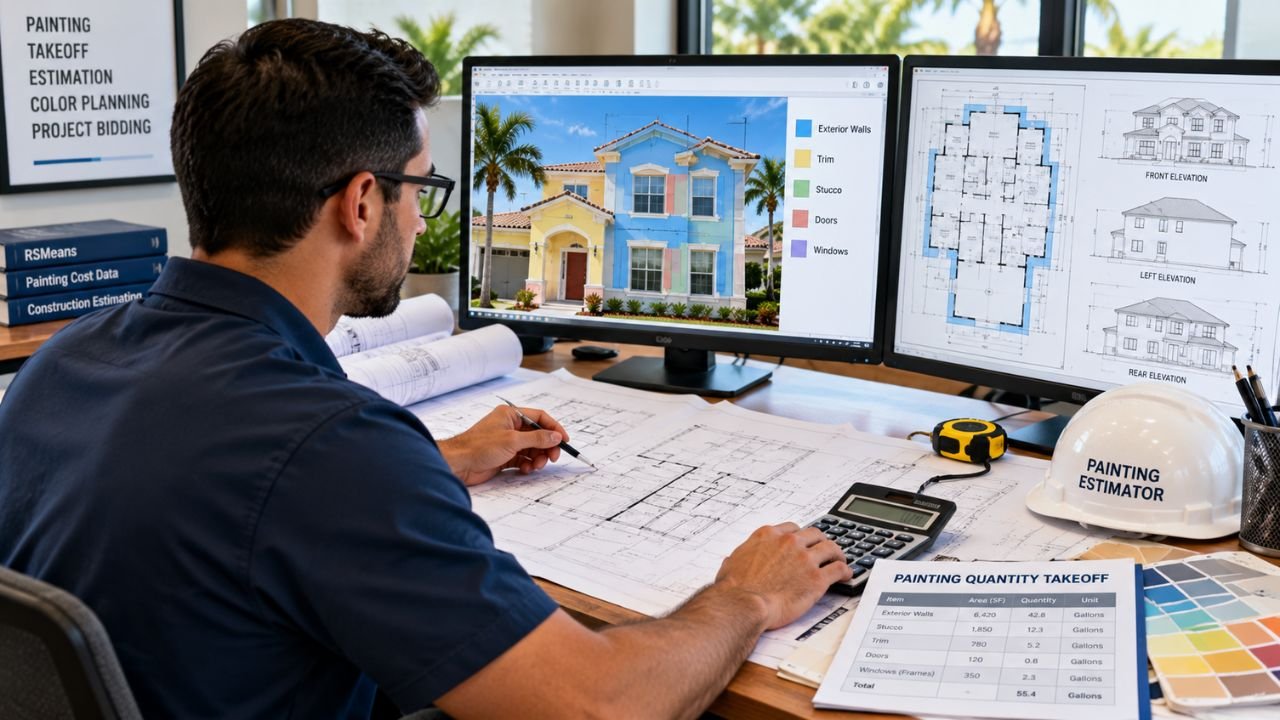
Relying solely on rule-of-thumb daily rates or rough floor area formulas can cause significant cost overruns. A professional quantity takeoff converts architectural plans or physical field measurements into precise surface quantities, ensuring labor estimations are grounded in exact data.
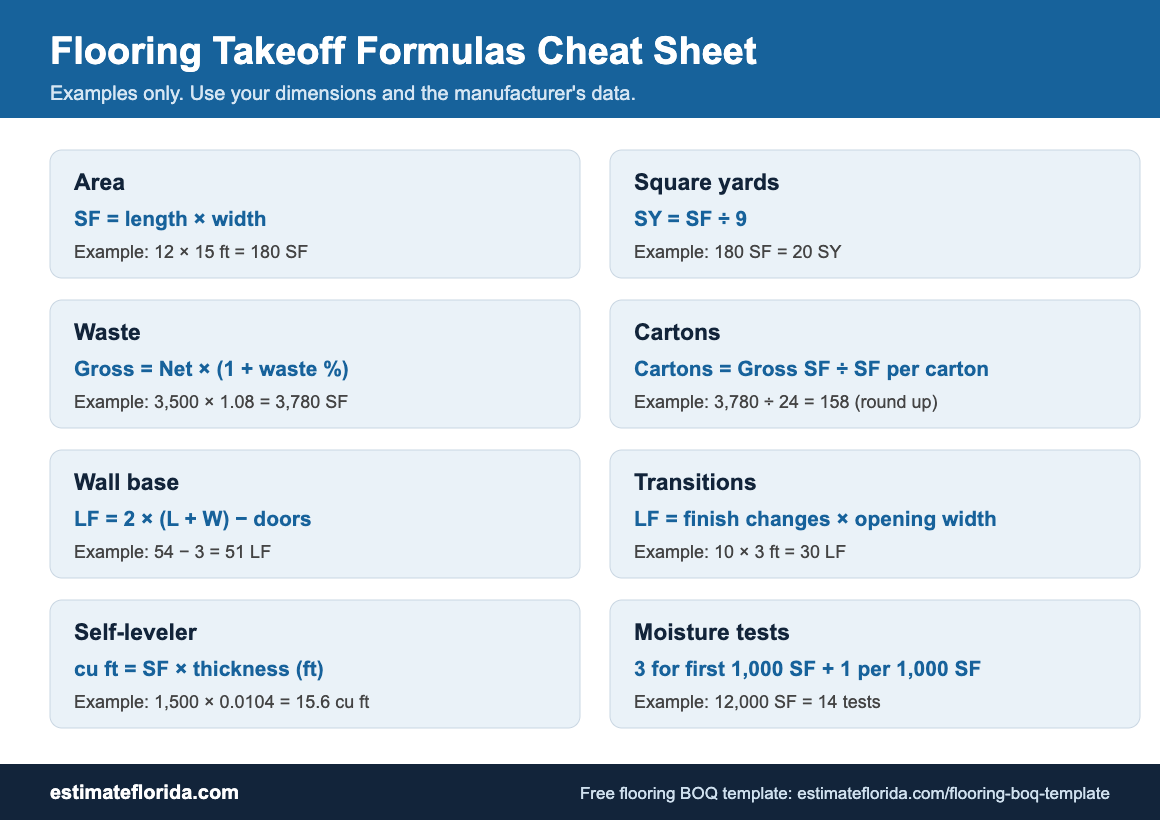
A comprehensive painting quantity takeoff calculates:
- Net Vertical Wall Surface Area: Deducting door and window openings from gross wall areas to determine true paintable square footage.
- Linear Feet of Architectural Trim: Measuring baseboards, crown molding, casing, fascia, and soffits independently.
- Door and Window Counts: Itemizing door types (flush, 6-panel, louvered) and window frames by unit count.
- Substrate-Specific Quantities: Separating smooth drywall, knockdown stucco, wood siding, and metal surfaces to apply correct labor productivity rates.
By pairing precise material and surface quantities with localized Florida productivity factors, project owners and contractors calculate exact labor hours rather than relying on guesswork.
How Estimate Florida Helps With Painting Estimates
Estimate Florida is a dedicated construction estimating and quantity takeoff service provider for residential and commercial projects throughout Florida. Estimate Florida does not perform physical painting contracting or construction work; rather, the firm provides independent, professional cost estimation data to contractors, property owners, developers, and architects.
Estimate Florida supports painting project planning through:
- Painting Quantity Takeoffs: Detailed quantification of interior walls, ceilings, trim, doors, and exterior stucco/siding from architectural blueprints or field measurements.
- Material Takeoff Services: Itemized lists detailing exact gallon requirements for primer, acrylic topcoats, elastomeric sealants, and caulking tubes.
- Labor Hours & Cost Breakdown: Comprehensive labor calculations based on current Florida labor market rates and specific site difficulty metrics.
- Bid Comparison Reports: Standardized bid formats that allow owners to evaluate multiple painting contractor quotes on an itemized, “apples-to-apples” basis.
To streamline your upcoming project budget, submit your project blueprints or scope details directly to Estimate Florida to receive a detailed quantity takeoff report.
Frequently Asked Questions
How much should I pay a painter per day in Florida?
The average customer-facing day rate for a professional painter in Florida ranges between $300 and $600 per day for direct labor, or $350 to $800+ per day per worker when hiring a licensed, insured painting contractor crew. Rates vary depending on experience, location, and prep complexity.
What is the average painter day rate in Florida?
Across Florida, the statewide average daily billing rate for a qualified journeyman painter is approximately $350 to $500 per day for standard residential work, rising to $500 to $750+ per day for specialized commercial or high-access exterior work.
How much does a painter make per hour in Florida?
Employed painters in Florida typically earn direct wages between $18 and $28 per hour ($144 to $224 per day before taxes). However, contractors bill client labor at $40 to $75+ per hour ($320 to $600+ per day) to cover workers’ compensation, liability insurance, payroll burden, overhead, and profit margins.
How much does a painter make per day?
An individual painter working as an employee earns approximately $140 to $240 per day in base pay, depending on skill level. An independent painting contractor billing clients typically collects $350 to $600+ per day per worker to cover full business operating expenses.
Is it better to pay a painter hourly or daily?
Daily rates are ideal for smaller, flexible tasks or punch-list repairs where the exact scope is evolving. For complete home interiors or exterior repaints, a fixed total project price based on a thorough quantity takeoff offers better cost control.
How much should a professional painter charge per day?
A professional painting contractor should charge between $350 and $750 per worker per day. This rate accounts for professional-grade equipment, liability insurance, workers’ compensation coverage, high-quality surface prep, and warranty support.
Does a painter’s experience affect the daily rate?
Yes. Helpers and apprentices charge lower rates ($180–$300/day), standard residential painters command mid-tier rates ($300–$420/day), while experienced lead painters and master spray applicators command $450 to $700+ per day due to superior speed and skill.
Do painter day rates include materials?
Usually, daily labor rates cover labor, basic hand tools, and standard application equipment (sprayers, drop cloths, brushes). Paint, primer, specialty sealants, and heavy scaffolding/lift rentals are typically billed separately or itemized within a total estimate.
How much does an exterior painter cost per day in Florida?
Exterior painting labor in Florida generally ranges from $350 to $650 per painter per day. Higher costs reflect the rigorous surface prep required for Florida stucco, ladder work, and weather-dependent scheduling.
How much does an interior painter cost per day in Florida?
Interior painting labor in Florida typically ranges from $300 to $500 per painter per day for standard walls and ceilings, increasing when intricate trim, doors, or multi-color schemes are involved.
What affects painter labor costs in Florida?
Key factors include surface preparation needs, height and ladder accessibility, substrate porosity (smooth vs. rough stucco), local cost of living, weather conditions, and whether the project is residential or commercial.
Can Estimate Florida provide a painting labor estimate?
Yes. Estimate Florida prepares independent painting quantity takeoffs and detailed material/labor cost estimates for residential and commercial construction projects across Florida.