For Florida homeowners and developers, the outdoor living space is often the centerpiece of the property. Whether it is a sprawling pool deck in Naples or a compact screened porch in Orlando, these structures provide essential protection from the state’s intense sun and notorious insect populations. However, building or replacing these enclosures requires more than just a cursory glance at a price-per-square-foot chart.
Accurate cost estimating is the foundation of any successful construction project. A professional pool cage / lanai cost estimator Florida analyzes the intricate details of aluminum framing, screen specifications, and Florida-specific structural requirements to ensure that a project remains on budget and compliant with local standards. For contractors, a precise quantity takeoff means the difference between a profitable bid and an expensive oversight. For property owners, it provides the transparency needed to evaluate contractor proposals fairly. This guide explores the variables that drive enclosure costs across the Sunshine State and demonstrates how professional estimating services can streamline the preconstruction process.
What Is a Pool Cage or Lanai?
In the Florida construction market, terminology can vary by region, but the core function of these structures remains the same: creating a protected transition between the indoors and the outdoors.
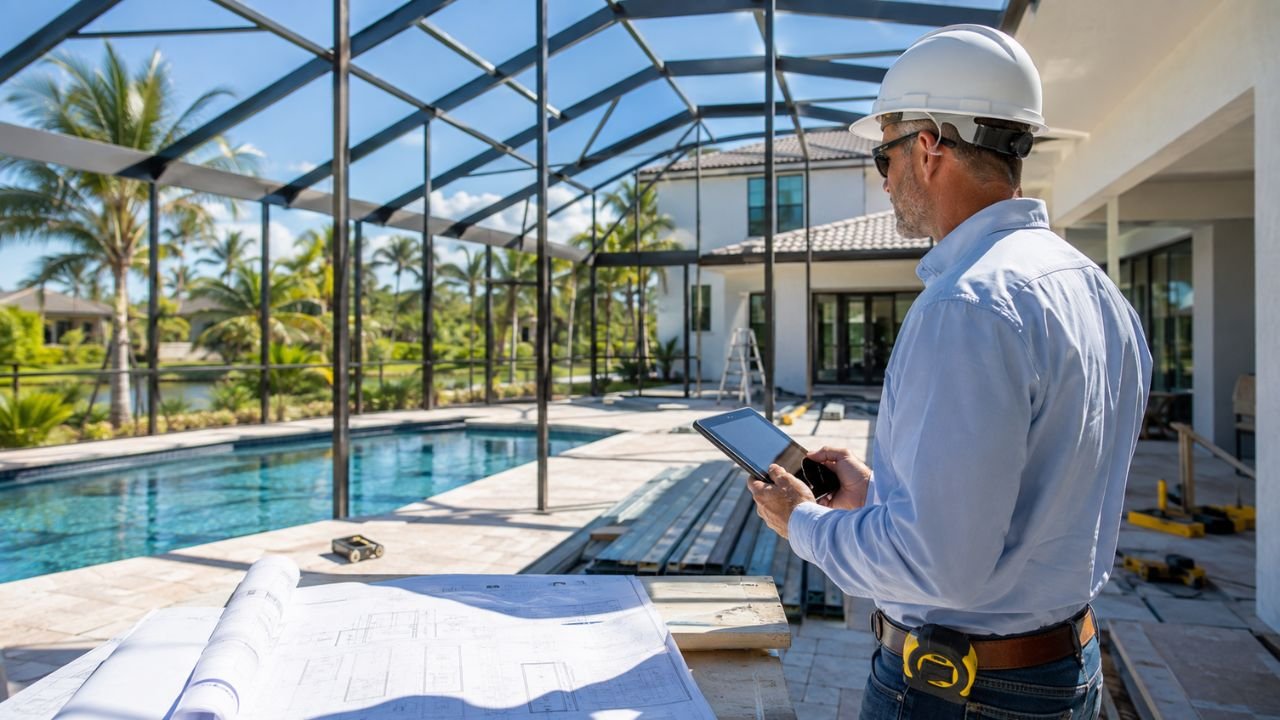
- Pool Cages: Also known as full screen enclosures, these structures typically cover the entire pool and deck area. They are constructed using an aluminum cage system and high-quality screening.
- Lanais: While often used interchangeably with “porch” or “patio,” a lanai specifically refers to a covered outdoor living area that is usually under the main house roof but remains open to the elements or is screened in.
- Aluminum Screen Enclosures: This is the technical term for the framing and mesh system used to create both pool cages and screened lanais.
- Attached and Detached Enclosures: Most residential enclosures are attached to the existing house structure, but detached “screen rooms” are common for larger estates or commercial properties.
While a homeowner in Miami might call their enclosure a pool cage, a builder in the Panhandle might refer to a similar structure as a screened-in lanai. Regardless of the name, the estimating process focuses on the same structural components and material requirements.
What Is a Pool Cage / Lanai Cost Estimator?
A cost estimator does not just guess a price; they perform a comprehensive evaluation of the project’s physical and logistical requirements. They review architectural drawings or site measurements to determine the exact scope of work. Key elements evaluated include:
- Project Dimensions and Footprint: The total area covered by the enclosure.
- Height and Layout: Higher walls require more aluminum and specialized bracing.
- Roof Configuration: Whether the roof is a Mansard, Gable, Hip, or Dome design.
- Aluminum Framing: Quantifying the linear feet of 2×3, 2×4, or 2×5 aluminum members.
- Structural Components: Analyzing the need for hurricane straps, K-bracing, and structural gutters.
- Labor and Materials: Applying current Florida market rates for both specialty aluminum labor and raw materials.
Preliminary Pool Cage Estimate
A preliminary estimate is typically used during the feasibility stage. It provides a ballpark figure based on standard sizes and basic configurations. It is helpful for initial budgeting but lacks the precision needed for final bidding.
Detailed Pool Cage Construction Estimate
This is a comprehensive report that includes labor, materials, equipment, and overhead. It accounts for site-specific conditions, such as property access or the condition of an existing slab.
Pool Cage Quantity Takeoff
A quantity takeoff is the process of measuring every single item on the plans. It results in a list of materials (the “bill of materials”) including every screw, screen roll, and aluminum post needed for the job.
How Much Does a Pool Cage Cost in Florida?
Providing a single guaranteed price for a Florida pool enclosure is impossible because no two projects are identical. However, understanding the variables allows for a more accurate projection. Costs are driven by the complexity of the design and the specific materials chosen.
Actual project costs can vary significantly based on enclosure size, framing design, screen material, roof configuration, labor, location, and existing site conditions. For instance, an enclosure built in a High-Velocity Hurricane Zone (HVHZ) like Miami-Dade County will require heavier-duty aluminum and more frequent bracing than a project in an inland county.
Factors Affecting Final Pricing:
- Roof Design: A flat roof is generally the least expensive, while a Mansard or Hip roof requires more complex cutting and framing.
- Screen Type: Standard 18×14 mesh is the baseline, but specialty options like “No-See-Um” or pet-resistant mesh can increase material costs.
- Site Access: If a contractor cannot get equipment to the backyard easily, labor costs will rise.
- Permitting and Engineering: Florida’s strict building codes often require site-specific engineering, which adds to the preconstruction cost.
Pool Cage Cost Per Square Foot in Florida
The cost-per-square-foot method is a common industry shorthand, but it must be used with caution. While it serves as a useful preliminary estimating tool, it can be misleading if the enclosure has unique vertical requirements.
A square-foot price usually accounts for the floor footprint. However, if you have two 500-square-foot enclosures, but one is 8 feet tall and the other is 12 feet tall, the latter will require significantly more material despite having the same footprint. Additionally, smaller enclosures often have a higher cost per square foot because they lack the economies of scale found in larger commercial or multi-family projects.
Pool Cage Cost by Size
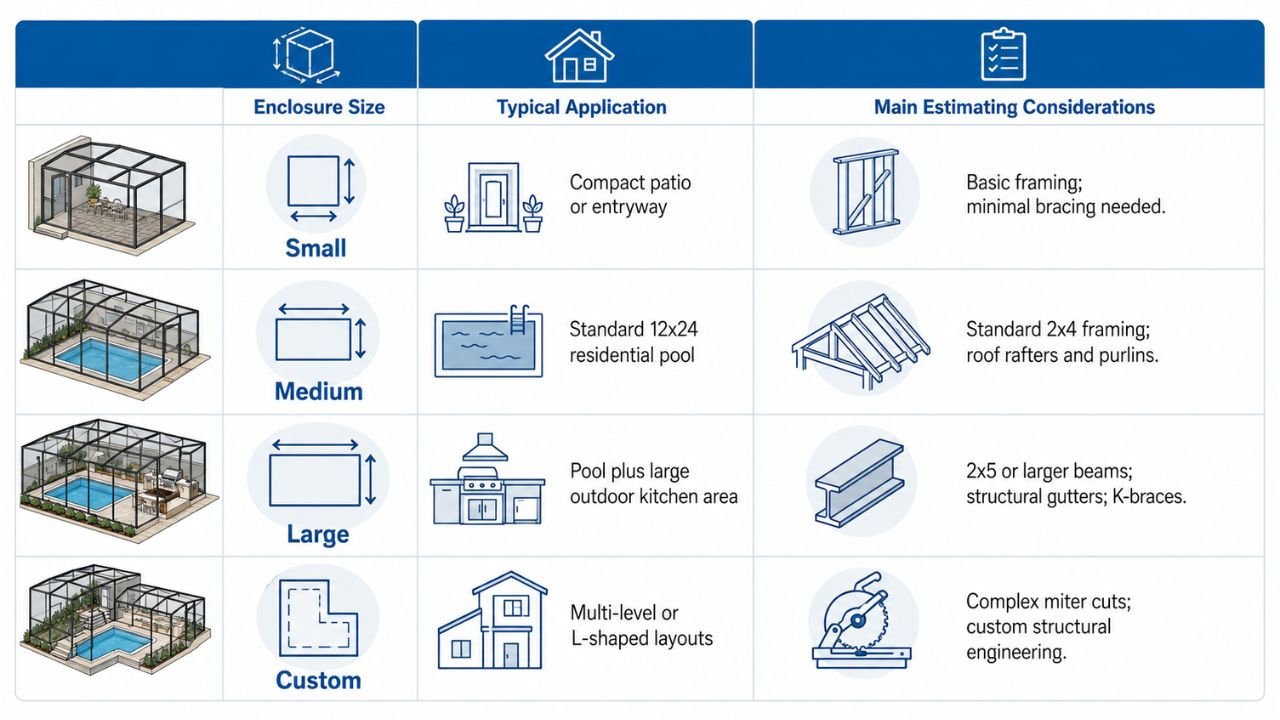
Size is the most obvious cost driver. The following table illustrates how different sizes impact the estimating considerations.
Pool Cage Estimating Considerations by Size
| Enclosure Size | Typical Application | Main Estimating Considerations |
|---|---|---|
| Small | Compact patio or entryway | Basic framing; minimal bracing needed. |
| Medium | Standard 12×24 residential pool | Standard 2×4 framing; roof rafters and purlins. |
| Large | Pool + large outdoor kitchen area | 2×5 or larger beams; structural gutters; K-braces. |
| Custom | Multi-level or L-shaped layouts | Complex miter cuts; custom structural engineering. |
Lanai Cost in Florida
Estimating a lanai often involves more trades than a standard pool cage. Because a lanai is frequently an extension of the home’s roofline, the estimate may need to include:
- Structural Roofing: If the lanai uses a solid roof (insulated composite panels or matching shingles), the cost increases compared to a screen-only roof.
- Flooring and Ceilings: Many lanai projects include tongue-and-groove ceilings or specialized pavers.
- Electrical: Fans, lighting, and outdoor outlets are standard features that must be quantified.
- Doors: Large sliding glass doors or French doors often separate the home from the lanai, requiring precise measurements.
Materials Used in Pool Cages and Lanais
The choice of materials is where a pool cage / lanai cost estimator Florida spends most of their time during a takeoff. Quality materials are essential for surviving Florida’s humidity and wind loads.
Aluminum Framing
The “bones” of the enclosure are made of 6063-T6 structural aluminum. Estimators must account for:
- Posts and Beams: The main vertical and horizontal supports.
- Rafters: The members that form the roof structure.
- Fasteners: High-quality ceramic-coated or stainless steel screws are required to prevent rust.
Screen Material
- Fiberglass Mesh: The standard choice for most Florida homes.
- Polyester (TuffScreen): A more durable, puncture-resistant option popular for homes with pets or high wind exposure.
- Specialty Screens: Privacy screens (Florida Glass) or fine-mesh “No-See-Um” screens.
Roof Systems
The roof is often the most expensive component of the frame.
- Screened Roofs: Allow airflow but require more frequent cleaning.
- Solid Roofs: Provide shade and protection from rain, often using insulated aluminum panels.
Major Cost Components of a Pool Cage or Lanai
When a professional firm like Estimate Florida prepares a report, they break the costs into logical categories to provide a clear picture of the budget.
- Design and Engineering: Site plans and wind-load calculations.
- Site Preparation: Removing existing landscaping or leveling the ground.
- Aluminum Fabrication: The cost of the raw aluminum and the shop labor to cut it.
- Screening and Spline: The mesh and the vinyl cord used to hold it in place.
- Hardware and Fasteners: Every bolt, anchor, and cable.
- Doors and Accessories: Screen doors, bug sweeps, and handles.
- Labor: Specialist crews for framing and screening.
- Disposal: For replacement projects, the cost of hauling away the old enclosure.
New Pool Cage vs. Pool Cage Replacement Cost
Estimating a replacement project is fundamentally different from estimating new construction.
New Construction
In new construction, the estimator works from architectural plans. The slab is usually fresh, and there are no existing structures to work around. This allows for a very clean quantity takeoff.
Replacement / Rescreening
Replacement estimates must account for the labor to dismantle the old structure and the potential for “hidden” costs.
- Frame Assessment: Can the existing aluminum frame handle modern wind-load requirements?
- Screw Replacement: Often, a full rescreening estimate includes “bolt-for-bolt” replacement of rusted fasteners.
- Paint/Finish: Many older frames require a fresh coat of electrostatic paint, which is a specialized trade cost.
Factors That Affect Pool Cage and Lanai Costs in Florida
Beyond simple dimensions, several variables can cause an estimate to fluctuate:
- Roof Shape: A Mansard roof (sloping on all four sides) is more expensive than a simple Gable roof because it requires more aluminum and complex assembly.
- Wind Zone Location: Florida is divided into different wind zones. A project in the Florida Keys or Miami-Dade requires significantly more structural reinforcement than one in Tallahassee.
- Property Access: If the yard is fenced or has limited space for a lift, the labor time increases.
- Attachment Method: Attaching to a brick house versus a wood-frame house with siding requires different flashing and fastener quantities.
Florida Location and Pool Cage Construction Costs
Regional market conditions play a significant role in estimating.
- South Florida (Miami, Fort Lauderdale, West Palm Beach): These areas have the strictest building codes (HVHZ) and generally higher labor rates.
- Central Florida (Orlando, Tampa): A high volume of new construction often leads to better material availability but competitive labor markets.
- Southwest Florida (Naples, Fort Myers, Cape Coral): High demand for hurricane-resistant enclosures often drives up lead times and pricing for specialty components.
- North Florida (Jacksonville, Pensacola): Generally lower wind-load requirements can lead to slightly less expensive framing specifications.
What Is a Pool Cage Quantity Takeoff?
A quantity takeoff is a precise measurement of all materials needed. Unlike a general estimate, which might say “Aluminum Framing: $5,000,” a takeoff will specify:
- “42 linear feet of 2x4x.125 Aluminum Main Beam”
- “18 rolls of 18×14 Charcoal Screen (84″ x 100′)”
- “1,200 count #10 1-inch Ceramic Coated Screws”
This level of detail allows contractors to order exactly what they need, reducing waste and preventing mid-project delays.
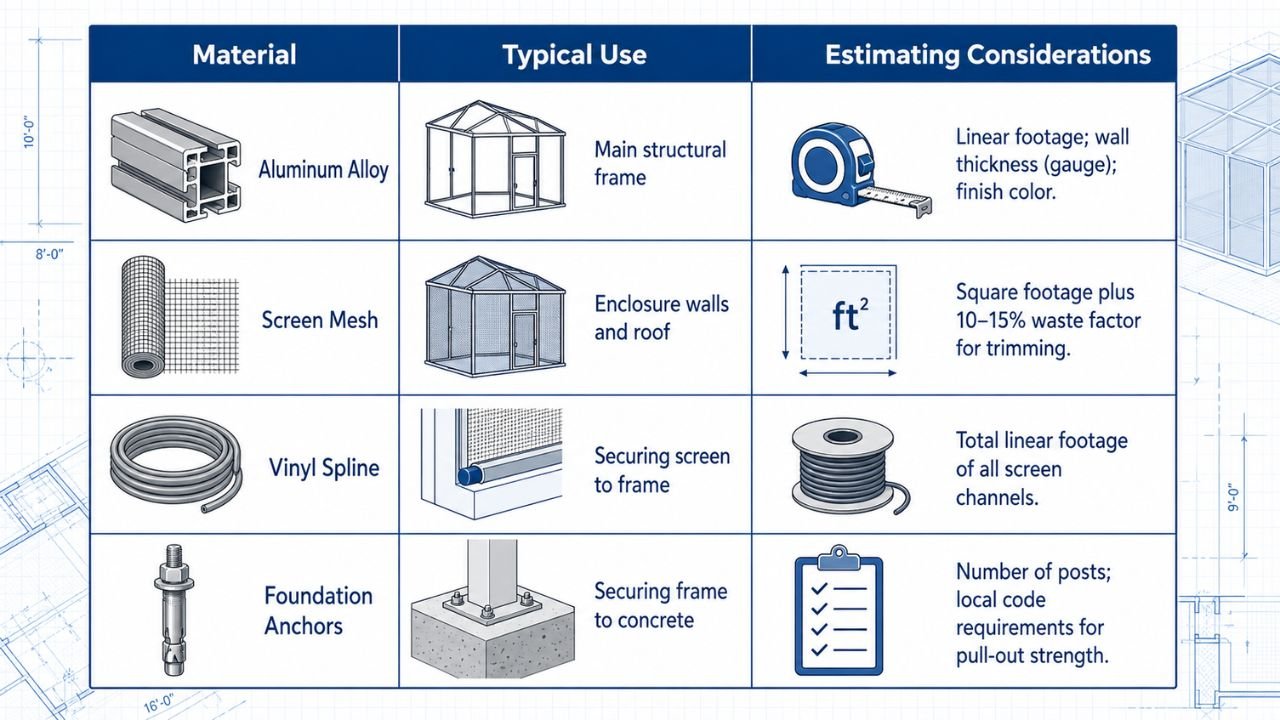
Pool Enclosure Materials & Estimating
| Material | Typical Use | Estimating Considerations |
|---|---|---|
| Aluminum Alloy | Main structural frame | Linear footage; wall thickness (gauge); finish color. |
| Screen Mesh | Enclosure walls and roof | Square footage plus 10-15% waste factor for trimming. |
| Vinyl Spline | Securing screen to frame | Total linear footage of all screen channels. |
| Foundation Anchors | Securing frame to concrete | Number of posts; local code requirements for pull-out strength. |
Pool Cage Quantity Takeoff vs. Cost Estimate
While often used together, these two documents serve different purposes.
Feature Comparison
| Feature | Quantity Takeoff | Cost Estimate |
|---|---|---|
| Material Quantities | Detailed list of every part | Included as grouped totals |
| Labor Costs | Not always included | Core component of the report |
| Material Pricing | Optional | Required based on market rates |
| Primary Goal | Procurement and ordering | Budgeting and bidding |
Common Pool Cage Estimating Mistakes
Avoiding these pitfalls is critical for maintaining project profitability:
- Measuring only the footprint: Forgetting that the walls and roof add significantly more square footage of screen.
- Ignoring wall height: Higher walls require larger aluminum gauges to meet wind-load codes.
- Missing hardware: Forgetting the cost of doors, cables, and specialized fasteners can add up to hundreds of dollars in “hidden” costs.
- Using generic square-foot numbers: This ignores the complexity of the roof design and site access issues.
- Forgetting waste: Estimators must account for the material lost when cutting screen or aluminum to fit custom angles.
How to Improve Pool Cage / Lanai Estimate Accuracy
Professional estimators follow a structured workflow to ensure precision:
- Review all drawings: Ensure the structural plans match the architectural vision.
- Confirm site dimensions: Verify the “as-built” conditions of the concrete slab.
- Calculate the 3D surface area: Measure all four walls and every facet of the roof.
- Determine framing specs: Identify the exact aluminum sizes required for the specific wind zone.
- Apply current pricing: Use Florida-specific data rather than national averages.
- Include a contingency: Account for small variations in material usage or site conditions.
Pool Cage / Lanai Cost Estimator Florida: How Estimate Florida Can Help
Estimate Florida provides professional construction estimating and quantity takeoff services tailored specifically to the Florida market. Our team understands the nuances of Florida’s building codes and the regional labor variances that impact project costs.
We provide detailed construction cost estimates, material takeoffs, and quantity takeoffs for a wide range of residential and commercial projects across the state. Whether you are a contractor preparing a bid for a luxury pool enclosure in Boca Raton or a developer planning a multi-family lanai project in Tampa, our reports provide the accuracy you need to plan and build with confidence. Our goal is to provide a defensible, itemized breakdown that supports your budgeting and procurement process without the guesswork.
Frequently Asked Questions About Pool Cage and Lanai Costs in Florida
How much does a pool cage cost in Florida?
Costs vary based on size and design. A standard residential enclosure might range from a few thousand to tens of thousands of dollars depending on the height, roof shape, and wind-load requirements of your specific Florida county.
How much does a lanai cost in Florida?
A lanai’s cost depends on whether it is a simple screen-in of an existing porch or a full structural addition including a solid roof, flooring, and electrical work.
What is the average cost per square foot for a pool enclosure?
While often used for rough budgeting, the cost per square foot is highly sensitive to the height of the walls and the complexity of the roof facets.
What factors affect pool cage costs?
The main drivers are enclosure size, roof design (Mansard vs. Gable), aluminum gauge, screen type, and whether the project is new construction or a replacement.
Is aluminum framing expensive?
Aluminum is the largest material cost component. Its price fluctuates based on global market conditions and the structural gauge required by local building codes.
What is included in a pool cage quantity takeoff?
A takeoff includes a detailed list of aluminum members, screen rolls, spline, fasteners, doors, cables, and anchors required for the project.
Does screen type affect the estimate?
Yes. Specialty screens, such as pet-resistant or “No-See-Um” mesh, have a higher price point per square foot than standard fiberglass screening.
Does pool cage height affect construction costs?
Significantly. Taller enclosures require heavier aluminum framing and more complex bracing to withstand Florida wind loads.
How much does pool cage rescreening cost?
Rescreening is estimated based on the total surface area (walls and roof) and whether hardware or fastener replacement is also required.
Is replacing a pool cage more expensive than rescreening?
Yes. A full replacement involves demolition of the old frame and the construction of a new structural system, whereas rescreening uses the existing frame.
Can a pool cage estimate be prepared from drawings?
Yes. Professional estimators use architectural and structural drawings to create highly accurate quantity takeoffs and cost reports before construction begins.
Can Estimate Florida provide pool enclosure quantity takeoffs?
Yes. Estimate Florida specializes in providing detailed quantity takeoffs and construction cost estimates for projects throughout Florida.
Conclusion
Navigating the costs of pool cages and lanais in Florida requires a deep understanding of local construction standards and material requirements. From the wind-swept coasts of the Atlantic to the growing suburbs of Central Florida, every project demands a tailored approach to budgeting. By utilizing a professional pool cage / lanai cost estimator Florida, you can eliminate the uncertainty of generic pricing and ensure your project is backed by accurate data. If you are planning a pool cage or lanai project in Florida and need detailed material quantities or construction cost information, Estimate Florida can provide professional estimating and quantity takeoff services to support your project budgeting and bidding needs.