Which company is best for CPVC in Florida? There is no single CPVC company that is best for every Florida project. The right choice depends on what “company” means in your situation: a CPVC manufacturer, a product brand, a local distributor, a plumbing supplier, or a plumbing contractor.
A manufacturer produces the pipe and fittings. A brand identifies a product system. A distributor or supplier provides inventory, pricing, and delivery. A plumbing contractor selects, estimates, and installs the system. These roles are connected, but they are not interchangeable.
For a Florida project, evaluate CPVC based on product standards, pipe-and-fitting compatibility, hot- and cold-water suitability, local availability, warranty documentation, technical support, installer familiarity, price, and total cost of ownership.
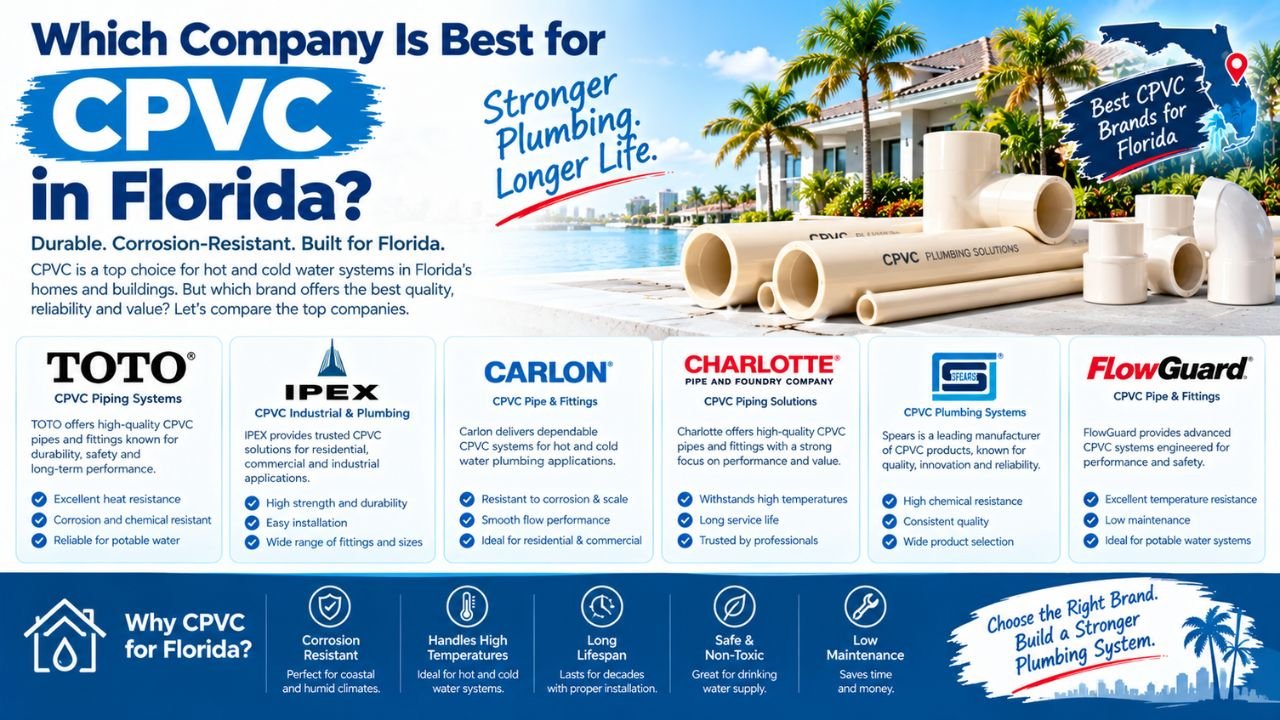
Florida’s heat, humidity, coastal exposure, water conditions, local construction requirements, and regional supplier availability can all affect CPVC selection. A well-known product may still be inconvenient if the correct fittings are unavailable locally or the installer is unfamiliar with the system.
Estimate Florida can help you prepare accurate CPVC plumbing estimates for your Florida project. To discuss your requirements, email us at info@estimateflorida.com.
What Does “Best CPVC Company” Mean?
The word “company” can refer to several different participants in a CPVC plumbing project.
CPVC manufacturer
A manufacturer produces CPVC pipe, fittings, solvent cement, accessories, or raw materials. It may provide:
-
Product specifications.
-
Installation instructions.
-
Technical data sheets.
-
Warranty documents.
-
Training resources.
-
Compatibility information.
-
Distributor support.
CPVC brand or product system
A brand may identify a complete pipe-and-fitting system or a material technology used by multiple manufacturers. The important question is not only the brand name but whether the exact pipe, fitting, solvent cement, and accessory combination is appropriate for the project.
Local plumbing supply distributor
A distributor or wholesaler may stock:
-
CPVC pipe.
-
Fittings.
-
Valves.
-
Solvent cement.
-
Transition fittings.
-
Repair components.
-
Installation tools.
Local inventory matters because a project may need additional fittings or replacement materials during installation.
Building materials supplier
A building materials supplier may sell CPVC products alongside framing, drywall, insulation, HVAC, and other construction materials. This can be convenient for larger projects, but the buyer should confirm that the correct product system and sizes are available.
Plumbing contractor
A plumbing contractor interprets the project scope, selects or proposes materials, prepares the installation, and performs the work. The contractor’s experience affects:
-
Routing.
-
Joint preparation.
-
Support.
-
Expansion allowances.
-
Testing.
-
Connections to other materials.
-
Troubleshooting.
-
Future maintenance.
Estimating or procurement consultant
An estimator or procurement consultant may help compare quantities, supplier quotes, material alternatives, and labor costs. This role is useful for larger residential, multifamily, commercial, or renovation projects.
A good manufacturer cannot replace a reliable local supplier, and a reliable supplier cannot replace proper installation. Homeowners and project owners may need all three.
Is CPVC Suitable for Florida Plumbing?
CPVC is a plastic piping material designed for hot- and cold-water distribution in applications approved by the product manufacturer and applicable requirements. It is commonly used in residential plumbing, renovations, repiping, and some commercial applications.
Common CPVC applications
CPVC may be considered for:
-
Hot-water supply.
-
Cold-water supply.
-
Residential plumbing.
-
Commercial plumbing.
-
New construction.
-
Repiping.
-
Bathroom renovations.
-
Kitchen renovations.
-
Water heater connections.
-
Utility-room plumbing.
Its suitability depends on the exact product, size, temperature, pressure, connection method, installation conditions, and project requirements.
Important CPVC considerations
Before selecting a CPVC system, verify:
-
Temperature rating.
-
Pressure rating.
-
Potable-water suitability.
-
Pipe and fitting compatibility.
-
Solvent cement requirements.
-
UV exposure limitations.
-
Protection from physical damage.
-
Support spacing.
-
Expansion and contraction requirements.
-
Manufacturer installation instructions.
-
Project specifications.
-
Applicable local requirements.
Not every CPVC product is intended for every application. A product for hot- and cold-water distribution should not automatically be assumed suitable for chemical waste, compressed air, gas, or other systems.
Pipe-and-fitting compatibility
A CPVC system usually works best when the pipe, fittings, solvent cement, and accessories are selected as a compatible system. Mixing products without verifying compatibility can affect installation quality and warranty terms.
The installer should confirm:
-
Same or compatible material standards.
-
Correct fitting dimensions.
-
Appropriate solvent cement.
-
Proper primer requirements, where applicable.
-
Cure time.
-
Temperature and pressure limitations.
-
Manufacturer instructions.
A product can be technically suitable while still being a poor choice if local suppliers do not stock the necessary fittings or the contractor cannot support the system properly.
What Makes a CPVC Company a Strong Choice?
The following criteria can help compare manufacturers, brands, suppliers, and contractors.
Standards and product verification
NSF explains that water-system products and components should be verified against applicable standards and plumbing requirements. Its water systems certification resources and product listings can help users check specific products rather than relying only on a company name.nsf+1
Do not assume that every product from a company carries the same certification. Check the exact product, size, application, and listing.
CPVC Brands and Manufacturers to Consider
The purpose of this section is not to rank one product system as number one. It identifies examples that may be worth evaluating and explains what to verify.
FlowGuard Gold CPVC
FlowGuard Gold CPVC is a recognized CPVC product system used in hot- and cold-water distribution applications. The official product information discusses CPVC pipe and fitting systems, standards, installation practices, and compatibility resources.
Potential reasons to evaluate it include:
-
Complete system approach.
-
Availability of technical documentation.
-
Compatibility guidance.
-
Product information for hot- and cold-water use.
-
Resources for contractors and specifiers.
Important verification points include:
-
Exact manufacturer of the pipe and fittings.
-
Local availability.
-
Applicable product listings.
-
Compatibility of solvent cement and fittings.
-
Written warranty conditions.
-
Project specification requirements.
-
Installer familiarity.
FlowGuard Gold should not be treated as automatically best for every Florida project. The actual product line and supplier availability still matter.
Charlotte Pipe CPVC products
Charlotte Pipe Plastic Pipe and Fittings provides information about the company’s plastic pipe and fittings product lines, including CPVC products.
The official product documentation may help users review:
-
Product categories.
-
Technical specifications.
-
Standards.
-
Installation information.
-
Warranty language.
-
Availability by product type.
Charlotte Pipe’s official FlowGuard Gold warranty document states that warranty coverage depends on conditions including proper installation, current installation instructions, applicable codes, and use of compatible products.charlottepipe+1
That illustrates an important point: a product warranty is not a substitute for proper installation or a complete review of the exact product system.
Other CPVC systems
Other CPVC products may be available through regional suppliers, plumbing wholesalers, or commercial channels. When evaluating another system, verify:
-
Manufacturer identity.
-
Product standards.
-
Potable-water listings.
-
Temperature and pressure ratings.
-
Pipe-and-fitting compatibility.
-
Solvent cement requirements.
-
Warranty terms.
-
Local availability.
-
Technical support.
-
Project specification acceptance.
The preferred product may vary between a single-family home, multifamily building, commercial renovation, and new construction project.
Manufacturer vs Local Supplier vs Plumbing Contractor
A homeowner may need the manufacturer’s documents, the supplier’s availability, and the contractor’s installation expertise. A builder may also need submittals, procurement schedules, substitution requests, and warranty records.
The most practical solution is often a coordinated supply chain rather than choosing a company based on a brand name alone.
Best CPVC for Florida Homes
The best CPVC for a Florida home depends on the building type, water demand, system layout, and installation conditions.
Single-family homes
For a single-family home, evaluate:
-
Number of bathrooms.
-
Hot-water demand.
-
Water heater location.
-
Pipe sizes.
-
Water pressure.
-
Accessibility.
-
Slab or raised foundation.
-
Existing plumbing.
-
Local supplier availability.
-
Repair and maintenance needs.
A basic residential system may need CPVC pipe and fittings in common sizes, shutoff valves, transition fittings, and appropriate solvent cement. A more complex home may need larger mains, recirculation, multiple water heaters, or specialty connections.
Townhomes and condominiums
Townhomes and condominiums may require:
-
Shared walls.
-
Vertical risers.
-
Limited access.
-
Sound considerations.
-
Firestopping interfaces.
-
Association or project specifications.
-
Coordination with common plumbing systems.
The selected CPVC system should be compatible with the approved design and building requirements.
Apartment buildings
Apartment projects may involve:
-
Repeated unit layouts.
-
Larger pipe sizes.
-
Multiple risers.
-
Pressure zones.
-
Hot-water recirculation.
-
Equipment rooms.
-
Phased construction.
-
Detailed material takeoffs.
Availability and delivery become especially important because a missing fitting or valve can delay several units.
Renovations and whole-home repiping
Renovation and repiping projects require review of:
-
Existing pipe material.
-
Existing water pressure.
-
Access routes.
-
Drywall and finish repairs.
-
Slab conditions.
-
Temporary water shutdowns.
-
Transition fittings.
-
Testing and inspection.
CPVC may be appropriate for some interior repiping applications, but the final choice should reflect the existing system and installation method.
Best CPVC for Commercial and Multifamily Projects
Commercial and multifamily projects have additional requirements beyond a single-family home.
Larger pipe sizes
Commercial plumbing often requires larger pipe sizes, which may affect:
-
Availability.
-
Support.
-
Expansion.
-
Fitting selection.
-
Labor.
-
Storage and delivery.
Repeated layouts
Hotels and apartment buildings may use repeated bathroom or kitchen layouts. A consistent CPVC assembly can help estimate quantities, but repeated scope still needs review for floor changes, risers, shafts, and equipment connections.
Pressure zones
Tall buildings may have different pressure zones. CPVC selection must match the design pressure and temperature for the specific zone.
Hot-water recirculation
Commercial hot-water systems may use recirculation loops, pumps, balancing valves, insulation, and controls. The CPVC product system must be suitable for the temperature and installation method.
Equipment connections
Water heaters, boilers, pumps, and specialty equipment may require transition fittings or materials specified by the manufacturer.
Coordination
CPVC must be coordinated with:
-
Structural framing.
-
Architectural walls.
-
Electrical work.
-
HVAC systems.
-
Fire protection.
-
Equipment bases.
-
Firestopping.
-
Access panels.
Specifications and submittals
Commercial specifications may require a particular product system or approved equivalent. The contractor may need to submit:
-
Product data.
-
Technical documents.
-
Samples.
-
Warranty information.
-
Compatibility statements.
-
Installation instructions.
-
Proposed substitutions.
Florida Conditions That Affect CPVC Selection
Heat and humidity
Florida heat and humidity can affect storage, handling, installation, expansion, and exposed piping. CPVC should be stored and installed according to manufacturer instructions, particularly in hot conditions.
Coastal salt air
CPVC itself is not a metal and does not corrode in the same way as copper or steel, but surrounding components may be affected by salt air. Consider:
-
Metal valves.
-
Supports.
-
Fasteners.
-
Water heater connections.
-
Exterior fittings.
-
Equipment-room conditions.
Hard water and water chemistry
Hard water can cause scale buildup in fixtures, valves, and water heaters. Water testing may be appropriate before selecting treatment or maintenance procedures.
The Florida Department of Environmental Protection provides water and environmental resources.floridadep+1
UV exposure
CPVC generally should not be left exposed to prolonged sunlight unless the product and installation method specifically allow it. Exterior or rooftop applications may require:
-
Protective covering.
-
Approved paint or coating.
-
Insulation.
-
Enclosures.
-
Different material selection.
Flood zones
Flood conditions can affect equipment, underground piping, drainage, and access. Review FEMA Flood Maps when flood exposure is relevant to the project.fema+1
High water pressure
Pressure ratings should be reviewed at the expected operating temperature. A product may have a higher rating at cooler temperatures than at hot-water conditions.
Slab-on-grade installations
Under-slab work should be carefully planned because access after concrete placement is limited. Important issues include:
-
Bedding.
-
Sleeves.
-
Pressure testing.
-
Expansion.
-
Protection.
-
As-built documentation.
-
Future leak detection.
Older homes and existing pipe materials
Older properties may contain galvanized steel, copper, polybutylene, or other materials. CPVC connections to existing systems require appropriate transition fittings and compatibility review.
Regional conditions
North Florida, Central Florida, South Florida, coastal communities, and the Florida Keys may differ in:
-
Supplier availability.
-
Labor costs.
-
Environmental exposure.
-
Water characteristics.
-
Local construction practices.
The Florida Building Code should be reviewed for official code-related information. Pipe selection should follow approved drawings, specifications, manufacturer instructions, and applicable local requirements.floridabuilding
CPVC Standards, Certifications, and Documentation
When evaluating a CPVC company or product system, request written documentation rather than relying on a general brand statement.
Look for:
-
NSF certification for applicable potable-water products.
-
ASTM standards.
-
Manufacturer technical data sheets.
-
Installation instructions.
-
Temperature ratings.
-
Pressure ratings.
-
Solvent cement requirements.
-
Compatibility statements.
-
Warranty documentation.
-
Product approval or project specification requirements.
-
Storage and handling instructions.
-
Testing recommendations.
NSF certification
NSF explains that plumbing products should be verified against applicable standards and plumbing codes. Its NSF certification resources and product listings can help users identify whether a specific product is listed for a particular application.nsf+1
Do not make a blanket assumption that every product from a company carries the same certification. Verify:
-
Exact manufacturer.
-
Exact product line.
-
Product size.
-
Intended application.
-
Applicable standard.
-
Certification status.
-
Listing conditions.
ASTM standards
CPVC products may reference standards related to:
-
Material compounds.
-
Pipe dimensions.
-
Fittings.
-
Solvent cement.
-
Potable-water systems.
-
Installation practices.
The specific standard should be checked against the project requirements.
Warranty documentation
A warranty may be limited by:
-
Improper installation.
-
Incorrect solvent cement.
-
Mixing incompatible products.
-
Unauthorized applications.
-
UV exposure.
-
Excessive temperature or pressure.
-
Physical damage.
-
Failure to follow installation instructions.
-
Failure to make a claim within the required period.
A written warranty should be reviewed before purchase.
CPVC Cost in Florida
CPVC cost depends on more than the pipe price.
Important cost factors include:
-
Pipe diameter.
-
Pipe length.
-
Fittings and valves.
-
Solvent cement and accessories.
-
Labor.
-
Accessibility.
-
Demolition and removal.
-
Drywall or finish repairs.
-
Slab work.
-
Water heater connections.
-
Permit and inspection scope.
-
Project location.
-
Supplier availability.
-
Emergency versus planned work.
Illustrative cost table
The following ranges are illustrative planning figures only. They are not guaranteed Florida market quotes.
Confirm current local pricing with suppliers and contractors. Material prices, labor rates, emergency charges, and availability can change.
A low quote may exclude:
-
Fittings.
-
Valves.
-
Solvent cement.
-
Testing.
-
Permit-related work.
-
Demolition.
-
Finish repairs.
-
Disposal.
-
Water shutoff coordination.
-
Additional access work.
How to Compare CPVC Company Quotes
When comparing supplier or contractor proposals, review the complete scope.
Check for:
-
Exact manufacturer and product line.
-
Pipe sizes and quantities.
-
Fittings and valves.
-
Solvent cement and accessories.
-
Labor.
-
Demolition.
-
Finish repairs.
-
Testing.
-
Permits and inspections, if included.
-
Warranty terms.
-
Exclusions.
-
Delivery.
-
Schedule.
-
Change-order rates.
-
Transition fittings.
-
Water heater connections.
-
Pressure testing.
-
Cleanup and disposal.
Estimate Florida can help you prepare accurate CPVC plumbing cost estimates for your Florida project. To discuss your requirements, email us at info@estimateflorida.com.
The lowest quote may not have the lowest total project cost if it excludes important materials, preparation, testing, or finish repairs.
How to Choose the Right CPVC Company
-
Define the plumbing application. Identify whether the project involves hot water, cold water, repiping, new construction, commercial work, or renovation.
-
Determine which role you need. Decide whether you are searching for a manufacturer, supplier, distributor, plumbing contractor, or estimator.
-
Review project drawings and specifications. Confirm the required pipe sizes, materials, fittings, and approved systems.
-
Confirm product standards and certifications. Verify the exact product rather than relying only on the company name.
-
Check local Florida availability. Ask suppliers about inventory, lead times, and replacement parts.
-
Compare complete installed costs. Include material, labor, access, demolition, restoration, testing, delivery, and potential changes.
-
Review warranty and support. Read conditions, exclusions, claim procedures, and installation requirements.
-
Confirm pipe-and-fitting compatibility. Use compatible products and approved solvent cement.
-
Ask about installer familiarity. The contractor should understand CPVC preparation, joining, support, and testing.
-
Request an itemized estimate. Quantities and unit costs make comparisons more meaningful.
-
Confirm assumptions and exclusions. Ask how concealed conditions and changes will be priced.
-
Keep product documents. Retain technical sheets, warranties, invoices, and installation records for future maintenance.
The best company is often the one that provides the right product, availability, support, documentation, and total value for the specific project.
Common Mistakes to Avoid
-
Choosing a CPVC company based only on price.
-
Confusing a manufacturer with a plumbing contractor.
-
Mixing pipe and fittings from incompatible systems.
-
Ignoring temperature or pressure ratings.
-
Buying products without reviewing documentation.
-
Assuming all CPVC products are interchangeable.
-
Ignoring UV exposure.
-
Failing to consider water chemistry.
-
Not checking local availability.
-
Accepting a quote without quantities.
-
Ignoring labor, testing, or finish repairs.
-
Assuming a recognized brand automatically guarantees correct installation.
-
Failing to review solvent cement requirements.
-
Not planning for future maintenance access.
-
Using an inappropriate product for chemical waste or other specialty applications.
-
Failing to confirm project specification acceptance.
-
Not documenting the product installed.
-
Ignoring the difference between material warranty and installation responsibility.
Final Recommendation
There is no universally best CPVC company for every Florida project.
A manufacturer or product system should be evaluated for:
-
Standards.
-
Compatibility.
-
Technical documentation.
-
Warranty.
-
Product range.
-
Local availability.
-
Technical support.
A supplier should be evaluated for:
-
Inventory.
-
Pricing.
-
Delivery.
-
Replacement parts.
-
Distributor support.
-
Ability to provide complete material packages.
A plumbing contractor should be evaluated for:
-
Experience.
-
Scope clarity.
-
Communication.
-
Installation quality.
-
Testing.
-
Access planning.
-
Warranty handling.
-
Local project knowledge.
Product choice should follow the project plans, specifications, application, manufacturer instructions, and applicable local requirements.
Final Thoughts
The answer to which company is best for CPVC in Florida depends on the project and the role the company plays. A manufacturer provides the product system and technical information. A supplier provides availability and pricing. A plumbing contractor provides installation, testing, and project execution.
Product quality, pipe-and-fitting compatibility, availability, installation, documentation, and support all matter. Florida humidity, heat, coastal salt air, hard water, water pressure, slab construction, flooding, and regional supplier conditions should also be considered.
Do not choose a CPVC company based only on brand recognition or the lowest quote. Compare the exact product, quantities, fittings, solvent cement, labor, testing, warranty, delivery, assumptions, and exclusions.
If you need a CPVC plumbing estimate for a Florida home, renovation, multifamily building, or commercial project, email Estimate Florida at info@estimateflorida.com to discuss your requirements.