
If you’ve ever asked a room full of contractors which program they trust for pricing a job, you’ll get more than one answer. But a few names come up again and again. Microsoft Excel remains the single most widely used tool for cost estimation across the construction industry, followed closely by purpose-built platforms like PlanSwift, STACK, Bluebeam, RSMeans Online, and CostX. Each one earned its popularity differently — Excel through sheer flexibility, the others through features built specifically for takeoffs, pricing, and bid production.
This guide breaks down exactly which tools dominate construction cost estimation in 2026, why they became so widely adopted, and where even the most popular software still falls short. If you’re a contractor, estimator, or project manager trying to choose the right tool — or wondering whether software alone is enough — you’re in the right place.
Key Takeaways
Before we go deep, here’s the short version.
- Excel is still the most widely used cost estimation tool in construction, largely because almost every estimator already knows it.
- PlanSwift, STACK, and Bluebeam are the most widely used quantity takeoff software among mid-size and growing contractors.
- RSMeans Online (Gordian) remains the most widely used cost estimating software for pulling standardized unit pricing.
- CostX is popular among commercial estimators who need BIM-integrated takeoffs.
- No single tool covers everything. Most estimating teams combine two or three programs.
- Software speeds up quantity counting, but it doesn’t know local labor rates, current material costs, or Florida Building Code requirements — that still takes human expertise.
- For Florida projects specifically, professional quantity takeoffs and cost estimates often deliver more reliable numbers than software output alone, especially in HVHZ zones.
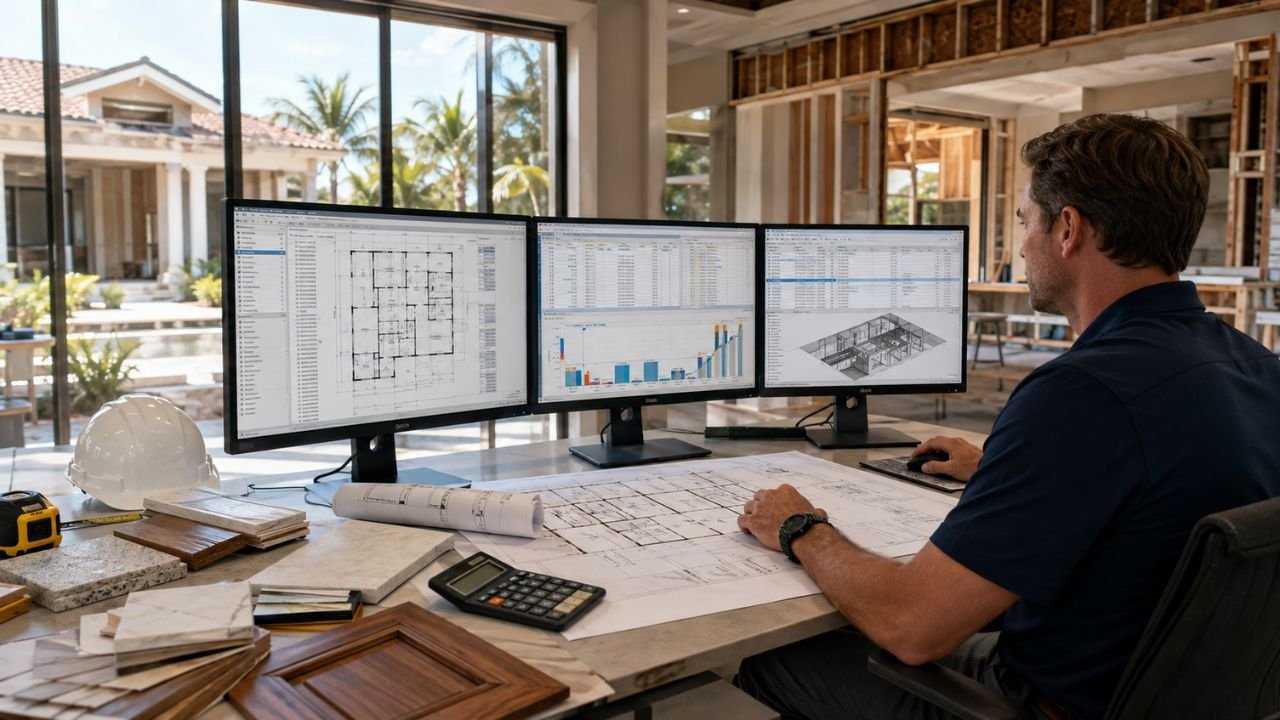
Which Software Tool Is Widely Used for Cost Estimation? A Quick Overview
When people ask which software tool is widely used for cost estimation, they’re usually picturing one universal answer. The reality is more nuanced. Construction cost estimation isn’t a single task — it includes quantity takeoffs, unit pricing, labor calculations, material sourcing, and final bid assembly. Different tools dominate different pieces of that workflow.
That said, a clear pattern shows up in industry surveys, contractor forums, and adoption data year after year. A small handful of platforms account for the overwhelming majority of usage:
- Microsoft Excel — the default starting point for nearly every estimator.
- PlanSwift — one of the most widely used quantity takeoff software programs for residential and light commercial work.
- STACK — a cloud-based platform that has become one of the most widely used cost estimation software tools among growing firms.
- Bluebeam Revu — technically a PDF markup tool, but so widely used for takeoffs that it functions as estimating software for many contractors.
- RSMeans Online (Gordian) — the best known construction cost estimating program for standardized unit-cost data.
- CostX — popular for BIM-based commercial and infrastructure estimating.
These six show up consistently across popular cost estimation software tools lists, contractor associations, and estimating job postings that specify required software knowledge.
Why Excel Remains the Most Widely Used Cost Estimation Tool
It’s not flashy, but Excel wins on sheer reach. Nearly every construction professional has used a spreadsheet at some point, which makes the learning curve close to zero.
Familiarity Beats Features
Estimators don’t need training to open a spreadsheet. They already know how formulas work, how to build a template, and how to hand a file to a project manager who can open it without a subscription.
Total Flexibility
Excel doesn’t force a workflow. An estimator can build a takeoff sheet, a unit-price database, and a bid summary in the same file, structured exactly how their company wants it. Purpose-built software often locks users into a fixed format.
Zero Additional Cost for Most Firms
Most companies already own Microsoft 365. That means Excel-based estimating carries no extra software expense, which matters enormously for small and mid-size contractors watching overhead.
Where Excel Falls Short
Manual entry means manual errors. There’s no automated takeoff from digital plans, no built-in cost database, and formulas break easily when someone edits the wrong cell. That’s exactly why so many firms pair Excel with a dedicated takeoff tool rather than replacing it entirely.
Popular Cost Estimation Software Tools Built for Construction
Beyond spreadsheets, a specific group of programs shows up repeatedly as the commonly used estimating software in construction. Here’s what makes each one popular.
PlanSwift
PlanSwift built its reputation on digital takeoffs — measuring quantities directly from uploaded plans instead of a printed set and a scale ruler. It’s especially popular with residential and light commercial contractors because it’s relatively affordable and doesn’t require a steep learning curve. Many estimators cite PlanSwift as the software that got them off paper takeoffs for good.
STACK
STACK is cloud-based, which means the whole estimating team can work from the same live takeoff without emailing files back and forth. That collaborative structure is a major reason it has become one of the most widely used quantity takeoff software platforms for growing firms with multiple estimators. STACK also bundles takeoff and estimating into one subscription, which appeals to companies trying to consolidate tools.
Bluebeam Revu
Bluebeam wasn’t originally built as estimating software — it’s a PDF markup and collaboration tool. But its measurement and markup features are so useful for takeoffs that huge numbers of estimators use it as their primary quantification tool, especially on commercial projects where drawing review and takeoff happen in the same file. Its widespread use across architecture, engineering, and construction makes it a near-universal skill requirement in estimating job postings.
RSMeans Online (Gordian)
When people talk about the best known construction cost estimating programs for pricing data specifically, RSMeans usually tops the list. It provides regularly updated unit-cost data across labor, material, and equipment, broken down by location. Estimators use it less for takeoffs and more as a pricing reference to validate their numbers against an independent, standardized source.
CostX
CostX is popular among commercial and infrastructure estimators because of its BIM integration — it can extract quantities directly from 3D models rather than 2D plans. That makes it one of the more advanced popular software for construction cost estimation, though its complexity and price point keep it less common among smaller residential contractors.
ProEst
ProEst combines takeoff, estimating, and proposal generation in a cloud platform, and it’s gained ground with mid-size commercial contractors who want an all-in-one system rather than stitching together separate tools.
Industry Adoption Trends: How Popularity Has Shifted
Software popularity in construction estimating isn’t static. The tools that dominate today aren’t necessarily the ones that dominated a decade ago, and understanding that shift helps explain why certain platforms are considered widely used cost estimating tools for contractors right now.
From Paper to Digital Takeoffs
A decade ago, plenty of estimators still measured quantities off printed plans with a scale ruler and a highlighter. That’s largely disappeared. Digital takeoff tools like PlanSwift and Bluebeam replaced the physical process almost entirely, because the time savings were too significant to ignore. Firms that resisted the switch found themselves consistently slower to turn around bids than competitors using digital measurement.
From Desktop to Cloud
The next major shift moved estimating from single-user desktop programs to cloud-based platforms. STACK and ProEst gained ground specifically because they let multiple estimators, project managers, and even subcontractors view and edit the same live takeoff. That collaborative model matters more as firms grow and estimating stops being a one-person job.
From Generic Pricing to Localized Data
Early estimating software leaned heavily on national average pricing. As material and labor costs diverged more sharply by region, estimators started demanding localized data instead of national averages. That’s part of why RSMeans Online remains popular — it breaks pricing down by location rather than offering a single blended national figure. It’s also why local, Florida-specific data still matters even when a firm uses top-tier national software.
What This Means Going Into 2026
The tools covered in this guide aren’t likely to be displaced overnight, but the trend toward cloud collaboration and localized pricing data is only accelerating. Contractors evaluating new software in 2026 should weigh not just takeoff speed, but how well a platform handles regional cost variation, because that’s increasingly where the real accuracy gap shows up.
Comparison Table: Most Widely Used Construction Estimating Software 2026
| Software | Best For | Takeoff Method | Typical Users | Adoption Level |
| Microsoft Excel | Custom templates, budgets, bid summaries | Manual entry | All contractor types | Highest — near-universal |
| PlanSwift | Residential & light commercial takeoffs | Digital plan takeoff | Small to mid-size GCs, subs | Very high |
| STACK | Team collaboration, cloud takeoffs | Digital plan takeoff | Growing firms, multi-estimator teams | Very high |
| Bluebeam Revu | Plan markup + takeoff in one file | Digital plan takeoff/markup | Commercial GCs, architects, engineers | Very high |
| RSMeans Online | Standardized unit-cost pricing | Reference data, not takeoff | Estimators validating pricing | High |
| CostX | BIM-based commercial/infrastructure estimating | 3D model extraction | Commercial estimators | Moderate-high |
| ProEst | All-in-one cloud estimating | Digital plan takeoff | Mid-size commercial contractors | Moderate |
This table reflects general industry adoption trends rather than a single verified source, since usage varies by region, project type, and company size.
What Makes These Tools Widely Adopted? Key Features Driving Popularity
A few common threads explain why certain programs became top construction estimating software while others faded.
- Speed of quantity extraction. Digital takeoff tools cut hours off manual counting and measuring.
- Collaboration. Cloud platforms let multiple estimators work the same project without version-control headaches.
- Integration with plans. Tools that read PDFs or BIM models directly reduce transcription errors.
- Cost database access. Built-in or linked pricing data saves estimators from researching every material and labor rate from scratch.
- Familiarity and training availability. Popular tools have more tutorials, user communities, and hires who already know them — which reduces onboarding time.
- Scalability. Software that works for a five-person shop and a fifty-person firm tends to spread faster through word of mouth and industry recommendations.
Estimating teams weigh these factors differently depending on project type, which is exactly why no single platform dominates every category. A residential remodeler prioritizing quick digital takeoffs will make a different software choice than a commercial estimator juggling BIM models, multiple trade packages, and a review team spread across several offices — and that variation is a big part of why the “most widely used” answer really depends on who’s asking.
Strengths and Limitations of Popular Estimating Software
It’s worth being balanced here, because no tool solves every problem.
Strengths
- Dramatically faster than manual, paper-based takeoffs, often cutting measurement time from hours to minutes on larger plan sets.
- Reduces simple math and transcription errors.
- Standardizes the estimating process across a team.
- Makes it easier to store, search, and reuse past estimates.
- Improves bid turnaround time, which matters in competitive markets.
Limitations
- Software doesn’t know current local material prices unless someone updates the database.
- Labor rates vary by county and trade availability — no program tracks that automatically in real time.
- Code compliance, especially Florida-specific requirements like High-Velocity Hurricane Zone (HVHZ) rules, isn’t built into generic takeoff software.
- Even the most widely used cost estimating tools for contractors still require a trained human to interpret plans correctly, catch scope gaps, and sanity-check the output.
- Subscription costs for premium platforms can be significant for small firms, and the learning curve varies widely between programs.
- Most platforms handle takeoff quantities well but stop short of assembling a fully bid-ready package — formatting, contingency allowances, and final proposal layout usually still require manual work afterward.
Software is a force multiplier, not a replacement for estimating judgment. The most effective estimators treat these tools as an accelerant for the repetitive parts of the job — counting, measuring, organizing — while reserving their own expertise for the parts that actually require judgment: reading intent into incomplete drawings, anticipating change orders, and knowing which line items tend to get underpriced on a given project type.
How Florida Contractors Use Widely Used Cost Estimating Tools for Contractors
Florida’s construction environment adds layers that generic software wasn’t built to handle. Contractors across the state use these popular tools, but they lean on additional resources to fill the gaps.
Digital Takeoffs, Local Pricing Overlay
Many Florida GCs use PlanSwift, STACK, or Bluebeam for the takeoff itself — counting doors, windows, square footage, and linear feet of framing — then apply Florida-specific unit pricing on top, since national databases don’t always reflect local material and labor costs accurately.
HVHZ and Wind-Load Requirements
Standard takeoff software doesn’t flag when a project falls inside a High-Velocity Hurricane Zone, which changes fastener schedules, impact-window requirements, and structural specs. Estimators still need to manually cross-reference the Florida Building Code for every affected line item.
County-by-County Variation
Permit fees, impact fees, and inspection requirements differ across Florida’s 67 counties. Software can hold that data, but someone has to enter and maintain it — which is where statewide Florida estimating coverage from a local team becomes valuable.
Bid-Ready Formatting
Winning a bid often depends on how the estimate is packaged, not just the numbers inside it. Many contractors export raw takeoff data from these platforms and then reformat it into a CSI MasterFormat-organized, bid-ready document — a step that’s easy to underestimate in terms of time. General contractors and owners reviewing a bid package expect line items grouped logically, contingencies clearly labeled, and totals that reconcile cleanly, which is more of a formatting and communication skill than a software feature.
Insurance and Storm-Related Adjustments
Florida’s hurricane exposure also affects how contractors use these tools. After a storm event, estimators frequently need to price repair and reconstruction work against insurance scopes, which requires cross-referencing software-generated quantities against adjuster documentation — another layer that generic takeoff software wasn’t designed to handle on its own.
Why Software Alone Isn’t Enough: The Role of Human Expertise and Local Data
Here’s the honest truth about even the most widely used cost estimation software: it’s only as good as the data and judgment behind it.
- Material prices move fast. Lumber, concrete, and steel prices can shift meaningfully within a single quarter, and most software databases lag behind real-time market changes.
- Labor availability affects cost. A tight labor market in South Florida can push subcontractor pricing well above what a national database assumes.
- Plans aren’t always complete. Estimators regularly catch missing details, conflicting specs, or unclear scope that no takeoff tool flags automatically.
- Code knowledge isn’t automated. Florida Building Code compliance, especially for wind mitigation and HVHZ construction, requires someone who actually understands the requirements — not just a program that counts quantities.
This is exactly why experienced estimators are still the most important part of the process, regardless of which software sits on their desktop.
When Professional Estimating Services Outperform Software
There’s a specific point where software stops being enough and professional experience takes over — usually when accuracy, turnaround, and code compliance all matter at the same time.
Professional estimating services tend to outperform in-house software use when:
- A bid deadline is tight and there’s no time to build a takeoff from scratch.
- The project spans multiple trades — MEP, sitework, and structural — and needs a unified, bid-ready estimate.
- Florida-specific code compliance is critical, particularly HVHZ wind-load and impact requirements.
- In-house staff lack estimating bandwidth, especially for small GCs juggling both fieldwork and bidding.
- A second, independent number is needed to validate an in-house estimate before submitting a bid.
That’s where Florida construction estimating services come in — combining the speed of digital takeoff tools with Florida-specific pricing, code knowledge, and a 24–48 hour turnaround on bid-ready deliverables. For homeowners and builders specifically pricing a house, residential construction estimating support fills a similar gap.
Frequently Asked Questions
Which software tool is widely used for cost estimation in construction?
Microsoft Excel remains the most widely used overall, with PlanSwift, STACK, Bluebeam, and RSMeans Online as the most widely used purpose-built alternatives.
Is Excel still used for professional construction estimating?
Yes. Many firms use Excel for bid summaries and budgets even after adopting dedicated takeoff software, because it’s flexible and requires no extra training.
What’s the difference between takeoff software and estimating software?
Takeoff software measures quantities from plans, while estimating software applies pricing to those quantities to produce a final bid. Some platforms, like STACK and ProEst, combine both functions.
Do most contractors use more than one software tool?
Yes. It’s common to pair a takeoff tool like PlanSwift or Bluebeam with Excel or a pricing reference like RSMeans Online rather than relying on a single program.
Is RSMeans Online a takeoff tool or a pricing tool?
RSMeans Online is primarily a pricing reference tool. It doesn’t perform takeoffs — it provides standardized unit-cost data that estimators apply to quantities they’ve already measured.
Which estimating software is best for small residential contractors?
Smaller firms tend to gravitate toward PlanSwift or Excel because of lower cost and a shorter learning curve compared to enterprise platforms like CostX.
Can software account for Florida Building Code requirements automatically?
No. Generic estimating software doesn’t automatically flag HVHZ, wind-load, or county-specific code requirements — that still requires manual review by someone familiar with Florida code.
Why would a contractor use a professional estimating service instead of software alone?
Professional services combine software efficiency with local pricing data, code expertise, and bid-ready formatting — useful when accuracy and turnaround time both matter.
How often is estimating software pricing data updated?
It varies by platform. RSMeans Online updates regularly, but many built-in databases in takeoff software lag behind real-time material and labor cost changes, which is why local verification still matters.
Does using popular estimating software guarantee an accurate bid?
No. Software accuracy depends entirely on the quantities entered, the pricing data applied, and whether the estimator caught every scope item on the plans. Widely used software still produces flawed estimates when the underlying inputs are wrong.
Final Thoughts
So, which software tool is widely used for cost estimation? The honest answer is a small cluster of them — Excel, PlanSwift, STACK, Bluebeam, RSMeans Online, and CostX — each dominant in a different part of the estimating workflow. Popularity, though, doesn’t guarantee accuracy. Software can’t know today’s Florida material prices, local labor availability, or HVHZ code requirements without a person feeding it the right data.
If you need an estimate you can actually bid with — accurate, Florida Building Code compliant, and delivered fast — contact Estimate Florida for a professional quantity takeoff and cost estimate built on real local data, not just software defaults.