If you ask contractors or project managers whether AI is ready to handle job pricing, you will get two very different answers. Tech enthusiasts claim artificial intelligence can instantly price a building from a prompt, while experienced estimators insist a computer program cannot understand the reality of a job site. So, can ChatGPT do construction estimates?
The short answer is: ChatGPT can assist with construction estimating, but it cannot produce an accurate, complete, or standalone construction estimate on its own.
While ChatGPT excels at organizing data, drafting scope language, structuring templates, and summarizing complex specifications, it lacks spatial awareness, real-time localized pricing, and spatial takeoff capabilities. It cannot read blueprinted dimensions with guaranteed scale accuracy, negotiate subcontractor rates, or account for site-specific physical constraints.
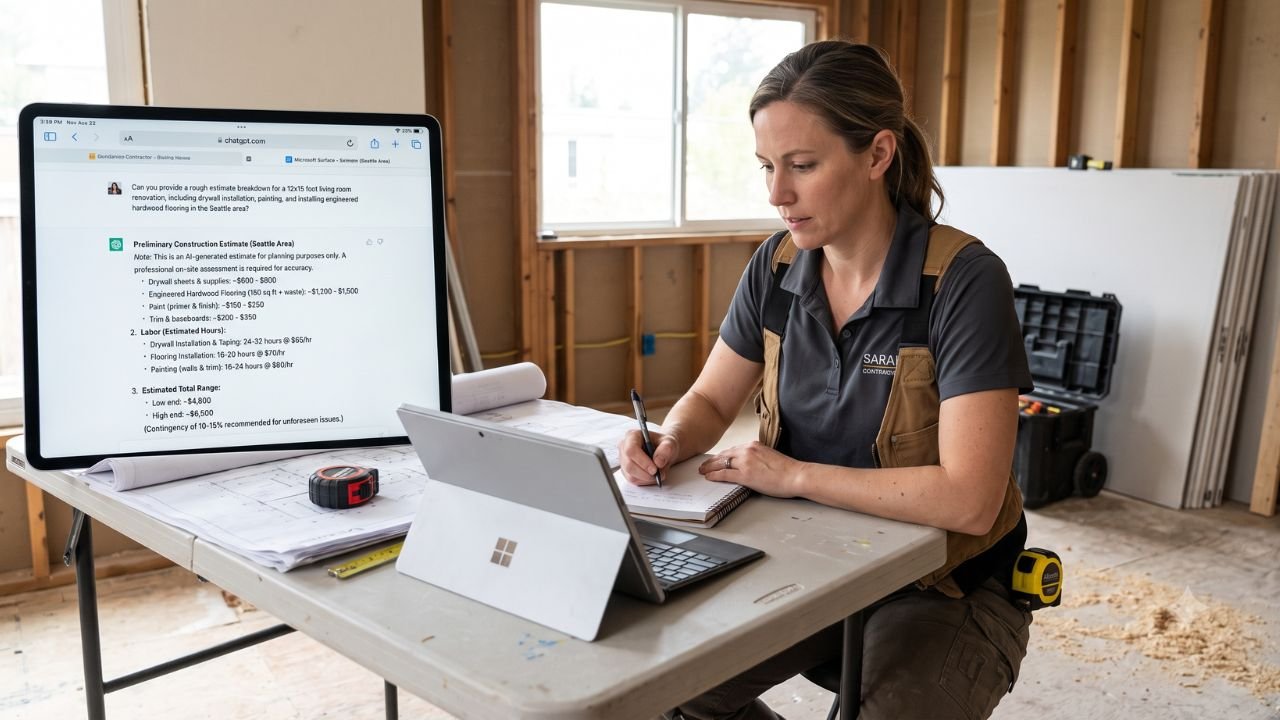
In this detailed breakdown, we will explore what ChatGPT can realistically do, where it fails, the risks of relying on AI for job costing, and how contractors can safely integrate large language models into their estimating workflow to save time without risking profitability.
What Is Construction Estimating?
To understand why AI has limitations, it is essential to define what a professional construction cost estimate actually requires. Construction estimating is the process of predicting the total cost of assembling a physical structure based on architectural drawings, project specifications, and environmental conditions.
A true, reliable estimate involves several interconnected steps:
-
Quantity Takeoff (QTO): Measuring plans to determine exact quantities of materials (e.g., cubic yards of concrete, square feet of drywall, linear feet of piping).
-
Direct Material Pricing: Securing current, localized quotes for raw materials, fixtures, and structural components.
-
Labor & Productivity Rate Calculation: Factoring in worker hourly rates, trade crew sizes, local prevailing wages, and realistic daily production rates.
-
Equipment & Tool Rentals: Accounting for machinery, scaffolding, cranes, fuel, and mobilization fees.
-
Subcontractor Bids: Gathering, leveling, and vetting quotes from specialty trade contractors.
-
Indirect Costs & Overhead: Adding project supervision, permits, dumpsters, temporary power, office overhead, and liability insurance.
-
Risk Contingency & Profit Margin: Factoring in site access difficulties, weather risks, inflation, and business profit goals.
An accurate estimate requires combining hard data with field experience. Missing a single line item or miscalculating labor productivity can instantly wipe out a contractor’s margin.
What Can ChatGPT Help With?
While ChatGPT cannot replace the quantitative rigor of a professional estimator, it is an exceptionally powerful administrative assistant. When used properly within a modern estimating workflow, ChatGPT speeds up narrative, organizational, and structural tasks that typically take hours of manual typing.
| Task Category | How ChatGPT Assists the Estimating Workflow |
| Scope Summaries | Extracts key points from lengthy specifications and highlights crucial requirements. |
| Drafting Language | Writes professional bid proposals, cover letters, and exclusion clauses. |
| Checklists & Review | Generates missing-item checks and site visit preparation notes. |
| Template Structures | Builds CSI MasterFormat outlines and standard scope frameworks. |
| Line-Item Categories | Brainstorms potential indirect costs, allowances, and cost breakdowns. |
1. Organizing Estimate Templates
ChatGPT can quickly generate structured line-item outlines based on standard industry formats, such as the CSI MasterFormat (16 or 50 divisions). You can prompt the AI to output an organized framework for a specific project type—such as a residential kitchen remodel or a commercial vanilla shell build-out—ensuring your team starts with a complete structure.
2. Summarizing Project Specifications & Scopes
Project specification books can run hundreds of pages long. You can paste sections of text from architectural specifications into ChatGPT and ask it to summarize key general requirements, submittal deadlines, or specialized material standards (e.g., specific paint sheen levels, commercial door fire ratings, or concrete slump requirements).
3. Drafting Bid Proposals & Qualifications
Turning numbers into a professional document for a client takes time. ChatGPT can take a raw list of inclusions, exclusions, and payment terms and turn them into a polished, professional client document. Using a structured bid proposal template alongside AI-drafted narrative text allows contractors to send out clear, thorough proposals much faster.
4. Creating Site Visit & Bid Checklists
Before visiting a job site or opening a blueprint set, you can ask ChatGPT to generate a comprehensive trade checklist. For example, asking for a “site inspection checklist for an old-building plumbing retrofit” will yield line items for water pressure checks, pipe material identification, access constraints, and permit considerations.
5. Outlining Cost Categories & Allowances
When putting together a preliminary concept budget, ChatGPT can help brainstorm potential indirect costs or site allowances you might otherwise forget—such as street closure permits, winter concrete heating fees, temporary site fencing, or utility hookup charges.
Where ChatGPT Falls Short
The primary danger of construction estimating with ChatGPT happens when contractors expect the software to perform spatial, mathematical, or local market tasks. Large language models (LLMs) operate on text pattern recognition, not spatial logic or live supply-chain tracking.
Key Takeaway: ChatGPT is a text engine, not a spatial calculator. It does not know what lumber costs in your specific county today, nor can it verify if a wall is structural simply by reading a text prompt.
1. Final Quantity Takeoffs
ChatGPT cannot open a 24×36 set of PDF architectural blueprints, verify drawing scales, or perform precise visual measurements. While some multi-modal AI models can view image files, they frequently misinterpret scale bars, miss hidden wall penetrations, and struggle with multi-layered architectural details.
2. Live Market Material & Labor Pricing
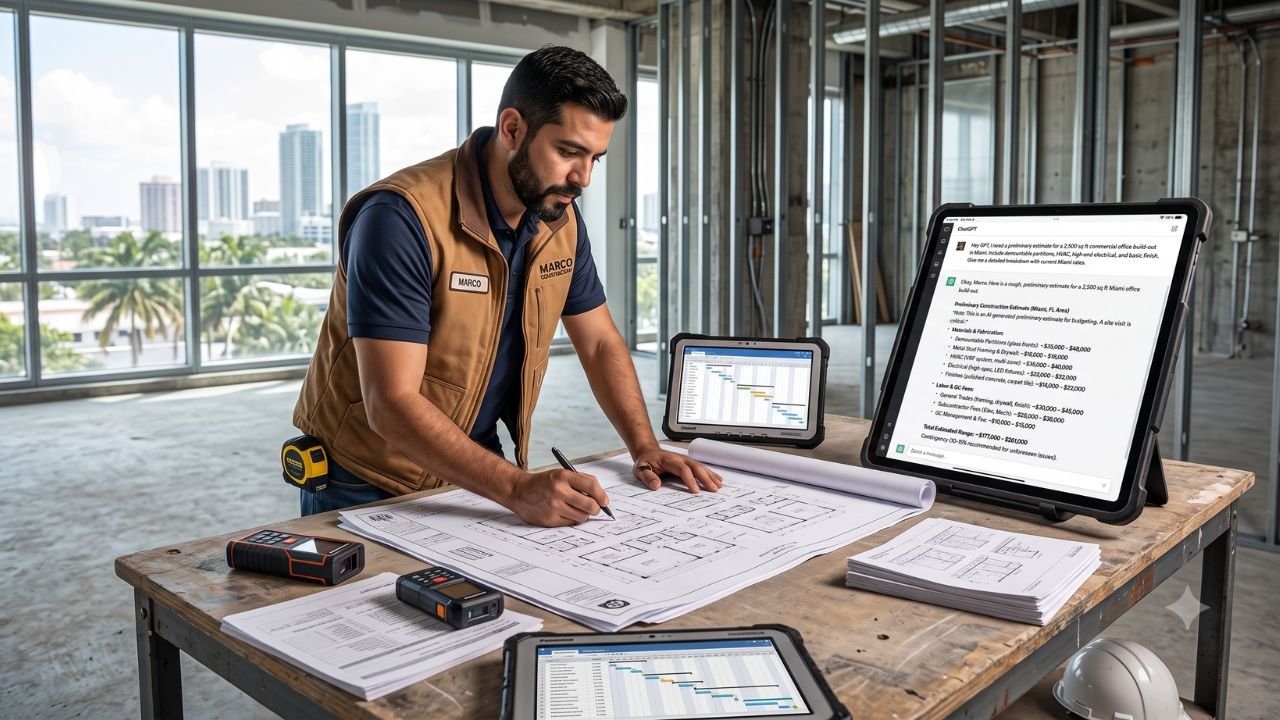
ChatGPT does not have real-time access to localized supplier pricing databases. It cannot tell you what a local ready-mix concrete plant charges per yard in South Florida versus Rural Ohio today. Material prices fluctuate based on freight, tariffs, fuel surcharges, and local supply-and-demand cycles.
3. Code Compliance & Permitting Rules
Building codes vary significantly across states, counties, and municipalities. A detail that meets national baseline codes may violate local High-Velocity Hurricane Zone (HVHZ) requirements, seismic codes, or local historical district mandates. ChatGPT cannot guarantee local building code compliance.
4. Structural & Engineering Decisions
AI cannot evaluate structural integrity, soil load capacities, or complex framing load paths. Relying on AI to determine structural timber sizing or steel beam specs creates severe safety hazards and massive legal liability.
5. Identifying Scope Conflicts
Blueprints and specification manuals frequently contradict one another (e.g., the architectural plan shows carpet, but the finish schedule specifies LVP flooring). A human estimator identifies these discrepancies during the takeoff process to write crucial Request for Information (RFI) notes. ChatGPT cannot spot these subtle spatial conflicts automatically.
Can ChatGPT Estimate Construction Costs?
The question of whether ChatGPT can estimate construction costs depends on how you define “estimate.”
If you are looking for a Rough Order of Magnitude (ROM) or conceptual budget narrative to test an early idea, ChatGPT can generate rough figures if you provide it with the correct cost parameters. However, those figures are strictly theoretical math exercises based on whatever numbers you feed into the prompt.
For example, if you ask: “How much does it cost to build a 2,000-square-foot house?” ChatGPT will pull generic, national averages from historical text data—producing a broad range like $150 to $300 per square foot ($300,000 to $600,000). That number is virtually useless for submitting an actual bid because it ignores site prep, local utility hookups, soil conditions, and current market labor rates.
On the other hand, if you feed ChatGPT exact local unit rates—stating “Calculate the total cost for 500 square feet of 4-inch concrete slab assuming material is $150 per cubic yard and labor is $2.50 per square foot”—it can execute the arithmetic instantly. But in that scenario, you did the actual estimating work; ChatGPT simply acted as a calculator.
How Contractors Can Use ChatGPT in Estimating
To safely integrate AI for construction estimating, contractors should adopt a hybrid workflow where AI handles administrative drafting, dedicated digital software handles spatial takeoffs, and human expertise validates the final numbers.
The Recommended 6-Step Hybrid Estimating Workflow
-
Scope Structuring (ChatGPT): Upload or paste project descriptions into ChatGPT to extract key requirements, identify potential missing scope items, and structure a MasterFormat line-item outline.
-
Digital Quantity Takeoff (Dedicated Takeoff Tools): Use specialized estimating software or manual scale measurements to calculate exact quantities for concrete, lumber, roofing, and drywall.
-
Local Unit Pricing (Real-World Vendor Data): Apply localized labor rates and current material quotes from local suppliers to your takeoff quantities.
-
Proposal Narrative Drafting (ChatGPT): Feed your finalized numerical totals and scope items into ChatGPT to write a polished, comprehensive client proposal letter.
-
Human Risk Audit & Review: A seasoned estimator checks every line item, reviews exclusions, verifies calculations, and adjusts risk contingencies.
-
Final Bid Submission: Issue the completed bid package to the owner or general contractor.
By utilizing this hybrid model, contractors who leverage specialized construction estimating services can shave hours off administrative prep time while keeping their pricing 100% accurate and grounded in real-world market conditions.
Example Uses for ChatGPT in Construction
Here are four practical, real-world examples showing how estimators and contractors can use ChatGPT for contractors to streamline daily administrative estimating tasks.
Example 1: Creating a MasterFormat Division Outline
-
User Prompt: “Act as a commercial construction estimator. Provide a CSI MasterFormat outline of line items required for a 3,000 sq ft office interior tenant improvement (TI) build-out.”
-
ChatGPT Output Benefits: Generates a structured list covering all relevant divisions (Demolition, Millwork, Doors, Finishes, MEP). This acts as an instant checklist to ensure no major trade category is overlooked.
Example 2: Drafting Standard Proposal Exclusions
-
User Prompt: “Draft a professional ‘Exclusions and Qualifications’ section for a residential roofing replacement bid proposal.”
-
ChatGPT Output Benefits: Produces clean bullet points stating that the estimate excludes structural roof rafter repairs, hidden rot remediation, deck replacement over 10%, mold abatement, and municipal permit fees unless specifically added via written change order.
Example 3: Summarizing Complex Spec Requirements
-
User Prompt: “Summarize these two pages of commercial painting specifications into a 5-point bulleted list covering surface prep, primer types, and coat requirements.”
-
ChatGPT Output Benefits: Distills dense architectural jargon into actionable field instructions for your painting crew or sub-bidding checklist in seconds.
Example 4: Writing a Client-Facing Bid Cover Letter
-
User Prompt: “Write a polite, professional cover letter to accompany a $120,000 residential addition bid proposal for a homeowner.”
-
ChatGPT Output Benefits: Delivers a warm, professional introduction outlining the project value, company commitment to quality, timeline estimates, and clear instructions on how the client can approve the contract.
Risks of Using ChatGPT Alone
Relying exclusively on conversational AI to price construction jobs creates significant operational and financial risks. Contractors who bypass human oversight frequently suffer from these critical pitfalls:
-
Hallucinated Pricing: Using nationwide averages instead of local rates will result in underbidding jobs by thousands of dollars.
-
Missed Scope Items: AI ignores site access difficulties or specialized dump fees, leading to unplanned out-of-pocket labor expenses.
-
Mathematical Glitches: LLM text string errors in multi-step multiplication can result in erroneous bid totals being sent to clients.
-
Legal Liability: Omitted local safety or code compliance requirements can cause failed inspections and costly project delays.
Best Practices for Using ChatGPT Safely
If you plan to use AI tools in your business, follow these essential safety rules to protect your profit margins:
-
Rule 1: Always Verify Quantities Manually: Never trust an AI-generated quantity takeoff. Use dedicated takeoff tools or manual measurements to verify every square foot, linear foot, and piece count.
-
Rule 2: Input Your Own Price Data: Do not ask ChatGPT “What does X cost?” Instead, tell ChatGPT: “Here are my verified material rates and labor costs. Use these exact numbers to format the summary.”
-
Rule 3: Maintain a Human-in-the-Loop Policy: Establish a strict policy that no bid proposal, cost breakdown, or scope document leaves the office without being reviewed and signed off by an experienced project estimator.
-
Rule 4: Keep Inputs Secure & Confidential: Avoid pasting sensitive client financial data, private addresses, or proprietary trade pricing into public AI models without understanding the platform’s data privacy settings.
-
Rule 5: Document All Assumptions: Use ChatGPT to help document every assumption (e.g., “Price assumes standard ground-level site access with no weekend work requirements”). Clear assumptions protect you when unexpected site issues arise.
ChatGPT vs. Estimating Software
To choose the right tools for your business, it helps to understand how conversational AI differs from dedicated AI estimating tools and human expertise.
| Feature / Capability | ChatGPT (Conversational AI) | Dedicated Estimating Software | Professional Human Estimator |
| Primary Function | Text drafting, organization, summaries | Spatial takeoff, database pricing, formula math | Full project strategy, risk audit, field logic |
| Blueprint Takeoff | Poor / Unreliable | High (Precision digital measuring) | High (Visual plan review & scale validation) |
| Local Price Tracking | None (Static historical text) | High (Integrated vendor pricing databases) | High (Real-time sub bids & vendor calls) |
| Drafting Scope Language | Exceptional | Basic / Template-bound | High (Tailored to site conditions) |
| Calculation Accuracy | Moderate (Text-based math risk) | Perfect (Programmed formula engine) | Perfect (Double-checked verification) |
While dedicated software measures blueprints and calculates quantities, ChatGPT excels at writing the narrative descriptions surrounding those calculations. Combining dedicated software with conversational AI creates a fast, highly efficient estimating environment. If you want to refine how your team handles incoming leads, exploring an established AI estimating workflow page can help integrate these technologies seamlessly.
Who Benefits Most From ChatGPT in Estimating?
Conversational AI offers valuable administrative leverage across several industry roles:
-
Small Residential Contractors: Solo builders and specialty trade contractors (painters, drywallers, carpenters) who lack a full-time administrative staff can use ChatGPT to quickly format client bids, draft scope notes, and polish professional emails.
-
Junior Estimators: New estimators can use ChatGPT as an educational sounding board to quickly look up trade terminology, review CSI divisions, and structure scope checklists for unfamiliar project types.
-
Busy Project Managers: PMs managing multiple active job sites can use AI to summarize dense spec books, write clear change order descriptions, and draft site visit reports in a fraction of the time.
-
Subcontractor Trade Business Owners: Electricians, plumbers, and HVAC owners can generate standard bid qualification letters, payment terms, and warranty disclaimers instantly.
Final Thoughts
So, can ChatGPT do construction estimates?
ChatGPT is an incredible administrative assistant, but it is not a chief estimator. It cannot measure blueprints with precision, negotiate local trade rates, understand local job-site constraints, or assume legal liability for a bid. Contractors who rely on ChatGPT to blindly generate job pricing are taking massive financial risks.
However, when used as a support tool to structure templates, summarize lengthy specification books, draft professional scope language, and build checklists, ChatGPT transforms the modern estimating workflow. It handles the tedious administrative work so experienced estimators can focus on what matters most: quantitative accuracy, value engineering, risk management, and contractor relationship building.
By pairing conversational AI with dedicated takeoff software and human field experience, contractors can produce polished, professional, and profitable bids faster than ever before.
Ready to take your construction estimating to the next level with airtight, professional accuracy? Explore our comprehensive estimating resources, or visit our contact page to connect with professional estimators who can help you build winning bids grounded in real-world market pricing.