Running a successful construction business in Florida requires speed, accuracy, and absolute precision during the pre-construction phase. Whether you are building custom coastal homes in Naples, commercial build-outs in Tampa, or multi-family developments in Orlando, your ability to deliver fast, accurate bids determines your profitability.
For many builders, Apple hardware—such as the MacBook Pro, MacBook Air, or iMac—is the preferred choice for daily operations due to its reliability, battery life, and powerful performance. However, finding construction estimating software for Mac in Florida that aligns with local building codes, weather challenges, and macOS hardware has historically presented a challenge for contractors.
Fortunately, the rise of cloud-based platforms and Mac-compatible digital tools has transformed the estimating landscape. Today, Florida contractors no longer need to rely on clunky Windows workarounds, virtualization software, or manual paper takeoffs to price their jobs. This comprehensive guide explores what to look for in construction estimating software for Mac in Florida, why local market conditions demand specialized estimating tools, and how to select the ideal platform for your company.
What Is Construction Estimating Software?
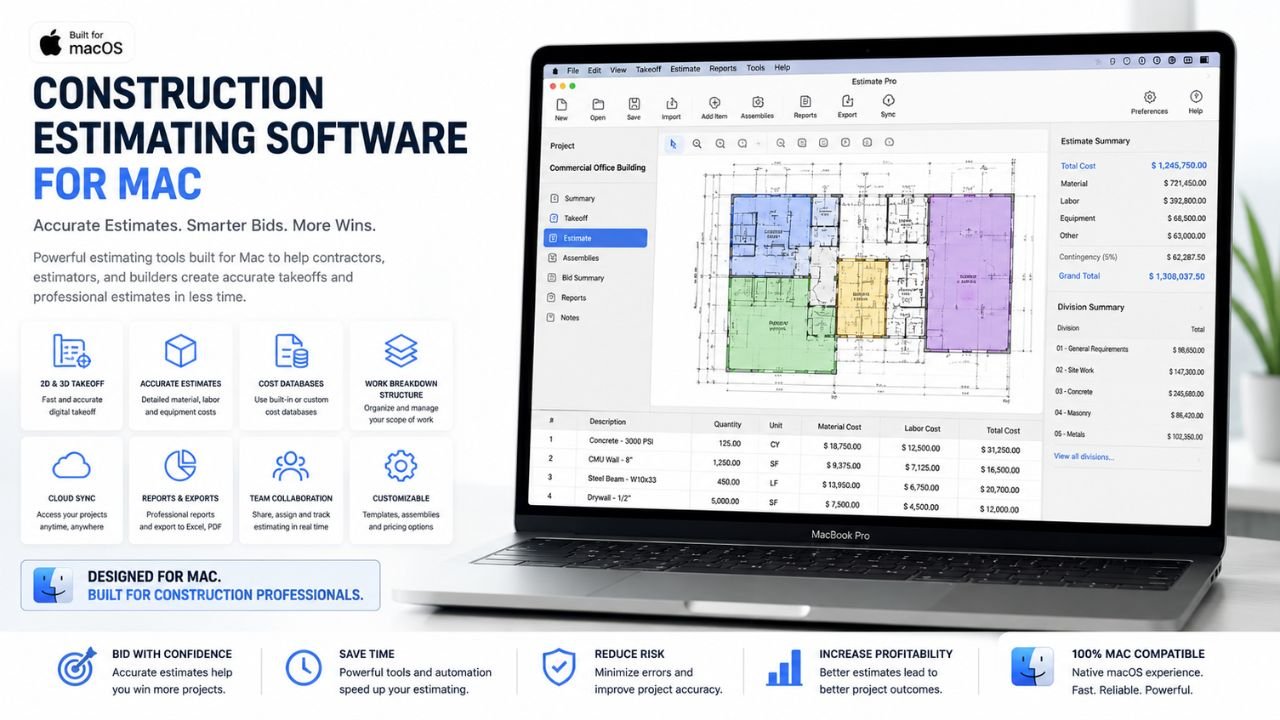
Construction estimating software is a digital solution designed to streamline, automate, and centralize the process of predicting project costs. Instead of relying on manual blueprints, scale rulers, physical highlighters, and error-prone Excel spreadsheets, modern software allows estimators to measure digital plans and apply material, labor, equipment, and overhead costs in a unified environment.
At its core, a complete estimating platform performs three fundamental tasks:
-
Digital Takeoff: Uploading PDF architectural drawings to measure linear footage, surface areas, volumes, and individual item counts with digital drawing tools.
-
Cost Calculation: Applying localized material pricing, trade labor rates, equipment rentals, subcontractor bids, and markup percentages to the measured quantities.
-
Bid Preparation: Generating polished, itemized proposals, budget summaries, and bills of quantities ready for submission to project owners, developers, or general contractors.
By bringing these functions together, construction estimating software reduces mathematical errors, standardizes pricing across your team, and cuts takeoff time by up to 50% compared to traditional paper methods.
Why Mac Compatibility Matters
For years, the commercial and residential construction software industry built tools almost exclusively for Windows operating systems. Florida contractors who used Apple hardware were forced to run virtual machine software or dual-boot environments like Boot Camp just to open their takeoff applications. These workarounds often caused system slowdowns, high battery consumption, loud cooling fans, and file management headaches.
Today, native macOS software and cloud-based web applications eliminate these technical hurdles. True Mac compatibility matters for several operational reasons:
-
Native Hardware Performance: Modern Apple Silicon processors (M-series chips) offer exceptional graphics rendering and processing speed. Mac-friendly software leverages this hardware to render multi-page, high-resolution PDF blueprint packages without lagging or freezing.
-
Trackpad and Multi-Touch Navigation: Estimating requires constant panning, zooming, and scrolling across detailed architectural plans. Software optimized for Mac natively supports Apple’s intuitive trackpad gestures and smooth scrolling.
-
Cloud Accessibility Across Devices: Modern contractors rarely stay seated at a desk all day. Cloud-based platforms allow you to perform a detailed digital takeoff on an iMac in the office, review the numbers on a MacBook at a jobsite, and present the final proposal to a client on an iPad.
-
Workflow Efficiency: Eliminating virtual machine workarounds reduces IT maintenance, prevents software crashes, and allows estimators to focus entirely on building accurate bids.
Why Florida Contractors Need the Right Software
Estimating construction projects in Florida is fundamentally different from estimating in most other regions of the United States. The state’s unique climate, geography, and regulatory environment create specific pricing and structural demands that must be factored into every estimate.
| Regional Factor | Construction Demand | Estimating Impact |
| Wind & Hurricane Codes | HVHZ compliance, engineered tie-downs, continuous paths | Requires higher framing, hardware, & masonry costs |
| Impact Fenestration | Laminated impact glass or rated shutter assemblies | Significant material cost line items |
| High Water Tables | Site fill dirt, continuous dewatering, stem wall pads | Excavation, dewatering, & site prep allowances |
| Moisture & Humidity | Closed-cell insulation, vapor barriers, stucco | Upgraded HVAC, sealing, & waterproofing assemblies |
1. High-Velocity Hurricane Zones (HVHZ) and Wind Load Codes
Florida maintains some of the strictest building codes in the nation, particularly in High-Velocity Hurricane Zones like Miami-Dade and Broward counties, as well as coastal windborne debris regions statewide. Estimating a building in Florida requires accounting for heavy-duty structural tie-down straps, reinforced masonry (CMU) lintels, engineered roof truss anchoring, and shear wall assemblies. Software that allows you to build custom assemblies ensures these code-mandated hardware items are automatically calculated with your structural framing.
2. Impact Windows and Exterior Envelopes
Standard double-pane windows rarely meet code along the Florida coastline without hurricane shutters. Most modern residential and commercial plans specify laminated impact-resistant windows and sliding glass doors. These openings represent a substantial percentage of the overall exterior envelope budget. Having takeoff software that accurately categorizes opening sizes, frame types, and impact ratings prevents multi-thousand-dollar estimating oversights.
3. Soil Conditions, High Water Tables, and Site Prep
Florida’s flat terrain, sandy soil, and elevated water tables mean site preparation involves much more than standard clearing and grading. Many Florida jobsites require importing thousands of cubic yards of engineered fill dirt to raise building pads above local Base Flood Elevations (BFE). Coastal or low-lying sites often require continuous well-point dewatering or deep piling systems. Your estimating tools must account for these heavy civil and earthwork variables during early cost modeling.
4. Masonry (CMU) vs. Wood Frame Construction
While wood framing dominates many northern markets, Concrete Masonry Unit (CMU) construction with exterior stucco is the standard for ground-floor residential structures and commercial builds across Florida. Calculating concrete block counts, rebar reinforcement, cell pour grout volumes, and multi-coat exterior stucco application requires flexible digital takeoff capabilities tailored to masonry trades.
5. Regional Labor Dynamics and Inflation
Labor pricing shifts dramatically across Florida’s major metropolitan markets. Prevailing labor rates in South Florida or the Keys are vastly different from those in rural inland counties or the Panhandle. Additionally, rapid population growth and frequent storm recovery efforts create periodic material supply chain bottlenecks. Estimating software allows builders to quickly adjust unit labor rates and material pricing to reflect real-time local market realities.
Key Features of Construction Estimating Software for Mac in Florida
When evaluating different platforms, Florida contractors should look beyond basic digital measuring tools. Look for these essential features to ensure the software supports your pre-construction workflow:
-
Advanced PDF Plan Measurement: High-speed rendering for large blueprint sets, with support for multi-page alignment, scale calibration, and automatic legend detection.
-
Custom Assembly Building: The ability to group related items into a single measurement. For example, clicking a 100-linear-foot CMU wall measurement should automatically calculate concrete blocks, rebar, mortar, grout fill, stucco square footage, and exterior paint.
-
Localized Cost Databases: Features that allow you to store, update, and manage your custom database of Florida material quotes, local trade labor rates, and subcontractor pricing.
-
Cloud Synchronization: Real-time data syncing that ensures your estimates are securely stored and accessible across all Mac, iPad, and desktop devices.
-
Revision and Overlay Tracking: The ability to overlay revised architectural sheets on top of original plans to instantly spot design changes, added openings, or footprint modifications made by the architect.
-
Export Flexibility: Seamless exporting to formats like CSV, Excel, or PDF bid forms, allowing you to interface easily with clients, lenders, and accounting software.
-
Proposal Generation: Built-in document formatting tools that convert raw estimating calculations into professional, branded bid proposals complete with scope descriptions, inclusions, and exclusions.
Browser-Based vs Native Mac Software
When selecting estimating tools for macOS, you will primarily choose between two architectural approaches: browser-based (cloud) software and native macOS desktop applications. Understanding the distinctions helps you make the right choice for your operating environment.
Browser-Based (Cloud) Solutions
Browser-based estimating applications run inside modern web browsers like Safari or Chrome. Because the processing occurs on remote cloud servers, these tools offer complete cross-platform flexibility. They are ideal for growing Florida contracting firms with multiple project managers, field superintendents, and remote estimators who need to collaborate on live estimates simultaneously.
Native macOS Applications
Native Mac applications are installed directly onto your computer’s hard drive. They are coded specifically for Apple’s operating system, allowing them to utilize your Mac’s processor and graphics power directly. They are well-suited for solo estimators or remote contractors who frequently work in areas with limited internet connectivity, such as rural job sites or new subdivision developments.
How Construction Estimating Software for Mac in Florida Improves Workflows
Integrating modern estimating software transforms a contractor’s pre-construction process from a chaotic scramble into an organized, repeatable system. Here is a step-by-step look at how a streamlined digital workflow functions on Apple hardware:
-
Digital Plan Upload and Scale Calibration: The estimator receives a PDF blueprint package from the architect and drags the file directly into the software on their Mac. The estimator sets the digital scale by clicking a known dimension on the plan (such as a standard door opening or structural grid line) to ensure mathematical accuracy.
-
Precision Digital Takeoff: Using a mouse or Apple trackpad, the estimator traces perimeter walls, highlights concrete slabs, and counts doors, windows, and plumbing fixtures. The software color-codes each measurement layer, providing a clear visual record of what has been counted.
-
Applying Florida-Specific Assemblies: The estimator links the visual measurements to pre-built material and labor assemblies. A 2,000-square-foot roof footprint measurement automatically calculates roof trusses, hurricane clips, plywood decking, underlayment, drip edge, and shingle or metal roofing quantities based on local wind code settings.
-
Localized Costing and Subcontractor Leveling: The software multiplies the calculated quantities by the contractor’s internal database of local Florida material quotes and trade labor rates. Bids from specialized electrical, plumbing, and HVAC subcontractors are inputted directly into the master estimate layout.
-
Risk Audit and Overhead Calculation: The project manager reviews the estimate to ensure site-specific risks—such as high water table dewatering or limited jobsite staging space—are covered with proper contingency allowances. Standard markups for company overhead and target profit margins are applied with a single click.
-
Proposal Generation and Submission: The platform automatically converts the completed takeoff and pricing data into a polished proposal letter. The estimator exports a PDF version and emails it to the client or general contractor, completing the bid process in a fraction of the traditional timeframe.
Contractors looking to streamline this workflow often rely on professional Florida estimating services or dedicated takeoff services to assist with large project volumes or complex specialty trade takeoffs.
Common Mistakes to Avoid
When transitioning to digital estimating tools on Mac, avoid these common pitfalls:
-
Buying Windows-Only Software with Virtualization Workarounds: Investing in legacy Windows applications that require running virtual machine software often leads to performance lag, system crashes, and poor trackpad integration. Choose native Mac apps or cloud-based solutions instead.
-
Ignoring Florida Building Code Factors: Using generic nationwide cost templates without customizing assemblies for Florida-specific wind-load straps, impact fenestration, CMU masonry, and flood elevation prep will lead to severe underbidding.
-
Failing to Maintain Local Material and Labor Rates: Material prices for concrete, steel, lumber, and roofing fluctuate constantly. Failing to update your software’s cost database with current local supplier pricing erodes profit margins on won jobs.
-
Skipping Estimator Oversight: Software is a powerful calculator, but it cannot replace human judgment. Always have an experienced estimator review drawings for scope notes, specification revisions, and unique site access constraints.
-
Overlooking Export Capabilities: Ensure your software can easily export data into standard spreadsheet formats, PDF reports, or accounting software to maintain a smooth handoff between pre-construction and field management teams.
How to Choose the Right Software
Selecting the best construction estimating software for Mac in Florida requires assessing your firm’s specific size, trade, and project portfolio. Use this evaluation framework to guide your decision:
-
Identify Your Primary Project Type: Residential builders should focus on software with strong visual takeoff tools and clean proposal generation for homeowners. Commercial GCs should prioritize platforms that excel at handling large, multi-page PDF blueprint packages and detailed CSI MasterFormat cost breakdowns. Specialty subcontractors need trade-specific depth for complex formula calculations.
-
Test the Interface on Mac Hardware: Always take advantage of free trials or live software demos. Test the software directly on your MacBook or iMac. Pay attention to how fast the platform renders large blueprints and how intuitive the user interface is.
-
Evaluate Cloud and Collaboration Needs: If your team consists of multiple estimators, project managers, and field superintendents who need to view and edit estimates from different locations, prioritize cloud-based browser platforms with real-time sync capabilities.
-
Review Training and Support Resources: Adopting new software requires an investment in team training. Ensure the software provider offers comprehensive onboarding tutorials and responsive customer support.
For a broader perspective on how digital estimating tools connect with accounting and project management platforms, review our comprehensive construction software guide.
Final Thoughts
Investing in dedicated construction estimating software for Mac in Florida is one of the most effective ways for local contractors to increase bidding capacity, eliminate costly pricing errors, and win more profitable work. By combining the speed and security of macOS hardware with digital takeoff tools tailored to Florida’s unique structural codes, high wind requirements, and coastal conditions, your firm can build a predictable, repeatable pre-construction system.
Remember that software is an accelerator for human expertise. When paired with real-world field experience, current supplier pricing, and thorough plan reviews, the right estimating platform allows you to submit confident, competitive bids on every project.
When you are ready to scale your bidding volume, refine your custom cost databases, or get expert assistance with complex quantity takeoffs, reach out through our contact page to connect with professional estimators who understand the realities of the Florida construction market.