In 2026, the question of how much does it cost to build a 20 story apartment building in Florida is central to the state’s booming residential landscape. On average, constructing a 20-story high-rise multifamily building in Florida costs between $85 million and $165 million. This range assumes a total square footage of approximately 250,000 to 350,000, including common areas and parking. Because of stringent 2026 hurricane codes, rising material prices, and labor shortages, vertical construction costs now typically range from $280 to $450 per square foot.
Navigating the financial complexities of high-rise development requires precision. Beyond the “per door” cost, developers must account for the unique “Florida Factor”—a combination of High-Velocity Hurricane Zone (HVHZ) requirements, high water tables, and evolving 9th Edition Building Codes. Partnering with Florida construction estimating services is the most effective way to safeguard your return on investment in this volatile market.
Key Takeaways for Florida High-Rise Construction in 2026
- Average Total Budget: $85.0M – $165.0M for a 20-story residential tower.
- Cost Per Square Foot: $280 – $450+ depending on luxury levels and structural systems.
- Cost Per Door: Expect $350,000 – $650,000+ for high-rise multifamily units.
- Regional Peak: South Florida (Miami/Fort Lauderdale) remains 20-30% more expensive due to HVHZ wind-load requirements.
- Structural Backbone: 20-story builds almost exclusively utilize reinforced concrete or post-tensioned slabs to meet 180+ mph wind loads.
- Efficiency Tip: Utilize professional quantity takeoffs and cost estimates to secure bank financing and avoid “silent killer” budget overruns.
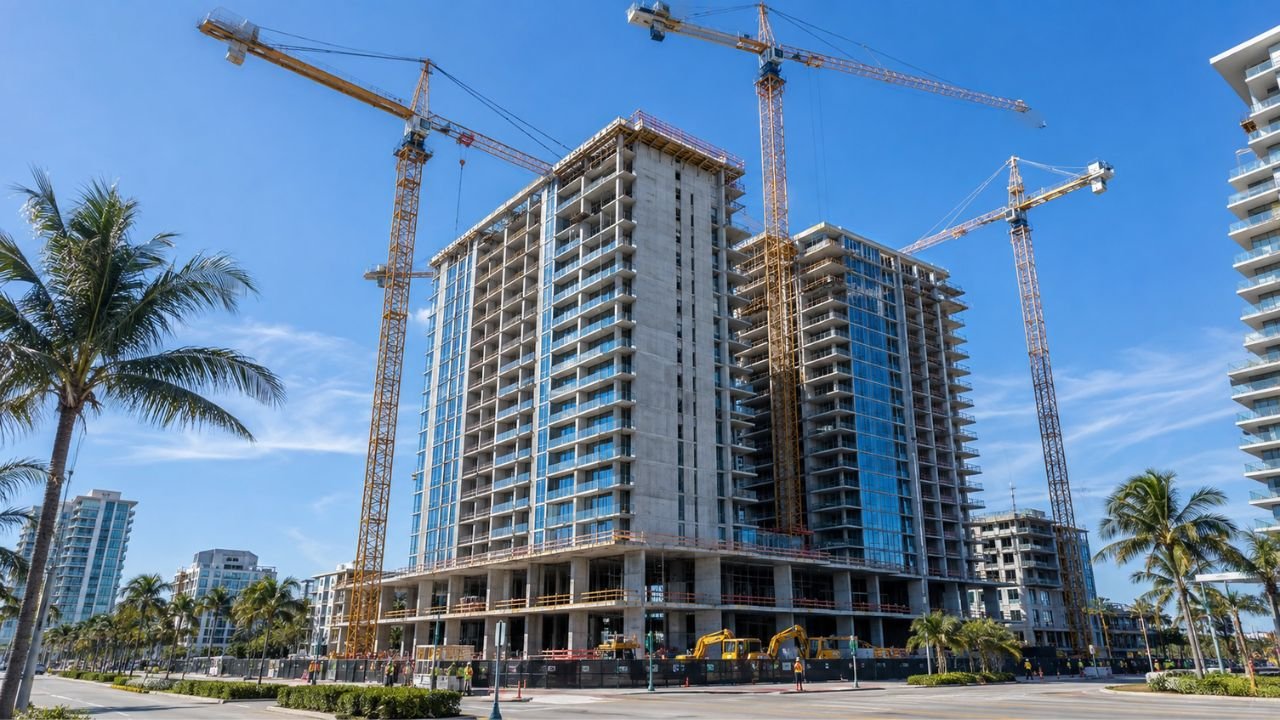
Understanding the 20 Story Apartment Building Cost Florida Benchmarks
Building a 20-story tower is fundamentally different from a low-rise or mid-rise project. At twenty stories, the project hits specific engineering and regulatory thresholds. These include mandatory double-banked elevators, pressurized stairwells, and enhanced fire suppression systems required by the Florida Building Code.
Defining the High-Rise Asset Class
A 20-story building is a true high-rise. Unlike mid-rise projects (4–6 stories) that can sometimes utilize wood-frame construction, a 20-story building requires a concrete and steel structural system. This structural shift accounts for a massive portion of the 20 story apartment building cost Florida developers face. Furthermore, the building must incorporate advanced moisture control and high-efficiency HVAC systems to combat Florida’s tropical humidity.
The Impact of 2026 Building Standards
In 2026, developers must comply with the 9th Edition of the Florida Building Code. These regulations mandate higher energy efficiency and enhanced wind resistance. For a 20-story structure, this means budgeting significantly more for specialized roof-to-wall connections and reinforced masonry compared to projects built just five years ago.
Cost per Square Foot 20 Story Apartment Florida
When evaluating the cost per square foot 20 story apartment Florida, most professionals look at vertical construction versus total development cost. In 2026, material volatility remains a concern. Specifically, concrete and specialized hurricane-rated fixtures have seen annual price increases of 9% to 12%.
2026 High-Rise Cost Benchmarks by Class
| Building Grade | Hard Cost Per Sq. Ft. | Avg. Cost Per Unit | Total Est. Budget (20 Stories) |
|---|---|---|---|
| Standard/Affordable | $280 – $320 | $350,000 – $400,000 | $85M – $110M |
| Mid-Range/Class B | $330 – $390 | $410,000 – $520,000 | $110M – $145M |
| Luxury/Class A | $400 – $500+ | $550,000 – $750,000+ | $150M – $200M+ |
By utilizing statewide Florida estimating coverage, developers can identify these price points across the state. Current market data suggests that a standard 20-story complex totaling 300,000 square feet will likely see hard construction costs alone exceed $100 million in urban hubs like Orlando or Tampa.
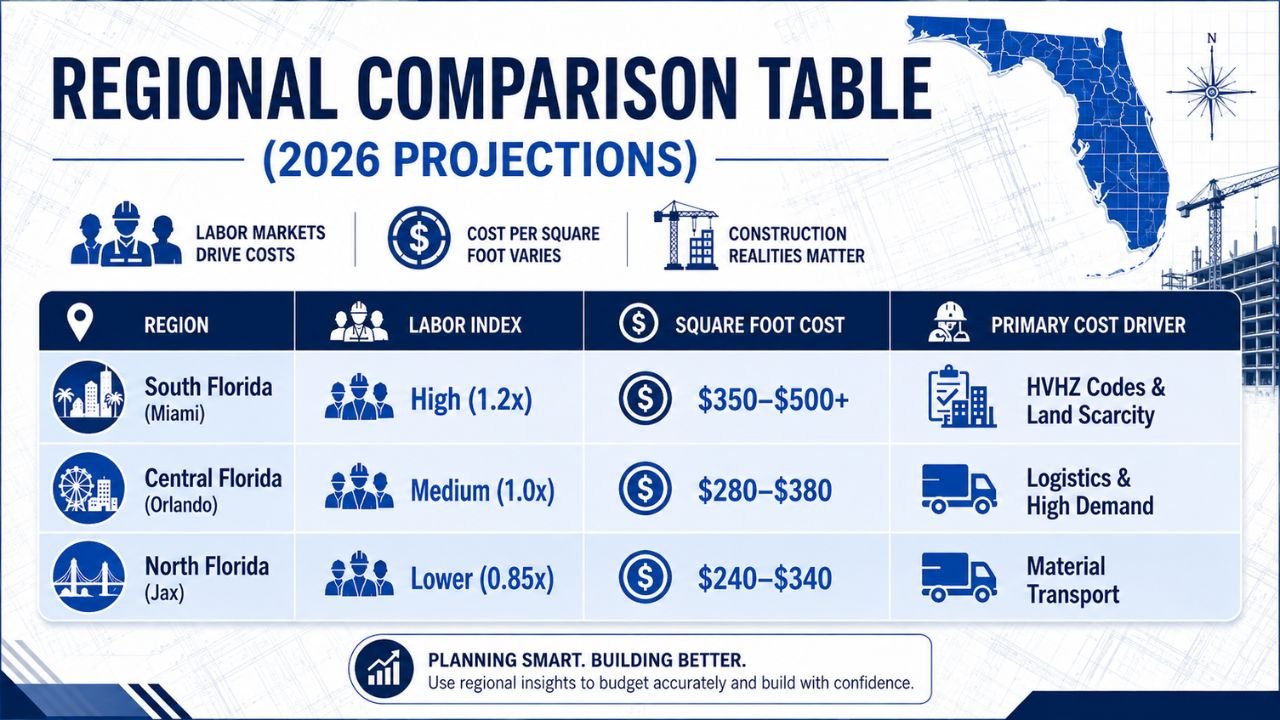
Cost to Build 20-Story Residential Tower South Florida vs North Florida
The cost to build high-rise apartment building Florida varies drastically between the tropical density of Miami and the expanding skyline of Jacksonville. Florida is not a pricing monolith.
South Florida (Miami, Fort Lauderdale, West Palm Beach)
South Florida remains the most expensive region. This is due to the High-Velocity Hurricane Zone (HVHZ) requirements. Every component—from roof tiles to the impact-resistant glazing—must have a specific Product Approval for 180+ mph wind resistance. Labor rates are also significantly higher, often 1.2x the state average. Developers in Miami should budget for the top end of the square footage range.
Central Florida (Orlando, Tampa)
Central Florida is experiencing a massive surge in high-rise demand. While HVHZ codes are less frequent inland, standard hurricane codes still apply. The 20 story multifamily construction cost Florida shows a significant gap here, with Central Florida averaging $300 to $380 per square foot.
North Florida (Jacksonville, Tallahassee)
North Florida generally offers the most competitive rates. Lower land costs and a more stable labor market contribute to this. However, logistics for material transport can occasionally cause spikes if specialized high-rise components aren’t sourced locally.
Regional Comparison Table (2026 Projections)
| Region | Labor Index | Square Foot Cost | Primary Cost Driver |
|---|---|---|---|
| South Florida (Miami) | High (1.2x) | $350 – $500+ | HVHZ Codes & Land Scarcity |
| Central Florida (Orlando) | Medium (1.0x) | $280 – $380 | Logistics & High Demand |
| North Florida (Jax) | Lower (0.85x) | $240 – $340 | Material Transport |
Breaking Down the High-Rise Apartment Construction Budget Florida
Hard costs represent the “bricks and mortar” of the project, typically accounting for 65% to 75% of your total high-rise apartment construction budget Florida. In a 20-story project, structural and MEP systems are the primary drivers.
Division 03: Concrete and Foundations
Concrete is the structural backbone of Florida apartment buildings. In 2026, rebar and ready-mix rates continue to fluctuate. For a 20-story tower, concrete work—including deep-pile foundations and reinforced columns—can range from $18 million to $35 million. High water tables in coastal areas often necessitate specialized dewatering during concrete pours, which adds $20 to $50 per square foot to the sitework budget.
Division 08: Openings (Impact-Resistant Glazing)
In a high-rise, windows are no longer just glass; they are highly engineered structural components. At the 20-story level, wind pressures are extreme. Impact-resistant glazing is mandatory statewide to meet wind-borne debris standards. For 20 stories, glazing and curtain wall systems typically cost between $95 and $185 per square foot of glass.
Division 14: Vertical Transportation
A 20-story building cannot function without high-speed elevators. Lenders and high-end tenants require at least three elevators (two passenger, one service) for a building of this scale. Each elevator shaft can add $250,000 to $450,000 to the budget, depending on speed and finish level.
Factors Affecting High-Rise Apartment Construction Cost Florida in 2026
Multiple factors affecting high-rise apartment construction cost Florida can swing a project’s feasibility by millions of dollars. The unique environmental challenges of the state demand specialized construction methods.
1. Wind Loads and Structural Bracing
The height of a 20-story building acts like a sail in hurricane-force winds. The structural frame must be designed to withstand lateral forces of 160–185 mph. This requires thicker slabs and more rebar than a low-rise building, significantly impacting the 20 story apartment building cost Florida.
2. Moisture Control and MEP Density
Mechanical, electrical, and plumbing (MEP) systems typically account for 25% to 35% of the total budget. Because of Florida’s high humidity, advanced dehumidification-focused HVAC systems are mandatory to prevent mold in 20-story stacks. Energy code R406 compliance also adds cost for high-efficiency lighting and occupancy sensors.
3. Parking: Surface vs. Structured
For a 20-story building, the site footprint is often small. Most urban Florida jurisdictions require 1.5 to 2.25 parking stalls per unit. If you cannot fit surface parking, you must build a structured parking garage. A parking podium can add $25,000 to $45,000 per stall, whereas a surface spot costs only about $3,500 to $6,500.
Permits, Fees, and Carrying Costs
Soft costs are the “invisible” expenses that can represent 15% to 25% of your total budget. In Florida, impact fees are a major outlier.
- Impact Fees: These cover roads, schools, and parks. Under Florida Statute 163.31801, these can range from $10,000 to $25,000 per unit. For a 200-unit high-rise, this is a $3 million to $5 million Day 1 expense.
- Architecture & Engineering (A&E): Professional design fees for a complex high-rise usually range from 6% to 10% of hard construction costs.
- Financing and Legal: Interest carry and loan origination fees are highly variable based on the 2026 interest rate environment.
Strategies for Cost Control and Precision Estimating
In a market where material costs can shift 5% in a single quarter, relying on generic calculators is a massive risk. Partnering with a firm that provides commercial construction cost modeling is your best defense against budget overruns.
Precision Quantity Takeoffs
Using tools like PlanSwift and Bluebeam, estimators count every linear foot of rebar and every square foot of drywall. This eliminates the guesswork that leads to “silent killers” like resource misallocation.
Localized RSMeans Data
National pricing data is often 15% to 20% off for Florida-specific projects. Expert estimators apply monthly-updated RSMeans Florida data tailored to each of the 67 counties. This ensures that your bid for a project in Miami isn’t based on Jacksonville labor rates.
Value Engineering for High-Rise Success
Professional estimating allows for value engineering. For example, grouping plumbing stacks back-to-back or optimizing the concrete mix can save hundreds of thousands of dollars without sacrificing structural integrity.
FAQ: High-Rise Construction in Florida
How much does it cost to build a 20 story apartment building in Florida on average?
Most 20-story projects in 2026 fall between $85 million and $165 million for the total project budget. Luxury towers in South Florida often exceed $200 million.
What is the typical construction cost per unit Florida apartments see for high-rises?
For a 20-story building, expect a cost per unit of $350,000 to $650,000. This includes the unit’s share of common areas, elevators, and structured parking.
Why is the cost to build 20-story residential tower South Florida higher?
The primary driver is the “Hurricane Tax”—mandatory impact glass and reinforced structural frames for the High-Velocity Hurricane Zone (HVHZ), plus higher labor and land costs.
Are elevators required for a 20-story building?
Yes, elevators are mandatory for ADA compliance, life safety, and marketability. Most 20-story buildings require 3–4 high-speed units.
How long does it take to build 20 stories in Florida?
Generally, a high-rise of this scale takes 24 to 36 months from groundbreaking to the certificate of occupancy. Permitting in regions like Miami can add another 6–12 months.
Does the budget include land costs?
Usually, construction estimates only cover the “hard” and “soft” costs of the build itself. Land acquisition is a separate capital expenditure that varies wildly by municipality.
How often do construction costs change in Florida?
Prices fluctuate monthly. Because of this, construction estimating across all 67 Florida counties must be updated in real-time to remain accurate for bidding.
What is the biggest “hidden cost” in Florida high-rise construction?
Impact fees and site development (dewatering/high water table mitigation) are the most common budget surprises for developers.
Conclusion: Start Your Development with Confidence
Understanding how much does it cost to build a 20 story apartment building in Florida is the first step toward a successful development. However, a general estimate is never enough for bank financing or competitive bidding. In the volatile 2026 market, precision is your best protection against budget overruns and project failure.
Estimate Florida offers the specialized expertise required for Florida’s unique high-rise landscape. With over 15 years of experience and $2 billion in projects estimated, we turn complex blueprints into actionable financial roadmaps.
Ready for a project-specific cost breakdown?
Contact us today to ensure your high-rise project stays on schedule and within budget.
- Email: info@estimateflorida.com