Fort Lauderdale is one of South Florida’s busiest construction markets. Waterfront condos rise along the Intracoastal, warehouses expand near Port Everglades, and single-family neighborhoods from Victoria Park to Coral Ridge keep adding renovations and custom builds. Behind nearly every one of these projects sits the same question: what will it actually cost to build?
That question is harder to answer than it sounds. Florida’s building codes account for hurricane wind loads and flood zones. Material prices shift with supply chains and tariffs. Labor rates in Broward County differ from labor rates two counties over. A general contractor pricing a bid, a developer underwriting a pro forma, or a homeowner planning an addition all need the same thing: a construction estimate that reflects real, current numbers rather than a rough guess.
That’s the gap Construction Estimating Services Fort Lauderdale fills. Professional estimating turns architectural drawings and specifications into a line-item breakdown of labor, materials, and equipment — organized by CSI division, priced to the local market, and ready to support a bid, a loan application, or a construction budget.
On this page, you’ll learn what construction estimating involves, which services are available for residential, commercial, and industrial projects, which CSI trades get estimated, how the process works from drawings to delivered estimate, and what to expect when you request a quote from Estimate Florida.
Construction Estimating Services in Fort Lauderdale
Construction estimating is the process of calculating the total probable cost of a construction project before a single shovel hits the ground. It starts with a quantity takeoff — counting and measuring every material, assembly, and system shown in the drawings — and ends with a cost estimate that applies current labor rates, material prices, equipment costs, and overhead to those quantities.
Detailed estimates matter because construction is expensive to get wrong. A contractor who underbids a job on guesswork risks losing money on labor and materials once the real costs come in. A contractor who overbids loses the job to a competitor with a tighter number. A developer who underestimates a pro forma can find a project no longer pencils out once financing is in place. In every case, the estimate is the foundation the rest of the project sits on.
Outsourcing estimating to a dedicated team offers a few concrete advantages over estimating in-house, especially for smaller contractors and busy project managers:
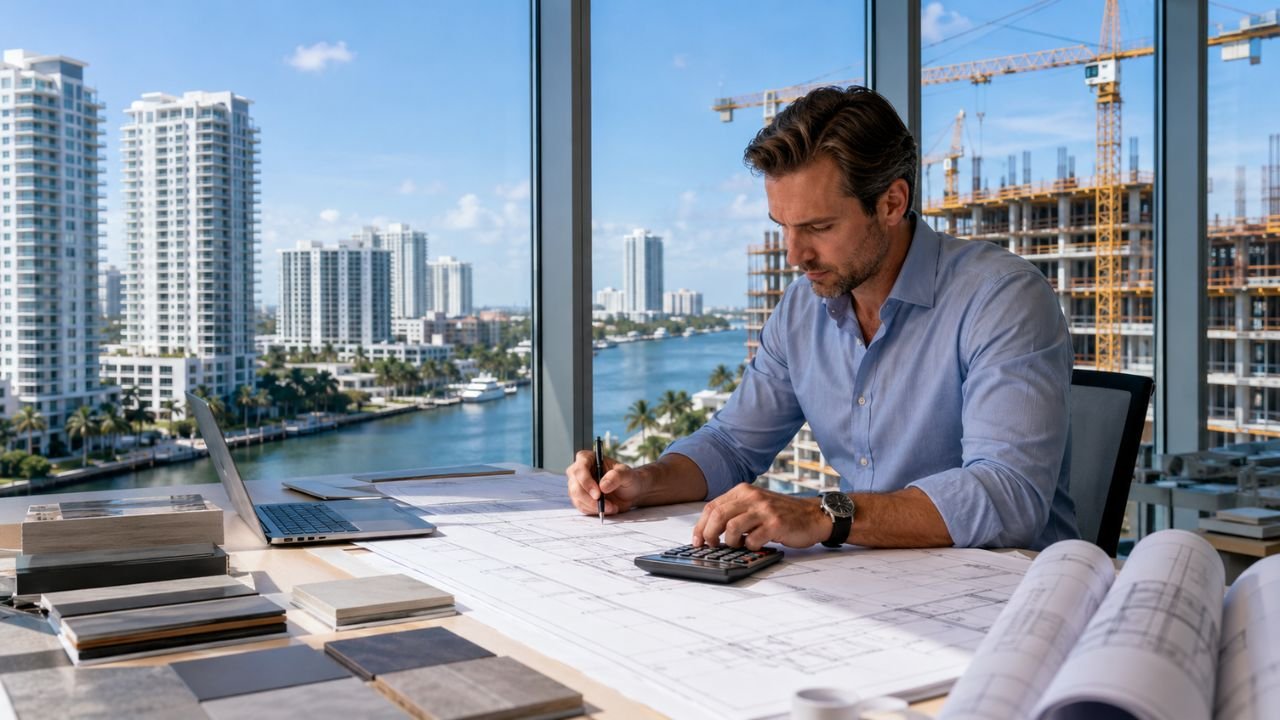
- Time saved. A detailed takeoff on a mid-size commercial job can take days. Outsourcing frees estimators, project managers, and owners to focus on running projects and winning work instead of counting studs and calculating concrete volumes.
- Consistency. A dedicated estimating service applies the same methodology and CSI structure to every estimate, which makes estimates easier to compare, audit, and hand off to a project manager once a bid is won.
- Reduced risk. Missed quantities and outdated pricing are two of the most common causes of margin erosion on a construction project. A careful, reviewed takeoff catches gaps before they become change orders.
- Better bid volume. Contractors who don’t have to build every estimate themselves can bid on more projects, which improves the odds of winning enough work to keep crews busy.
None of this replaces the contractor’s own judgment about a project. An estimate is a tool — a detailed, defensible starting point that a contractor, developer, or property owner can use to negotiate, plan, and budget with more confidence than they’d have from a rough per-square-foot number alone.
Our Construction Estimating Services
Estimate Florida provides a full range of estimating services for projects throughout Fort Lauderdale and the surrounding area, covering every phase from early conceptual planning through construction change orders.
Quantity Takeoff Services — A detailed count and measurement of every material and assembly shown in the construction drawings, broken out by CSI division. This is the foundation every other estimate is built on.
Material Takeoff Services — A material-only breakdown used by suppliers, subcontractors, and contractors who need to know exactly how much lumber, concrete, drywall, roofing, or other material a project requires, independent of labor pricing.
Residential Construction Estimating — Cost estimates for single-family homes, custom homes, renovations, and multifamily residential projects, covering everything from foundation to finishes.
Commercial Construction Estimating — Cost estimates for office buildings, retail centers, restaurants, hotels, and other commercial projects, accounting for the tenant improvement work and code requirements specific to commercial construction.
Industrial Construction Estimating — Cost estimates for warehouses, distribution centers, and industrial facilities, including structural steel, specialized flooring, and large-scale site work.
Budget Estimates — Early-stage cost projections used during feasibility and planning, before drawings are finalized, to help owners and developers understand whether a project fits their budget.
Bid Estimates — Detailed, bid-ready estimates built from complete construction documents, used by general contractors and subcontractors to submit competitive, accurate bids.
Preliminary Estimates — Rough-order-of-magnitude estimates prepared early in design, useful for comparing design options before full drawings exist.
Design Estimates — Cost estimates tied to a specific design phase (schematic design, design development, or construction documents), used to track how cost changes as a design develops.
Conceptual Estimates — High-level cost estimates based on project type, size, and quality level, often used for very early feasibility studies.
Change Order Estimates — Cost estimates for scope changes that occur mid-construction, priced to match the original estimate’s methodology so owners and contractors can evaluate change orders fairly.
Value Engineering — A review of the design and specifications to identify lower-cost alternatives that preserve the project’s function and quality, helping owners keep a project within budget without cutting corners on performance.
Cost Management — Ongoing tracking of actual costs against the original estimate throughout construction, helping project teams catch overruns early.
CPM Scheduling Support — Cost data structured to support critical path method scheduling, so project managers can tie cost and schedule together.
Residential Construction Estimating
Fort Lauderdale’s residential market covers a wide range of project types, from mid-century single-family homes in Rio Vista to waterfront estates along the New River. Each type of residential project carries its own cost drivers, and an accurate estimate accounts for all of them.
- Single-Family Homes — Standard new-construction homes, priced by foundation type, framing method, and finish level.
- Custom Homes — One-off designs with unique layouts, higher-end finishes, and non-standard structural elements that require a detailed, project-specific takeoff.
- Luxury Homes — High-end finishes, custom millwork, specialty systems (elevators, smart-home wiring, generators), and premium exterior materials.
- Waterfront Homes — Seawalls, dock construction, elevated foundations, impact-rated openings, and flood-zone compliance specific to Fort Lauderdale’s canals and Intracoastal-adjacent lots.
- Condominiums — Multi-unit residential buildings with shared systems, common-area finishes, and vertical construction cost factors.
- Apartments — Multifamily rental developments priced per unit and per building, accounting for repeated unit types and shared amenities.
- Townhomes — Attached residential units with shared walls and party-wall fire-rating requirements.
- Home Renovations — Kitchen, bathroom, and whole-house remodels, priced against existing conditions rather than clean new-construction drawings.
- Home Additions — Square-footage additions that tie into an existing structure’s foundation, framing, and systems.
- Multifamily Developments — Larger residential developments combining multiple building types, site work, and shared infrastructure.
Accurate estimating matters most on the projects where scope is easiest to underestimate: renovations with unknown existing conditions, waterfront homes with flood and wind-load requirements, and custom homes with non-repeatable details. A detailed quantity takeoff catches the line items a rough per-square-foot number would miss, which is where most residential budget overruns start.
Commercial Construction Estimating
Commercial projects in Fort Lauderdale range from small retail buildouts along Las Olas Boulevard to large mixed-use developments near the beach. Estimate Florida provides commercial estimating for:
- Office Buildings — Core-and-shell and tenant-improvement estimating for office construction and buildouts.
- Hotels — Guest room repetition, common-area finishes, and hospitality-specific systems like laundry facilities and pool decks.
- Restaurants — Kitchen equipment, grease trap and ventilation systems, and finish-heavy dining areas.
- Retail Stores — Storefront construction, interior buildouts, and signage-related site work.
- Shopping Centers — Multi-tenant retail developments with shared parking, site work, and utility infrastructure.
- Healthcare Facilities — Specialized mechanical, electrical, and plumbing systems required for medical-grade construction.
- Educational Buildings — Schools and training facilities with code requirements specific to occupancy and life safety.
- Warehouses — Large-span structures, loading dock construction, and industrial flooring.
- Industrial Buildings — Manufacturing and processing facilities with heavy structural and mechanical requirements.
- Mixed-Use Developments — Combined residential, retail, and commercial construction within a single project, requiring coordination across multiple estimate types.
Commercial estimates typically carry more complexity than residential ones because of code-driven systems (fire protection, accessibility, commercial-grade mechanical and electrical) and because commercial financing often requires a detailed cost breakdown before a lender will release funds.
CSI Trades We Estimate
Estimate Florida organizes every estimate by CSI (Construction Specifications Institute) division, the industry-standard framework contractors, architects, and lenders use to organize project costs. Trades covered include:
- Concrete — Foundations, slabs, and structural concrete work.
- Masonry — CMU block, brick, and stone construction.
- Structural Steel — Steel framing, connections, and structural components.
- Metals — Miscellaneous metals, railings, and structural fabrications.
- Lumber & Framing — Wood framing materials and labor for residential and light commercial construction.
- Roofing — Roofing systems rated for South Florida’s wind and hurricane requirements.
- Drywall — Interior wall and ceiling systems.
- Flooring — Tile, hardwood, carpet, and commercial flooring systems.
- Painting — Interior and exterior finish coatings.
- HVAC — Heating, ventilation, and air conditioning systems.
- Plumbing — Water supply, drainage, and fixture systems.
- Electrical — Power distribution, lighting, and low-voltage systems.
- Fire Protection — Sprinkler systems and fire-rated assemblies.
- Doors & Windows — Including impact-rated openings required in Florida’s high-velocity hurricane zones.
- Finishes — Interior and exterior finish materials and installation.
- Site Work — Grading, utilities, and site infrastructure.
- Earthwork — Excavation, fill, and soil-related work.
- Demolition — Selective and full demolition scopes.
- Landscaping — Site landscaping and irrigation systems.
Breaking a project down by CSI division gives contractors and owners a cost structure they can compare against other bids, track through construction, and hand directly to a project manager once the job starts.
Why Choose Estimate Florida?
- Experienced construction estimators who understand Florida’s building codes, wind-load requirements, and flood-zone construction standards.
- Accurate quantity takeoffs performed line by line against the construction drawings, not shortcut with square-footage averages.
- Detailed cost estimates broken down by CSI division for easy comparison and tracking.
- Fast turnaround times so estimates are ready when a bid deadline or financing decision requires them.
- Competitive pricing structured as a flat fee per project.
- Florida construction market expertise, including current regional labor and material pricing.
- Industry-standard estimating software used alongside experienced human review on every estimate.
- Confidential project handling for drawings, specifications, and proprietary project information.
- Responsive customer support throughout the estimating process.
Estimating Software We Use
Estimate Florida uses industry-standard estimating and takeoff software to improve accuracy and turnaround time, including:
- PlanSwift — Digital takeoff software for measuring quantities directly from drawings.
- Bluebeam Revu — PDF markup and takeoff tool widely used across the construction industry.
- CostX — Takeoff and cost planning software with 3D model integration.
- STACK — Cloud-based takeoff and estimating software.
- Autodesk Construction Cloud — Project data and document management for construction teams.
- Trimble — Estimating and project management software used across commercial construction.
- Microsoft Excel — Used for cost breakdowns, summaries, and client-facing deliverables.
Software speeds up the takeoff process and improves measurement accuracy, but it doesn’t replace judgment. Every estimate produced by Estimate Florida is reviewed by an experienced estimator before delivery to check quantities, pricing, and scope against the actual drawings.
Industries We Serve
- Residential
- Commercial
- Industrial
- Hospitality
- Healthcare
- Retail
- Government
- Education
- Infrastructure
- Multifamily Construction
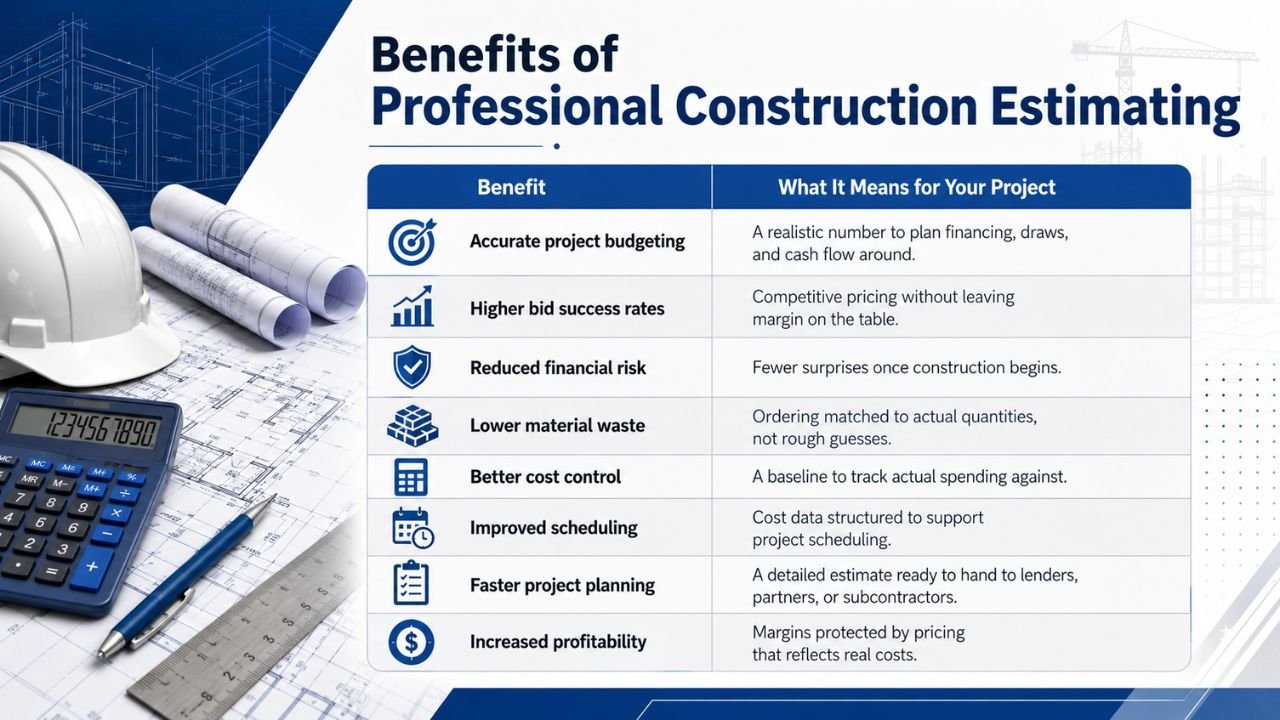
Benefits of Professional Construction Estimating
| Benefit | What It Means for Your Project |
| Accurate project budgeting | A realistic number to plan financing, draws, and cash flow around |
| Higher bid success rates | Competitive pricing without leaving margin on the table |
| Reduced financial risk | Fewer surprises once construction begins |
| Lower material waste | Ordering matched to actual quantities, not rough guesses |
| Better cost control | A baseline to track actual spending against |
| Improved scheduling | Cost data structured to support project scheduling |
| Faster project planning | A detailed estimate ready to hand to lenders, partners, or subcontractors |
| Increased profitability | Margins protected by pricing that reflects real costs |
Our Construction Estimating Process
- Receive project drawings and specifications. Send plans, specs, and any relevant project documents.
- Review project scope. The estimating team reviews the documents to understand the full scope of work.
- Perform detailed quantity takeoffs. Every material and assembly is measured and counted, organized by CSI division.
- Apply current labor and material pricing. Quantities are priced using current Florida-market labor and material costs.
- Conduct quality assurance checks. Every estimate is reviewed against the drawings before delivery to check for missed scope or pricing errors.
- Deliver a professional construction estimate. The finished estimate is delivered in a clear, organized format ready for bidding, budgeting, or financing.
Construction costs vary depending on project size, materials, labor rates, permits, design complexity, and market conditions — every estimate reflects the specific project it’s built from rather than a generic average.
Areas We Serve Around Fort Lauderdale
In addition to Fort Lauderdale itself, Estimate Florida provides construction estimating services throughout the surrounding Broward County area, including Hollywood, Plantation, Davie, Sunrise, Pembroke Pines, Weston, Oakland Park, Wilton Manors, Pompano Beach, Deerfield Beach, Coral Springs, and Lauderdale-by-the-Sea.
Frequently Asked Questions
What is included in a construction estimating service? A construction estimate typically includes a full quantity takeoff, labor and material pricing by CSI division, and a summary cost breakdown that can be used for bidding, budgeting, or financing.
How long does it take to get a construction estimate in Fort Lauderdale? Turnaround depends on project size and complexity. Smaller residential projects are typically faster than large commercial or industrial estimates; specific timelines are provided once project drawings are reviewed.
Do I need complete architectural drawings to get an estimate? Complete drawings produce the most accurate estimate, but preliminary or conceptual estimates can be prepared from partial drawings or design-stage documents when a project is still in early planning.
What’s the difference between a quantity takeoff and a cost estimate? A quantity takeoff measures and counts materials and assemblies. A cost estimate applies current labor and material pricing to those quantities to produce a total project cost.
Can Estimate Florida provide estimates for both residential and commercial projects? Yes. Estimating services cover residential, commercial, and industrial projects throughout Fort Lauderdale and the surrounding area.
What CSI divisions are included in a typical estimate? Estimates can cover any combination of CSI divisions relevant to the project, from concrete and masonry through electrical, HVAC, and finishes.
Do estimates account for Florida’s hurricane and flood-zone building requirements? Yes. Estimates for Fort Lauderdale projects account for wind-load requirements, impact-rated openings, and flood-zone construction standards where applicable.
How is pricing determined for a construction estimate? Pricing is structured as a flat fee based on project size and scope, provided after an initial review of the project drawings.
Can Estimate Florida help with change order pricing during construction? Yes. Change order estimates are priced using the same methodology as the original estimate, so cost changes can be evaluated consistently.
What estimating software does Estimate Florida use? Estimates are prepared using tools including PlanSwift, Bluebeam Revu, CostX, STACK, Autodesk Construction Cloud, Trimble, and Microsoft Excel, with every estimate reviewed by an experienced estimator.
Is my project information kept confidential? Yes. Project drawings, specifications, and related information are handled confidentially throughout the estimating process.
Can a construction estimate help with securing project financing? A detailed, professionally prepared cost estimate is often required by lenders as part of the financing process for construction projects.
What’s the difference between a preliminary estimate and a bid estimate? A preliminary estimate is a rough-order projection prepared early in design. A bid estimate is a detailed, bid-ready cost breakdown built from complete construction documents.
Do you provide value engineering as part of the estimating process? Value engineering is available as a service to identify lower-cost design alternatives that preserve a project’s function and quality.
How do I get started with a construction estimate for my Fort Lauderdale project? Submit your project drawings and specifications to request a quote, and the estimating team will follow up with a scope review and pricing.
Key Takeaways
- Construction estimating turns drawings and specifications into a detailed, line-item cost breakdown organized by CSI division.
- Accurate estimates reduce financial risk, improve bid competitiveness, and protect profit margins on residential, commercial, and industrial projects.
- Estimate Florida provides quantity takeoffs, material takeoffs, and full cost estimates across residential, commercial, and industrial construction in Fort Lauderdale.
- Every estimate covers relevant CSI trades, from concrete and structural steel through HVAC, electrical, and finishes.
- Estimates account for Florida-specific construction factors, including wind-load and flood-zone requirements.
- Software tools like PlanSwift, Bluebeam Revu, and CostX support the process, but every estimate is reviewed by an experienced estimator before delivery.
- Construction costs vary by project size, materials, labor, permits, design complexity, and market conditions.
- Service is available throughout Fort Lauderdale and surrounding Broward County communities.
Conclusion
Whether you’re a general contractor preparing a competitive bid, a developer underwriting a new project, or a homeowner planning a renovation, an accurate construction estimate is the foundation everything else gets built on. Guesswork and rough per-square-foot numbers leave too much room for costly surprises once construction is underway.
Estimate Florida provides detailed, CSI-organized Construction Estimating Services in Fort Lauderdale for residential, commercial, and industrial projects — built from your actual drawings, priced to the current Florida market, and delivered by experienced estimators. Contact Estimate Florida today to request a quote for your Fort Lauderdale construction project.