
Miami’s concrete market runs on two things at once: relentless bid deadlines and a building code that doesn’t forgive shortcuts. Between the county’s High-Velocity Hurricane Zone (HVHZ) requirements, a water table that sits just a few feet below grade almost everywhere south of Kendall, and a construction pipeline that ranges from Brickell high-rises to Homestead slab-on-grade tract homes, a concrete estimate built on national averages is a liability before the first yard is poured.
Concrete estimating services give contractors, developers, and design teams a detailed, documented breakdown of exactly how much concrete, reinforcement, formwork, and labor a project requires — measured directly from drawings and specifications, not guessed from a rule of thumb. For Miami, that means a takeoff that already accounts for post-tension slab design on coastal high-rises, dewatering on sites with high groundwater, and the reinforcing details HVHZ wind loads demand.
Estimate Florida prepares concrete quantity takeoffs and cost estimates for Miami-area contractors and developers, built from local labor rates and Florida-specific material pricing rather than generic national data. Whether the scope is a single custom-home foundation in Coral Gables or a tilt-up warehouse slab in Doral, the goal of this guide is to explain what concrete estimating actually involves, what drives cost in Miami specifically, and how to get an estimate that holds up through the bidding process.
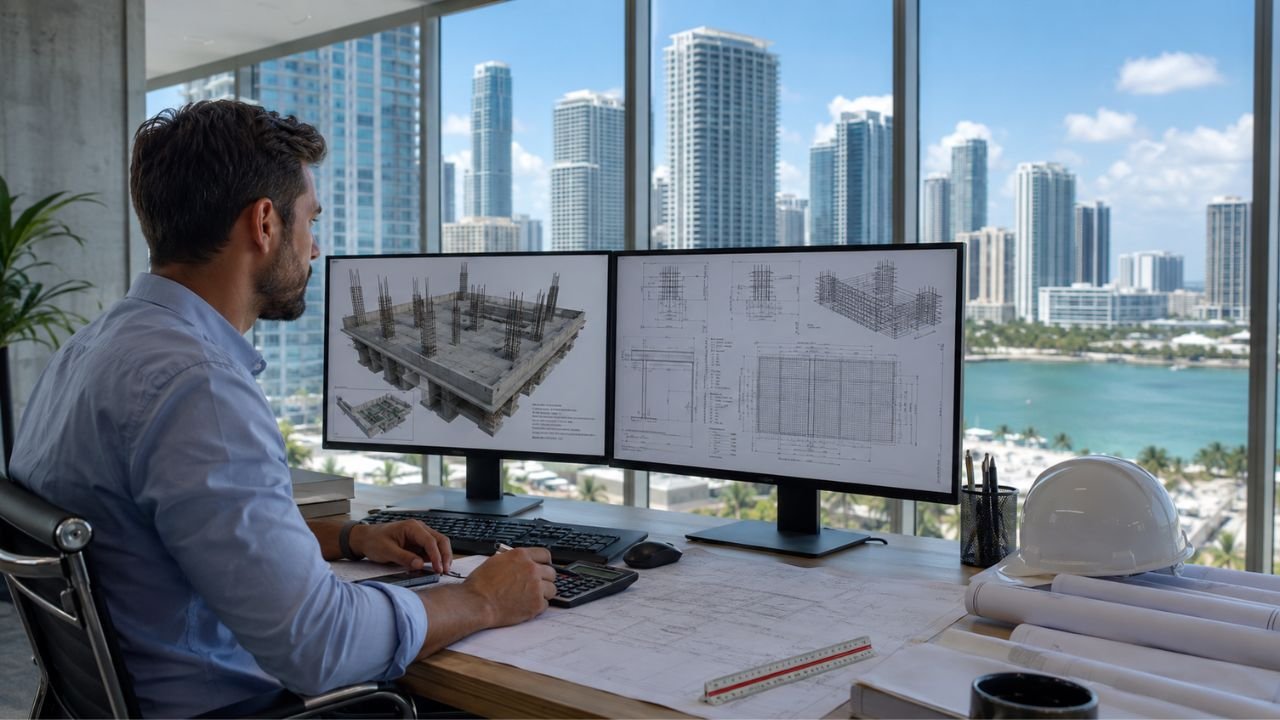
What Are Concrete Estimating Services?
Concrete estimating is the process of translating construction drawings and specifications into a measured, priced scope of concrete work. It starts with a quantity takeoff — measuring every concrete element on the plans (slabs, footings, foundations, walls, columns, beams, paving) and converting those measurements into cubic yards of concrete, tons or pounds of reinforcing steel, and square footage of formwork.
Once quantities are established, an estimator applies pricing: ready-mix concrete cost by PSI strength, rebar and wire mesh by weight, formwork labor and material, placement and finishing labor, equipment (pumps, buggies, screeds), and any specialty items like curing compounds or joint sealants. The result is a line-item cost estimate that can support a contractor’s bid, a developer’s preconstruction budget, or an owner’s early feasibility study.
A concrete estimate is built from whatever documentation is available — structural drawings, architectural plans, specifications, and any issued addenda. Incomplete plans don’t stop the process; a competent estimator flags assumptions clearly rather than guessing silently. The construction estimating services process at Estimate Florida follows this same documented approach across every trade, with concrete typically the first trade priced since structural and foundation work drives the sequencing of everything that follows.
Why Accurate Concrete Estimating Matters in Miami
Concrete is usually the largest single cost category on a Miami foundation or structural package, and it’s one of the least forgiving to get wrong. A missed rebar schedule or an underestimated slab thickness doesn’t just cost money — it can delay a permit inspection or trigger a change order mid-pour.
- Competitive bidding. Miami’s construction market is dense and competitive. Contractors bidding public and private work need concrete numbers tight enough to bid competitively without eating into margin on execution.
- Post-tension and elevated slab risk. A large share of Miami’s residential and commercial construction is mid- to high-rise, meaning post-tension elevated decks rather than simple slab-on-grade. PT cable quantities, stressing allowances, and shoring costs are easy to underprice if an estimator isn’t specifically accounting for them.
- Dewatering exposure. South Florida’s high water table turns dewatering from an occasional line item into a near-default cost on foundation work, particularly below grade or near the coast. Estimates built on national databases routinely miss this.
- HVHZ reinforcing requirements. Miami-Dade sits entirely within the state’s High-Velocity Hurricane Zone, which drives stricter connection and reinforcing detailing than most of the country. Rebar quantities calculated without HVHZ in mind tend to run light.
- Budget control for developers. For multifamily and commercial developers, an accurate concrete estimate early in preconstruction is often the difference between a project that pencils and one that doesn’t once actual bids come in.
Concrete Estimating Services We Provide
Concrete Quantity Takeoff
A quantity takeoff measures every concrete element shown on the structural and architectural drawings — slab-on-grade and elevated slab volumes, spread and continuous footings, grade beams, pile caps, foundation and retaining walls, columns, beams, and site paving — and converts each into cubic yards by placement area. For Miami projects this typically includes separate line items for slab-on-grade versus elevated post-tension decks, since the two carry very different cost structures.
Concrete Material Takeoff
Beyond raw concrete volume, a material takeoff quantifies ready-mix by PSI specification, rebar and wire mesh by bar size and weight, formwork materials, vapor barriers, expansion and control joint materials, and finishing accessories. This is the level of detail that lets a contractor go to suppliers with a real material list instead of a rounded estimate.
Concrete Bid Estimating
A bid estimate combines the quantity takeoff with current Florida labor and material pricing to produce a number a contractor can submit with confidence. It includes labor productivity assumptions specific to South Florida crews, equipment costs, and contractor overhead.
Concrete Budget and Preliminary Estimating
Early in a project — before drawings are complete — developers and owners often need a preliminary budget number based on square footage, project type, and known structural systems. This early-stage estimate is less granular than a detailed bid estimate but is critical for feasibility decisions before design is finalized.
Detailed Concrete Estimating
Once construction documents are issued for bid, a detailed estimate prices every quantity from the actual plans rather than square-footage assumptions — the standard for GC bid submissions and subcontractor proposals.
Concrete Change Order Estimating
When addenda or field conditions change the concrete scope mid-project, a change order estimate isolates and prices exactly what changed, keeping the pricing conversation with the owner or GC transparent and defensible.
Concrete Value Engineering
Value engineering looks for ways to reduce cost without automatically assuming the cheapest option is the best one — alternate mix designs, formwork systems, or placement sequencing that can lower cost while still meeting the structural and code requirements on the drawings.
Types of Concrete Projects We Estimate
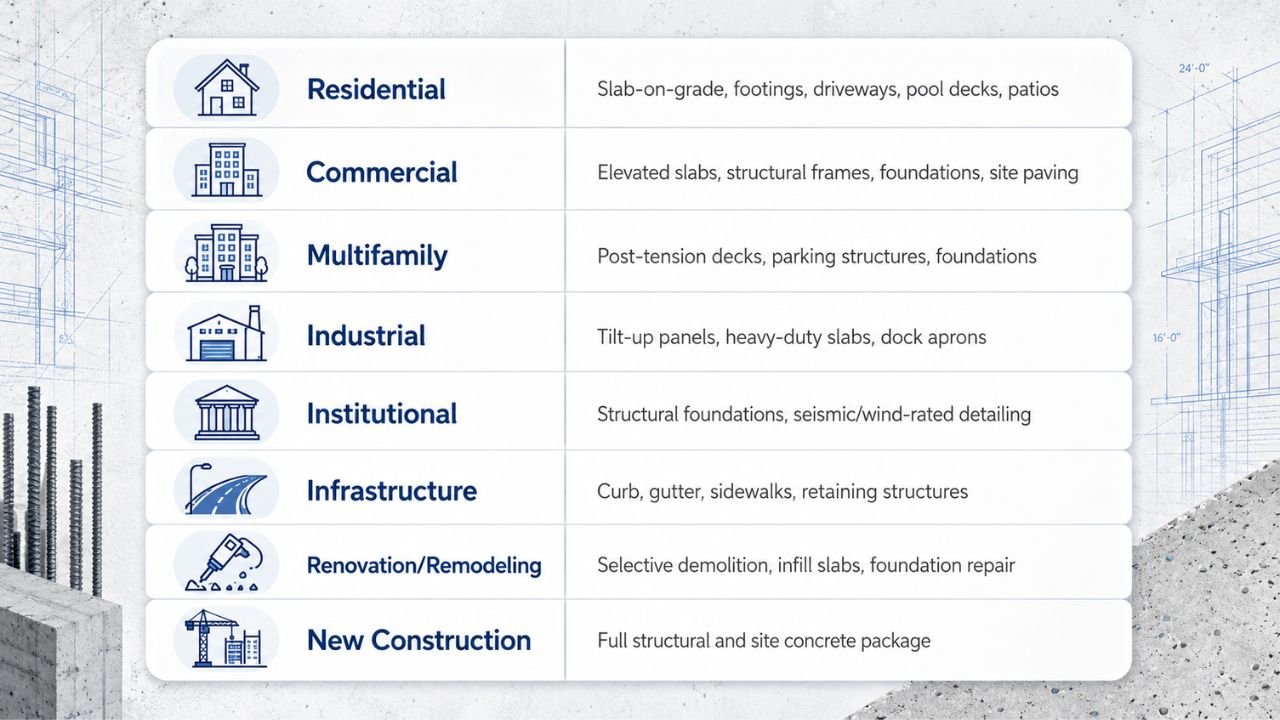
Concrete estimating spans a wide range of project types, each with different cost drivers:
| Project Type | Typical Concrete Scope |
| Residential | Slab-on-grade, footings, driveways, pool decks, patios |
| Commercial | Elevated slabs, structural frames, foundations, site paving |
| Multifamily | Post-tension decks, parking structures, foundations |
| Industrial | Tilt-up panels, heavy-duty slabs, dock aprons |
| Institutional | Structural foundations, seismic/wind-rated detailing |
| Infrastructure | Curb, gutter, sidewalks, retaining structures |
| Renovation/Remodeling | Selective demolition, infill slabs, foundation repair |
| New Construction | Full structural and site concrete package |
Residential Concrete Estimating in Miami
Miami residential concrete work spans custom and luxury single-family homes, townhomes, duplexes, small multifamily buildings, additions, and site improvements like driveways, patios, and pool decks. Florida residential construction is predominantly concrete block and stucco (CBS) rather than wood frame, which shifts a meaningful share of what would be a “framing” cost elsewhere in the country into the concrete and masonry scope — tie beams, lintels, and bond beams tie directly into the concrete estimate.
For custom and luxury homes in areas like Coral Gables, Pinecrest, or Key Biscayne, slab specifications, pool deck detailing, and foundation design for larger footprints all add complexity that a standardized per-square-foot number won’t capture accurately.
Commercial Concrete Estimating in Miami
Commercial concrete estimating in Miami covers office buildings, retail centers, hotels, restaurants, warehouses, healthcare facilities, schools, and mixed-use developments. These projects typically involve larger, more complex structural concrete packages — elevated post-tension or conventionally reinforced decks, structural columns and beams, and site concrete for parking and loading areas — estimated at a CSI MasterFormat level of detail suitable for GC bid packages and subcontractor scope confirmation. The commercial construction estimating process folds concrete pricing into the full trade breakdown alongside MEP, envelope, and finishes.
Concrete Components We Estimate
- Foundations and footings (spread, continuous, pile caps)
- Slabs-on-grade and elevated structural slabs
- Post-tension decks and cables
- Concrete and retaining walls
- Columns and beams
- Stairs
- Curbs, gutters, and sidewalks
- Driveways, parking areas, and pavements
- Site concrete and flatwork
- Formwork (SOG edge forms, wall forms, elevated deck shoring)
- Reinforcing steel and wire mesh
- Expansion and construction joints
- Concrete finishes (broom, trowel, exposed aggregate)
Concrete Quantity Takeoff Process
- Review structural and architectural drawings
- Review project specifications and any addenda
- Identify the full concrete scope across all drawing sheets
- Measure quantities by placement area
- Calculate concrete volumes in cubic yards
- Calculate reinforcement quantities in pounds or tons
- Calculate formwork by square footage
- Calculate related materials — vapor barrier, joint materials, accessories
- Apply current Florida labor and material pricing
- Review quantities for completeness against the drawing set
- Prepare the final formatted estimate
Concrete Estimating Software
Estimators commonly use digital takeoff tools such as PlanSwift, Bluebeam Revu, and STACK to measure quantities directly from PDF or CAD drawings, alongside Excel for pricing and cost databases for current material and labor rates. These tools speed up measurement and reduce transcription error, but software alone doesn’t guarantee an accurate estimate — professional review of the quantities against the actual drawings and specifications remains essential, particularly for catching missing addenda items or unusual details a template might not flag.
Factors Affecting Concrete Costs in Miami
Concrete project costs in Miami vary based on a range of factors, including:
- Project size and total concrete volume
- Specified concrete strength (PSI) and mix design
- Reinforcement requirements, including HVHZ-driven detailing
- Formwork type and complexity
- Site access and staging conditions
- Pumping requirements for elevated or hard-to-reach pours
- Labor availability and current market rates
- Material pricing and supplier lead times
- Equipment needs
- Project schedule and sequencing constraints
- Design complexity
- Site conditions, including groundwater and soil bearing capacity
- Broader material and labor market conditions
Because these factors shift by project and by month, this guide does not publish fixed per-yard or per-square-foot concrete prices. Current, project-specific pricing is available by submitting plans for a quote.
How Much Does Concrete Estimating Cost?
Estimating fees depend on project size and scope, the number and detail level of drawings provided, how many trades are included, project complexity, and turnaround requirements. A single-trade concrete takeoff for a small residential project costs less than a full CSI MasterFormat estimate for a multi-story commercial building. Rather than publish a flat rate that wouldn’t reflect real project variation, Estimate Florida reviews submitted plans and responds with a flat-fee quote — typically the same business day.
Benefits of Outsourcing Concrete Estimating
- Saves contractors the time otherwise spent on manual takeoffs
- Frees up capacity to bid on more projects
- Reduces the risk of measurement error under deadline pressure
- Improves cost organization for bid submission and internal budgeting
- Helps identify scope gaps before they become field problems
- Supports more accurate material procurement planning
- Gives owners and developers a defensible number for budget control
- Lets contractors focus on running projects instead of running takeoffs
Common Concrete Estimating Mistakes
- Incorrect or inconsistent measurements between sheets
- Missing reinforcement, particularly at HVHZ-driven connection details
- Missing or underestimated formwork, especially for elevated decks
- Incorrect concrete volume calculations
- Unrealistic waste factor assumptions
- Missing accessories — joint materials, vapor barriers, curing compounds
- Outdated labor or material pricing
- Missing drawing revisions or issued addenda
- Double-counting quantities across overlapping drawing sheets
- Incorrect unit conversions
- Ignoring site conditions like groundwater or poor soil bearing
Professional review against the full, current drawing set is the most reliable way to catch these before they reach a bid submission.
Who Needs Concrete Estimating Services?
Concrete contractors need detailed quantity takeoffs to submit competitive, accurate bids without spending weekend hours on manual measurement.
General contractors need concrete numbers that integrate cleanly into a full project bid alongside every other trade.
Subcontractors preparing concrete-specific proposals need a defensible, itemized breakdown to support their pricing.
Developers rely on concrete estimates for preconstruction budgeting and feasibility analysis before committing to a project.
Home builders need residential-specific concrete estimates that reflect Florida CBS construction rather than generic wood-frame assumptions.
Architects and engineers sometimes need preliminary concrete cost input to evaluate design alternatives during schematic design.
Property owners planning concrete work — driveways, additions, foundations — benefit from an independent estimate to evaluate contractor bids.
Why Choose Estimate Florida?
Estimate Florida applies a consistent, documented estimating workflow to every concrete scope — detailed quantity takeoffs, organized line-item reports, and Florida-specific construction knowledge including HVHZ requirements and high-water-table conditions common across Miami-Dade. Estimates are delivered as a formatted Excel workbook plus a PDF summary, structured to CSI MasterFormat by default, with one revision round included and clear communication throughout. See the full construction estimating services overview or the residential and industrial estimating pages for scope-specific detail.
Concrete Estimating vs. Concrete Takeoff
| Concrete Takeoff | Concrete Estimate |
| Measures quantities | Calculates project costs |
| Focuses on scope quantities | Includes labor and material pricing |
| Produces quantity information | Produces cost information |
| Used as an estimating foundation | Used for budgeting and bidding |
A takeoff is the measurement step; an estimate is the priced output built on top of it. Every concrete estimate starts with a takeoff, but not every takeoff is turned into a full priced estimate — some scopes only need the quantities.
How Accurate Estimates Support Better Bids
Complete plans lead to an accurate takeoff, which leads to correct pricing, which produces an organized estimate — and an organized estimate supports better bid decisions. Accurate estimating doesn’t guarantee winning a contract, but it removes pricing error as a reason to lose one, and it protects margin on the jobs that are won.
Frequently Asked Questions
What does a concrete estimator do? A concrete estimator measures concrete quantities from construction drawings and applies current labor and material pricing to produce a cost estimate for bidding, budgeting, or planning purposes.
What is included in a concrete takeoff? A concrete takeoff includes measured quantities for slabs, footings, foundations, walls, columns, beams, and site concrete, along with associated reinforcement and formwork quantities.
How much does concrete estimating cost? Cost depends on project size, scope, and complexity. Submit plans for a project-specific flat-fee quote.
How long does a concrete estimate take? Most estimates are delivered within 24–48 business hours; larger or more complex scopes may take longer, confirmed at the time plans are reviewed.
Do you estimate residential concrete projects? Yes — custom homes, additions, remodels, and multifamily residential concrete scopes are all estimated regularly.
Do you estimate commercial concrete projects? Yes — office, retail, hospitality, healthcare, and warehouse commercial concrete packages are estimated to a full CSI MasterFormat level of detail.
Can you prepare concrete quantity takeoffs from PDF plans? Yes — PDF drawings, CAD files, and scanned plans are all accepted.
Do you estimate rebar and reinforcement? Yes — rebar and wire mesh quantities are measured and priced as part of every concrete estimate.
Do you estimate formwork? Yes — formwork is quantified and priced separately for slab-on-grade edge forms, wall forms, and elevated deck shoring.
Can you estimate concrete change orders? Yes — change order scopes are isolated and priced against the original estimate for clear, transparent pricing.
What documents are needed for a concrete estimate? Structural and architectural drawings, specifications, and any issued addenda. Incomplete plans can still be estimated, with assumptions flagged clearly.
What factors affect concrete construction costs? Project size, concrete strength, reinforcement, formwork complexity, site access, pumping needs, labor and material market conditions, and site-specific factors like groundwater all affect cost.
Why should contractors outsource concrete estimating? Outsourcing saves time, reduces error risk, and allows a contractor to bid on more projects without expanding in-house estimating staff.
What is the difference between a concrete takeoff and a concrete estimate? A takeoff measures quantities; an estimate adds pricing to those quantities to produce a total cost.
Key Takeaways
- Concrete estimating translates drawings and specifications into measured, priced quantities for bidding and budgeting.
- Miami’s HVHZ requirements, high water table, and prevalence of post-tension construction all affect concrete costs in ways national estimating data can miss.
- A concrete estimate covers quantity takeoff, material takeoff, labor, formwork, and equipment pricing.
- Residential and commercial concrete estimating require different levels of detail and different cost drivers.
- Software speeds up measurement, but professional review of quantities against drawings remains essential.
- Outsourcing concrete estimating saves time and reduces the risk of costly measurement errors.
- Accurate estimates support better bid decisions, though they can’t guarantee a win.
Conclusion
Accurate concrete estimating gives Miami contractors, developers, and design teams the foundation for better construction decisions — from competitive bidding to realistic preconstruction budgets. A detailed quantity takeoff, priced with current Florida labor and material rates and built with Miami-Dade’s HVHZ and high-water-table conditions in mind, helps contractors understand scope and cost before a shovel goes in the ground. Estimate Florida provides concrete estimating services for projects throughout Miami and across Florida. Contact Estimate Florida or send your plans for a project-specific concrete estimating quote.