Florida property owners rarely get to choose when a storm shows up, and they rarely get a simple answer to “what will this cost to fix?” A roof that lost two courses of shingles in a squall is a different repair project than a roof that lost its deck to straight-line winds. A stucco crack from age looks a lot like a stucco crack from wind-driven rain until someone actually measures the damage and prices the scope. That gap — between what a property owner sees and what a repair actually requires — is exactly what a storm damage repair cost estimate is built to close.
Repair costs after a Florida storm vary enormously from one property to the next, and not because pricing is random. They vary because damage severity, building type, accessibility, material selection, and the number of trades involved all move independently of one another. A single-story block home with wind-driven shingle loss is a different estimating problem than a mid-rise condominium with water intrusion through multiple floors. Even two homes on the same street can carry very different repair scopes depending on roof age, construction type, and how quickly temporary protection went up after the storm passed.
A storm damage cost estimator evaluates all of it — roofing, siding, windows and doors, interior finishes, and in more serious cases, structural framing — and turns it into a documented, line-item scope of work. Florida’s building code requirements, wind-load standards, and county permitting rules all factor into that scope, because repairs here aren’t judged against a generic national baseline; they’re judged against the Florida Building Code and, in Miami-Dade and Broward counties, the High-Velocity Hurricane Zone (HVHZ) provisions layered on top of it.
This guide walks through what a storm damage repair cost estimate actually covers, how professional estimators build one, what typically drives cost up or down, and how a detailed estimate can support — without guaranteeing — the insurance documentation process. It closes with how Estimate Florida approaches construction cost estimating and quantity takeoffs for storm-related repair projects across the state.

What Is a Storm Damage Repair Cost Estimate?
A storm damage repair cost estimate is a documented, quantity-based breakdown of what it will cost to repair or replace the components of a property damaged by a storm event. It’s built from a defined scope of work — every damaged material, assembly, and system identified and measured — and priced using current material costs, labor rates, equipment needs, and disposal costs for the project’s location.
It’s worth separating two terms that get used interchangeably but aren’t the same thing:
- Damage assessment is the inspection-level process of identifying and documenting what was damaged — a visual or technical review that produces a list or report of affected components.
- Construction cost estimate takes that documented damage and converts it into priced, quantified scope: how many squares of roofing, how many linear feet of fascia, how many sheets of drywall, how many hours of labor, and what all of it costs to install or replace.
A complete storm damage repair estimate typically accounts for:
- Scope of damage — every affected building component, inside and out
- Quantity takeoff — measured amounts of material needed for each repair item
- Material costs — current pricing for roofing, siding, windows, drywall, flooring, and other components
- Labor costs — installation labor priced at regional rates
- Equipment — lifts, cranes, dehumidification equipment, or specialty tools required
- Disposal costs — debris removal and landfill or recycling fees
- Temporary repairs — tarping, board-up, and emergency mitigation
- Permanent repairs — the final scope that restores the property
- General conditions — supervision, mobilization, safety, and site logistics
- Other project costs — permits, engineering review where applicable, and contingency allowances
What Does a Storm Damage Cost Estimator Do?
A construction cost estimator working on a storm-damaged property performs a defined sequence of tasks, translating raw damage information into a usable, bid-ready document:
- Reviews available documentation — architectural or structural drawings if they exist, plus any inspection reports or photographs already gathered.
- Reviews photographs and inspection notes to identify which components are affected and how severely.
- Identifies damaged components by category — roofing, envelope, structural, interior, MEP.
- Measures quantities for each damaged item, whether that’s roof area in squares, siding in square feet, or drywall in sheets.
- Calculates material requirements based on those quantities, including waste factors appropriate to the material and installation method.
- Estimates labor using regional Florida labor rates for each trade involved.
- Estimates equipment and disposal needs tied to the scope, from tear-off dumpsters to lift rental for multi-story work.
- Prepares line items organized in a consistent, readable structure — typically following CSI MasterFormat divisions for larger or multi-trade projects.
- Reviews the full scope for completeness before finalizing.
- Delivers a professional cost estimate formatted for bidding, budgeting, or internal review.
How Much Does Storm Damage Repair Cost in Florida?
Storm damage repair costs in Florida span an extremely wide range because so many variables move independently. A single missing ridge cap and a torn-off roof deck are both “roof storm damage,” but they are not remotely the same repair project. The factors below are the primary drivers estimators weigh on every storm-related project:
- Damage severity — cosmetic damage versus structural damage changes the entire scope
- Property size — square footage drives quantities across nearly every trade
- Building type — single-family CBS block, wood-frame, mid-rise, or commercial construction each price differently
- Location — coastal wind exposure, HVHZ requirements, and county permit fees vary by jurisdiction
- Material selection — asphalt shingle versus tile versus metal roofing carries very different material and labor costs
- Labor availability — post-storm demand surges can affect crew availability and pricing
- Accessibility — steep roofs, gated communities, or multi-story buildings add equipment and labor time
- Structural damage — framing, sheathing, or connection repairs add engineering and structural trade costs
- Water intrusion — extraction, drying, and secondary material replacement add scope beyond the visible damage
- Debris and emergency work — tear-off, hauling, and temporary protection are often the first costs incurred
- Permits — Florida county permit fee schedules apply to most repair and replacement work
- Market conditions — material and labor pricing can shift in the weeks following a widespread regional storm event
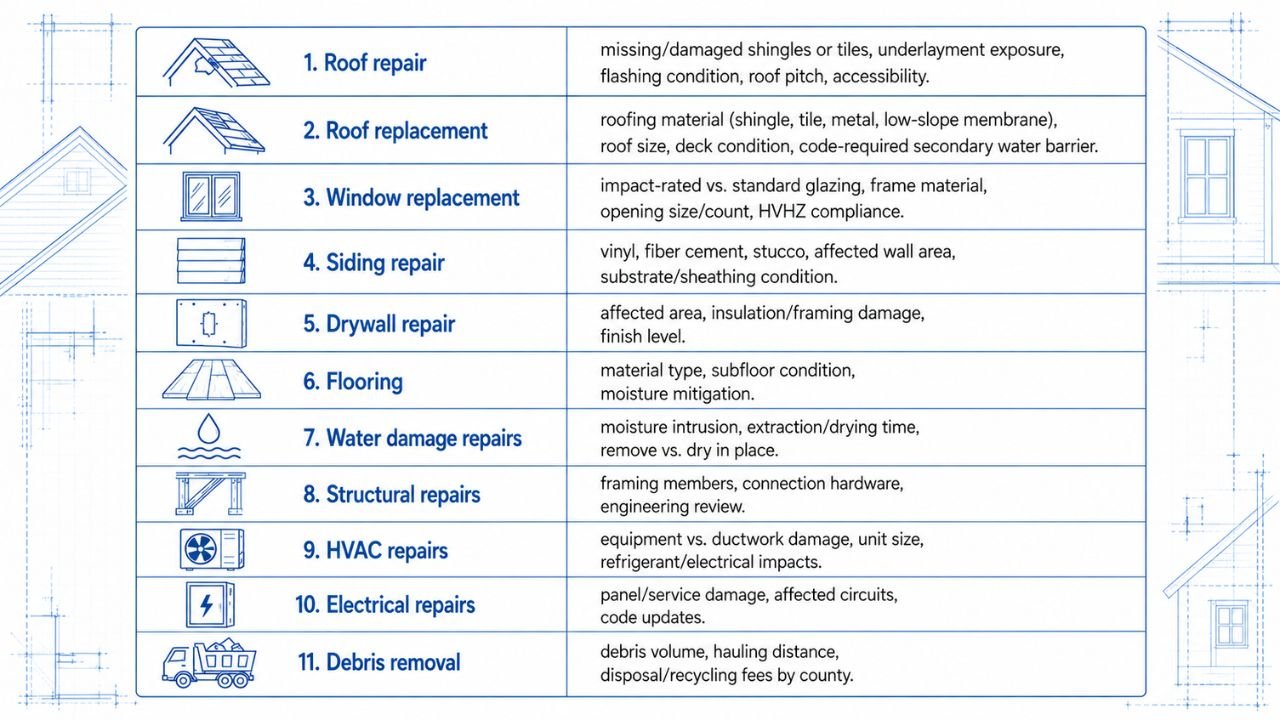
Storm Damage Repair Cost Factors by Category
| Repair Category | Typical Cost Factors |
| Roof repair | Extent of missing/damaged shingles or tiles, underlayment exposure, flashing condition, roof pitch and accessibility |
| Roof replacement | Roofing material (shingle, tile, metal, low-slope membrane), roof size in squares, deck condition, code-required secondary water barrier |
| Window replacement | Impact-rated vs. standard glazing, frame material, opening size and count, HVHZ compliance where applicable |
| Siding repair | Material type (vinyl, fiber cement, stucco), wall area affected, substrate and sheathing condition beneath the siding |
| Drywall repair | Area affected in square feet, whether insulation or framing behind the drywall was also damaged, finish level required |
| Flooring | Material type, subfloor condition after moisture exposure, whether moisture mitigation is needed before new flooring goes down |
| Water damage repairs | Extent of moisture intrusion, extraction and drying time, materials requiring removal versus drying in place |
| Structural repairs | Framing member count and type, connection hardware, whether engineering review is required |
| HVAC repairs | Equipment damage versus ductwork damage, unit size, whether refrigerant lines or electrical connections were affected |
| Electrical repairs | Panel or service damage, circuit count affected, code-required updates triggered by the scope of repair |
| Debris removal | Volume of debris, hauling distance, disposal or recycling fees by county |
Storm Damage Repair Cost Per Square Foot
Some contractors and property owners look for a single per-square-foot number to estimate storm repair costs quickly. Square-foot and unit pricing can work as a rough planning tool for straightforward, single-trade scopes — a roof-only repair, for instance, priced per square (100 square feet) of roofing installed.
Per-square-foot pricing becomes less reliable on storm restoration projects specifically because storm damage rarely respects trade boundaries. A single event can affect roofing, siding, windows, insulation, drywall, and flooring simultaneously, each with its own cost basis. Assembly pricing (pricing a full wall or roof assembly as a unit) and quantity-based, line-item pricing generally produce a more accurate number for multi-trade storm repairs than a single blended square-foot rate, because they account for exactly what was damaged rather than averaging across a whole building.
Major Types of Storm Damage in Florida
Florida property owners deal with several distinct categories of storm-related damage, and estimators price each one differently because the underlying failure mechanism is different.
- Hurricane damage combines high sustained wind, wind gusts, wind-driven rain, and in coastal areas, storm surge. It’s frequently the most complex damage type to estimate because multiple failure modes — wind uplift on roofing, impact damage from wind-borne debris, and water intrusion — often occur on the same structure at once.
- Wind damage on its own — from straight-line winds, downbursts, or non-hurricane storm systems — can cause shingle loss, siding damage, and downed trees without the storm surge or sustained-duration exposure of a hurricane.
- Hail damage is less frequent in Florida than in some other states but does occur, particularly with severe thunderstorms and embedded supercells. It typically shows up as roofing granule loss, dented metal components, and cracked or bruised shingles or tiles.
- Heavy rain damage without high wind can still cause significant loss through roof leaks, gutter overflow, and window or door seal failures that let water into the building envelope.
- Water intrusion is the broader category covering any point where water enters the structure through storm-related openings — a compromised roof, a failed window seal, or wind-driven rain forced through vents and soffits.
- Flood-related damage is a distinct category from wind-driven water intrusion and matters for both the estimating scope and the insurance conversation: flood damage typically originates from rising water (storm surge or inland flooding) rather than rain entering through the building envelope. It’s important not to treat every water-related loss as flood damage, since the repair scope, drying protocol, and — separately — the applicable insurance policy can differ meaningfully between the two.
- Tornado damage, sometimes spun off from hurricane bands or independent severe weather, tends to produce more concentrated, severe structural damage in a narrower footprint than broader straight-line wind events.
- Lightning and electrical storm damage can affect electrical panels, HVAC equipment, and low-voltage systems even without direct structural damage to the building envelope.
Roof Storm Damage Estimating
Roofing is the most common storm-damage category and often the most consequential, since a compromised roof is what allows secondary water damage to spread into the rest of the structure. A professional roof storm damage estimate accounts for:
- Missing, damaged, or lifted shingles by count or percentage of roof area
- Tile damage — cracked, slipped, or missing concrete or clay tile, common on Florida tile roofs
- Metal roofing panel damage, including panel replacement versus spot repair
- Flat and low-slope roofing systems — TPO, PVC, and EPDM membrane damage and seam failures
- Flashing damage at penetrations, valleys, and roof-to-wall transitions
- Roof penetrations — vents, pipe boots, and skylights
- Gutter and downspout damage
- Underlayment and secondary water barrier condition, which Florida Building Code requires on most re-roofing work
- Roof deck condition where water intrusion has compromised sheathing
- Insulation affected by roof-level water intrusion
- Tear-off and disposal scope for full or partial re-roofing
- Temporary tarping to stop ongoing water intrusion while permanent repairs are scheduled
A professional estimator calculates roofing quantities in squares and linear feet from photographs, measurements, or drawings, then applies Florida-specific material pricing and labor rates — including any Florida Product Approval or HVHZ-compliant fastening requirements that apply to the property’s county.
Window and Door Storm Damage Estimating
Window and door damage estimating covers broken glass, damaged frames, and compromised weatherproofing at openings. Line items typically include:
- Broken glass replacement or full unit replacement
- Damaged frame repair or replacement, including impact-resistant window and door units where applicable
- Sliding glass door and exterior door damage
- Hardware replacement
- Removal and disposal of damaged units
- Installation labor for new units
- Flashing and sealant work around each opening
- Waterproofing at the rough opening to prevent recurring intrusion
In HVHZ counties and along the coast, impact-resistant products with current Florida Product Approval or Miami-Dade Notice of Acceptance (NOA) documentation are often specified for storm repair and replacement work, which affects both material selection and cost.
Siding and Exterior Damage Estimating
Exterior envelope damage — beyond roofing and openings — covers siding, stucco, trim, and related components:
- Siding material damage (vinyl, fiber cement, wood)
- Stucco cracking, delamination, or wind-driven impact damage
- Exterior trim, soffit, and fascia damage
- Gutter and downspout systems
- Exterior paint and finish damage following repair work
- Exterior finish systems generally
Quantities are measured in square feet of affected wall area and linear feet of trim, gutter, and fascia, with material selection (matching existing siding or stucco finish where possible) affecting both cost and lead time.
Interior Storm Damage Estimating
When water intrudes through a compromised roof, window, or wall, interior damage typically follows. Interior storm damage scope covers:
- Drywall removal and replacement, sized to the water line or damage extent
- Insulation replacement where wall or ceiling cavities were affected
- Flooring — removal of water-damaged material and replacement
- Ceiling systems, including acoustic tile and drywall ceilings
- Cabinet damage from water intrusion at lower walls
- Painting following drywall and finish work
- Trim and interior door replacement
- General water-damaged material removal and disposal
The actual scope always depends on the documented extent of damage and available photographs or inspection notes — an estimator prices what’s been identified and measured, not a generic assumption about how far water travels in every home.
Structural Storm Damage Estimating
More severe storm events can affect structural components — framing, sheathing, and connections. Estimating considerations include:
- Roof framing member replacement or repair
- Wall framing damage, particularly at openings exposed to wind pressure
- Structural sheathing replacement
- Column and beam damage in more serious events
- Connection hardware — hurricane straps, clips, and fasteners
- General structural repair scope
It’s important to be clear about the estimator’s role here: a construction cost estimator prices a defined structural repair scope. Where structural design decisions or load-bearing evaluations are required, that work falls to a licensed structural engineer, and an estimate should reflect the engineer’s documented scope rather than substitute for that review.
Water Damage and Storm Restoration Estimating
Water damage that follows storm-related intrusion involves its own set of estimating line items, separate from the “dry” repair scope:
- Water extraction from affected areas
- Drying and dehumidification equipment and time
- Removal of water-damaged materials that can’t be dried in place
- Restoration of affected finishes and assemblies
- Mold-related considerations where prolonged moisture exposure has occurred
A construction cost estimate can price the documented restoration scope, but it isn’t a substitute for professional mold assessment or environmental testing where that’s warranted — those determinations sit with qualified restoration or environmental professionals, not with the cost estimate itself.
Commercial Storm Damage Estimating
Commercial properties — office buildings, retail centers, hotels, warehouses, industrial buildings, multifamily properties, healthcare facilities, schools, and mixed-use developments — bring larger quantities, more trades, and more complex building systems into a storm damage estimate. Considerations specific to commercial scope include:
- Larger roof areas and often more complex roof systems (low-slope membrane, multiple roof levels)
- Multiple trades sequenced across a larger, often multi-story building
- Glazing systems, including storefront and curtain wall damage
- HVAC systems sized for commercial loads, including rooftop units
- Electrical systems serving larger service entrances and distribution
- Structural repairs across a larger structural grid
- Specialty equipment — generators, elevators, life-safety systems
- Project phasing where portions of the building remain occupied during repairs
Residential Storm Damage Estimating
Residential storm damage estimates cover single-family homes, townhomes, condominiums, multifamily properties, garages, and outbuildings. A residential estimate frequently spans multiple trades within a single project — roofing, siding, windows, and interior finishes together — even on a relatively modest-sized home, because storm damage doesn’t confine itself to one system.
Factors That Affect Storm Repair Costs
Pulling the cost drivers together, the factors that most often move a Florida storm repair estimate up or down include:
- Damage severity
- Property size
- Building type
- Location
- Accessibility
- Building height
- Roofing system
- Exterior materials
- Window type
- Structural damage
- Water intrusion
- Labor availability
- Material availability
- Disposal requirements
- Equipment needs
- Emergency work already performed
- Permits
- Code-related upgrades triggered by the scope, where applicable
- Project complexity
- Current market pricing
Storm Damage Estimating Process
A professional storm damage cost estimate generally follows a consistent sequence:
Step 1: Gather Project Documentation — collect any existing plans, prior inspection reports, and available project history.
Step 2: Review Inspection Information — incorporate roof inspection reports, adjuster notes, or contractor walk-through findings where available.
Step 3: Identify Damage — build a complete list of affected components from photographs and documentation.
Step 4: Define Scope of Work — translate identified damage into a clear repair or replacement scope, trade by trade.
Step 5: Measure Quantities — take off quantities for every line item in the defined scope.
Step 6: Calculate Materials — apply current material pricing to each quantity, including appropriate waste factors.
Step 7: Calculate Labor — apply Florida regional labor rates by trade.
Step 8: Add Equipment and Disposal — price lifts, specialty equipment, dumpsters, and disposal fees tied to the scope.
Step 9: Apply Current Pricing — confirm material and labor costs reflect current market conditions rather than outdated averages.
Step 10: Review the Estimate — check the full scope for completeness and consistency before finalizing.
Step 11: Prepare the Final Cost Report — deliver a formatted, line-item document ready for bidding, budgeting, or documentation purposes.
Documents Needed for a Storm Damage Estimate
The documents that support an accurate estimate vary by project, but commonly include:
- Existing architectural or structural plans, if available
- Photographs of the damage
- Inspection reports, including roof-specific reports
- Measurements taken during a site visit or from available plans
- Material specifications for existing and replacement products
- Any prior estimates prepared for comparison
- Contractor proposals already received
- Change orders if repair work is already underway
- Engineering reports where structural review has occurred
- Product information for specified replacement materials
- Any project revisions or updated scope documents
Storm Damage Takeoff
A storm damage quantity takeoff measures every damaged material category identified in the scope, typically including:
- Roofing area and linear-foot items (flashing, ridge, valleys)
- Window and door counts by size and type
- Siding and stucco area
- Drywall area by room or level
- Flooring area by material type
- Insulation area and type
- Framing member counts where structural repair is included
- Painting area following finish work
- Gutter and downspout linear footage
- Electrical components affected
- HVAC components affected
- Other damaged construction materials specific to the property
Line-Item Storm Damage Estimate
Detailed line items make a storm damage estimate easier to review, compare, and use for documentation. A typical structure looks like this:
| Category | Description | Quantity | Unit | Labor | Material | Total |
| Roofing | Architectural shingle tear-off & replacement | — | SQ | — | — | — |
| Windows | Impact-rated window replacement | — | EA | — | — | — |
| Drywall | Water-damaged drywall removal & replacement | — | SF | — | — | — |
| Flooring | LVP replacement, moisture mitigation included | — | SF | — | — | — |
| Debris Removal | Tear-off debris hauling & disposal | — | CY | — | — | — |
Actual quantities, unit pricing, and totals depend on the specific project’s documented scope and current Florida market conditions at the time the estimate is prepared.
Storm Damage Estimate vs. Contractor Bid
Property owners and professionals sometimes use “estimate” and “bid” interchangeably, but they serve different purposes:
| Storm Damage Cost Estimate | Contractor Bid |
| Focuses on estimated repair costs based on documented scope | Represents a contractor’s proposed price to perform the work |
| Helps establish and quantify the repair scope | Includes the contractor’s pricing strategy and margin |
| Can be used for budgeting, planning, or documentation purposes | Used to formally propose project work to an owner |
| Typically organized in detailed line items | May include contract terms, exclusions, and conditions specific to that contractor |
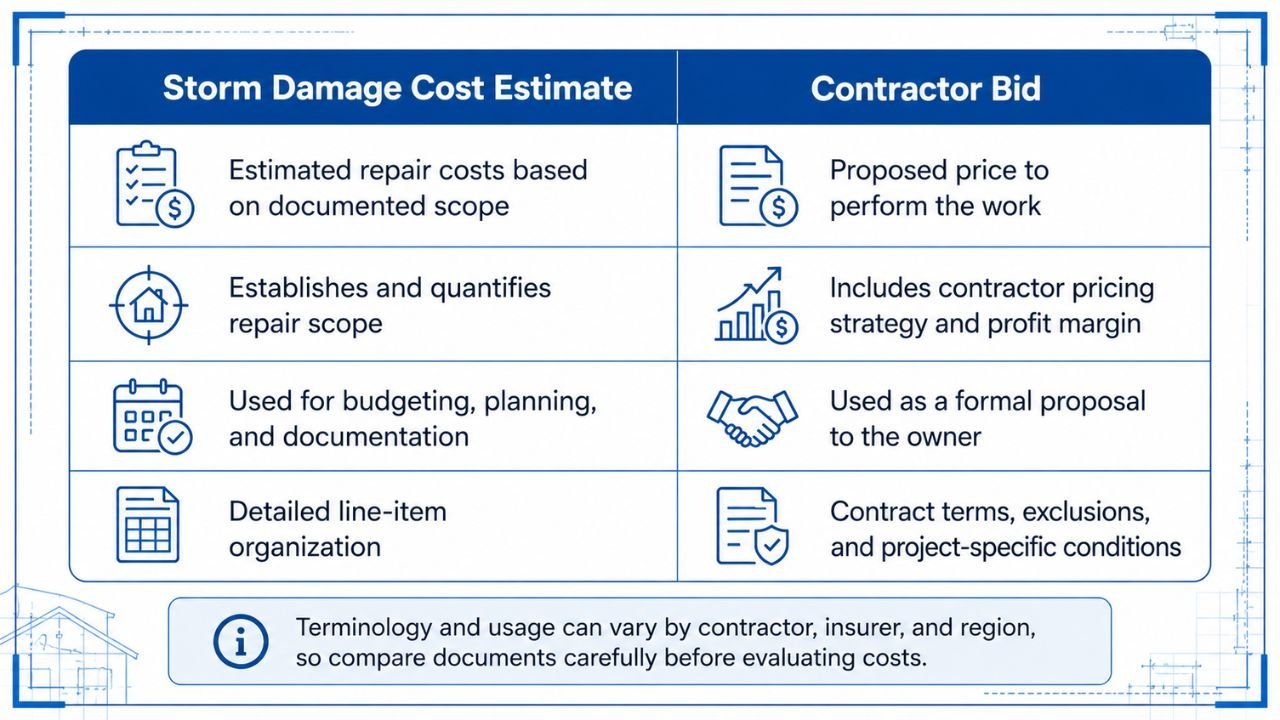
Terminology and usage can vary by contractor, insurer, and region, so it’s worth clarifying which document you’re looking at before comparing numbers across sources.
How Estimates Can Support Insurance Documentation
A detailed construction cost estimate can help organize the information that supports an insurance claim — scope of repairs, quantities, materials, labor breakdown, and repair categories presented in a clear, professional format. That kind of documentation can make it easier to communicate the full extent of a repair scope to an insurer or adjuster.
It’s important to be direct about the limits of that role: an estimate does not determine insurance coverage. Whether a specific repair is covered, how depreciation is applied, what your deductible is, and how your claim is ultimately settled all depend on your individual insurance policy and your insurance carrier’s determination. A construction cost estimate is a scope-and-cost document, not a coverage determination, and nothing in this article should be read as legal or insurance advice. For claims-process questions, Florida’s Department of Financial Services maintains consumer hurricane and storm claims resources, and your policy documents and carrier remain the authoritative source on coverage.
Common Storm Damage Estimating Mistakes
Estimating accuracy on storm-damaged properties depends heavily on catching the details that are easy to miss. Common mistakes include:
- Missing damaged components that aren’t immediately visible (roof deck, wall cavities)
- Incorrect measurements taken from photographs alone without verification
- Missing labor line items, particularly for specialty or high-access work
- Missing disposal costs for tear-off and demolition debris
- Missing temporary repair costs (tarping, board-up) already incurred
- Missing accessories — fasteners, sealants, flashing tie-ins
- Incorrect material quantities that don’t account for waste factors
- Ignoring secondary damage caused by delayed drying or exposure
- Using outdated pricing instead of current material and labor costs
- Missing scope revisions after addenda or updated inspection findings
- Incomplete scope that leaves out affected but less obvious systems
- Failing to distinguish repair versus full replacement where it changes the cost basis significantly
- Ignoring code-related requirements that apply to the repair, where applicable
Software and Technology for Storm Damage Estimating
Professional estimators commonly use digital tools to speed up and organize storm damage estimating work:
- Bluebeam Revu — PDF markup and takeoff for drawings and damage photos
- PlanSwift — digital takeoff software for measuring quantities from plans
- STACK — cloud-based takeoff and estimating platform
- Excel — line-item cost breakdowns and estimate formatting
- Digital takeoff software generally, for measuring roof, wall, and floor area from uploaded documents
- Estimating databases — current material and labor cost references
- Photo documentation systems — organizing and referencing damage photos against the line-item scope
Technology speeds up the process and improves organization, but professional review of the final scope and pricing remains an important part of producing an accurate, usable estimate.
Benefits of Professional Storm Damage Estimating
Bringing in a dedicated construction cost estimator for storm repair work offers several practical advantages over assembling an estimate informally:
- Faster turnaround than building a scope and cost breakdown in-house
- Better-organized documentation for insurance or internal review
- Detailed, defensible quantities rather than rough approximations
- More organized scopes that are easier for contractors to bid against
- Reduced manual workload for contractors juggling multiple storm-damaged projects at once
- Improved budgeting accuracy for property owners and property managers
- Stronger bid packages when the estimate is used to solicit contractor pricing
- Easier project planning once the full scope and cost picture is documented
- Support across multiple trades on a single, coordinated estimate
When Should You Hire a Storm Damage Cost Estimator?
A dedicated estimator adds the most value in situations such as:
- Large-scale storm damage spanning multiple systems
- Projects involving multiple trades that need to be coordinated into one scope
- Commercial properties with more complex building systems
- Complex roof systems or multi-level roofing
- Structural damage requiring detailed, documented repair scope
- Large restoration projects or properties with multiple buildings
- Situations that call for detailed repair documentation
- Contractor bidding processes that need a consistent scope for comparison
- Preconstruction planning for a larger repair or restoration project
Why Choose Estimate Florida?
Estimate Florida provides construction cost estimating and quantity takeoff services for Florida projects, including storm-related repair and restoration scopes across residential, commercial, and industrial property types. That includes:
- Construction estimating expertise applied specifically to Florida projects
- Quantity takeoffs measured directly from plans, photographs, or site documentation
- Material takeoffs organized by trade and CSI division
- Multi-trade estimating for projects that span roofing, exterior, interior, and structural scope
- Florida-focused estimating that reflects Florida labor rates, material pricing, and Florida Building Code requirements — including HVHZ compliance for Miami-Dade and Broward counties
- Organized, line-item cost estimates suitable for bidding, budgeting, or documentation
- Bid support for contractors comparing subcontractor pricing
- Detailed project documentation delivered as a formatted Excel workbook and PDF summary
Estimate Florida is a construction estimating service, not an insurance company, public adjuster, or emergency restoration contractor, and doesn’t represent itself as any of those. The estimate documents repair scope and cost — it doesn’t determine insurance coverage, negotiate claims, or guarantee project savings.
How Much Does a Storm Damage Estimate Cost?
Estimating fees for storm damage projects depend on several factors specific to the project rather than a single flat number across every scope:
- Property size and number of structures involved
- Complexity of the damage and number of trades affected
- Number of drawings or documents available to work from
- Required level of detail in the final deliverable
- Whether the project is residential or commercial
- Turnaround time requested
- How much documentation (photos, prior reports) is already available
There isn’t a single universal fee that applies across every storm damage estimate — pricing is scoped to the specific project once the documentation is reviewed. [VERIFY: Add Estimate Florida’s actual current fee structure or starting price for storm damage scopes before publishing.]
Key Takeaways
- Storm damage repair costs in Florida vary widely based on severity, building type, and location — there’s no single number that applies broadly.
- Multiple trades are often involved in a single storm repair project, even on residential properties.
- Detailed quantity takeoffs give property owners and contractors real visibility into the repair scope, not just a rough total.
- Both labor and material costs matter, and both should be itemized rather than blended into a single lump figure.
- Florida-specific conditions — HVHZ requirements, Florida Building Code provisions, and county permit fees — affect repair costs statewide.
- Thorough documentation supports better decision-making, whether for budgeting, contractor bidding, or insurance-related documentation.
- Professional estimating can support better project planning by turning documented damage into a clear, priced scope of work.
Conclusion
Storm damage repairs in Florida can involve multiple trades working through roofing, exterior, interior, and — in more serious cases — structural scope, all on a single property and often on a tight timeline. Accurate quantity takeoffs and detailed cost estimates give property owners, contractors, and other project stakeholders a clear, documented picture of what the repair actually requires, rather than a rough guess based on visible damage alone. Florida-specific conditions, from Building Code requirements to county permitting, should be factored into that scope from the start.
Estimate Florida provides construction estimating support for Florida storm-related repair projects, delivering detailed, bid-ready cost estimates and quantity takeoffs for residential, commercial, and industrial properties statewide. Contact Estimate Florida for a project-specific storm damage repair cost estimate or construction takeoff.
FAQs
- How much does storm damage repair cost in Florida? It depends on the severity and type of damage, the building’s size and construction type, and which trades are involved. A detailed, line-item estimate for the specific property gives a far more accurate number than a general statewide average.
- What does a storm damage estimator do? A storm damage estimator reviews documentation and photos, identifies damaged components, measures quantities, and prepares a priced, line-item cost estimate covering materials, labor, equipment, and disposal.
- How is storm damage repair estimated? Estimators define the repair scope from documented damage, take off quantities for each affected item, and apply current Florida material and labor pricing to produce a detailed cost breakdown.
- What is included in a storm damage estimate? A complete estimate covers the full scope of damage — roofing, exterior, interior, and structural where applicable — along with material and labor quantities, equipment, disposal, temporary repairs, and general conditions.
- How much does roof storm damage repair cost? Roof repair costs depend on the roofing material, the extent of damage (spot repair versus full replacement), roof size and pitch, and whether the roof deck or underlayment was also affected.
- How much does hurricane damage repair cost? Hurricane damage repair costs vary significantly because a single hurricane event can affect roofing, windows, siding, and interior finishes together. A multi-trade, line-item estimate is generally more accurate than a single combined figure.
- How are storm damage quantities measured? Quantities are measured from photographs, site visits, or available plans — roofing in squares, siding and drywall in square feet, framing in linear feet or by member count, and so on — depending on the material and system involved.
- Can a storm damage estimator prepare a line-item estimate? Yes. A line-item format is standard for storm damage estimates, breaking the scope down by category, quantity, unit, labor, material, and total cost for clarity and easier review.
- Can storm damage estimates support insurance documentation? A detailed estimate can help organize and document the repair scope, but it does not determine what your insurance policy covers — that depends on your specific policy and your insurance carrier.
- What documents are needed for a storm damage estimate? Helpful documents include existing plans, photographs of the damage, inspection reports, prior estimates or contractor proposals, and any engineering reports if structural damage is involved. Requirements vary by project.
- How long does a storm damage estimate take? Turnaround depends on project size and complexity. Estimate Florida targets a 24–48 hour standard turnaround for most scopes, with rush options available for tighter deadlines.
- Do storm damage estimates include labor and materials? Yes. A complete estimate breaks out both labor and material costs by line item, rather than presenting a single combined figure, so the scope is easier to review and compare.
- Can Estimate Florida estimate commercial storm damage? Yes. Estimate Florida provides commercial construction estimating for storm-related repair scopes, including multi-trade projects on office, retail, hospitality, healthcare, and warehouse properties.
- Can Estimate Florida estimate residential storm damage? Yes. Estimate Florida provides residential construction estimating for storm-damaged single-family homes, townhomes, condominiums, and multifamily properties.
- What factors affect storm damage repair costs in Florida? Damage severity, property size and type, location, accessibility, material selection, labor availability, structural involvement, water intrusion, permits, and current market pricing all affect the final repair cost.