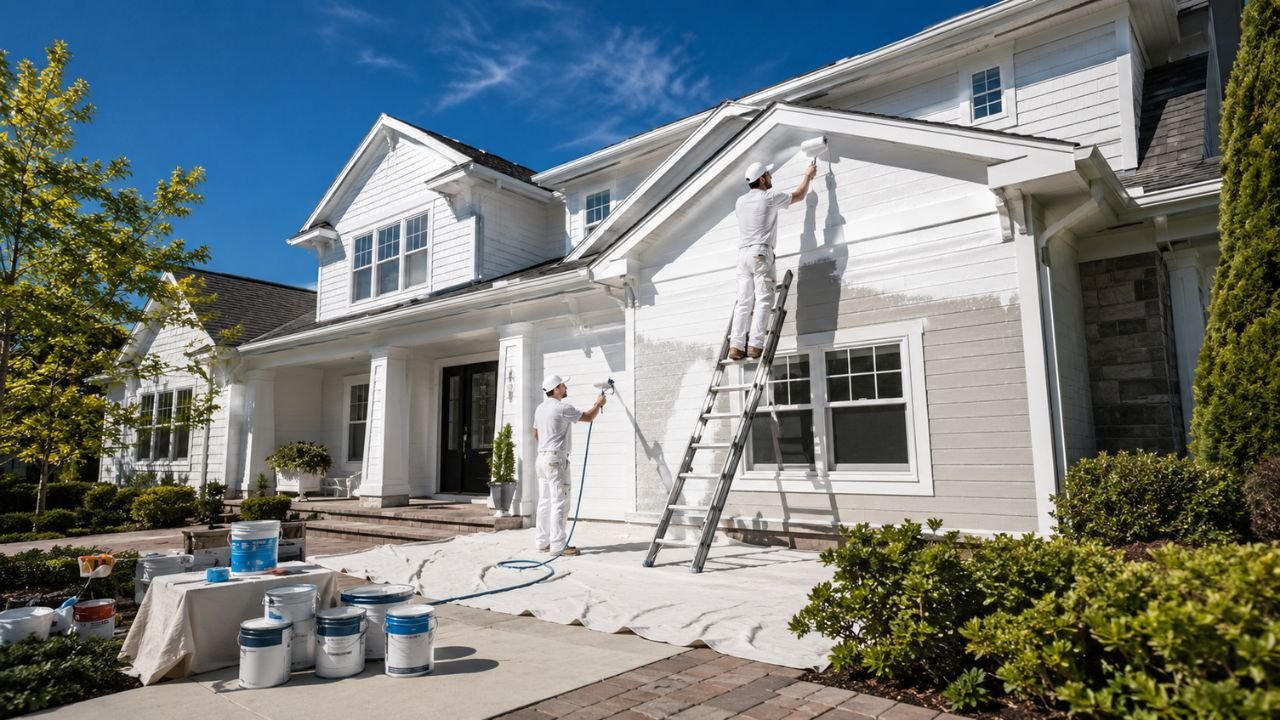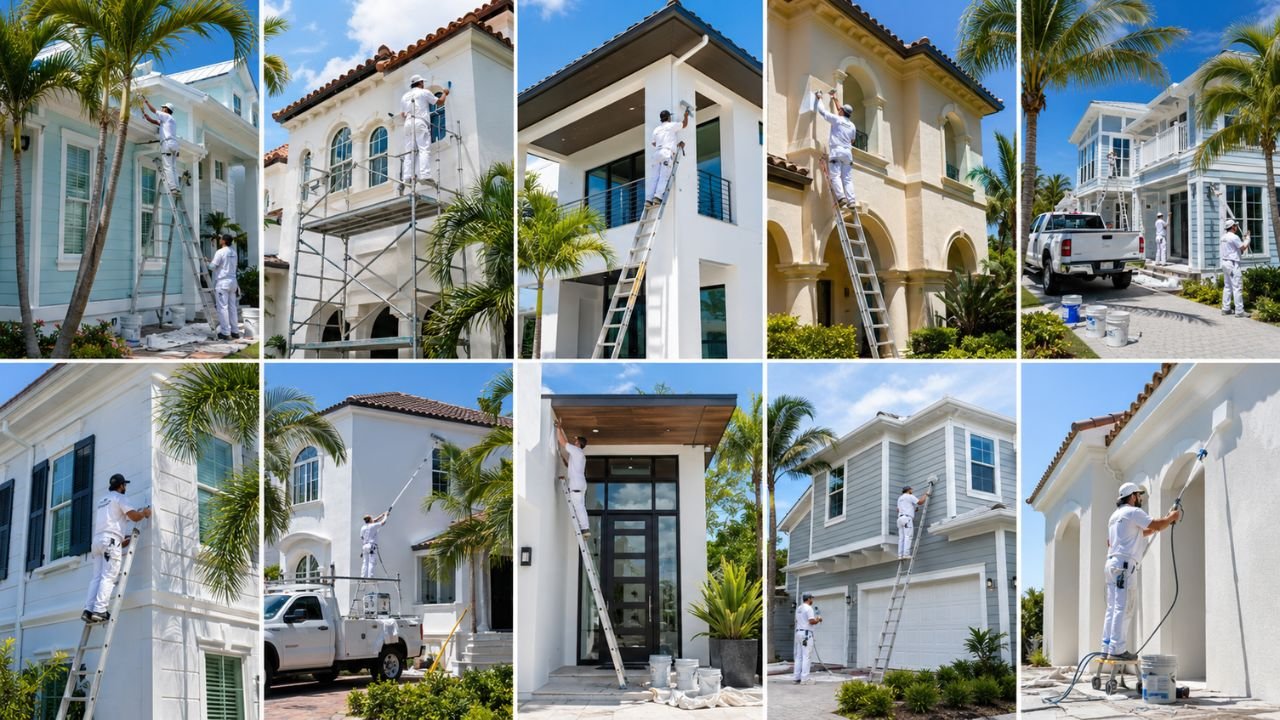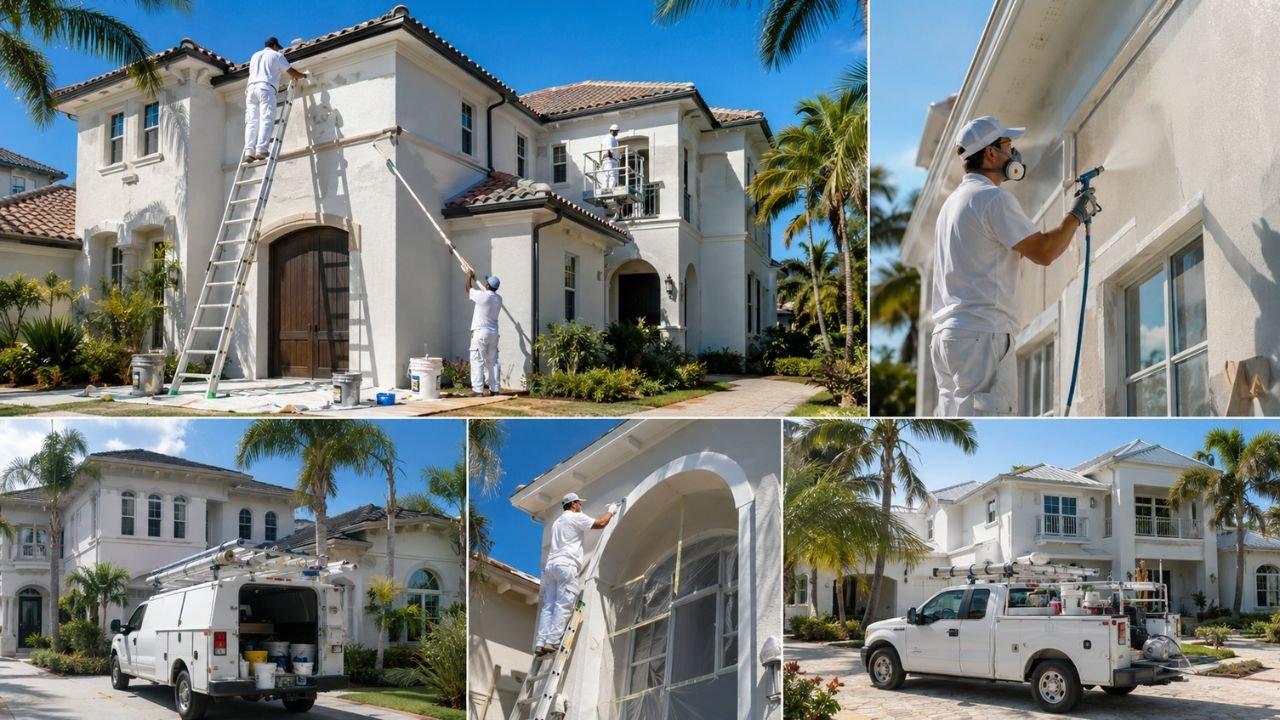
The best month to paint a house in Florida is generally March or November. These months represent the “sweet spots” of the Florida climate, offering a balance of moderate temperatures, lower relative humidity, and minimal rainfall. While exterior painting can be performed throughout much of the year, the window from late fall through early spring provides the most consistent conditions for paint application, drying, and long-term curing.
Florida’s unique geography—stretching from the subtropical Panhandle to the tropical Keys—means that “ideal” conditions vary significantly by region. A successful exterior project depends on navigating the state’s high humidity, intense UV exposure, and frequent afternoon thunderstorms. While interior painting is largely insulated from these factors in climate-controlled environments, exterior surfaces are at the mercy of the elements. Choosing the right month is a strategic decision that affects not just the ease of application, but the ultimate longevity of the coating system.
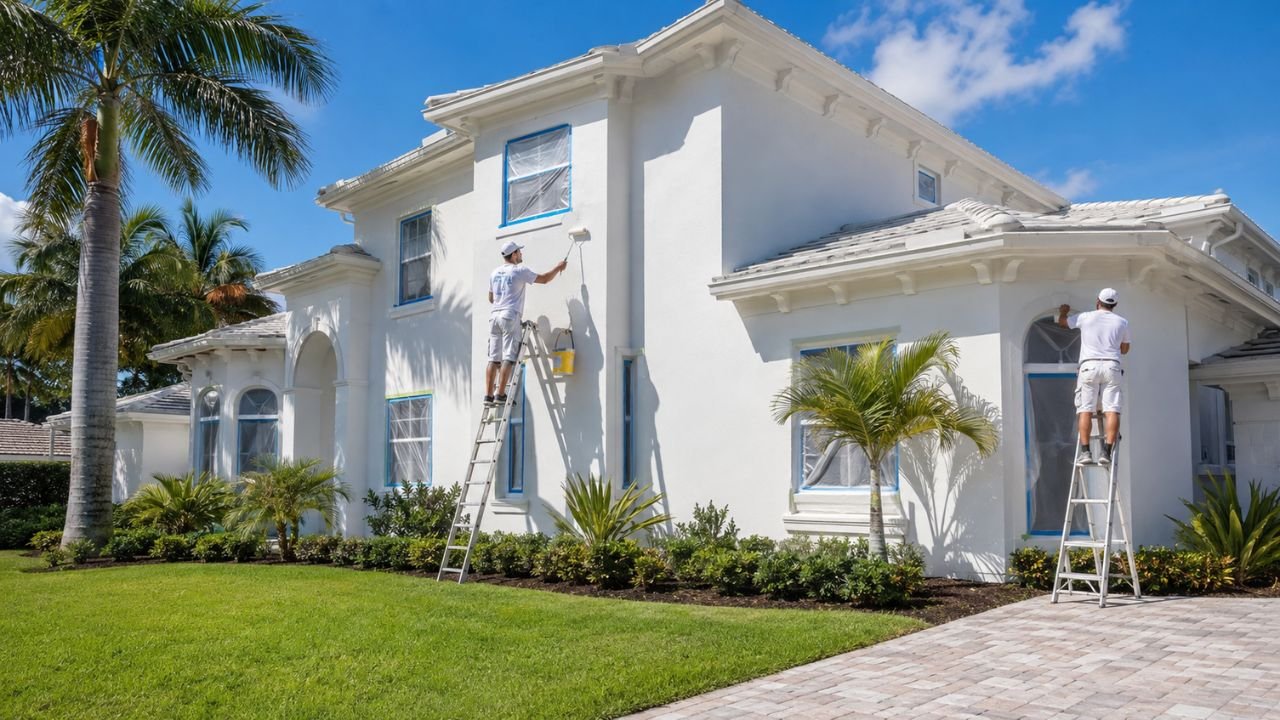
Best Months to Paint in Florida
| Month | General Conditions | Exterior Painting Suitability | Key Consideration |
|---|---|---|---|
| March | Mild, dry, and sunny | Excellent | Peak window before spring rains |
| November | Cool, crisp, and low humidity | Excellent | Post-hurricane season stability |
| April | Warming but still relatively dry | Very Good | Monitor rising humidity levels |
| October | Transitional; rain decreasing | Good | Potential for late-season tropical activity |
| January | Cool and dry | Good | Watch for North Florida cold fronts |
| July | Hot, humid, daily storms | Challenging | Rain and high surface temperatures |
What Is the Best Month to Paint a House in Florida?
Based on historical climate data from the Florida Climate Center, March stands out as the premier month for exterior painting. During this time, the frequent cold fronts of mid-winter have typically subsided, yet the intense humidity and daily torrential downpours of the summer “wet season” have not yet arrived. March offers the predictable “dry” window that estimators and contractors look for when scheduling large-scale residential projects.
November is the strongest alternative. As Florida exits the Atlantic hurricane season, the atmosphere undergoes a noticeable shift. The humidity drops significantly, which is critical for the evaporation of water in latex and acrylic paints. Lower humidity allows the paint film to form correctly without moisture being trapped within the coating, leading to better adhesion and a more durable finish.
However, it is important to distinguish between the “best month” and the “best painting window.” Even in March, a single week of unseasonable rain can disrupt a project. Professional planning requires looking beyond the calendar and analyzing the specific multi-day forecast for your local municipality.
What Is the Best Season to Paint a House in Florida?
Florida essentially operates on two major seasons rather than the traditional four: the Dry Season (November through April) and the Wet Season (May through October).
Late Fall (October – November)
This is a period of transition. October can still see tropical moisture, but by November, the air becomes significantly drier. This is an ideal time for exterior work as the risk of afternoon thunderstorms—the bane of Florida painters—drops to its lowest point of the year.
Winter (December – February)
In Central and South Florida, winter is often excellent for painting. However, North Florida (Jacksonville to Pensacola) can experience temperatures below 50°F. Most modern paints require an ambient and surface temperature of at least 50°F to cure properly, though some specialized “low-temp” products can be applied down to 35°F. Always consult the specific product’s Technical Data Sheet (TDS).
Early Spring (March – April)
This is widely considered the peak “painting season.” The days are longer, providing more light for crews, and the weather is typically stable. It is the most in-demand time for contractors, making professional quantity takeoffs essential for early material procurement and scheduling.
Late Spring & Summer (May – September)
This is the most challenging period. Daily relative humidity often exceeds 90% in the mornings, and the “1 o’clock thunderstorm” becomes a near-daily occurrence. While painting is possible, it requires meticulous monitoring of radar and shorter work windows to ensure paint is “rain-safe” before the clouds open up.
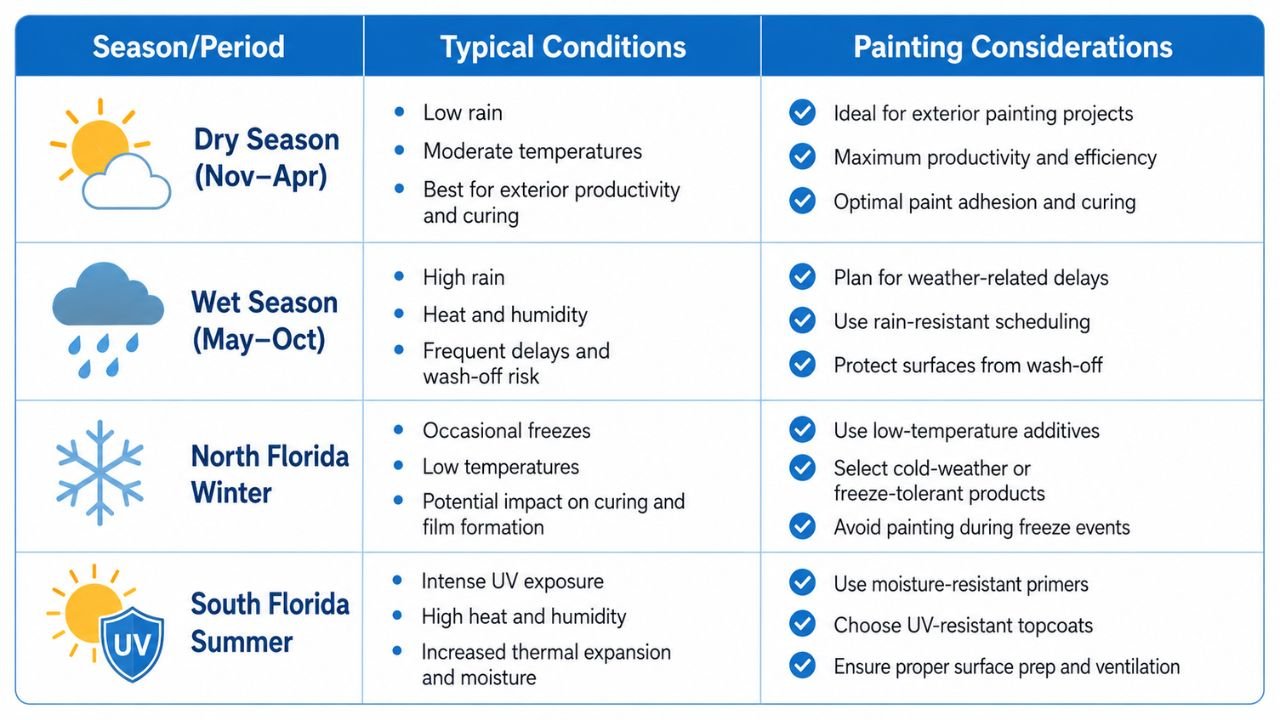
Florida Painting Seasons
| Season/Period | Typical Conditions | Painting Considerations |
|---|---|---|
| Dry Season (Nov-Apr) | Low rain, moderate temps | Best for exterior productivity and curing |
| Wet Season (May-Oct) | High rain, high heat/humidity | Frequent delays; risk of wash-offs |
| North FL Winter | Occasional freezes | Low-temp additives or specific products needed |
| South FL Summer | Intense UV & humidity | Focus on moisture-resistant primers and UV protection |
Month-by-Month Florida House Painting Calendar
| Month | Typical Florida Conditions | Exterior Painting Suitability | Main Considerations |
|---|---|---|---|
| January | Cool and very dry | 8/10 | Monitor overnight lows in North Florida |
| February | Cool, increasing wind | 8/10 | Excellent for South and Central regions |
| March | Mild and stable | 10/10 | The “Sweet Spot” for all of Florida |
| April | Warming, low rain | 9/10 | High demand; book estimators early |
| May | Rising humidity | 7/10 | Beginning of the transition to wet season |
| June | Rainy and hot | 5/10 | High humidity slows drying times |
| July | Peak heat and storms | 4/10 | Surface temperatures can exceed 140°F |
| August | Tropical activity peaks | 3/10 | High risk of storm-related rework |
| September | Humid and wet | 4/10 | Frequent scheduling interruptions |
| October | Drier air arriving | 7/10 | Watch for late-season tropical storms |
| November | Crisp and dry | 10/10 | Ideal post-hurricane season window |
| December | Cool and dry | 8/10 | Shorter days; monitor morning dew |
Why Weather Matters When Painting a House in Florida
In the construction estimating world, weather isn’t just a comfort factor; it’s a variable that dictates labor productivity and material performance.
- Adhesion: For paint to bond to stucco or wood, the surface must be dry. High humidity or recent rain can leave microscopic moisture in the substrate, leading to premature peeling or “bubbling.”
- Curing vs. Drying: “Drying” is when the paint feels dry to the touch. “Curing” is the chemical process where the paint reaches its maximum hardness. Florida’s humidity can slow curing from days to weeks if conditions are unfavorable.
- Surfactant Leaching: If it rains too soon after application, or if humidity is extremely high, the ingredients that keep paint stable (surfactants) can rise to the surface, leaving unsightly brown or white streaks.
Weather Factors and Their Effects
| Weather Factor | Effect on Painting | What to Check |
|---|---|---|
| Temperature | Affects flow and dry time | Air and surface temperature (follow TDS) |
| Humidity | Slows evaporation | Relative humidity (ideally below 85%) |
| Rain | Causes wash-offs/blisters | 24-hour forecast and radar |
| Wind | Causes debris to stick | Wind speed (over 15mph is risky) |
| Sun Exposure | Rapid drying/blistering | Wall surface temperature in direct sun |
How Humidity Affects Exterior House Painting in Florida
Florida is one of the most humid states in the U.S. When the relative humidity is high, the water in latex paint cannot evaporate into the air. This keeps the paint “open” for too long, which may seem helpful for avoiding brush marks, but it often leads to sagging or running.
Morning dew is a specific Florida challenge. Even in the “dry” month of March, surfaces like wood siding or fascia may be soaked with condensation until 10:00 AM. Painting over this moisture is a recipe for failure. Estimators must account for these shorter daily windows when calculating labor costs.
How Temperature Affects Exterior Painting in Florida
Most people focus on the air temperature, but the surface temperature is often more critical. In the Florida summer, a sun-exposed stucco wall can easily reach 140°F or higher. If you apply paint to a surface that hot, the paint dries almost instantly, preventing it from “wetting” into the pores of the substrate. This results in poor adhesion and a finish that may flake off within a year.
Conversely, in North Florida winters, if the temperature drops below the manufacturer’s threshold (often 50°F) before the paint has had 4–8 hours to dry, the film may never form correctly, leaving the coating brittle.
Can You Paint a House in Florida During Summer?
Yes, you can, but it requires a higher level of professional oversight. Summer painting in Florida typically follows a “follow the shade” strategy. Crews start on the west side of the house in the morning (while it’s in the shade) and move to the east side in the afternoon.
The biggest hurdle is the afternoon thunderstorm. A professional estimate should include a “weather contingency” to account for the fact that a crew might lose 2–3 hours of production every afternoon. Using high-quality, “rain-ready” paints that can withstand moisture in as little as 90 minutes is often a strategic choice for summer projects.
Regional Florida Differences
Regional Florida Differences
| Region | Climate Considerations | Planning Notes |
|---|---|---|
| South Florida | Tropical; no real “winter” | Humidity is the #1 concern year-round |
| Central Florida | High thunderstorm frequency | June–August are peak risk months |
| North Florida | Seasonal freezes possible | Winter requires low-temp products |
| Gulf Coast | High salt air/coastal fog | Focus on salt-resistant coatings |
| Atlantic Coast | Higher wind/salt spray | Durable, flexible elastomeric coatings often used |
Best Month for South Florida (Miami, Fort Lauderdale, Naples)
In South Florida, the “winter” months of December through February are often the best because the humidity is at its lowest. Unlike the North, there is very little risk of temperatures dropping too low for standard paint.
Best Month for North Florida (Jacksonville, Tallahassee, Pensacola)
March and October are the prime months here. January and February can be too cold for traditional coatings, and the summer humidity is just as intense as in the South.
Exterior vs. Interior Painting in Florida
There is a massive difference in how weather impacts these two project types.
- Exterior Painting: Entirely dependent on weather. Requires a minimum of 24–48 hours of dry weather (depending on the product) for the best results.
- Interior Painting: Can be done 365 days a year as long as the home is enclosed and the HVAC system is running. The air conditioner acts as a giant dehumidifier, creating the perfect “controlled” environment for paint to cure.
Exterior vs. Interior Painting
| Factor | Exterior | Interior |
|---|---|---|
| Weather Sensitivity | Extremely High | Very Low |
| Humidity Impact | Direct (Ambient) | Controlled (HVAC) |
| Temperature Range | Varied (50°F – 100°F+) | Consistent (68°F – 75°F) |
| Scheduling | Seasonal peaks | Year-round |
| Main Threat | Rain/UV | Ventilation/Dust |
How to Check the Weather Before Painting
A professional planning process should involve the following steps:
- Check the Multi-Day Forecast: Look for a 3–5 day window with less than 20% chance of rain.
- Monitor Hourly Rain Probability: In Florida, “30% rain” often means a 100% chance of rain in a very specific spot. Check the radar.
- Inspect Surface Moisture: Use a moisture meter if possible, especially on wood surfaces.
- Confirm Manufacturer Requirements: Every bucket of paint has a label. If it says “Do not apply if rain is expected within 24 hours,” take it seriously.
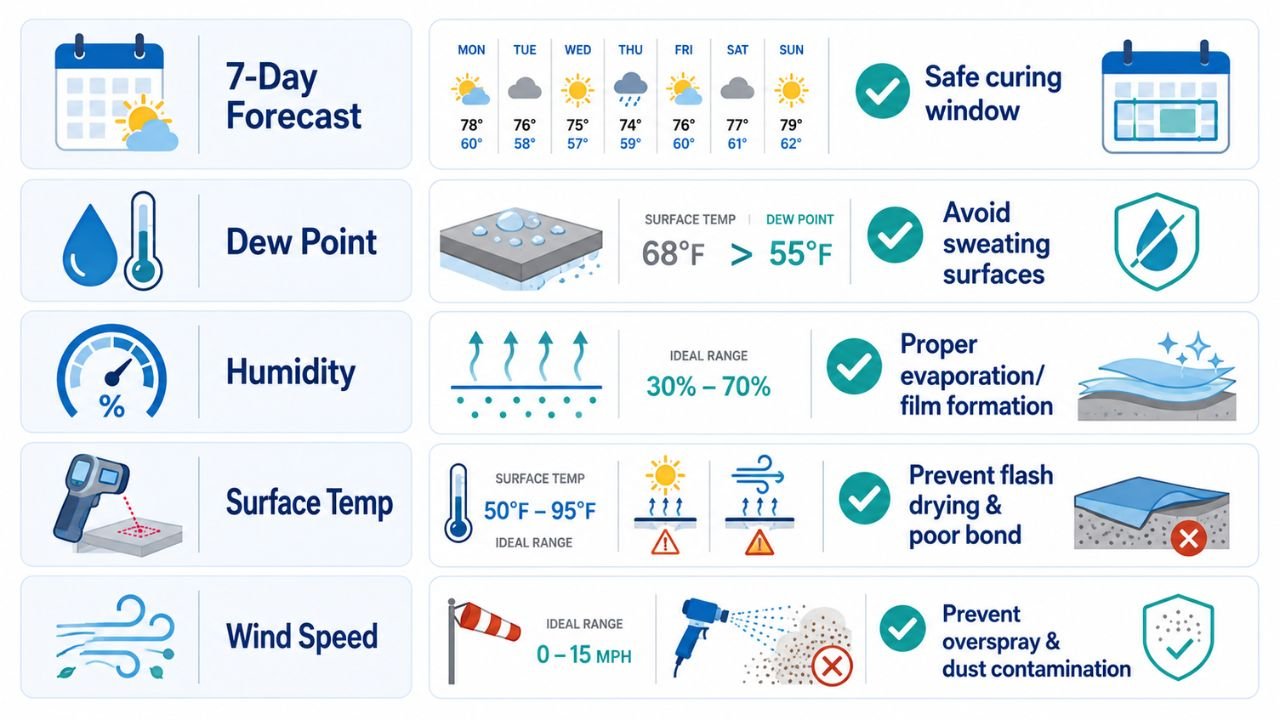
Pre-Painting Weather Checklist
| Check | Why It Matters |
|---|---|
| 7-Day Forecast | Ensures a safe window for curing |
| Dew Point | Prevents painting on “sweating” surfaces |
| Humidity | Ensures proper evaporation/film formation |
| Surface Temp | Prevents “flash drying” and poor bond |
| Wind Speed | Prevents overspray and dust contamination |
Why Surface Preparation Matters More Than Choosing the Month
You could choose the most perfect day in March, but if the surface isn’t prepared, the paint will still fail. In Florida, “prep” often involves dealing with chalking (the breakdown of old paint due to UV) and mildew (due to humidity).
Standard prep includes:
- Pressure Washing: Removing salt, dirt, and loose paint.
- Scraping and Sanding: Creating a “profile” for the new paint to grab onto.
- Caulking: Sealing gaps in trim and windows to prevent moisture intrusion.
- Priming: Essential for new stucco or repaired areas to neutralize pH levels.
What Is a Painting Quantity Takeoff?
A painting quantity takeoff is the process of measuring every square foot of surface area on a project to determine exactly how much material and labor is required. For a Florida home, this includes:
- Exterior Walls: Measuring stucco or siding area, subtracting for large “voids” like garage doors.
- Trim and Detail: Calculating the linear footage of soffits, fascia, and decorative “bands.”
- Opening Counts: Counting doors and windows that require specialized coatings.
- Material Counts: Calculating total gallons of primer, body paint, and trim paint based on the number of coats specified.
By having an accurate quantity takeoff, homeowners and contractors can avoid the common mistake of over-ordering expensive materials or, conversely, running out of a specific tint mid-project.
How Estimate Florida Helps With Painting Estimates
Estimate Florida provides professional construction estimating services and quantity takeoffs specifically tailored for the Florida market. We help subcontractors, developers, and homeowners move from a “rough guess” to a line-item budget based on actual blueprint measurements or site data.
Our services include:
- Painting Quantity Takeoffs: Detailed reports of all paintable surfaces.
- Material Takeoffs: Precise lists of gallons, caulk tubes, and primer required.
- Labor Estimation: Calculated hours based on Florida’s specific regional labor rates.
- Project Scheduling Support: Helping you understand how long a project will take so you can fit it into the ideal weather window.
Note: Estimate Florida provides estimating and takeoff services only; we do not perform the actual painting work or provide contracting services.
Frequently Asked Questions
What is the best month to paint a house in Florida?
March and November are generally the best months due to low rainfall and moderate humidity.
Is winter a good time to paint a house in Florida?
Yes, especially in Central and South Florida. In North Florida, you must monitor for temperatures below 50°F.
Can you paint a house in Florida during the rainy season?
It is possible but risky. You must have a clear 4–8 hour window of dry weather, and the surface must be completely dry before application.
Does humidity affect exterior house painting in Florida?
Absolutely. High humidity slows the drying process and can lead to surfactant leaching or poor adhesion.
How hot is too hot for exterior painting?
Most manufacturers recommend an upper limit of 90°F–95°F air temperature. Surface temperatures should not exceed the manufacturer’s specifications.
How long should exterior paint have before it rains?
While some “early rain resistance” paints are ready in 90 minutes, most standard paints require at least 4–24 hours of dry time.
Is interior painting affected by Florida weather?
Rarely. If the home is climate-controlled, you can paint the interior at any time of year.
Does the best month to paint affect the cost?
It can. Contractors are often busiest in the “ideal” months (Spring/Fall), which may affect scheduling availability and labor rates.
Conclusion
Determining the best month to paint a house in Florida requires a balance of climate data and local insight. While March and November offer the most reliable conditions, success is ultimately found in the details of preparation and the accuracy of the project plan. Florida’s harsh environment—from the salt air of the Gulf Coast to the intense UV rays of the interior—demands a professional approach to both application and budgeting.
By understanding the seasonal shifts between the dry and wet seasons, and by utilizing professional painting takeoff services, you can ensure your project is completed during a window that maximizes the life of your investment. Whether you are a homeowner looking to refresh your curb appeal or a contractor bidding on a multi-family development, the numbers must be as accurate as the brushwork.
If you’re planning a residential painting project in Florida and need accurate quantities, material takeoffs, or a detailed construction estimate, Estimate Florida can provide professional estimating support based on your plans, measurements, and project scope.