A professional roof estimate template Excel in Florida is essential for winning bids and controlling costs on projects shaped by the state’s extreme weather—high wind loads, intense UV exposure, high humidity, salt air, and strict High-Velocity Hurricane Zone (HVHZ) requirements. From Miami-Dade and Broward to Tampa, Orlando, and Jacksonville, roofing contractors and property owners face elevated design pressures, secondary water barrier mandates, impact-resistant underlayment rules, and regional differences in labor and material pricing. Generic national templates overlook these realities and routinely produce underbids, material shortages, or non-compliant assemblies.
Estimate Florida provides Florida-calibrated Excel templates and full roofing quantity takeoff support designed for residential, commercial, and multi-family work. A complete roof estimate template Excel in Florida measures true roof area with pitch and waste factors, quantifies decking, underlayment, coverings, flashing, and accessories, and applies regional labor rates while embedding HVHZ and code notes. This guide explains why a Florida-specific format matters, what belongs in the workbook, how to use it, the primary 2026 cost drivers, common estimating mistakes, and when to escalate to professional roofing takeoffs.
Why a Florida-Specific Roof Estimate Template Matters?
National roofing templates assume moderate wind zones, basic felt underlayment, and uniform labor productivity. Florida’s climate and code environment make those assumptions expensive.
Hurricane wind-load and uplift requirements dominate the High-Velocity Hurricane Zone (Miami-Dade and Broward) and extend across most coastal counties. Products often must carry Miami-Dade Notices of Acceptance (NOA) or Florida Product Approvals with documented testing. Secondary water barrier and enhanced underlayment requirements are now standard under the Florida Building Code for many re-roof and new-construction projects. Intense UV and heat accelerate material aging, while high humidity and coastal salt air influence fastener selection, metal corrosion resistance, and expected service life. Labor productivity and material pricing also vary significantly from South Florida’s denser markets to Central and North Florida.
An incomplete roof takeoff cascades into change orders for extra squares, upgraded underlayment, additional flashing, or non-compliant products rejected at inspection. A Florida-optimized roof estimate template Excel in Florida embeds wind and HVHZ defaults, secondary barrier requirements, UV and humidity adjustments, and regional pricing so the numbers stay realistic from first measurement to final proposal.
Why this matters for Florida projects: Contractors and property managers who use localized templates reduce underbidding risk, protect margins on both residential and commercial roofs, and deliver clearer proposals that meet code and insurer expectations across the state.
What’s Inside a Professional Roof Estimate Template Excel in Florida?
A strong roof estimate template Excel in Florida is multi-tabbed, square-based, and designed for both simple residential re-roofs and complex commercial or multi-family systems. Core components include:
- Project info header: Client or owner name, project address, county, roof type and slope, approximate squares or square footage, bid date, and FBC/HVHZ notes.
- Roof area takeoff: Measured squares with pitch factors, hip/valley waste allowances, and deductions for penetrations or non-roofed areas.
- Decking, underlayment, and secondary water barrier quantities: Plywood or OSB replacement, synthetic or self-adhered underlayment, and secondary barrier materials required by current code.
- Roof covering: Shingles, concrete or clay tile, metal panels, TPO, or modified bitumen by type, manufacturer, and wind rating.
- Flashing, drip edge, vents, ridge, valleys, and accessories: Step flashing, pipe boots, ridge vents, drip edge, starter strips, and specialty items.
- Labor hours by task: Tear-off, decking repair, underlayment installation, covering installation, and detailing, using Florida-adjusted productivity rates.
- Disposal, scaffolding/access, and equipment allowances: Dumpster or haul-off costs, lift or scaffolding days, and protection for landscaping or adjacent surfaces.
- Summary dashboard: Totals by category, cost-per-square metrics, contingency lines, and clear grand-total views suitable for client or insurance presentation.
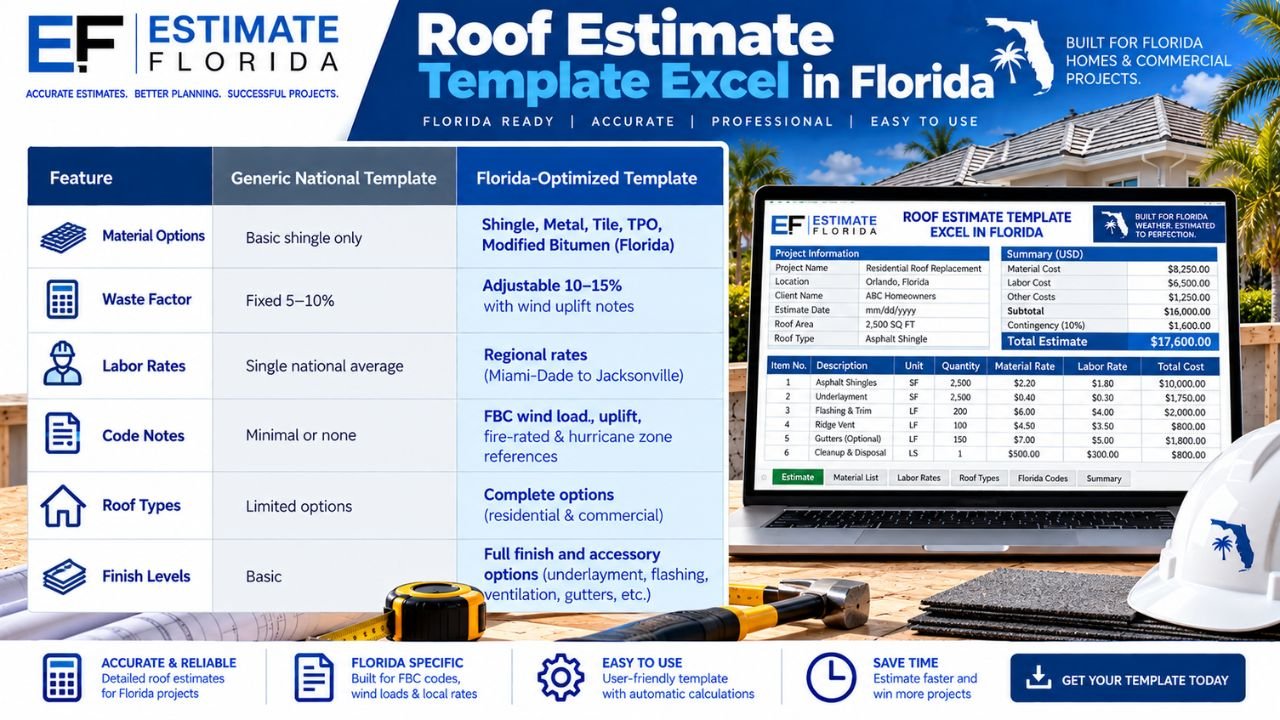
Generic Roof Template vs. Florida-Optimized Template
| Feature | Generic National Template | Florida-Optimized Template |
| Wind/HVHZ Defaults | Standard wind ratings | HVHZ/NOA notes, elevated design pressures, uplift detailing |
| Underlayment Requirements | Basic felt or synthetic | Secondary water barrier and enhanced underlayment defaults |
| UV/Humidity Adjustments | Minimal | High-performance materials and fastener notes for coastal exposure |
| Regional Pricing | Single national averages | South Florida, Central, and North Florida rate tables |
| Code Notes | Generic | FBC, HVHZ, and secondary barrier references |
This structure keeps estimates transparent for homeowners, property managers, and general contractors while remaining fully editable for the roofing estimator.
Step-by-Step: How to Use the Roof Estimate Template Excel in Florida
- Measure true roof area and apply pitch/waste factors. Calculate actual roof surface area from plans or field measurements. Apply pitch multipliers and realistic waste factors for hips, valleys, and complex geometry common on Florida homes and multi-family buildings.
- Identify roof system type and Florida code requirements. Determine whether the project is in the HVHZ or wind-borne debris region. Confirm secondary water barrier, underlayment, and product approval requirements that apply to the specific county and roof type.
- Quantify decking, underlayment, covering, and all flashings/accessories. Take off replacement decking, underlayment squares, covering materials by type, and every linear foot of drip edge, flashing, ridge, and valley material. Include vents, pipe boots, and specialty accessories.
- Apply current regional material, labor, and equipment rates. Update unit prices from South Florida, Central Florida, or North Florida sources. Adjust labor productivity for heat, humidity, multi-story access, and tile versus shingle versus metal installation rates.
- Add tear-off, disposal, access, and weather contingency allowances. Include tear-off labor and disposal, scaffolding or lift costs, and a contingency sized for weather delays common during Florida’s rainy and hurricane seasons.
- Generate client-ready summaries and export packages for bidding or insurance claims. Review the dashboard totals and cost-per-square metrics. Export clean PDF proposals or keep the live Excel file for revisions. Roofing often coordinates with other major trades—see related estimate templates such as our drywall estimate template Excel in Florida, painting estimate template Excel in Florida, and concrete estimate template Excel in Florida. For complete building packages that include roofing, explore residential building estimate template in Florida or commercial building estimate template in Florida.
Why this matters for Florida projects: Following these steps produces accurate square counts and accessory quantities that account for wind loads, secondary barriers, and regional conditions instead of relying on national rules of thumb.
Key Cost Drivers for Roofing in Florida (2026)
Florida roofing costs in 2026 continue to be shaped by impact-rated and high-wind products, labor availability, tear-off and disposal expenses, and system type. Shingle, tile, and metal systems each carry different material and labor profiles; tile and architectural metal typically command higher installed costs than standard asphalt shingles. HVHZ and high-wind products add measurable premiums for tested underlayment, enhanced fastening, and NOA or Florida Product Approval documentation.
Labor remains a major variable. Heat, humidity, and multi-story work reduce daily production rates compared with milder climates. Tear-off and disposal costs rise with the number of existing layers and local landfill or transfer-station fees. Scaffolding or lift access for two-story and commercial buildings adds further cost, while HOA and multi-family projects often require tighter scheduling and more extensive site protection.
A well-built roof estimate template Excel in Florida treats these drivers as adjustable inputs by region, roof type, and complexity rather than locking in a single statewide price-per-square. Contractors handling larger packages frequently combine roofing takeoffs with broader formats such as our civil estimate format in Excel in Florida when site or drainage work is involved.
Why this matters for Florida projects: Treating cost drivers as variables the Excel template calculates keeps bids competitive in high-cost South Florida markets while remaining profitable on inland or North Florida work.
Common Mistakes Florida Roofing Contractors Make with Estimates
Even experienced roofers fall into predictable traps when using generic tools:
- Underestimating waste on complex hips, valleys, and irregular roof geometries common on Florida custom and multi-family buildings.
- Ignoring or minimizing secondary water barrier and enhanced underlayment requirements that current Florida Building Code provisions demand.
- Applying national labor rates and productivity figures that do not reflect Florida heat, humidity, or multi-story conditions.
- Missing flashing, drip edge, penetration, and accessory quantities that add significant material and labor.
- Setting insufficient contingency for weather delays, especially during the rainy and hurricane seasons.
- Forgetting HVHZ product premiums and the documentation required for Miami-Dade NOA or equivalent approvals.
- Under-allowing for decking repair or replacement when existing sheathing is damaged or non-compliant.
A purpose-built roofing takeoff Excel Florida format prevents these errors by forcing accurate square and accessory takeoffs, embedding secondary barrier and HVHZ defaults, and applying regional labor rates. The result is fewer mid-job surprises and more reliable profit margins.
When a Template Isn’t Enough: Professional Roofing Takeoffs & Estimating
An excellent Excel template handles routine single-family re-roofs and simpler commercial jobs efficiently. Larger multi-family, HOA, commercial, or multi-building packages, and projects with complex geometry or strict HVHZ requirements, often benefit from professional roofing quantity takeoffs. Estimate Florida delivers full-service roofing estimating with 24–48 hour turnaround on most scopes, Excel plus PDF delivery, Florida-specific code compliance, and detailed material and labor breakdowns by system type.
Upload plans, elevations, or clear roof photos and receive quantified squares, underlayment, covering, flashing, and accessory lists priced to current local conditions and code requirements. Many clients combine roofing estimates with related trade templates when preparing complete residential or commercial packages.
Why this matters for Florida projects: Professional roofing takeoffs reduce risk on high-visibility or high-volume work while allowing field crews to focus on installation quality and schedule rather than measurement and pricing.
Get Your Florida Roof Estimate Template & Professional Support
Accurate roofing estimating in Florida starts with precise measurements and local knowledge. A properly designed roof estimate template Excel in Florida accounts for hurricane wind loads, HVHZ requirements, secondary water barriers, UV and humidity exposure, and regional labor and material rates so your bids stay competitive and your margins stay protected.
Request your customized Excel roof estimate template or upload plans and photos for a complete professional takeoff. Estimate Florida delivers fast, Florida-calibrated results in Excel and PDF formats ready for client proposals, insurance claims, or internal bidding. Contact us at info@estimateflorida.com or use the Upload Plans option on the site to get started. Precise roofing takeoffs today protect profitability on every Florida residential, commercial, and hurricane-ready roof tomorrow.