A professional civil estimate format in Excel in Florida is essential for controlling costs and winning bids on projects shaped by the state’s unique conditions—high water tables, sandy soils, intense seasonal rainfall, and strict stormwater management rules. From Miami-Dade to Jacksonville, civil contractors and developers routinely face dewatering demands, retention pond requirements, FDOT compliance, county-specific drainage standards, and variable soil conditions that range from clean sand to limestone and organic muck. Generic national templates overlook these realities and routinely produce underbids or costly change orders.
Estimate Florida supplies Florida-calibrated Excel formats and full civil/sitework takeoff support built around local soil data, water-table adjustments, and current regional rates. A properly structured civil estimate format in Excel captures earthwork volumes with correct swell/shrink and compaction factors, utilities with bedding and depth allowances, stormwater systems, paving, and site improvements while embedding contingency for dewatering and erosion control. This guide details exactly what belongs in a Florida-ready workbook, how to use it step by step, the primary 2026 cost drivers, common estimating mistakes, and when to move from a template to professional takeoff services.
Why a Florida-Specific Civil Estimate Format Matters?
National civil templates assume stable water tables, uniform soils, and standardized production rates. Florida’s environment invalidates those assumptions on nearly every project.
High water tables—frequently only 2–4 feet below grade in South Florida and many coastal counties—drive dewatering costs that can dominate foundation and utility excavation. Stormwater regulations enforced by the South Florida Water Management District, Southwest Florida Water Management District, and local counties require retention or detention systems, swales, underdrains, and SWPPP compliance that must be quantified early. Soil conditions vary dramatically: sandy soils common across much of the peninsula behave differently from limestone in parts of South Florida or organic muck that often requires complete removal and replacement. FDOT standards govern roadway and utility work on state corridors, while county and municipal codes add further layers for private development.
Hurricane and flood-zone considerations further influence grading elevations, drainage capacity, and the need for resilient site improvements. An inaccurate civil takeoff cascades into foundation delays, utility conflicts, and stormwater redesigns. A Florida-optimized civil estimate format in Excel embeds water-table adjustments, soil-specific factors, stormwater defaults, and regional pricing so the numbers remain realistic from initial survey to final bid.
Why this matters for Florida projects: Contractors and developers who use localized formats reduce the gap between estimated and actual site costs, protect schedules in wet seasons, and submit competitive yet sustainable proposals across residential subdivisions, commercial sites, and public-works packages.
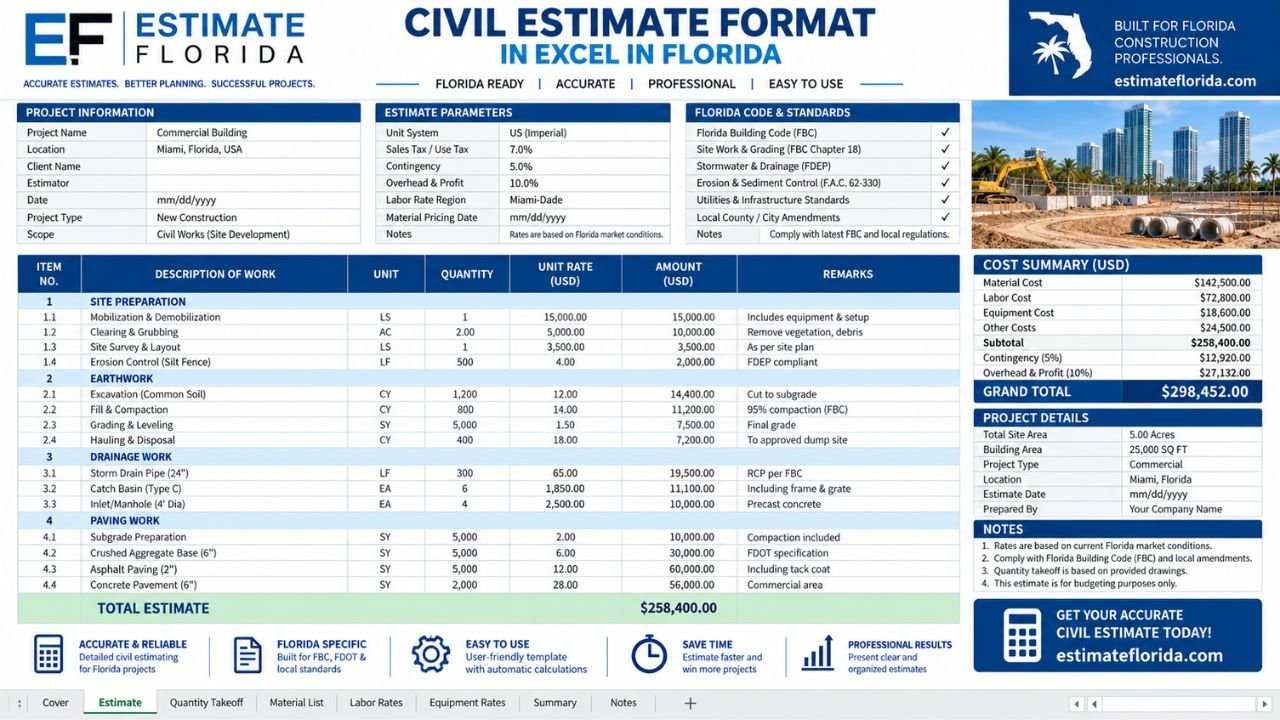
What’s Inside a Professional Civil Estimate Format in Excel in Florida
A robust civil estimate format in Excel is multi-tabbed, formula-driven, and designed for both quick residential site packages and detailed commercial or FDOT-scale work. Core components typically include:
- Project info header: Client or owner name, site address, county, bid date, applicable Florida Building Code edition, water-management district, and referenced standards (FDOT, local stormwater ordinance).
- Earthwork & grading sheet: Cut and fill volumes in bank, loose, and compacted cubic yards; borrow and export quantities; swell/shrink factors tailored to Florida soils; compaction percentages; clearing and grubbing; demucking allowances.
- Site utilities: Water, sanitary sewer, storm sewer, and force main quantified by linear foot, depth ranges, pipe material and diameter, fittings, manholes, cleanouts, and bedding/backfill requirements.
- Stormwater management: Retention or detention ponds (volume and excavation), swales, inlets, storm pipe networks, underdrains, control structures, and erosion-control items.
- Paving & hardscape: Asphalt or concrete pavement by thickness and area, base course, curb and gutter, sidewalks, driveways, and parking-lot striping allowances.
- Site improvements: Retaining walls, fencing, gates, landscaping or sod allowances, and miscellaneous site structures.
- Labor, equipment, and production rates: Crew and equipment productivity adjusted for sandy soils, wet conditions, and regional labor markets from South Florida to North Florida.
- Summary dashboard: Subtotals by category, unit costs, overhead and profit lines, contingency (especially for dewatering and unforeseen soils), tax if applicable, and grand total with cost-per-acre or cost-per-cubic-yard metrics.
Generic Civil Template vs. Florida-Optimized Format
| Feature | Generic National Template | Florida-Optimized Format |
| Water Table Adjustments | Minimal or none | Explicit dewatering and high-water-table line items |
| Stormwater Defaults | Basic pipe and inlet quantities | Retention/detention ponds, swales, SWPPP, underdrains |
| Soil Factors | Standard swell/shrink | Adjustable factors for sand, limestone, muck, and compaction |
| Code Notes | Generic notes | FBC, FDOT, and water-management district references |
| Regional Pricing | Single national averages | County/metro tables (Miami-Dade through Jacksonville) |
This structure keeps estimates transparent for owners, lenders, and general contractors while remaining fully editable for the estimator.
Step-by-Step: How to Build and Use the Civil Estimate Format in Excel in Florida
- Import or enter site survey and grading data. Bring in topographic survey points, existing and proposed contours, and boundary information. Establish existing grade versus finished grade so cut and fill volumes can be calculated accurately.
- Calculate cut/fill with Florida-specific swell/shrink and compaction factors. Convert bank volumes to loose (for haul) and compacted (for placement). Apply higher swell factors for organic or saturated soils and realistic compaction percentages for sandy Florida fill. Identify areas requiring demucking or unsuitable-material removal.
- Quantify utilities and storm systems with proper depth and bedding allowances. Measure linear feet of each utility by diameter and material. Add depth ranges that trigger additional shoring or dewatering. Include manholes, inlets, fittings, and bedding/backfill quantities consistent with local standards.
- Apply current Florida material, equipment, and labor rates by region. Update unit prices for earthwork, pipe, asphalt, concrete, and equipment from local suppliers and recent bids. Differentiate production rates between dry sandy sites and wet or rocky conditions common in parts of the state.
- Add dewatering, erosion control, and permit-related costs. Insert line items for well-point or pump dewatering, silt fence, inlet protection, temporary seeding, and any known permit or inspection fees. These items are frequently underestimated on Florida sites.
- Generate summary reports for bidding, bank packages, or owner review. Review the dashboard totals, unit-cost metrics, and contingency. Export clean PDF summaries or keep the live Excel file for revisions. Developers preparing bank packages often combine this civil format with our construction estimate format for bank loan in Florida or detailed estimate of building format in Excel in Florida for a complete package.
Why this matters for Florida projects: Following these steps produces defendable quantities that account for water table, soil variability, and stormwater rules instead of relying on national rules of thumb that fail under Florida conditions.
Key Cost Drivers for Civil/Sitework in Florida (2026)
Florida civil and sitework costs in 2026 continue to be driven by soil conditions, water table depth, equipment and fuel pricing, material volatility, and regulatory requirements. Earthwork productivity is generally higher in clean sandy soils than in areas requiring rock excavation or extensive demucking. South Florida projects frequently carry higher dewatering expenses because of shallow groundwater, especially during the wet season. Asphalt and concrete pricing remains sensitive to oil and aggregate markets, while equipment rates reflect both ownership costs and regional demand.
Project type creates further variation. Residential subdivision work often involves lighter earthwork and simpler storm systems, while commercial sites and multi-family developments demand larger retention ponds and more extensive utility networks. FDOT or county roadway packages introduce stricter material specifications and testing requirements that affect unit costs. A well-designed civil estimate format in Excel treats these drivers as adjustable inputs by county or ZIP code rather than locking in a single statewide figure. Contractors handling larger scopes frequently pair the civil workbook with related templates such as our warehouse construction estimate template for Florida, apartment building construction estimate template, or detailed estimate of a residential building in Excel PDF for Florida.
Why this matters for Florida projects: Treating cost drivers as variables that the Excel format calculates keeps bids competitive in high-cost South Florida markets while remaining profitable on inland or North Florida sites.
Common Mistakes Florida Contractors Make with Civil Estimates
Even experienced estimators encounter recurring pitfalls when using generic tools on Florida sites:
- Underestimating dewatering duration and cost, especially on South Florida and coastal projects with seasonal high water tables.
- Ignoring or minimizing muck excavation and replacement, which can dramatically increase earthwork volumes.
- Applying national production rates instead of Florida-adjusted rates that reflect sandy soils, heat, humidity, and wet-season constraints.
- Omitting stormwater permit allowances, SWPPP implementation, and temporary erosion-control items required by water-management districts and counties.
- Using incorrect swell/shrink or compaction factors that misstate borrow and export quantities.
- Overlooking utility conflicts or existing infrastructure that require extra excavation, support, or relocation.
- Failing to include bedding, select fill, and compaction testing requirements that local standards demand.
A purpose-built civil takeoff Excel Florida format prevents these errors by embedding water-table and soil-adjustment fields, stormwater default assemblies, regional production rates, and clear contingency lines. The result is fewer surprises during construction and more reliable bids.
When a Template Isn’t Enough: Professional Civil Takeoffs & Estimating
An excellent Excel format handles routine residential and small commercial site packages efficiently. Larger mixed-use developments, industrial sites, multi-phase subdivisions, or projects involving complex stormwater modeling and FDOT coordination often benefit from professional civil takeoffs. Estimate Florida delivers full-service civil and sitework estimating with 24–48 hour turnaround on most scopes, Excel plus PDF delivery, Florida-specific material and equipment rates, and clear formatting ready for inclusion in broader project bids or bank packages.
Upload surveys, grading plans, or utility drawings and receive quantified earthwork volumes, utility quantities, stormwater systems, paving, and site improvements priced to current local conditions. Many clients combine civil takeoffs with related trade estimates such as our plumbing estimate template Excel Florida for contractors, electrical estimate template Excel Florida, or masonry estimate template Excel Florida for coordinated bidding across the full project.
Why this matters for Florida projects: Professional takeoffs reduce risk on high-value or high-complexity site packages while allowing field and office teams to focus on production, permitting, and client delivery.
Get Your Florida Civil Estimate Format & Professional Support
Accurate civil and sitework estimating in Florida starts with the right structure and local knowledge. A properly designed civil estimate format in Excel in Florida accounts for high water tables, variable soils, stormwater regulations, and regional cost differences so your bids stay competitive and your margins stay protected.
Request your customized Excel civil estimate format or upload plans and surveys for a complete professional takeoff. Estimate Florida delivers fast, Florida-calibrated results in Excel and PDF formats ready for bidding, owner review, or lender packages. Contact us at info@estimateflorida.com or use the Upload Plans option on the site to get started. Precise civil takeoffs today protect schedules and profitability on every Florida project tomorrow.