What type of pipe is best for plumbing in Florida? There is no single best pipe for every Florida plumbing application. PEX, copper, CPVC, PVC, ABS, polyethylene, galvanized steel, cast iron, and stainless steel each have appropriate uses depending on the system, water quality, location, pressure, temperature, installation conditions, existing plumbing, budget, and approved project plans.
Florida homes face unique conditions such as humidity, heat, hard water in some areas, coastal salt air, high water pressure in some buildings, slab-on-grade construction, and flood exposure. These conditions can affect water supply lines, drain-waste-vent (DWV) systems, underground services, and specialty piping.
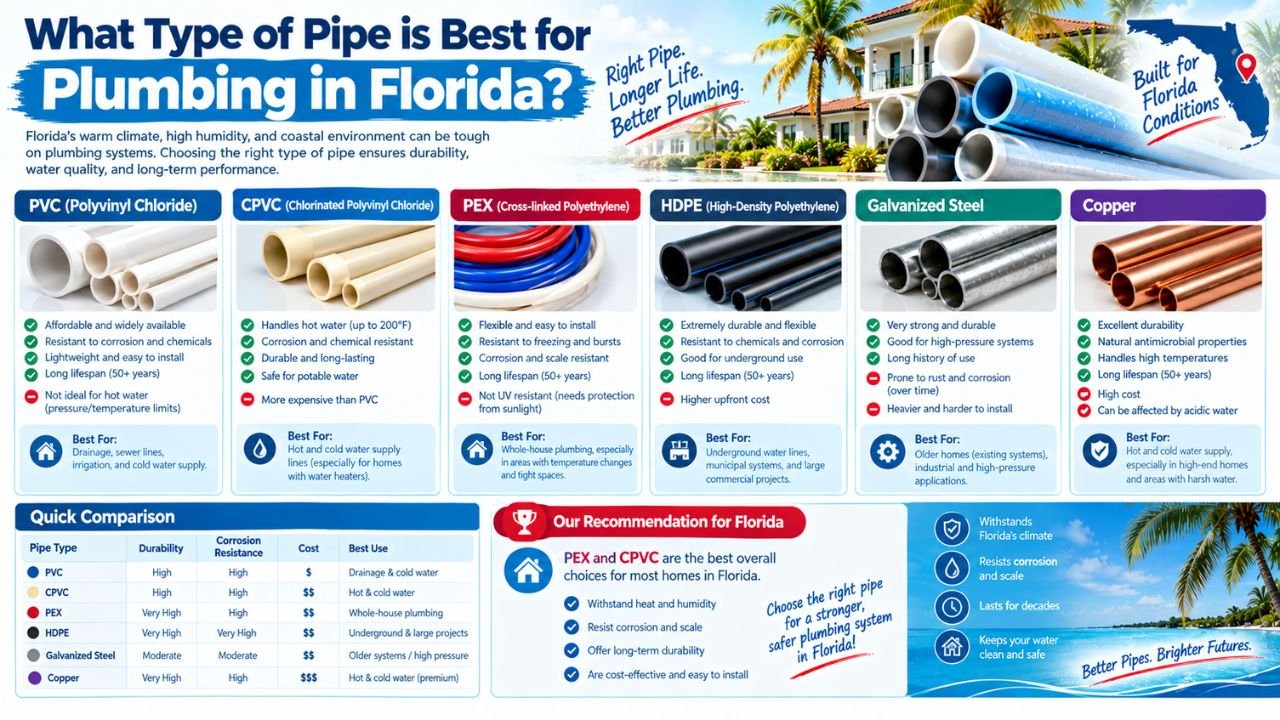
This article compares common pipe materials and explains how to choose the right one for each application. It does not rank one material as universally superior. Instead, it provides a practical selection framework for Florida homeowners, builders, contractors, plumbers, remodelers, property managers, and real estate investors.
Estimate Florida can help you prepare accurate plumbing cost estimates for your Florida project. To discuss your requirements, email us at info@estimateflorida.com.
Why There Is No Single Best Pipe for Every Florida Home
“Best” depends on many factors, not just the material name. Understanding these factors helps homeowners and contractors make informed decisions rather than simply choosing based on price or brand recognition.
Pipe system
The best pipe for a water supply line may not be suitable for drain, waste, and vent (DWV) piping, gas piping, outdoor irrigation, or underground service lines. Each system has different requirements:
- Water supply lines must handle pressure and temperature variations.
- DWV systems operate under gravity flow and require proper slope.
- Gas piping has specific material and joint requirements.
- Outdoor irrigation may need UV-resistant materials.
- Underground services must resist soil conditions and potential movement.
Using the wrong pipe for a specific system can lead to premature failure, code violations, or safety issues.
Water quality and chemistry
Florida water quality varies significantly by location. Some areas have hard water with high mineral content, others have higher iron or sulfur content, and some regions have aggressive or acidic water conditions. Water chemistry can affect:
- Corrosion rates in metal pipes.
- Scale buildup that reduces flow over time.
- Material compatibility with fittings and joints.
- Water quality at fixtures and appliances.
- Treatment requirements for whole-home systems.
For example, aggressive water may accelerate copper corrosion in some conditions, while hard water may cause scale buildup in any pipe material over time.
Water pressure
High or low water pressure can affect pipe selection and system design. Some materials have different pressure ratings, and high pressure may require:
- Specific materials with higher pressure ratings.
- Additional fittings or supports.
- Pressure-reducing valves to protect the system.
- More frequent inspection and maintenance.
Municipal water pressure can vary from 40 PSI to over 100 PSI in some areas. The pipe material and installation must accommodate the actual pressure conditions.
Temperature
Hot water systems require materials rated for elevated temperatures. Some plastic pipes have temperature limitations that make them unsuitable for certain hot water applications. Considerations include:
- Maximum operating temperature for the material.
- Temperature fluctuations during daily use.
- Water heater settings and their effect on piping.
- Ambient temperature in unconditioned spaces.
- Thermal expansion and contraction.
For example, CPVC has different temperature ratings than PEX, and both differ from copper’s capabilities.
Location within the home
Interior piping, exterior piping, underground piping, and mechanical room piping may have different requirements:
- Interior piping is protected from UV and weather but may be subject to physical damage.
- Exterior piping must resist UV exposure, temperature extremes, and weather.
- Underground piping must resist soil conditions, moisture, and potential movement.
- Mechanical room piping may require higher temperature ratings and fire resistance.
Each location may require different materials, protection methods, or installation practices.
Above-ground versus underground installation
Underground piping may require different materials, joint types, and protection than above-ground piping:
- Soil conditions can affect corrosion rates and pipe movement.
- Water table can create buoyancy issues for some materials.
- Root intrusion can damage certain pipe types.
- Traffic loads may require additional protection.
- Access for repairs is more difficult underground.
Above-ground piping may be easier to inspect and repair but may require UV protection or physical protection from damage.
Slab-on-grade versus raised foundation
Slab construction creates special considerations for underground piping, slab penetrations, pressure testing, leak detection, and repiping. Raised foundations may allow easier access but may have different exposure conditions:
- Slab construction limits access after installation and may require specialized leak detection.
- Raised foundations allow easier access but may expose piping to different conditions.
- Crawl spaces may have humidity and pest considerations.
- Basement construction (less common in Florida) has different requirements.
The foundation type affects both initial installation and future maintenance or repair strategies.
New construction versus repiping
New construction allows more flexibility in material selection, while repiping may require compatibility with existing systems, limited access, or specific routing constraints:
- New construction can use optimal routing and materials from the start.
- Repiping may need to work around existing finishes and structures.
- Partial repairs may require matching existing materials.
- System upgrades may allow material changes in specific areas.
Repiping projects often require more planning and may have higher labor costs due to access challenges.
Existing plumbing material
Compatibility with existing plumbing may affect material choice. Mixing incompatible materials or fittings can create galvanic corrosion, joint failures, or other problems:
- Dielectric unions may be required when connecting dissimilar metals.
- Transition fittings may be needed between different materials.
- System-wide changes may be more practical than partial replacements.
- Future maintenance may be complicated by mixed materials.
A qualified plumber should evaluate compatibility before making material changes.
Contractor experience
Plumbers and contractors may have more experience with certain materials. Familiarity can affect installation quality, troubleshooting, and long-term serviceability:
- Installation quality varies with contractor experience.
- Tool availability may affect material choice.
- Warranty support may depend on certified installers.
- Local practice may favor certain materials.
Choosing a material that local contractors are familiar with can improve installation quality and future serviceability.
Approved plans and specifications
The Florida Building Code and local amendments may affect material selection, especially for water supply, DWV, gas, and specialty systems.
- Code requirements may specify approved materials.
- Local amendments may add additional requirements.
- Engineered systems may have specific material requirements.
- Inspection requirements may affect material choice.
Always verify that selected materials meet applicable code and specification requirements.
Budget and long-term maintenance priorities
Material cost, installation cost, maintenance requirements, and expected lifespan all affect the total cost of ownership:
- Initial material cost varies significantly between materials.
- Installation labor may differ based on material and complexity.
- Maintenance requirements vary by material and installation.
- Expected lifespan affects long-term value.
- Repair costs may differ by material accessibility.
A lower upfront cost may not always result in lower long-term cost when maintenance, repairs, and replacement are considered.
A good pipe material can perform poorly if installed incorrectly or used in the wrong application. Proper installation, compatible fittings, water conditions, and code-compliant design are often more important than material choice alone.
Florida Plumbing Conditions That Affect Pipe Choice
Florida’s climate and geography create conditions that can influence plumbing pipe selection. Understanding these conditions helps in selecting appropriate materials and installation methods.
Humidity and heat
High humidity and heat can affect plumbing systems in several ways:
- Exterior piping may experience accelerated degradation of certain materials.
- Metal components may corrode faster in humid conditions.
- Joint integrity may be affected by thermal expansion and contraction.
- Material expansion can stress fittings and connections.
- Ventilation requirements may affect pipe routing in enclosed spaces.
- Condensation on cold water lines can create moisture issues.
Proper material selection, insulation, and installation practices can help mitigate these effects.
UV exposure
Exposed piping may be subject to strong sunlight, which can degrade certain plastic materials over time:
- PEX is not suitable for prolonged UV exposure without protection.
- CPVC may become brittle with extended UV exposure.
- PVC and ABS may require UV-rated formulations for exterior use.
- Copper is generally UV-resistant but may develop patina.
- Protective measures such as paint, insulation, or conduit may be required.
Exterior applications require UV-rated materials or protective measures to ensure long-term performance.
Coastal salt air and corrosion
Homes near the coast may experience accelerated corrosion and material degradation:
- Metal components may corrode faster in salt air.
- Certain finishes may degrade more quickly.
- Electrical connections for pumps and water heaters may require additional protection.
- Fasteners and supports may need corrosion-resistant materials.
- Maintenance requirements may increase in coastal environments.
Corrosion-resistant materials such as stainless steel, certain plastics, or properly protected metals may be more suitable for coastal applications.
Hard water in some regions
Some Florida areas have harder water, which can affect plumbing systems:
- Scale buildup can reduce pipe interior diameter over time.
- Fixture performance may be affected by mineral deposits.
- Water heater efficiency may decrease with scale buildup.
- Appliance lifespan may be reduced without treatment.
- Water treatment may be beneficial in hard water areas.
Water testing can help determine hardness levels and appropriate treatment options.
Aggressive or acidic water conditions
Some water sources may be more aggressive or acidic, which can affect material selection:
- Metal pipe corrosion may accelerate in aggressive water.
- Joint integrity may be compromised over time.
- Material selection may need to account for water chemistry.
- Treatment requirements may include pH adjustment or corrosion inhibitors.
Water testing and consultation with local water authorities can help identify water chemistry issues.
The Florida Department of Environmental Protection provides water quality information and resources for residents and professionals.
High water pressure in some buildings
High pressure can stress pipes, fittings, and fixtures:
- Pipe ratings must accommodate actual pressure conditions.
- Fitting integrity may be compromised by excessive pressure.
- Fixture lifespan may be reduced without pressure regulation.
- Noise issues may occur with high-pressure flow.
- Pressure-reducing valves may be required in some installations.
Municipal water pressure should be verified before selecting materials and designing systems.
Heavy rain and flooding
Flooding can affect underground and low-lying plumbing systems:
- Underground piping may be subject to buoyancy or movement.
- Drainage systems may be overwhelmed during heavy rain.
- Sump and sewer pumps may be required in flood-prone areas.
- Backflow prevention may be necessary to protect the system.
- Service line location may need to account for flood levels.
FEMA provides official flood mapping through its Flood Maps resources.
Slab-on-grade construction
Many Florida homes are built on slabs, which creates special considerations:
- Underground piping is encased in or under the slab.
- Access for repairs is limited after slab placement.
- Material selection may affect long-term maintainability.
- Leak detection may require specialized equipment.
- Repiping strategies may need to route around the slab.
Proper pressure testing before slab placement is essential to identify leaks before they become inaccessible.
High water table
A high water table can affect underground plumbing:
- Pipe buoyancy may require additional anchoring.
- Drainage system design may need to account for groundwater.
- Sump pump requirements may increase in high water table areas.
- Waterproofing needs may be more critical.
- Septic system design may be affected by water table height.
Site evaluation and proper engineering can help address high water table challenges.
Older homes with legacy piping
Older homes may have galvanized steel, polybutylene, cast iron, or other aging materials:
- Galvanized steel may be corroded and restricted by scale.
- Polybutylene may be subject to premature failure.
- Cast iron may be corroded or damaged.
- Material compatibility may affect repair strategies.
- System evaluation may be necessary before making changes.
A qualified plumber should evaluate the condition of legacy systems and recommend appropriate action.
Regional differences
North Florida, Central Florida, South Florida, and the Florida Keys may have different conditions:
- Water characteristics may vary by region and source.
- Climate exposure may differ between inland and coastal areas.
- Local requirements may vary by jurisdiction.
- Material availability may differ by region.
- Contractor experience may favor certain materials in different areas.
Local knowledge and experience can help guide appropriate material selection.
Pipe selection should follow the approved plans, specifications, and applicable local requirements. Consulting with local professionals can help ensure appropriate material selection for specific conditions.
PEX Pipe for Florida Plumbing
What is PEX?
PEX (cross-linked polyethylene) is a flexible plastic pipe commonly used for interior water supply applications. It has become increasingly popular in residential construction and repiping projects due to its flexibility, corrosion resistance, and ease of installation.
PEX is available in different colors:
- Red for hot water lines.
- Blue for cold water lines.
- White or gray for general use.
It is connected using three main methods:
- Crimp fittings using a crimp ring and crimping tool.
- Clamp fittings using a stainless steel clamp and clamping tool.
- Expansion fittings using an expansion tool and PEX-A material.
Advantages
- Flexibility: Can be routed around obstacles with fewer fittings in some layouts, reducing potential leak points and installation time.
- Corrosion resistance: Not subject to corrosion like metal pipes, making it suitable for various water conditions.
- Resistance to scale buildup: Smooth interior surface resists scale accumulation better than some metal pipes.
- Suitable for many interior water supply applications: Commonly used in new construction and repiping throughout Florida.
- Expansion and contraction behavior: Can accommodate some thermal movement without damage to fittings or joints.
- Freeze resistance: More resistant to freeze damage than rigid pipes due to flexibility, though not freeze-proof.
- Quiet operation: Tends to operate more quietly than metal pipes, reducing water hammer noise.
- Cost-effective: Generally lower material and installation cost compared to copper.
Considerations
- UV exposure: PEX is not suitable for prolonged UV exposure. Exterior applications require protection or UV-rated materials. Direct sunlight can degrade PEX over time.
- Proper fittings and connections: Requires compatible fittings and proper installation tools. Incorrect crimping or clamping can lead to leaks.
- Manufacturer compatibility: Different PEX brands may have different fitting systems. Mixing incompatible systems can cause problems.
- Protection from physical damage: Should be protected from sharp objects, nails, screws, and physical abuse. Proper drilling and nailing practices are essential.
- Temperature and pressure ratings: Must be used within manufacturer ratings. Typical ratings are 160°F at 80 PSI or 100°F at 160 PSI.
- Need for correct installation practices: Proper crimping, clamping, or expansion is essential. Training and experience improve installation quality.
- Rodent resistance: Some studies suggest PEX may be more susceptible to rodent damage than metal pipes in certain conditions.
- Permeability: PEX may allow some oxygen permeation, which could affect certain heating systems (less relevant for potable water).
When PEX may be a strong choice
- Interior water supply lines in new construction or repiping.
- Repiping projects where flexibility allows routing through walls and ceilings with minimal demolition.
- New construction with accessible framing and standard layouts.
- Applications where corrosion resistance is important due to water quality.
- Areas with moderate to hard water where scale buildup is a concern.
- Budget-conscious projects where material and labor cost savings are important.
- Cold water lines in unconditioned spaces where freeze resistance is beneficial.
When another material may be more appropriate
- Exterior exposed applications without UV protection or conduit.
- High-temperature applications beyond PEX ratings (above 160°F).
- Applications requiring rigid pipe support such as certain mechanical room installations.
- Where local code or specifications require different materials.
- Gas piping applications where PEX is not approved.
- Underground direct burial without proper protection or rated materials.
Copper Pipe for Florida Plumbing
What is copper?
Copper is a metal pipe that has been used for plumbing for many decades. It is available in different types with different wall thicknesses:
- Type K: Thickest wall, often used for underground service.
- Type L: Medium wall, commonly used for interior water supply.
- Type M: Thinnest wall, used in some residential applications where allowed.
Copper is connected using:
- Soldering with lead-free solder for potable water.
- Brazing for higher temperature applications.
- Press-fit fittings using specialized tools.
- Compression fittings for certain applications.
Advantages
- Long history of use: Well-understood performance characteristics with decades of field experience.
- Durability: Can provide long service life (50+ years) when properly installed and maintained.
- Heat resistance: Suitable for hot water applications and high-temperature environments.
- UV resistance: Suitable for exposed applications without degradation from sunlight.
- Recyclability: Can be recycled at end of life, providing environmental benefits.
- Suitability for certain exposed or mechanical applications: Often used in mechanical rooms, water heater connections, and exposed locations.
- Rigid installation: Provides stable, straight runs that are easy to support and protect.
- Bacteria resistance: Copper has natural antimicrobial properties that may inhibit bacterial growth.
- Fire resistance: Does not contribute to fire spread and maintains integrity at high temperatures.
Considerations
- Water chemistry and corrosion: Aggressive or acidic water can cause corrosion in some conditions, potentially leading to pinhole leaks.
- Cost: Generally higher material cost than plastic alternatives (2-4 times more expensive than PEX or CPVC).
- Soldering or press-fit installation: Requires skilled installation or specialized tools. Poor soldering can lead to leaks.
- Potential pinhole leaks: Can occur in certain water conditions, particularly with aggressive water or improper installation.
- Theft risk: Exposed copper may be targeted for theft, particularly in vacant properties or construction sites.
- Compatibility with existing systems: Must be compatible with existing materials and fittings. Dielectric unions may be required when connecting to steel.
- Thermal conductivity: Loses more heat than plastic pipes, potentially requiring more insulation for hot water lines.
- Galvanic corrosion: Can corrode when connected to certain other metals without proper isolation.
- Installation time: Generally takes longer to install than flexible plastic pipes.
When copper may be a strong choice
- Exposed applications where UV resistance and appearance are important.
- Mechanical room piping where rigidity and temperature resistance are beneficial.
- Water heater connections where high temperatures are present.
- Applications requiring rigid pipe support such as long straight runs.
- Where local practice or specifications favor copper due to tradition or code requirements.
- High-end installations where the premium material is preferred.
- Fire sprinkler systems where copper is commonly specified.
- Medical gas systems where copper is often required.
When another material may be more appropriate
- Budget-conscious projects where plastic alternatives are acceptable and code-compliant.
- Areas with aggressive water chemistry that may accelerate copper corrosion.
- Applications where flexibility is beneficial for routing around obstacles.
- Where theft risk is a significant concern for exposed piping.
- Repiping projects where minimal demolition is desired.
- DIY installations where soldering skills are not available.
CPVC Pipe for Florida Plumbing
What is CPVC?
CPVC (chlorinated polyvinyl chloride) is a plastic pipe commonly used for hot and cold water supply applications. It is similar to PVC but has been chlorinated to improve temperature resistance. CPVC is typically light yellow or cream colored and is connected using solvent cement and fittings designed specifically for CPVC.
CPVC has been used in Florida residential construction for decades and is approved by the Florida Building Code for potable water applications when installed according to manufacturer specifications and code requirements.
Advantages
- Suitable for hot and cold water supply: Rated for temperatures up to 180°F, making it suitable for residential hot water systems.
- Corrosion resistance: Not subject to corrosion like metal pipes, making it suitable for various water conditions.
- Lower material cost than copper: Generally more affordable than copper (similar to or slightly higher than PEX).
- Lightweight installation: Easier to handle and transport than metal pipes, reducing labor fatigue.
- Common use in residential supply systems: Widely available and understood by Florida contractors.
- Smooth interior surface: Provides good flow characteristics and resists scale buildup.
- Chemical resistance: Resistant to many chemicals that may be present in water or soil.
- Non-conductive: Does not conduct electricity, which can be beneficial in certain applications.
- Quiet operation: Tends to operate more quietly than metal pipes.
Considerations
- Temperature and pressure ratings: Must be used within manufacturer ratings. Typical ratings are 100 PSI at 180°F or 400 PSI at 73°F.
- UV exposure: Not suitable for prolonged UV exposure without protection. Sunlight can degrade CPVC over time.
- Brittleness over time: Can become brittle with age, particularly if exposed to UV, certain chemicals, or physical stress.
- Compatible fittings and solvent cement: Requires proper CPVC fittings and cement. Using PVC cement on CPVC can cause joint failures.
- Protection from physical damage: Should be protected from sharp objects, impact, and physical abuse. More brittle than PEX.
- Manufacturer installation requirements: Must follow manufacturer instructions for proper installation, including primer use, cement application, and cure times.
- Thermal expansion: Expands more than copper with temperature changes, requiring proper support and expansion allowances.
- Joining technique: Requires proper solvent welding technique. Insufficient cement or improper joint preparation can cause leaks.
- Support requirements: Requires more frequent support than copper to prevent sagging.
When CPVC may be a strong choice
- Interior water supply lines in new construction or renovations.
- Hot and cold water distribution within temperature and pressure ratings.
- Budget-conscious projects where material cost is a significant factor.
- Applications where corrosion resistance is important due to water quality.
- Where local practice or specifications favor CPVC due to tradition or availability.
- Straight runs where rigidity is beneficial for support and appearance.
- Retrofit applications where existing CPVC systems are being extended.
When another material may be more appropriate
- Exterior exposed applications without UV protection or paint.
- Applications requiring flexibility for routing around obstacles.
- High-temperature applications beyond CPVC ratings (above 180°F).
- Where local code or specifications require different materials.
- Freeze-prone areas where PEX’s flexibility may be more beneficial.
- Repiping projects where minimal demolition is desired and flexibility is important.
PVC and ABS Pipe for Drainage
Difference between PVC and ABS
PVC (polyvinyl chloride) and ABS (acrylonitrile butadiene styrene) are both plastic pipes commonly used for drain, waste, and vent (DWV) systems. The main differences include:
- Color: PVC is typically white or gray, while ABS is typically black.
- Chemical composition: PVC uses vinyl chloride, while ABS uses acrylonitrile, butadiene, and styrene.
- Joining method: PVC typically uses primer and solvent cement, while ABS uses solvent cement without primer (in most jurisdictions).
- Temperature resistance: PVC generally has slightly better temperature resistance than ABS.
- Impact resistance: ABS may have better impact resistance at low temperatures.
- Code acceptance: Both are widely accepted, but local codes may prefer one over the other.
Some jurisdictions may have preferences based on local experience, availability, or historical practice. Always check local code requirements before selecting materials.
Common uses
- Drain, waste, and vent systems: Interior DWV piping for residential and commercial buildings.
- Building sewers: Underground drainage from building to municipal sewer or septic tank.
- Storm drainage: Roof drains, leaders, and site storm drainage systems.
- Condensate drainage: HVAC condensate lines from air handlers and evaporator coils.
- Irrigation or outdoor drainage: Where appropriate and code-compliant.
- Vent piping: Roof vents and termination points.
- Floor drains and cleanouts: Access points for maintenance and cleaning.
Advantages
- Corrosion resistance: Not subject to corrosion like metal pipes, making them suitable for drainage applications.
- Lightweight installation: Easier to handle and transport than metal pipes, reducing labor requirements.
- Cost-effective material: Generally affordable compared to metal alternatives.
- Smooth interior surface: Provides good flow characteristics and resists buildup.
- Common availability: Widely available through plumbing suppliers and home centers.
- Chemical resistance: Resistant to many household chemicals and waste products.
- Long service life: Can provide decades of service when properly installed.
- Easy to cut and fit: Can be cut with simple tools and fitted quickly.
Considerations
- Temperature limits: Not suitable for high-temperature applications. PVC DWV is typically rated to 140°F, while ABS may have lower ratings.
- UV exposure: May require protection or UV-rated materials for exterior applications. Prolonged sunlight can degrade both materials.
- Proper solvent cement and fittings: Requires compatible fittings and cement. Using the wrong cement can cause joint failures.
- Support and slope: Must be properly supported and sloped for drainage. Improper slope can cause drainage problems.
- Local code and inspection requirements: Must meet local code requirements. Some jurisdictions may have specific requirements.
- Not all PVC or ABS products are suitable for potable water: DWV products should not be used for water supply. Only use pressure-rated and potable-water-approved materials for supply applications.
- Expansion and contraction: Requires proper support and allowance for thermal movement.
- Noise transmission: May transmit more noise than cast iron in some applications.
When PVC or ABS may be a strong choice
- Interior DWV systems in residential and commercial buildings.
- Building sewer lines from structure to sewer or septic.
- Storm drainage systems for roof and site drainage.
- Condensate drainage from HVAC equipment.
- Applications where corrosion resistance is important.
- Budget-conscious projects where material cost is a factor.
- Standard residential drainage where both materials are code-compliant.
When another material may be more appropriate
- High-temperature applications such as commercial kitchen drains with hot water.
- Applications requiring metal pipe strength such as certain industrial applications.
- Where local code requires specific materials such as cast iron in certain multi-story buildings.
- Potable water applications (use appropriate water supply materials like PEX, copper, or CPVC).
- Fire resistance requirements where cast iron may be specified.
- Sound-sensitive applications where cast iron’s sound dampening is beneficial.
Polyethylene, Galvanized Steel, Cast Iron, and Stainless Steel
Polyethylene
Polyethylene (PE) pipe is commonly used for specific applications in Florida plumbing systems:
Common uses:
- Water service lines from meter to building.
- Irrigation systems and landscape watering.
- Underground applications where flexibility is beneficial.
- Some industrial and agricultural applications.
- Well casing and pump connections.
Advantages:
- Flexible and can accommodate some ground movement.
- Corrosion-resistant and suitable for underground use.
- Available in long coils, reducing joints.
- Cost-effective for service lines and irrigation.
- Resistant to many chemicals and soil conditions.
Limitations:
- Not suitable for interior water distribution in most residential applications.
- Temperature limitations (typically rated to 140°F or less).
- UV degradation if exposed to sunlight without protection.
- Requires specialized fittings and installation techniques.
- May not be approved for all plumbing applications by local code.
Galvanized Steel
Galvanized steel pipe is primarily found in older Florida homes and legacy systems:
Common uses:
- Older homes built before the 1970s.
- Legacy water supply systems.
- Limited new use in specialty applications.
- Some gas piping applications (where approved).
Advantages:
- Strong and rigid construction.
- Historical use with proven performance in some conditions.
- Fire resistant and maintains integrity at high temperatures.
- Suitable for certain gas applications where approved.
Limitations:
- Subject to corrosion and rust over time, particularly with aggressive water.
- Scale buildup can significantly reduce flow capacity.
- Potential water quality issues from rust and corrosion.
- Difficult to work with compared to modern materials.
- Threaded joints can leak over time.
- Generally not recommended for new water supply installations.
- May need replacement in repiping projects due to age and condition.
Cast Iron
Cast iron pipe is found in older drainage systems and some modern applications:
Common uses:
- Older drainage systems in homes and buildings.
- Certain commercial or multi-story applications.
- Some modern no-hub cast iron applications.
- Sound-sensitive applications where noise dampening is important.
Advantages:
- Durable and long-lasting when properly installed.
- Excellent sound dampening compared to plastic pipes.
- Fire resistant and maintains integrity at high temperatures.
- Heavy and stable, reducing movement and noise.
- Resistant to high temperatures in drainage applications.
Limitations:
- Heavy and difficult to handle and install.
- Subject to corrosion and rust over time, particularly in drainage applications.
- Expensive compared to plastic alternatives.
- Requires specialized tools and skills for installation.
- Joints can fail over time due to corrosion or movement.
- May need replacement in older homes due to age and condition.
Stainless Steel
Stainless steel pipe is used in specialty applications:
Common uses:
- Specialty plumbing applications requiring corrosion resistance.
- Corrosion-resistant applications in coastal or industrial environments.
- Specific mechanical uses in commercial buildings.
- Some food service, laboratory, or industrial applications.
- High-purity water systems.
Advantages:
- Excellent corrosion resistance, particularly in harsh environments.
- Durable and long-lasting when properly specified.
- Maintains appearance and integrity over time.
- Suitable for high-temperature and high-pressure applications.
- Resistant to many chemicals and contaminants.
Limitations:
- Higher cost compared to other materials.
- Specialized installation requiring specific skills and tools.
- May not be readily available through standard plumbing suppliers.
- Over-specified for most residential applications.
- Requires proper grade selection for specific applications.
Legacy Materials and Replacement
Older materials may need replacement in repiping projects due to:
- Corrosion that compromises pipe integrity.
- Scale buildup that significantly reduces flow capacity.
- Reduced flow that affects fixture performance.
- Water quality issues from rust, corrosion, or contamination.
- Age-related deterioration that increases failure risk.
- Code compliance issues with outdated materials.
- Insurance requirements that may affect coverage for certain materials.
However, not all legacy materials should be automatically replaced without inspection. A qualified plumber should evaluate:
- Current condition through visual inspection and testing.
- Water quality to assess corrosion and contamination.
- Flow capacity to determine if restriction is significant.
- Leak history to assess failure risk.
- System accessibility to evaluate replacement complexity.
- Budget considerations to balance costs and benefits.
- Future plans for the property.
In some cases, partial replacement or targeted repairs may be more appropriate than whole-system replacement. The decision should be based on professional evaluation rather than assumptions.
PEX vs Copper vs CPVC for Florida Homes
| Material | Common use | Advantages | Limitations | Cost range (illustrative per foot) | Best applications | Florida considerations |
| PEX | Interior water supply | Flexible, corrosion-resistant, freeze-resistant, fewer fittings, quiet operation | UV sensitivity, requires proper fittings, potential rodent concerns, not for exterior without protection | 0.50–1.50 | Repiping, new construction, interior supply, retrofit projects | Protect from UV, use proper fittings, consider rodent activity in some areas |
| Copper | Interior water supply, exposed applications, water heater connections | Durable, heat-resistant, UV-resistant, rigid, fire-resistant, bacteria-resistant | Higher cost, potential corrosion in aggressive water, theft risk, requires skilled installation | 2.00–5.00 | Exposed piping, mechanical rooms, water heater connections, high-end installations | Consider water chemistry, theft risk in vacant properties, heat loss may require more insulation |
| CPVC | Interior water supply, hot and cold distribution | Corrosion-resistant, lower cost than copper, lightweight, temperature-resistant to 180°F | UV sensitivity, can become brittle over time, requires proper solvent welding, more supports needed | 0.40–1.20 | Budget-conscious projects, interior supply, straight runs, hot water within ratings | Protect from UV, follow manufacturer instructions, allow for thermal expansion |
These prices are illustrative examples only and represent material costs. Actual costs vary by project, location, market conditions, contractor, and installation complexity. Labor costs can significantly exceed material costs. The best material depends on the application, not a universal ranking.
Additional considerations for comparison:
- Installation time: PEX is generally fastest to install, followed by CPVC, then copper.
- Skill requirements: Copper requires the most skill (soldering), while PEX and CPVC have lower skill thresholds.
- Tool investment: Each material requires specific tools, which can affect DIY or contractor costs.
- Warranty: Manufacturer warranties vary by material and brand.
- Code acceptance: All three materials are accepted by the Florida Building Code when installed properly.
- Resale value: Some buyers may perceive copper as premium, while others prioritize functionality over material.
Best Pipe for Water Supply Lines
Common options by application
Different parts of the water supply system may use different materials based on requirements:
Main water service (meter to building):
- Polyethylene: Flexible, corrosion-resistant, suitable for underground burial.
- Copper Type K: Durable, rigid, commonly used for service lines.
- PVC: Cost-effective, corrosion-resistant, used in some jurisdictions.
- Other approved materials: Depending on local code and utility requirements.
Interior hot and cold water distribution:
- PEX: Flexible, corrosion-resistant, cost-effective for most residential applications.
- Copper: Durable, rigid, suitable for exposed or high-temperature applications.
- CPVC: Cost-effective, suitable for hot and cold water within temperature ratings.
Water heater connections:
- Copper: Commonly used due to high-temperature resistance and rigidity.
- CPVC: Suitable within temperature ratings (up to 180°F).
- PEX: Suitable within temperature ratings, may require specific fittings.
- Flexible connectors: Approved flexible connectors for final connections.
Fixture supply lines:
- Copper: Rigid supply lines for permanent installations.
- PEX: Flexible supply lines for easier installation.
- CPVC: Rigid supply lines where appropriate.
- Flexible supply lines: Braided stainless or other approved flexible connectors.
Recirculation systems:
- Copper: Commonly used for hot water recirculation due to temperature resistance.
- PEX: Suitable for recirculation within temperature ratings.
- CPVC: Suitable within temperature ratings.
Repiping projects:
- PEX: Often preferred for minimal demolition and flexibility.
- Copper: Traditional choice for exposed or mechanical areas.
- CPVC: Cost-effective option for interior repiping.
Selection factors
Water pressure:
- Must be within pipe pressure ratings.
- Consider pressure fluctuations and water hammer.
- May require pressure-reducing valves for high-pressure systems.
- Affects fitting selection and support requirements.
Temperature:
- Hot water requires appropriate temperature ratings.
- Consider maximum water heater settings.
- Account for ambient temperature in unconditioned spaces.
- Thermal expansion must be accommodated.
Water chemistry:
- Aggressive water may affect certain materials.
- Hard water may cause scale buildup in any material.
- pH levels can affect metal pipe corrosion.
- Water treatment may be beneficial.
Accessibility:
- Affects installation method and cost.
- Influences future maintenance and repair access.
- May dictate material choice in retrofit situations.
- Impacts leak detection and repair strategies.
Code requirements:
- Must meet local code and specifications.
- Some jurisdictions may have material preferences.
- Engineered systems may have specific requirements.
- Inspection requirements may affect material choice.
The same home may use different materials for different parts of the system. For example:
- Polyethylene for the main service line from meter to building.
- Copper for water heater connections and mechanical room piping.
- PEX for interior distribution through walls and ceilings.
- CPVC for specific branches or additions.
This hybrid approach can optimize cost, performance, and installation efficiency while meeting all code requirements.
Best Pipe for Drain, Waste, and Vent Systems
Common options by application
Different drainage applications may use different materials:
Interior DWV piping:
- PVC: Most common for residential DWV systems.
- ABS: Alternative to PVC, accepted in many jurisdictions.
- Cast iron: Used in some multi-story or sound-sensitive applications.
- No-hub cast iron: Modern cast iron with mechanical joints.
Building sewer (structure to sewer/septic):
- PVC: Commonly used for residential building sewers.
- ABS: Alternative in some jurisdictions.
- Cast iron: Used in some commercial or older installations.
- Clay pipe: Found in older installations, less common in new work.
Storm drainage:
- PVC: Commonly used for roof drains and leaders.
- Corrugated pipe: Used for underground storm drainage.
- Metal pipe: Used in some commercial applications.
- Concrete pipe: Used for large storm drainage systems.
Condensate drainage:
- PVC: Most common for HVAC condensate lines.
- CPVC: Suitable for higher temperature condensate.
- Flexible tubing: Used for short connections to air handlers.
Vent piping:
- PVC: Commonly used for residential vent stacks.
- ABS: Alternative in some jurisdictions.
- Cast iron: Used in some multi-story buildings.
- Copper: Sometimes used for roof flashings and terminations.
Floor drains and cleanouts:
- PVC: Common for residential floor drains.
- Cast iron: Used in commercial or heavy-duty applications.
- Stainless steel: Used in specialty applications.
Selection factors
Slope:
- Must be properly sloped for gravity drainage (typically 1/4″ per foot for 3″ pipe).
- Insufficient slope can cause drainage problems and clogs.
- Excessive slope can cause water to drain too quickly, leaving solids behind.
- Proper slope calculation is essential for system performance.
Support:
- Must be properly supported to prevent sagging.
- Support spacing varies by pipe size and material.
- Improper support can cause joint failures and drainage problems.
- Hangers and supports must be compatible with pipe material.
Fittings:
- Must use compatible fittings for the pipe material.
- Proper fitting selection affects flow and drainage.
- Long-radius fittings may be preferred for drainage.
- Cleanouts must be accessible for maintenance.
Proper venting:
- Essential for drainage system performance.
- Prevents siphoning of trap seals.
- Allows sewer gases to escape safely.
- Must terminate properly above roof.
Code requirements:
- Must meet local code and specifications.
- Some jurisdictions may have material preferences.
- Pipe sizes must be appropriate for fixture units.
- Cleanout requirements must be met.
Drainage pipe selection differs significantly from water supply pipe selection:
- DWV systems operate under gravity flow, not pressure.
- Temperature requirements are generally lower.
- Material thickness and pressure ratings are different.
- Joint types and installation methods differ.
- Venting requirements are unique to drainage systems.
Best Pipe for Slab-On-Grade Florida Homes
Special considerations for slab construction
Slab-on-grade construction is common in Florida and creates unique plumbing considerations:
Limited access after installation:
- Piping under or in the slab is difficult to access after concrete is poured.
- Leaks may require slab penetration or alternative routing.
- Repairs can be expensive and disruptive.
- Proper pressure testing before slab placement is critical.
Potential need for rerouting:
- If problems occur, piping may need to be rerouted through walls or ceilings.
- Alternative routing may affect fixture locations.
- Repiping may require significant demolition or creative solutions.
- Planning for future access can reduce long-term costs.
Underground service lines:
- Must be properly protected from soil conditions.
- Depth requirements must meet code.
- Bedding and backfill materials affect pipe performance.
- Proper compaction prevents settling and pipe damage.
Slab penetrations:
- Must be properly sealed to prevent water intrusion.
- Sleeves may be required for pipe penetrations.
- Expansion joints must accommodate movement.
- Proper flashing prevents moisture problems.
Pressure testing:
- Essential before slab placement to identify leaks.
- Test pressure should exceed normal operating pressure.
- Test duration should be sufficient to identify slow leaks.
- Documentation of testing should be maintained.
Leak detection:
- More difficult with slab construction than raised foundations.
- May require specialized equipment such as acoustic detectors.
- Infrared cameras may help identify wet spots.
- Moisture meters can help locate problem areas.
Repiping considerations:
- May require routing through walls, ceilings, or attics.
- PEX flexibility can be beneficial for retrofit routing.
- Access points may need to be created for repairs.
- Cost of repiping is typically higher for slab construction.
Common materials for slab applications
Under-slab piping:
- Copper Type K: Traditional choice, durable, rigid.
- PEX: Increasingly used, flexible, corrosion-resistant.
- CPVC: Used in some applications, cost-effective.
- Other approved materials: Depending on local code and engineering.
Rerouted systems:
- PEX: Often preferred for flexibility in retrofit situations.
- Copper: Used for exposed or mechanical areas.
- CPVC: Cost-effective for interior routing.
Service lines:
- Polyethylene: Common for underground service from meter.
- Copper: Traditional choice for service lines.
- PVC: Used in some jurisdictions for service lines.
Best practices for slab construction
- Proper bedding: Use appropriate sand or gravel bedding.
- Protection: Protect pipes from sharp rocks and debris.
- Wrapping: Consider wrapping pipes for additional protection.
- Testing: Pressure test thoroughly before slab placement.
- Documentation: Maintain as-built drawings of pipe locations.
- Sleeves: Use sleeves for penetrations through slab.
- Expansion joints: Accommodate thermal expansion and slab movement.
- Corrosion protection: Consider corrosion protection for metal pipes.
No single material is always best for slab work. The choice depends on:
- Specific project requirements.
- Local practice and contractor experience.
- Code requirements and engineering specifications.
- Budget considerations.
- Long-term maintenance plans.
- Water quality and soil conditions.
Consultation with experienced local contractors and engineers can help ensure appropriate material selection and installation practices for slab-on-grade construction.
How to Choose the Right Pipe for Your Florida Project
Choosing the right pipe material requires careful consideration of multiple factors. Follow this step-by-step process to make an informed decision:
1. Identify the plumbing system
Determine which system you are working with:
- Water supply: Requires pressure-rated pipe for hot and cold water.
- Drain, waste, and vent: Requires DWV-rated pipe for gravity drainage.
- Gas piping: Requires specific materials approved for gas.
- Irrigation: May use different materials than interior plumbing.
- Storm drainage: Requires appropriate materials for exterior use.
- Specialty systems: May have unique requirements.
Each system has different material requirements and code considerations.
2. Confirm water quality and pressure
Understanding your water conditions helps select appropriate materials:
- Test water quality: Consider testing for pH, hardness, and corrosivity.
- Check water pressure: Verify municipal pressure or well system pressure.
- Review water treatment: Consider if treatment systems are planned.
- Consult local data: Review local water quality reports.
- Consider future changes: Account for potential water quality changes.
Water testing can be done through local utilities, private labs, or water treatment companies.
3. Review the home’s location and exposure
Environmental conditions affect material selection:
- Coastal proximity: May require corrosion-resistant materials.
- UV exposure: Exterior piping needs UV protection or rated materials.
- Temperature extremes: Consider ambient temperature effects.
- Flood risk: May affect underground piping decisions.
- Soil conditions: Affects underground pipe selection.
- Indoor vs. outdoor: Different requirements for each location.
Site-specific conditions may require special considerations or materials.
4. Check existing plumbing material
Compatibility with existing systems is important:
- Identify current materials: Determine what is already installed.
- Assess condition: Evaluate the condition of existing piping.
- Plan compatibility: Ensure new materials are compatible.
- Consider transition fittings: May be needed between different materials.
- Evaluate system-wide changes: May be more practical than partial replacements.
A qualified plumber can help identify existing materials and compatibility issues.
5. Review approved plans and specifications
Ensure compliance with project requirements:
- Check architectural plans: Review specified materials.
- Review engineering specifications: Ensure compliance with engineered systems.
- Verify code requirements: Confirm local code compliance.
- Check HOA requirements: Some communities have material requirements.
- Review insurance requirements: Some insurers have material preferences.
Always verify that selected materials meet all applicable requirements before installation.
6. Consider accessibility and future maintenance
Think about long-term access and maintenance:
- Installation access: Consider how materials will be installed.
- Future maintenance: Plan for future access to valves and fittings.
- Leak detection: Consider how leaks will be detected and repaired.
- Replacement access: Plan for eventual replacement needs.
- Shut-off locations: Ensure valves are accessible.
Planning for maintenance can reduce long-term costs and disruption.
7. Compare material cost and installation cost
Consider total project cost:
- Material cost: Compare material prices per foot.
- Labor cost: Different materials may have different installation costs.
- Tool investment: Consider tool costs for DIY or contractor.
- Total installed cost: Material plus labor plus accessories.
- Long-term cost: Consider maintenance and replacement costs.
The lowest material cost may not result in the lowest total installed cost.
8. Confirm compatible fittings and connections
Ensure all components work together:
- Fitting compatibility: Verify fittings match pipe material.
- Transition fittings: May be needed between different materials.
- Valve compatibility: Ensure valves are compatible with pipe material.
- Support requirements: Different materials may need different supports.
- Sealants and adhesives: Use appropriate products for each material.
Incompatible fittings can cause leaks and system failures.
9. Ask a qualified plumber about local experience
Local knowledge is valuable:
- Contractor experience: Ask about experience with different materials.
- Local practice: Understand what works well in your area.
- Warranty support: Consider manufacturer and contractor warranties.
- Service availability: Ensure materials can be serviced locally.
- References: Ask for references from similar projects.
Experienced local contractors can provide valuable insights.
10. Obtain an itemized estimate
Get detailed pricing before proceeding:
- Material costs: Itemized by type and quantity.
- Labor costs: Broken down by task or phase.
- Accessories: Fittings, valves, supports, etc.
- Permits: Permit fees and inspection costs.
- Cleanup and restoration: Drywall repair, painting, etc.
- Warranty: Warranty terms and coverage.
Compare multiple estimates to ensure fair pricing and scope.
The best pipe is often the one that offers the right balance of:
- Durability: Long-term performance and reliability.
- Compatibility: Works with existing systems and local conditions.
- Availability: Readily available through local suppliers.
- Cost: Fits within project budget considering total installed cost.
- Suitability: Appropriate for the specific installation and application.
Making an informed decision requires balancing these factors rather than focusing on a single criterion.
How Much Does Repiping Cost in Florida?
Repiping cost varies significantly based on multiple factors. Understanding these factors helps homeowners budget appropriately and compare estimates.
Factors affecting repiping cost
Home size:
- Larger homes require more pipe and more labor.
- Square footage affects total material quantities.
- Number of stories affects vertical runs and access.
- Layout complexity affects installation time.
Number of bathrooms:
- Each bathroom adds fixtures, supply lines, and drain connections.
- Master bathrooms may have more complex plumbing.
- Guest bathrooms add additional branches.
- Powder rooms add toilet and sink connections.
Pipe material:
- Different materials have different costs per foot.
- Copper is typically most expensive.
- PEX and CPVC are generally more affordable.
- Material choice affects both material and labor costs.
Accessibility:
- Easy access reduces labor time and cost.
- Finished walls and ceilings increase restoration costs.
- Crawl spaces and attics may be easier to access than slab.
- Multi-story homes may require more complex access.
Slab versus raised foundation:
- Slab construction typically costs more to repipe.
- Raised foundations allow easier access to plumbing.
- Slab repiping may require routing through walls and ceilings.
- Foundation type affects leak detection and repair strategies.
Number of fixtures:
- More fixtures require more supply and drain connections.
- Each fixture adds valves, fittings, and connections.
- Fixture locations affect pipe routing.
- Specialty fixtures may require additional plumbing.
Drywall repair:
- Access holes require repair and painting.
- Extensive demolition increases restoration costs.
- Texture matching may be required.
- Flooring may need repair or replacement.
Permit requirements:
- Permits add to project cost.
- Inspections may affect scheduling.
- Different jurisdictions have different fees.
- Some projects may require engineering.
Location:
- Labor rates vary by region.
- Material costs may vary by location.
- Travel time may affect contractor pricing.
- Local competition affects pricing.
Emergency versus scheduled work:
- Emergency work typically costs more.
- Scheduled work allows better planning and pricing.
- After-hours work may have premium rates.
- Planning ahead can reduce costs.
Illustrative price ranges
These prices are illustrative examples only. Actual costs vary by project, location, and market conditions. Obtain multiple itemized estimates for your specific project.
| Service | Illustrative price range | Notes |
| Partial repiping (single bathroom or section) | 2,000–8,000+ | Depends on scope, accessibility, and material |
| Whole-home repiping (average home) | 5,000–15,000+ | Depends on home size, material, and accessibility |
| Copper repiping (whole home) | 8,000–20,000+ | Higher material cost, skilled labor required |
| PEX repiping (whole home) | 5,000–12,000+ | Lower material cost, faster installation |
| CPVC repiping (whole home) | 4,000–10,000+ | Cost-effective option for interior repiping |
| Sewer line replacement (50-100 feet) | 3,000–10,000+ | Depends on depth, access, and material |
| Water service replacement (meter to house) | 1,500–5,000+ | Depends on distance, material, and excavation |
| Slab leak repair | 1,000–5,000+ | Depends on leak location and repair method |
| Reroute plumbing (avoid slab) | 3,000–12,000+ | Depends on home size and routing complexity |
Additional cost considerations
Restoration costs:
- Drywall repair: 200–800+ per opening
- Painting: 300–1,500+ depending on area
- Flooring repair: 500–3,000+ depending on material
- Landscaping restoration: 500–2,000+ for exterior work
Permit and inspection costs:
- Plumbing permits: 100–500+ depending on jurisdiction
- Inspections: May be included in permit fee
- Engineering: 500–2,000+ if required
Additional work that may be needed:
- Water heater replacement: 800–3,000+
- Fixture replacement: 150–1,000+ per fixture
- Valve upgrades: 200–800+ per valve
- Water treatment: 500–3,000+ for whole-home systems
Financing options:
- Home equity loans
- Personal loans
- Contractor financing
- Insurance claims (for covered damage)
Estimate Florida can help you prepare accurate plumbing cost estimates for your Florida project. To discuss your requirements, email us at info@estimateflorida.com.
Getting accurate estimates
To get accurate estimates for your project:
- Obtain multiple estimates: Compare at least 3 detailed estimates.
- Verify scope: Ensure all estimates include the same work.
- Check references: Verify contractor qualifications and references.
- Review warranties: Understand warranty terms and coverage.
- Confirm permits: Ensure permits are included in pricing.
- Plan for restoration: Include drywall, painting, and cleanup costs.
- Consider timing: Schedule during contractor’s slower periods if possible.
Accurate estimating requires detailed project information and professional evaluation.
Common Mistakes to Avoid
Avoiding common mistakes can save time, money, and frustration. Here are key mistakes to avoid when selecting and installing plumbing pipe:
Choosing pipe based only on price
- Problem: Lowest price may not provide best long-term value.
- Solution: Consider total installed cost and long-term performance.
- Impact: Cheap materials may fail prematurely or cost more to install.
Mixing incompatible materials or fittings
- Problem: Incompatible materials can cause galvanic corrosion or joint failures.
- Solution: Use compatible materials and proper transition fittings.
- Impact: Leaks, corrosion, and premature system failure.
Ignoring water quality
- Problem: Water chemistry affects pipe performance and lifespan.
- Solution: Test water and select appropriate materials.
- Impact: Corrosion, scale buildup, and reduced pipe life.
Using the wrong pipe for hot water or potable water
- Problem: Not all pipe is rated for hot water or potable applications.
- Solution: Use only approved materials for each application.
- Impact: Pipe failure, code violations, and potential health issues.
Exposing non-UV-rated pipe to sunlight
- Problem: UV exposure degrades many plastic pipes.
- Solution: Use UV-rated materials or provide protection.
- Impact: Premature pipe degradation and failure.
Ignoring water pressure
- Problem: High pressure can stress pipes and fittings.
- Solution: Verify pressure ratings and install pressure-reducing valves if needed.
- Impact: Leaks, fitting failures, and reduced pipe life.
Failing to plan for maintenance access
- Problem: Inaccessible valves and fittings make maintenance difficult.
- Solution: Plan access points and shut-off locations.
- Impact: Higher maintenance costs and longer repair times.
Assuming all plastic pipes are interchangeable
- Problem: Different plastic pipes have different properties and requirements.
- Solution: Understand differences between PEX, CPVC, PVC, and ABS.
- Impact: Improper installation and system failures.
Ignoring existing plumbing compatibility
- Problem: New materials may not be compatible with existing systems.
- Solution: Evaluate compatibility and use proper transition fittings.
- Impact: Corrosion, leaks, and system problems.
Choosing a material without reviewing approved plans
- Problem: Plans may specify materials for engineering or code reasons.
- Solution: Review and follow approved plans and specifications.
- Impact: Code violations and potential engineering issues.
Assuming a premium material automatically solves plumbing problems
- Problem: Expensive materials don’t fix poor installation or design.
- Solution: Focus on proper installation and system design.
- Impact: Wasted money on materials that don’t solve underlying problems.
Not considering Florida-specific conditions
- Problem: Florida’s climate and water conditions affect pipe performance.
- Solution: Consider humidity, heat, salt air, and water quality.
- Impact: Premature degradation and reduced pipe life.
Failing to verify code compliance
- Problem: Not all materials are approved for all applications.
- Solution: Verify code compliance before installation.
- Impact: Failed inspections and required rework.
Not planning for future repairs or replacements
- Problem: All plumbing will eventually need maintenance or replacement.
- Solution: Plan for access and future maintenance.
- Impact: Higher costs and disruption when repairs are needed.
Skipping pressure testing
- Problem: Undetected leaks can cause significant damage.
- Solution: Pressure test before closing walls or pouring slabs.
- Impact: Water damage and expensive repairs.
Not documenting the installation
- Problem: Future work is more difficult without documentation.
- Solution: Maintain as-built drawings and photos.
- Impact: Difficulty locating pipes for future work.
Avoiding these mistakes requires careful planning, professional guidance, and attention to detail. Investing time in proper planning can save significant costs and problems later.
Final Thoughts
There is no single best pipe for every Florida plumbing application. PEX, copper, CPVC, PVC, ABS, polyethylene, galvanized steel, cast iron, and stainless steel each have appropriate uses depending on the system, water quality, location, pressure, temperature, installation conditions, existing plumbing, budget, and approved project plans.
The key to successful plumbing pipe selection is understanding:
- Application requirements: Different systems need different materials.
- Local conditions: Florida’s climate and water affect material performance.
- Installation quality: Proper installation is as important as material selection.
- Code compliance: Materials must meet applicable code requirements.
- Long-term planning: Consider maintenance, repairs, and eventual replacement.
Proper installation, compatible components, water conditions, and regular maintenance are essential for long-term performance. A mid-range material that is properly installed and maintained may perform better than a premium material that is installed incorrectly or used in the wrong application.
Florida’s unique conditions—humidity, heat, hard water in some areas, coastal salt air, high water pressure in some buildings, slab-on-grade construction, and flood exposure—should influence pipe selection. The Florida Building Code and local amendments may also affect material requirements.
Key takeaways:
- No universal best: Different applications need different materials.
- Installation matters: Quality installation is critical regardless of material.
- Local knowledge: Experienced local contractors understand regional conditions.
- Code compliance: Always verify materials meet applicable requirements.
- Long-term view: Consider total cost of ownership, not just initial cost.
- Professional guidance: Consult qualified professionals for complex projects.
Whether you are planning new construction, repiping, renovation, or repair, taking time to understand pipe materials and selection criteria can help ensure a successful, long-lasting plumbing system.
If you need a plumbing estimate for a Florida home, renovation, repiping, or new construction project, email Estimate Florida at info@estimateflorida.com to discuss your requirements.