A commercial building replacement cost estimate tells you what it would cost to rebuild your building today, at current Florida construction prices and current code. Owners use it to set insurance limits, lenders use it to underwrite loans, and after a storm it helps decide whether to repair or rebuild. This guide explains what a replacement cost estimate includes, shows current Florida construction cost benchmarks, and covers the Florida rules that can raise the number.
Last updated: October 2026. Construction cost benchmarks: Rider Levett Bucknall (RLB), North America Quarterly Construction Cost Report, Q3 2026, Miami market.
Replacement cost vs market value vs actual cash value
- Replacement cost: the cost to rebuild the same building, with similar materials and quality, at today’s prices and under today’s codes. It doesn’t include land.
- Market value: what the property would sell for. It reflects location, income and demand, and includes land, so it can be far above or below replacement cost.
- Actual cash value: replacement cost minus depreciation. Some policies pay this instead of full replacement cost.
Insuring to market value or an old appraisal is a common way to end up underinsured. A replacement cost estimate based on the building’s actual size, structure and systems gives you a defensible number.
Florida construction cost benchmarks (hard costs)
Replacement cost starts with what it costs to build. These are current published hard construction costs per square foot of gross floor area for the Miami market. Use them as a reference, not a valuation.
| Building type | Low ($/SF) | High ($/SF) |
|---|---|---|
| Office, secondary | $175 | $245 |
| Office, prime (Class A) | $265 | $455 |
| Retail, strip center | $190 | $295 |
| Retail, shopping center | $220 | $360 |
| Industrial warehouse | $80 | $160 |
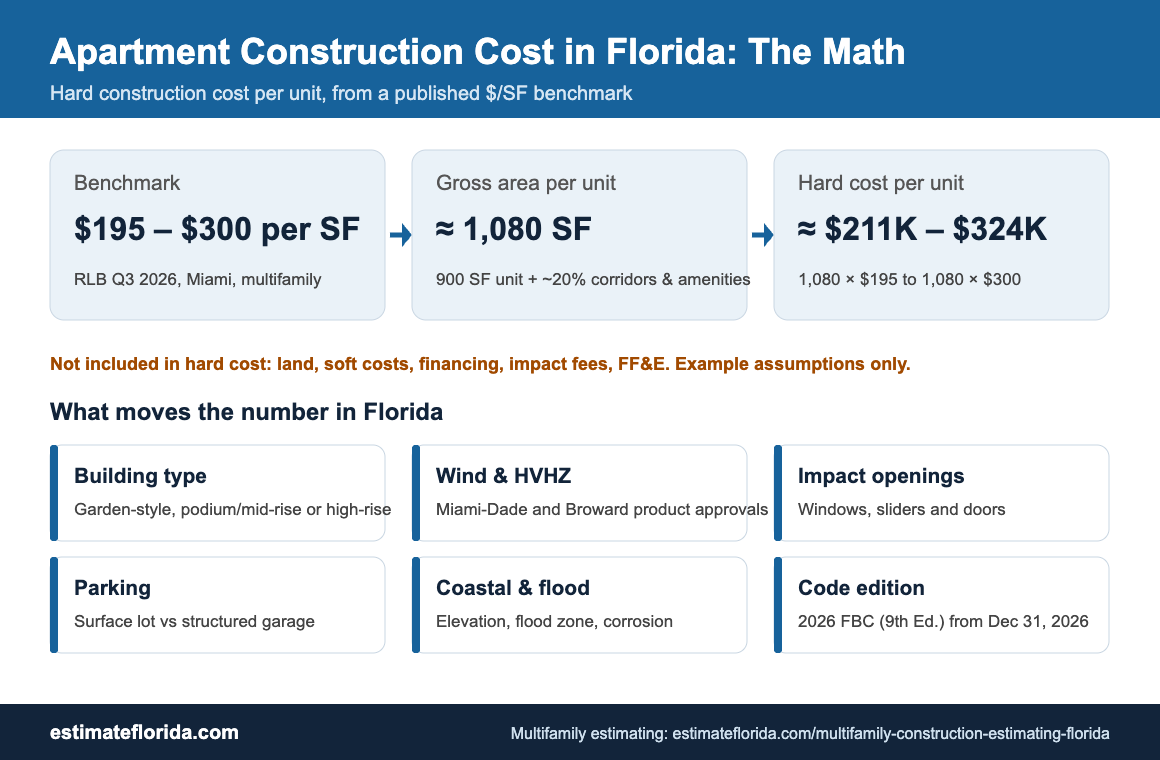
| Multifamily | $195 | $300 |
| Hotel, 3-star | $335 | $440 |
| Hotel, 5-star | $485 | $645 |
| Hospital (general) | $520 | $735 |
| Parking, above ground | $130 | $205 |
Source: Rider Levett Bucknall, Q3 2026 North America Quarterly Construction Cost Report, Miami. RLB’s Miami cost index rose 4.55% from July 2025 to July 2026. See our full Florida commercial construction cost per square foot guide.
What a replacement cost estimate adds on top of construction cost
- Demolition and debris removal: after a loss, the damaged structure has to come out before rebuilding starts.
- Current code requirements: a rebuilt building must meet today’s Florida Building Code, not the code it was originally built under. That can mean stronger wind design, impact-rated openings, updated fire protection, accessibility and energy upgrades. Insurance often handles these under “ordinance or law” coverage, so it helps to see them separately.
- Soft costs: design and engineering fees, permits, impact fees and testing.
- Site conditions: foundations, flood elevation and site work specific to your property.
- Escalation: costs keep rising, so valuations should be refreshed regularly.
Florida rules that can raise replacement cost
Wind design and the High-Velocity Hurricane Zone
Miami-Dade and Broward are in the Florida Building Code’s High-Velocity Hurricane Zone, where products need HVHZ approvals and envelope requirements are stricter. Elsewhere, Florida’s wind provisions still drive roofing, openings and connections. An older building rebuilt today will usually cost more than its original construction suggests.
The 2026 Florida Building Code
Permit applications submitted on or after December 31, 2026 fall under the 9th Edition (2026) Florida Building Code, which includes new corrosion-resistance requirements for fasteners and connectors near saltwater, roofing changes and more. See our 2026 code cost impact guide.
The FEMA 50% rule in flood zones
Under the National Flood Insurance Program, a building in a Special Flood Hazard Area is “substantially damaged” when the cost to restore it to its pre-damage condition equals or exceeds 50% of the structure’s market value (not counting land). The same 50% test applies to “substantial improvements.” When the threshold is met, the building generally has to be brought into compliance with current floodplain rules, such as elevating it, or for non-residential buildings, floodproofing. The local building official or floodplain manager makes the determination, and some communities use a lower threshold or track improvements over several years.
FEMA notes that these determinations need a detailed cost estimate, prepared by a licensed contractor or professional estimator, priced at market rates for qualified labor and materials. We prepare those estimates.
Who uses replacement cost estimates
- Owners and property managers setting or reviewing insurance limits.
- Condominium and commercial associations reviewing coverage for buildings.
- Lenders and investors underwriting acquisitions and refinancing.
- Owners after a storm deciding whether to repair or rebuild, or documenting a substantial damage determination.
- Insurance agents and adjusters who need a construction-based number.
How we prepare a replacement cost estimate
- Send what you have: drawings if available, or the building’s size, age, construction type, number of stories, photos and a description of systems and finishes.
- We build the estimate by CSI division, priced to current Florida market rates, with code-driven items shown separately.
- You receive a line-item Excel workbook and a PDF summary with our assumptions, exclusions and the code edition priced.
Request a flat-fee quote or call 561-530-2845.
Related guides
- Florida commercial construction cost per square foot
- Commercial construction estimating services
- Multifamily construction estimating
- Warehouse construction estimating
- Steel building cost estimator · Metal building cost estimator
Frequently asked questions
Is replacement cost the same as an appraisal?
No. An appraisal estimates market value, which includes land and reflects demand and income. Replacement cost is the cost to rebuild the structure itself at current prices and code.
How often should a replacement cost estimate be updated?
Whenever the building changes significantly, when codes change, and regularly as construction costs rise. RLB’s Miami cost index rose 4.55% in the year to July 2026.
Does replacement cost include code upgrades?
A good estimate prices the building to current code and shows code-driven items separately, so you can see what ordinance or law coverage needs to handle.
What is the FEMA 50% rule?
For buildings in a Special Flood Hazard Area, if repair or improvement costs equal or exceed 50% of the structure’s market value, the building generally must be brought into compliance with current floodplain requirements. Local officials make the determination, and some communities use stricter thresholds.
Can you estimate without drawings?
Yes. We can work from the building’s size, construction type, photos and a site visit report, and list our assumptions clearly. Drawings make the estimate more precise.