The ability to produce accurate, timely, and competitive bids is the lifeblood of any construction business. Whether you are a custom home builder in Naples or a commercial subcontractor in Orlando, your “bid-hit” ratio and profit margins depend entirely on the precision of your preconstruction process. However, as project volumes fluctuate and the complexity of the Florida Building Code increases, many companies face a critical strategic dilemma: should they hire a full-time, in-house estimator or partner with an outsourced estimating service?
The choice between an In-House Estimator vs. Outsourced Estimating Service is not merely a matter of cost; it is a decision that impacts your company’s scalability, operational overhead, and long-term growth. For some, the direct control of an internal employee is essential. For others, the flexibility and specialized expertise of an external team provide a much-needed competitive edge during busy bidding seasons. This comprehensive guide examines both models, comparing costs, accuracy, and efficiency to help you determine which approach aligns with your specific business goals.
What Is an In-House Construction Estimator?
An in-house construction estimator is a full-time or part-time employee dedicated to managing the preconstruction and bidding needs of a single construction firm. This individual is integrated into the daily company culture and workflow, often working alongside project managers, superintendents, and the executive team.
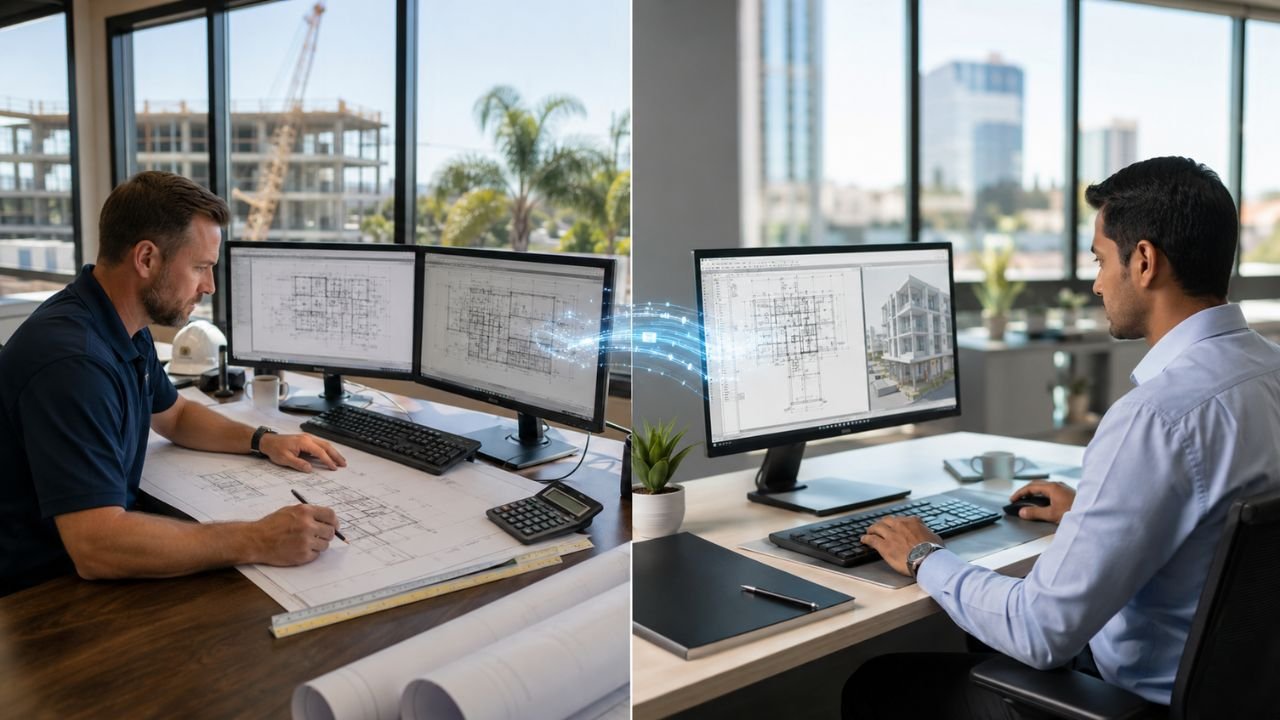
The role of an internal estimator goes beyond just numbers. Their daily responsibilities typically include:
- Comprehensive Plan Review: Deep-diving into architectural, structural, and MEP (mechanical, electrical, and plumbing) drawings to identify potential conflicts or missed details.
- Quantity Takeoffs: Manually or digitally measuring materials required for every phase of the project.
- Internal Pricing Management: Maintaining a database of the company’s specific labor rates, historical performance data, and preferred vendor pricing.
- Bid Preparation: Organizing all cost data into a formal proposal for the client.
- Post-Bid Support: Assisting project managers during the transition from estimating to construction, ensuring the “as-bid” scope is clearly understood by the field team.
In this model, the estimator becomes a repository of institutional knowledge, understanding exactly how the company builds and where past projects have succeeded or struggled.
What Is an Outsourced Estimating Service?
An outsourced estimating service is an external professional firm—like Estimate Florida—that provides on-demand quantity takeoffs and cost projections. These services act as an extension of a contractor’s existing team, offering specialized support without the long-term commitment of a permanent hire.
Outsourced firms typically operate by:
- Receiving Project Data: Contractors share digital plans (usually PDFs) and project specifications through secure portals.
- Performing Trade-Specific Takeoffs: Specialized estimators measure everything from cubic yards of concrete to linear feet of conduit, often using industry-leading software like PlanSwift or Bluebeam.
- Generating Reports: Delivering itemized material and labor estimates organized by CSI MasterFormat divisions.
- Providing Scalable Capacity: Handling “overflow” work when an internal team is buried or providing full-service estimating for smaller firms that do not need a full-time staff member.
The key distinction is that an outsourced service is project-centric. They provide high-level technical expertise when you need it, allowing you to bid on more work without increasing your permanent payroll.
In-House Estimator vs. Outsourced Estimating Service: At a Glance
| Factor | In-House Estimator | Outsourced Estimating Service |
|---|---|---|
| Employment Model | Internal W2 Employee | External B2B Service Provider |
| Fixed Payroll | Yes (Salary + Benefits) | No (Project-based or Retainer) |
| Workload Flexibility | Fixed capacity per person | Highly scalable per project |
| Institutional Knowledge | Very High | Developed over time |
| Recruitment Required | Yes (High cost/time) | No |
| Software/Tech Costs | Company pays | Included in service fee |
| Scalability | Slow (requires hiring/training) | Fast (immediate support) |
| Management Needs | Daily supervision | Performance/Deliverable management |
Cost of Hiring an In-House Estimator
When evaluating the cost of an internal estimator, many business owners make the mistake of looking only at the base salary. According to general data from the U.S. Bureau of Labor Statistics (BLS), construction estimators command professional-level wages reflecting the high risk and technical nature of their work. However, the Total Cost of Employment (TCOE) is significantly higher.
Essential cost factors for an in-house hire include:
- The “Burden” Rate: This includes payroll taxes, health insurance, 401(k) contributions, and workers’ compensation.
- Recruitment and Onboarding: Hiring a skilled estimator in a competitive market like Miami or Tampa often requires headhunter fees and significant time spent interviewing.
- Technology Overhead: You must provide high-end computers, large-format monitors, and expensive annual subscriptions to takeoff software (PlanSwift, etc.).
- Training and Retention: Continuous education on Florida Building Code updates and new software features is necessary to keep their skills sharp.
- Idle Capacity: Perhaps the most overlooked cost is “downtime.” If you have a slow month with fewer bid opportunities, you are still paying the full salary and benefits of your internal staff.
Cost of Outsourcing Construction Estimating
Outsourcing offers a more variable cost structure that aligns directly with your revenue-generating activities. Common pricing models include:
- Per-Project Fee: A flat rate based on the complexity and size of a specific set of plans.
- Hourly Rates: Used for consulting or complicated revisions.
- Trade-Specific Pricing: Paying only for what you need (e.g., just a drywall takeoff or just an MEP estimate).
- Monthly Retainer: Ideal for contractors who need consistent “overflow” support and want to lock in availability.
Pricing for outsourced services typically depends on the scope of work, the number of trades involved, and the urgency of the deadline. While you may pay a higher “per-hour” equivalent than an employee, you eliminate the costs of benefits, taxes, office space, and software.
Advantages of an In-House Estimator
Deep Knowledge of the Company
An internal estimator knows your “secret sauce.” They understand your specific field crews’ productivity rates and which vendors give you the best discounts. This familiarity allows for highly nuanced pricing that reflects your unique competitive advantages.
Direct Collaboration and Communication
When a project manager has a question about a bid, they can walk over to the estimator’s desk. This real-time feedback loop is invaluable for fast-tracking internal decisions and making last-minute adjustments before a bid deadline.
Consistent Internal Workflow
An in-house hire can take on secondary tasks, such as assisting with project scheduling, reviewing change orders on active jobs, or helping with purchasing once a project is awarded.
Disadvantages of an In-House Estimator
The primary disadvantage is rigidity. An internal team has a “ceiling” of capacity. If five major RFPs (Requests for Proposal) land on your desk in the same week, an in-house estimator simply cannot process them all accurately without working unsustainable hours, leading to errors or missed deadlines. Furthermore, the financial risk of a “bad hire” is significant; if an internal estimator makes a recurring measurement error, it can compromise multiple projects before being discovered.
Advantages of Outsourcing Construction Estimating
Unlimited Scalability
Outsourcing allows you to scale your bidding department up or down instantly. During a construction boom in Florida, you can bid on ten projects at once by leveraging an external firm, then scale back to zero cost during a slow period.
Access to Specialized Expertise
Professional estimating firms often employ specialists for different trades. If you are a general contractor bidding on a project with complex structural steel requirements that your team isn’t familiar with, you can outsource that specific portion of the estimate to a specialist.
Reduced Fixed Overhead
By moving estimating costs from “Fixed” to “Variable,” you protect your company’s cash flow. You only pay for estimating when you are actively pursuing new revenue.
Disadvantages of Outsourced Estimating
The most common challenge is the learning curve. An external provider needs to understand your specific requirements and how you prefer your reports formatted. Additionally, because they are not in your office, communication requires a more disciplined process of sharing RFIs (Requests for Information) and project updates. Quality control is also critical; you must have an internal process to review outsourced takeoffs to ensure they align with your final bid strategy.
In-House vs. Outsourced Estimating: Accuracy
A common misconception is that one model is inherently more accurate than the other. In reality, accuracy is a function of the process, not the location.
An in-house estimator might be more accurate regarding your company’s specific labor costs, while an outsourced service might be more accurate in their raw material measurements due to specialized digital takeoff tools and a lack of office distractions. Most professional estimating services achieve 98-99% takeoff accuracy by utilizing senior-level reviews and the latest cost databases (like RSMeans) calibrated for the Florida market.
In-House vs. Outsourced Estimating: Scalability
Workload fluctuations are the single biggest driver for outsourcing. In the Florida construction market, bidding opportunities often come in “waves.”
- The Problem: Hiring another full-time estimator to handle a temporary spike is expensive and leads to layoffs later.
- The Solution: Use an outsourced service as an “overflow valve.” Keep your core team focused on high-priority bids and outsource the standard quantity takeoffs to an external firm.
Which Option Is Better for Small Contractors?
For many small contractors or startups in Florida, hiring a full-time estimator is financially out of reach. The salary and burden alone could represent a massive chunk of their annual overhead. For these businesses, outsourcing is often the most logical path. It allows them to present professional, itemized bids that compete with larger firms without the crushing cost of a permanent preconstruction department.
Which Option Is Better for Large Construction Companies?
Large firms typically benefit from a Hybrid Model. While they maintain a robust internal preconstruction department for strategy and relationship-building, they use outsourced services to:
- Verify internal takeoffs on high-risk projects.
- Handle specialized trades (e.g., HVAC or Electrical) during a capacity crunch.
- Process high-volume, repetitive estimates (like multi-family units) while internal staff focuses on complex custom builds.
Hybrid Estimating: The Best of Both Worlds
The most successful Florida contractors rarely choose just one. Instead, they use a hybrid approach.
- Internal Team: Focuses on client relationships, site visits, final pricing strategy, and project handoffs.
- External Service: Handles the “heavy lifting” of digital quantity takeoffs and data entry.
This model ensures that your expensive in-house talent isn’t spending hours counting light fixtures or measuring drywall, but is instead focused on winning the job and managing the budget.
When Should a Contractor Outsource?
Consider partnering with an external service if you recognize these signs:
- Missed Deadlines: You are turning down bid opportunities because you don’t have time to “do the math.”
- Estimator Burnout: Your internal team is working nights and weekends to keep up with takeoffs.
- Expansion: You are moving into a new market (e.g., a Miami residential builder moving into commercial work in West Palm Beach) and need expertise in that new sector.
- Cost Control: Your overhead is too high, and you need to convert fixed salaries into project-based expenses.
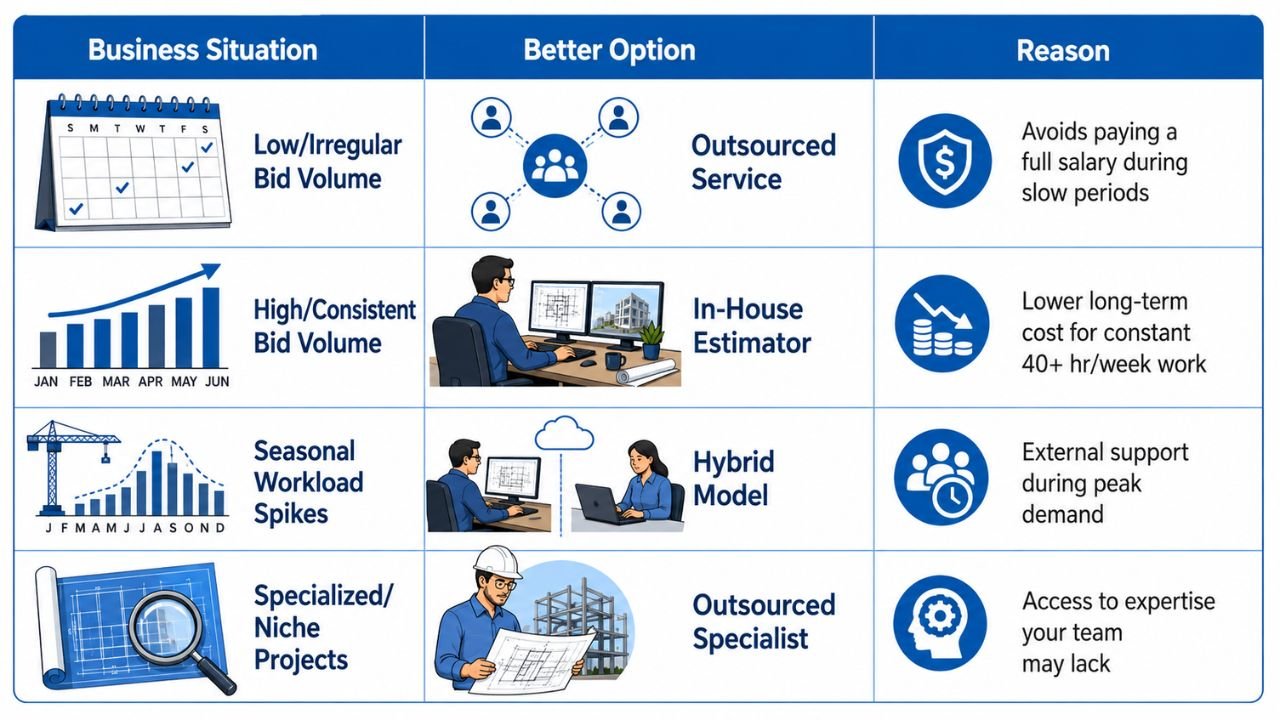
How to Decide: A Decision Framework
| If your business situation is… | The potentially better option is… | Reason |
|---|---|---|
| Low/Irregular Bid Volume | Outsourced Service | Avoids paying a full salary during slow periods. |
| High/Consistent Bid Volume | In-House Estimator | Lower long-term cost for constant 40+ hr/week work. |
| Seasonal Workload Spikes | Hybrid Model | Use external support for the peaks. |
| Specialized/Niche Projects | Outsourced Specialist | Access to expertise your team may lack. |
Questions to Ask Before Choosing an Outsourcing Partner
If you decide to outsource, vet your provider carefully with these questions:
- What software do you use? (Look for industry standards like PlanSwift or Bluebeam).
- Do you understand the Florida Building Code? (Crucial for HVHZ and flood zone requirements).
- How do you handle revisions? (Construction plans change; you need a partner who can update takeoffs quickly).
- Can I see a sample report? (Ensure their format matches your needs—CSI divisions are standard).
- What is your typical turnaround? (Most professional services aim for 24-48 hours for standard takeoffs).
How Estimate Florida Can Support Your Business
At Estimate Florida, we provide professional construction estimating and quantity takeoff services designed to fit into your existing workflow. Whether you need a one-off material takeoff for a residential remodel or ongoing bid support for a large-scale commercial development, our team delivers accurate, data-driven reports tailored to the Florida market.
Our services include:
- Detailed Quantity Takeoffs: Precise measurements for all trades (Concrete, MEP, Finishes, etc.).
- Construction Cost Estimating: Accurate pricing based on current local labor and material rates.
- Trade-Specific Support: Specialized takeoffs for subcontractors.
- Preconstruction Consulting: Helping developers establish realistic budgets before ground-breaking.
By partnering with us, you gain the technical capacity of a full estimating department with the flexibility of a project-based service, allowing you to build with confidence across all 67 Florida counties.
Frequently Asked Questions
Is it cheaper to outsource construction estimating?
It is often cheaper in terms of fixed overhead. While a single project fee might seem high, it eliminates the 30-40% “burden” of taxes, benefits, and software subscriptions associated with a full-time employee.
What is the difference between an in-house and outsourced estimator?
An in-house estimator is your employee; they are in your office and handle strategy. An outsourced estimator is a service provider who performs technical takeoffs and cost projections on a contract basis.
Should a small contractor hire an estimator?
Rarely. Small contractors often don’t have the consistent bid volume to justify a $70k-$100k+ total employment cost. Outsourcing is usually more cost-effective.
Is an outsourced estimator as accurate as an in-house estimator?
Accuracy depends on the quality of the plans and the estimator’s experience. Professional firms use identical software and more rigorous quality-check processes than many internal departments.
Can contractors use both?
Yes, this is called the “Hybrid Model.” It is common for contractors to use internal staff for pricing strategy and external services for high-volume quantity takeoffs.
What does an outsourced service need from me?
Typically, a digital set of architectural and structural plans (PDF), project specifications, and a clear scope of work.
How fast is the turnaround?
Turnaround depends on complexity, but most residential or small commercial takeoffs are delivered within 1 to 2 business days.
Can outsourced estimators handle all trades?
Yes, full-service firms like Estimate Florida cover all CSI divisions, from earthwork to final finishes.
Does outsourcing help win more bids?
Yes, by providing professional, itemized reports that build trust with clients and lenders, and by allowing you to bid on more projects simultaneously.
Can Estimate Florida provide services outside of South Florida?
Yes, Estimate Florida provides estimating and takeoff services for projects across the entire state, including Orlando, Tampa, and Jacksonville.
Conclusion
Deciding between an In-House Estimator vs. Outsourced Estimating Service ultimately depends on your project volume and business structure. If you have a constant, high-volume bidding pipeline and require daily face-to-face collaboration, an internal hire may be your best long-term investment. However, if you need the flexibility to scale, access to specialized trade knowledge, or a way to reduce fixed overhead, outsourcing is a powerful tool for profitability.
If your construction company needs additional estimating capacity, detailed quantity takeoffs, or project-specific cost estimates, Estimate Florida provides the professional support you need to turn your blueprints into bid-ready documents.