Planning a new home build or a major renovation in Florida often begins with a single, pressing question: what is the actual residential construction cost per sq ft with material? In a market defined by volatile supply chains, specialized hurricane-rated requirements, and varying regional labor pools, arriving at a realistic number requires more than a simple online calculator.
While the “cost per square foot” metric is the industry’s most common shorthand for project feasibility, it can be deeply misleading if the underlying data—specifically the material and labor components—isn’t clearly defined. For homeowners, contractors, and developers across the Sunshine State, understanding the distinction between material-only costs and full turn-key construction costs is vital to preventing budget overruns.
This guide provides a comprehensive framework for navigating Florida’s residential construction costs. We will break down the essential material categories—from foundation concrete to high-velocity hurricane zone (HVHZ) windows—and explain how a detailed quantity takeoff transforms rough guesses into defensible construction budgets. Whether you are evaluating a custom build in Naples or a production-style development in Orlando, this authoritative resource establishes the clarity needed for preconstruction success.
What Does Residential Construction Cost Per Square Foot Mean?
At its most basic level, residential construction cost per square foot is a calculation intended to express the total price of building a home relative to its size. However, the accuracy of this figure depends entirely on how “cost” and “square footage” are defined.
- Gross Building Area (GBA): This typically includes the total area under the roof, including garages, porches, and lanais.
- Heated/Cooled Square Footage: Many contractors and real estate professionals calculate costs based only on the livable, climate-controlled interior space.
- Total Construction Cost: This should include the sum of all material costs, labor costs, equipment rentals, and contractor overhead/profit.
The standard formula is: Total Construction Cost ÷ Total Applicable Square Footage = Construction Cost Per Square Foot. For a truly useful estimate, this number must account for both “hard costs” (materials and labor) and the specific design complexities of the project.
Does Residential Construction Cost Per Sq Ft Include Materials?
It depends on who is providing the number. In the construction industry, you will encounter several different ways to quote a square-foot price:
- Material-Only Cost: This identifies only the price of the physical items required to build (e.g., lumber, concrete, fixtures). It does not include the craftsmen required to install them.
- Labor-Only Cost: This covers the wages and benefits for the trades but assumes the owner or a separate entity is purchasing all materials.
- Material + Labor (Hard Costs): This is the most common “construction cost” figure. It includes everything physically attached to the building and the work required to install it.
- Full Project Cost: This adds “soft costs” like architectural fees, engineering, permits, and land acquisition to the hard costs.
Before comparing bids or evaluating project feasibility, always confirm whether your residential construction cost per square foot with material also includes the labor and overhead components.
Residential Construction Cost Per Sq Ft With Materials in Florida
Florida’s construction market is unique due to its geography and climate. A residential project here is subject to the Florida Building Code, which requires specific structural reinforcements and wind-load ratings that are not necessary in many other states.
While costs fluctuate, recent market data indicates that Florida home construction costs vary significantly by region. For instance, high-end builds in Miami-Dade or Palm Beach counties often face higher costs due to High-Velocity Hurricane Zone (HVHZ) requirements and local labor demand. Conversely, projects in more rural North Florida counties may see lower labor rates but higher material transportation costs.
Actual project costs are influenced by home size, design complexity, and material grade. A 2,000-square-foot home with a simple rectangular footprint and standard finishes will always have a lower cost per square foot than a same-sized custom home with complex rooflines and premium finishes.
What Is Included in Residential Construction Cost Per Square Foot?
A comprehensive residential construction estimate includes several major phases, each with its own material and labor requirements:
- Site Preparation & Foundation: Excavation, soil treatment, and the concrete slab or crawlspace.
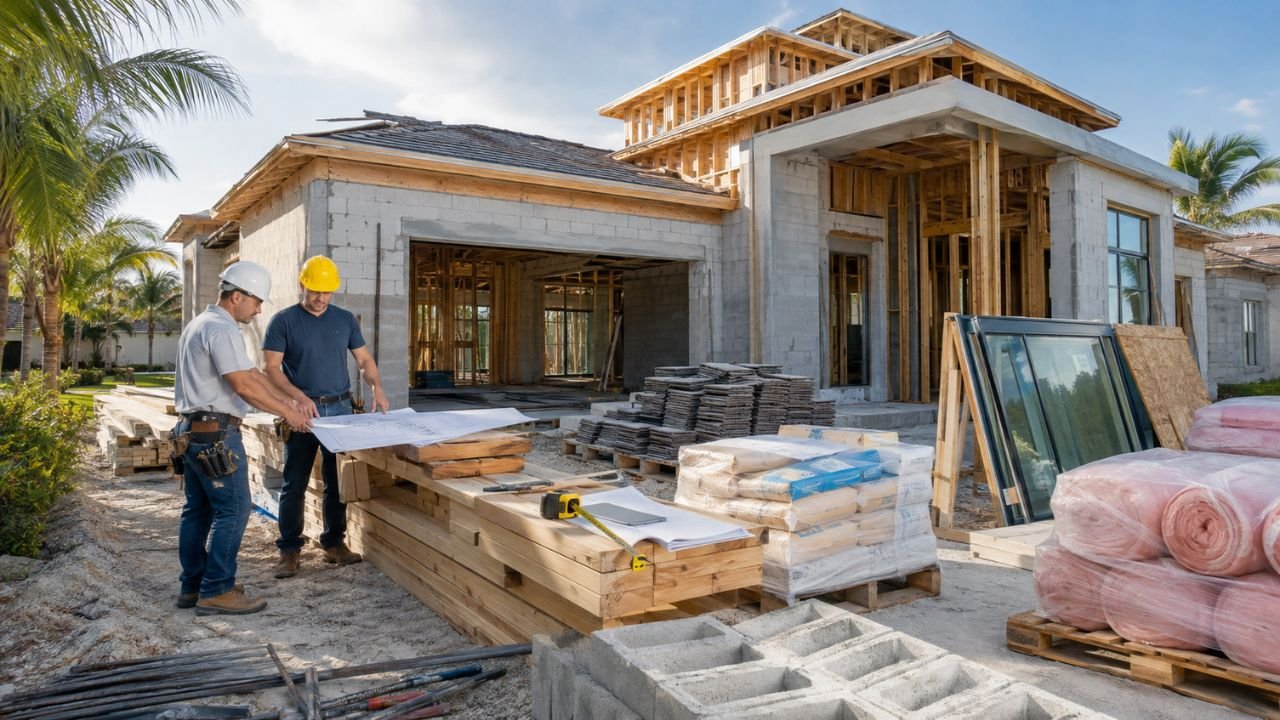
- Structural Shell: Framing (wood or masonry), trusses, and exterior sheathing.
- Exterior Envelope: Roofing, windows, exterior doors, and siding or stucco.
- MEP Systems: Mechanical (HVAC), Electrical, and Plumbing rough-ins and fixtures.
- Interior Finishes: Insulation, drywall, flooring, cabinetry, countertops, and painting.
It is important to note that site-specific costs—such as clearing a heavily wooded lot or installing a long utility line—are often excluded from standard “building-only” square-foot estimates.
Material Cost Per Square Foot for Residential Construction
Calculating the material-only portion of your budget is a critical step in cost control. This involves a material takeoff, which is the process of quantifying every physical item shown on the blueprints.
Material costs are driven by:
- Grade Selection: Choosing between builder-grade, mid-range, or luxury materials.
- Market Volatility: Prices for commodities like lumber and steel can shift weekly.
- Waste Factors: Accounting for cutting, breakage, and installation errors (typically 5–10%).
| Cost Type | Materials Included | Labor Included | Typical Use |
|---|---|---|---|
| Material-only estimate | Yes | No | Procurement & specialized budgeting |
| Labor-only estimate | No | Yes | Crew planning & subcontractor management |
| Material + labor | Yes | Yes | General construction budgeting |
| Full project estimate | Yes | Yes | Detailed project planning & financing |
Required Material Cost Breakdown
To understand the residential construction cost per sq ft with material, one must look at the specific components that drive the price.
Foundation and Concrete Materials
In Florida, most homes utilize a reinforced concrete slab-on-grade. This requires ready-mix concrete, steel rebar or wire mesh for reinforcement, vapor barriers, and formwork. Foundation costs can spike if soil conditions require additional footings or if the lot is in a flood zone requiring an elevated slab.
Framing Materials
Framing is often the most material-intensive phase. Whether using traditional wood studs or concrete masonry units (CMU), this includes structural lumber, engineered wood (LVLs), trusses, and specialized connectors required for Florida wind-load paths.
Roofing Materials
Roofing costs are more than just shingles or tile. The estimate must include underlayment, flashing, ridge vents, and hurricane-rated fasteners. Because roof area is often 1.5x larger than floor area due to pitches and overhangs, roofing materials have a significant impact on the $/sq ft calculation.
Exterior Wall Materials
Exterior finishes like stucco, fiber-cement siding, or brick veneer affect both material cost and future maintenance. In Florida, stucco over CMU is a standard choice, requiring lath, cement, sand, and weather-resistant barriers.
Windows and Doors
Due to Florida’s coastal climate, impact-resistant windows and doors are often required by code. These materials are significantly more expensive than standard glass but provide essential protection against hurricanes.
Insulation, Drywall, and Interior Finishes
Interior materials include thermal insulation (fiberglass or spray foam), drywall panels, joint compound, and texture. Finish levels—such as level 4 or level 5 drywall finishes—can notably increase labor and material costs per square foot.
Flooring, Cabinets, and Countertops
These categories represent the highest variability in a budget. Transitioning from standard carpet to high-end Italian marble or from laminate to quartz countertops can shift a project’s total cost by tens of thousands of dollars.
MEP (Plumbing, Electrical, HVAC)
Mechanical, Electrical, and Plumbing systems include all piping, wiring, electrical panels, and HVAC equipment. In Florida, high-efficiency AC systems sized for high humidity are a critical and costly material component.
How House Size Affects Cost Per Square Foot
It is a common misconception that smaller homes always have a lower cost per square foot. In reality, economies of scale often make larger homes cheaper per square foot even though their total price is higher.
This is because “fixed costs”—such as the HVAC system, kitchen appliances, electrical service, and mobilization—remain relatively similar regardless of whether the home is 1,800 or 2,400 square feet. In a smaller home, these high-cost items are divided by a smaller number of square feet, driving the $/sq ft figure up.
Why Two Homes With the Same Square Footage Can Cost Different Amounts
Design complexity is the primary driver of cost differences between projects of equal size. For example, consider two 2,500-square-foot homes:
- Home A: A simple ranch-style rectangle with a standard roof, 8-foot ceilings, and builder-grade finishes.
- Home B: A multi-level custom build with vaulted ceilings, a complex roof with multiple gables, impact-rated floor-to-ceiling windows, and premium finishes.
Home B will likely cost 40-60% more than Home A despite having the exact same square footage. Every corner added to a foundation and every valley added to a roof increases both material quantities and labor hours.
Florida Location and Residential Construction Cost Per Sq Ft
Geographic location within Florida influences every aspect of construction costs.
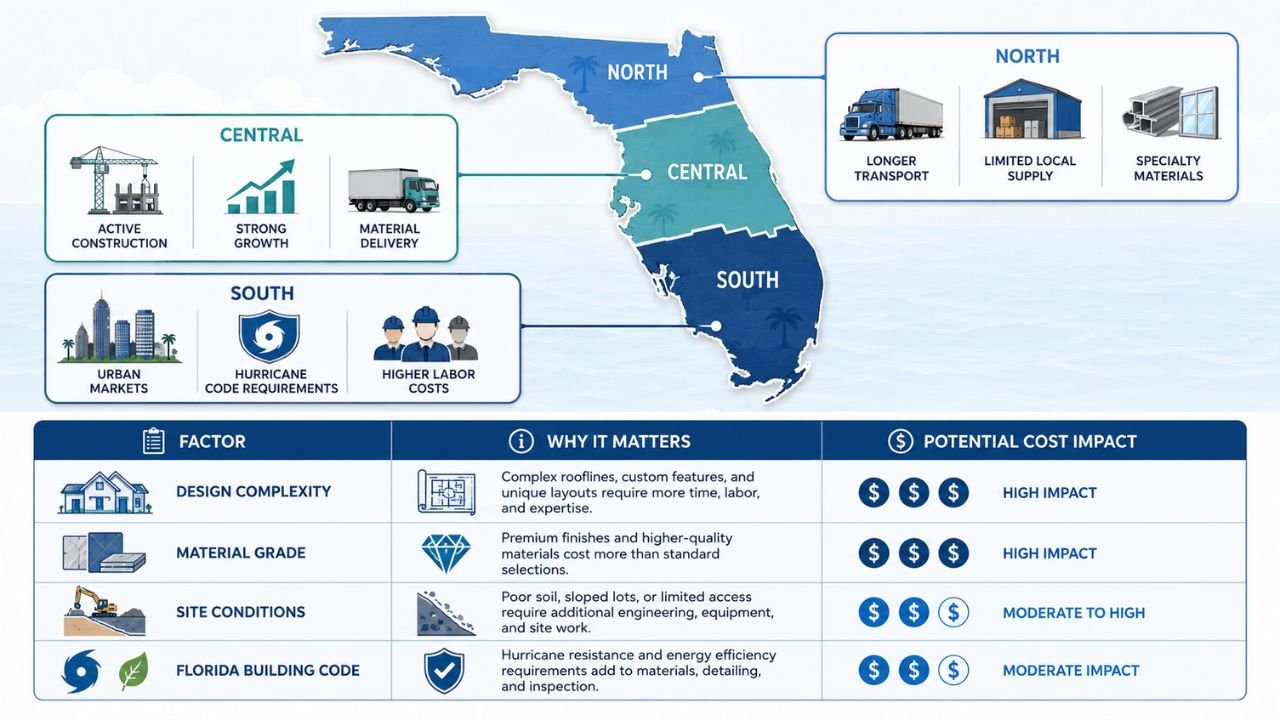
- South Florida (Miami, Fort Lauderdale, Naples): Higher labor rates and strict HVHZ building codes often result in higher costs.
- Central Florida (Orlando, Tampa): High demand and rapid growth can lead to material shortages and increased delivery fees.
- North Florida (Jacksonville, Tallahassee): While labor may be more available, specialized materials may need to be transported further.
| Factor | Why It Matters | Potential Cost Impact |
|---|---|---|
| Design Complexity | Corners, rooflines, and ceiling heights increase material waste. | High |
| Material Grade | Custom vs. standard fixtures and finishes. | High |
| Site Conditions | Steep grades or poor soil require more earthwork/concrete. | Moderate to High |
| Florida Building Code | Hurricane ratings (HVHZ) and energy efficiency. | Moderate |
Hard Costs vs. Soft Costs in Residential Construction
Understanding the difference between these two categories is essential for accurate budgeting.
Hard Costs
These are the tangible “bricks and mortar” costs. They include all building materials, labor for installation, and site-specific equipment like cranes or excavators.
Soft Costs
Soft costs are the intangible expenses required to get a project off the ground. These include architectural and engineering fees, financing costs, land surveys, and legal fees. While critical to the project, soft costs are often excluded from a basic residential construction cost per sq ft with material quote provided by a builder.
What Is NOT Always Included in Residential Construction Cost Per Sq Ft?
To avoid “sticker shock,” project owners should clarify what is excluded from a preliminary estimate. Common exclusions include:
- Land Acquisition: The price of the property itself.
- Site Utilities: Bringing water, sewer, and power from the street to the building pad.
- Landscaping & Hardscaping: Pools, lanais, driveways, and irrigation systems.
- Impact Fees: Municipal fees charged for new developments to support infrastructure.
- Furniture & Window Treatments: Items that are not permanently attached to the structure.
How Quantity Takeoffs Help Calculate Residential Construction Cost Per Sq Ft
A quantity takeoff is the most accurate way to verify a square-foot price. Rather than relying on historical averages, a professional estimator uses specialized software to measure every line and object on your blueprints.
- Measurement: Measuring every wall, slab, and roof plane.
- Quantification: Determining exact counts for studs, square footage of drywall, and linear feet of piping.
- Pricing: Applying current Florida-specific material and labor rates to those quantities.
By using a detailed takeoff, contractors can bid with confidence, and homeowners can verify that they are paying a fair market rate for the actual scope of work.
How to Calculate Residential Construction Cost Per Square Foot
If you are looking to arrive at a defensible number, follow this step-by-step methodology:
- Step 1: Determine Building Area: Decide if you are calculating based on livable space or total under-roof area.
- Step 2: Define Scope: Clarify exactly which finishes and systems are included.
- Step 3: Complete Quantity Takeoff: Get an itemized list of materials from your plans.
- Step 4: Determine Material Costs: Research current local pricing for those specific items.
- Step 5: Determine Labor Costs: Factor in current market wages for all trades.
- Step 6: Add Overhead & Profit: Don’t forget the contractor’s management fees.
- Step 7: Calculate: Divide the total of steps 3-6 by the area in step 1.
Residential Construction Cost Per Sq Ft With Material: How Estimate Florida Can Help
At Estimate Florida, we specialize in helping contractors, builders, and property owners navigate the complexities of construction budgeting. We provide professional construction estimating and quantity takeoff services for residential projects of all sizes—from single-family renovations to high-end custom estates.
Our team utilizes industry-standard software and current Florida-specific cost data to deliver accurate, bid-ready estimates within 24 to 48 hours for most projects. We provide the detailed material counts you need to order supplies accurately and the labor cost projections required to bid competitively in Florida’s busy construction market.
If you are planning a residential project in Florida and need an accurate understanding of your residential construction cost per sq ft with material, contact Estimate Florida today to get started with a professional quantity takeoff.
Frequently Asked Questions
What is the residential construction cost per square foot with materials?
The cost varies based on design, location, and finishes. In Florida, it typically includes hard costs like concrete, framing, and roofing, but actual figures depend on current market conditions and building code requirements.
Does cost per square foot include labor and materials?
Most “construction cost” quotes include both labor and materials (hard costs), but “material takeoff” quotes focus only on the physical items. Always confirm the scope of any estimate.
How much do building materials cost per square foot?
Material costs are typically 40-50% of the total construction budget, but this fluctuates based on the selection of high-end finishes like stone countertops or impact-rated windows.
Does the cost per square foot include land?
Generally, no. Most construction cost-per-square-foot metrics refer only to the cost of building the structure, excluding the price of land acquisition and soft costs.
Why do two homes with the same square footage have different costs?
Design complexity, ceiling heights, number of bathrooms, and finish quality (e.g., laminate vs. hardwood) create significant cost differences between identically sized homes.
How does Florida location affect construction costs?
Regional labor markets, proximity to suppliers, and local building codes (like HVHZ in South Florida) mean building in Miami or Naples is often more expensive than in North Florida.
Is remodeling cost per square foot different from new construction?
Yes. Remodeling often has a higher cost per square foot because it involves demolition, working within existing structures, and potential hidden conditions that are not present in new builds.
How does a material takeoff help estimate construction costs?
A material takeoff provides the exact quantities of materials required from the plans, allowing for precise pricing rather than relying on rough historical averages.
Can Estimate Florida provide residential quantity takeoff services?
Yes. Estimate Florida provides professional quantity takeoff and estimating services for residential, commercial, and industrial projects across all 67 Florida counties.