The average cost for exterior house painting in Florida ranges between $3,500 and $11,000 for a typical single-family home. On a unit-rate basis, complete exterior painting projects fall between $1.50 and $5.50 per paintable square foot of exterior wall surface. Actual project budgets vary substantially based on paintable surface area, building height, stucco condition, preparation severity, coating grade, and regional labor market dynamics across Florida.
Determining an accurate exterior painting budget in the Sunshine State requires looking beyond generic national averages. Florida’s sub-tropical climate—defined by extreme ultraviolet (UV) radiation, high relative humidity, frequent tropical storms, wind-driven rain, and aggressive coastal salt spray—places unique physical demands on building envelopes. Whether you are a homeowner establishing a long-term maintenance strategy, a general contractor compiling trade bids, or a developer planning multi-unit renovations, understanding how net paintable surface area, material volume, surface preparation, and detailed quantity takeoffs drive final contract pricing is essential for financial accuracy.
At Estimate Florida, we provide expert pre-construction cost modeling, material takeoff services, and independent construction estimating services to help builders, subcontractors, and property owners establish defensible budgets before work begins.
Exterior Painting Cost Factors in Florida
To help you evaluate baseline project requirements, the table below outlines typical planning ranges for core exterior painting scope components across Florida sub-markets.
| Exterior Painting Component | Typical Planning Cost Consideration | Key Variables & Cost Drivers |
|---|---|---|
| Exterior Wall Surface Painting | $1.20 – $4.25 / sq. ft. | Substrate porosity, stucco texture profile, finish coats applied. |
| Surface Preparation & Cleaning | $0.40 – $1.10 / sq. ft. | High-PSI pressure washing, biological sanitizing, scraping. |
| Stucco Repair & Joint Sealing | $300 – $1,200 total | Hairline crack elastomeric caulking, hydraulic cement patching. |
| Trim, Fascia, & Soffits | $1.50 – $4.50 / linear ft. | Architectural complexity, height penalties, hand-brush labor. |
| Doors & Garage Bay Doors | $120 – $350 per unit | Material substrate, detail complexity, spray vs. hand-roll finish. |
| Shutters & Architectural Accents | $40 – $110 per shutter | Hardware removal, substrate prep, multi-coat accent colors. |
| Scaffolding, Lifts, & Access | $350 – $1,500 total | Multi-story access penalties, steep slopes, narrow site lines. |
| Paint & Masonry Primers | $45 – $110 / gallon | Mildewcide content, 100% acrylic resins, elastomeric build. |
Note: The unit rates above represent regional market planning benchmarks. Every property requires a site-specific quantity takeoff and physical scope inspection to establish binding contract pricing.
How Much Does Exterior House Painting Cost Per Square Foot in Florida?
When professional cost estimators analyze an exterior painting project, unit pricing is calculated on the net paintable exterior surface area, not the interior living floor area listed in property tax records. Standard unit rates range from $1.50 to $5.50 per square foot depending on the preparation scope, surface texture, and coating specifications.
Understanding Floor Living Area vs. Paintable Exterior Area
A primary source of budget error in pre-construction planning is confusing horizontal floor space with vertical wall coverage:
- Floor Living Area: Measures horizontal interior space contained within wall perimeters.
- Paintable Exterior Surface Area: Measures vertical wall coverage, gables, overhangs, pop-outs, soffits, fascia, and architectural trim.
For example:
- Single-Story 2,000 Sq. Ft. Home: A single-story rectangular layout (40 ft. x 50 ft.) with 9-foot ceilings contains roughly 1,620 sq. ft. of gross exterior wall area. Deducting 200 sq. ft. for doors and windows leaves a net paintable wall surface of 1,420 sq. ft.
- Two-Story 2,000 Sq. Ft. Home: A two-story structure with the same 2,000 sq. ft. living area (1,000 sq. ft. per floor, measuring 30 ft. x 33.3 ft.) and a 19-foot overall wall height contains roughly 2,405 sq. ft. of gross wall area. Deducting openings yields a net paintable wall area of approximately 2,150 sq. ft.—plus high gables and eaves.
Despite both properties possessing identical interior living footprints, the two-story home contains over 50% more vertical exterior surface area and requires elevated access equipment, substantially increasing labor costs.
Average Exterior House Painting Cost by Home Size
Exterior painting costs scale primarily with total vertical surface area, architectural geometry, height access, and preparation severity. Below is a benchmark guide translating interior home sizes into vertical paintable wall ranges and estimated planning costs across Florida.
| Home Living Area | Estimated Paintable Wall Surface | Baseline Project Cost Range | Premium / Multi-Story Range |
|---|---|---|---|
| 1,000 sq. ft. | 1,100 – 1,400 sq. ft. | $1,800 – $3,200 | $2,800 – $5,200 |
| 1,500 sq. ft. | 1,400 – 1,900 sq. ft. | $2,400 – $4,200 | $3,800 – $7,200 |
| 2,000 sq. ft. | 1,800 – 2,500 sq. ft. | $3,200 – $5,500 | $5,500 – $11,000 |
| 2,500 sq. ft. | 2,200 – 3,200 sq. ft. | $3,900 – $6,800 | $7,200 – $13,500 |
| 3,000+ sq. ft. | 2,800 – 4,500+ sq. ft. | $5,200 – $9,500 | $9,000 – $18,500+ |
Key Cost Drivers by Property Size
- 1,000 Sq. Ft. Homes: Typically single-story structures with straightforward perimeter geometry. Lower scaffolding requirements keep labor production fast.
- 1,500 Sq. Ft. Homes: Commonly feature attached two-car garages and moderate soffit detailing. Variations depend heavily on stucco porosity and window masking counts.
- 2,000 Sq. Ft. Homes: The threshold where story height creates major divergence. Single-story units remain cost-effective, while two-story models require ladder shifts, staging, and elastomeric joint sealing.
- 2,500 Sq. Ft. Homes: Frequently feature complex rooflines, multiple gable ends, accent bands, and multi-level soffit spans.
- 3,000+ Sq. Ft. Estate Homes: Involve multi-level access, intricate architectural trim (corbels, crown moldings), multiple color breaks, and specialized boom lift rentals.
15 Critical Factors Affecting Exterior Painting Costs in Florida
Professional cost estimators evaluate numerous operational variables to determine labor hours, material consumption, and equipment requirements:
- Total Paintable Surface Area: The foundation of all material gallon calculations and crew labor hour allocations.
- Number of Stories & Height Access: Ground-level application allows maximum labor productivity. Two- or three-story structures require extension ladders, scaffolding, or articulated boom lifts, reducing crew output by 15% to 35%.
- Exterior Siding Substrate: Heavily textured stucco or rough-sawn wood absorbs up to 40% more paint than smooth fiber cement panels or vinyl siding.
- Existing Surface Deterioration: Peeling, flaking, or heavily chalked paint demands mechanical scraping, wire brushing, and power sanding before priming.
- Stucco Crack Repair Severity: Concrete masonry unit (CMU) settlement cracks require elastomeric sealant injection, while structural fractures require hydraulic cement restoration.
- Mold, Mildew, & Algae Growth: High ambient humidity promotes organic growth that must be chemically sanitized (fungicidal/chlorine wash) prior to pressure cleaning.
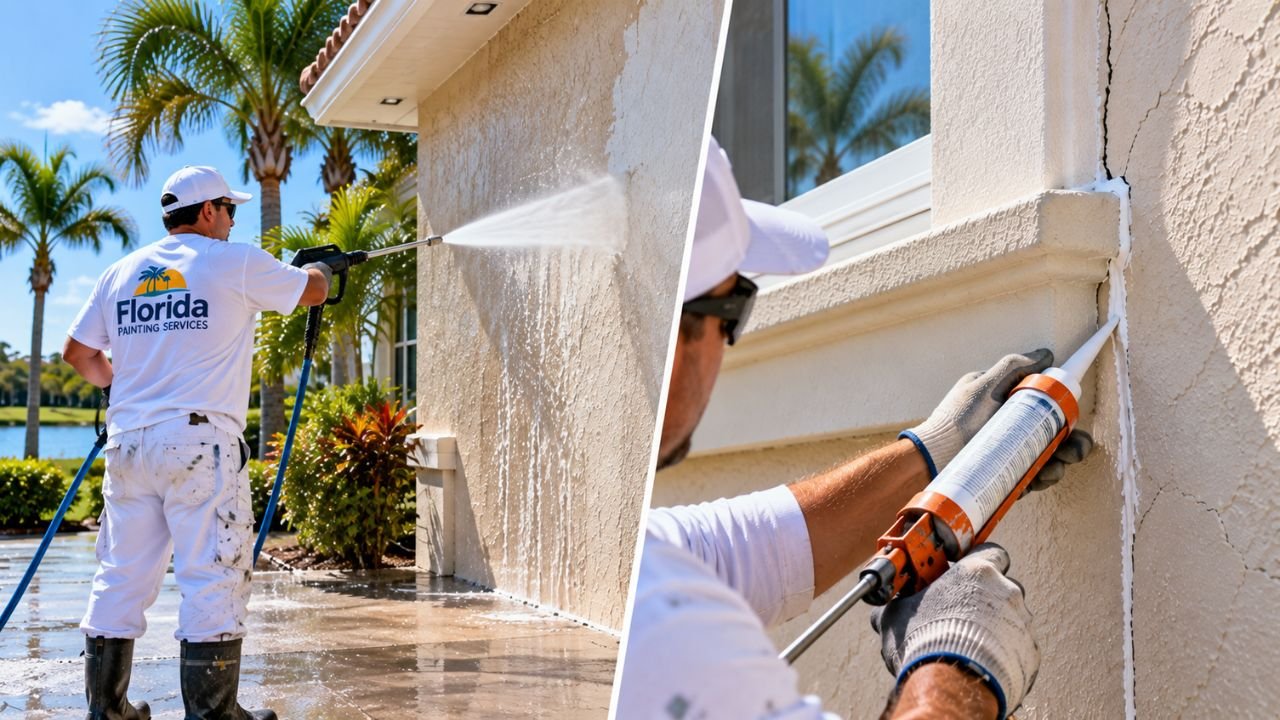
- Pressure Washing Scope: High-PSI surface cleaning is mandatory to remove surface chalk, airborne salt deposits, and dirt to ensure coating adhesion.
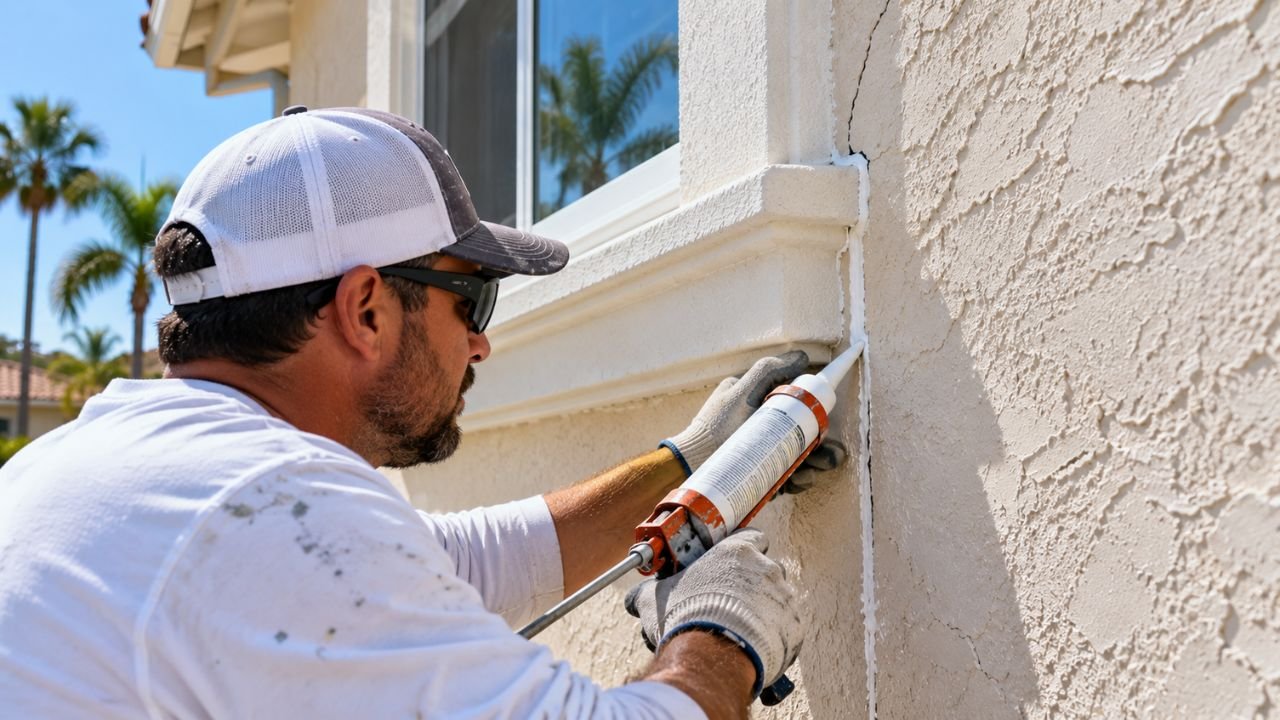
- Caulking & Perimeter Sealing: Recaulking window surrounds, door frames, expansion joints, and soffit transitions protects the building envelope against water penetration.
- Priming Requirements: Bare masonry, fresh stucco patches, weathered wood, or drastic color transitions require dedicated alkali-resistant or stain-blocking primer coats.
- Number of Finish Coats: Florida performance standards generally require one full primer coat followed by two finish topcoats for maximum film thickness and UV resistance.
- Paint Quality & Formulation: Premium 100% acrylic latex or cross-linking elastomeric coatings increase upfront material costs but extend coating lifespans to 8–12 years.
- Trim & Architectural Detail: Intricate soffits, fascia, corbels, dentil molding, and window surrounds demand painstaking hand-brush labor.
- Doors, Shutters, & Accent Items: Specialty accent colors, door enamels, or shutter removal/reinstallation add setup and masking steps.
- Site Accessibility & Protection: Dense tropical foliage, swimming pools, patio enclosures, and narrow lot lines require protective masking and slow equipment placement.
- Local Labor Market Rates: Prevailing wage burdens and contractor overhead in major metropolitan centers elevate contract pricing compared to rural interior markets.
Florida-Specific Climate Considerations for Exterior Painting
Painting an exterior envelope in Florida differs fundamentally from painting in northern climates. Florida’s environmental stressors directly govern coating specifications, surface preparation, and labor scheduling:
1. Intense UV Radiation & Chalking
Florida experiences severe solar irradiance year-round. Ultraviolet rays break down synthetic paint binders, causing topcoats to degrade into a chalky powder residue. Formulations must utilize 100% acrylic resins and UV-stable pigments. While these high-grade coatings carry higher material price points, they prevent early color fading and film breakdown.
2. High Humidity & Curing Windows
Elevated relative humidity retards water evaporation during paint curing cycles. During the summer rainy season (June through October), afternoon thunderstorms leave narrow application windows. Crews must stop spraying early in the day to allow film formation before rain hits, reducing daily production rates.
3. Wind-Driven Rain & High-Velocity Hurricane Zones (HVHZ)
In coastal jurisdictions governed by strict High-Velocity Hurricane Zone (HVHZ) building codes, as referenced by the Florida Building Code Official Portal, waterproofing integrity is mandatory. High-build elastomeric coatings are often specified to bridge dynamic masonry cracks and withstand wind-driven rain during tropical weather events.
4. Coastal Salt Air Exposure
Structures located near saltwater bodies absorb airborne chloride salts continuously. Salt draws atmospheric moisture and accelerates corrosion on exposed metal flashings, soffits, and structural fasteners. Coastal repaints mandate salt-neutralizing chemical washes, wire brushing, and rust-inhibiting metal primers prior to topcoating.
Coastal vs. Inland Florida Exterior Painting Costs
Geographic positioning across Florida influences coating selection, maintenance intervals, and prep labor.
| Operational Variable | Coastal Florida Properties | Inland Florida Properties |
|---|---|---|
| Primary Environmental Stressors | Airborne salt spray, wind-driven rain, severe tropical storms. | Surface heat, intense UV degradation, high humidity. |
| Surface Prep Focus | Salt-neutralizing chemical washes, rust-inhibiting primers. | Mildew removal, heavy chalk scraping, stucco crack filling. |
| Coating Specifications | High-build elastomeric coatings, alkali-resistant sealers. | Premium 100% acrylic latex, high-pigment UV blockers. |
| Typical Repaint Cycle | Every 4 to 6 years due to coastal weathering. | Every 6 to 8 years depending on sun exposure. |
Note: Coastal exposure increases material performance requirements, but inland properties with extensive sun degradation or poor initial prep can incur equal labor expenses.
Substrate Comparison: Stucco vs. Siding vs. Brick vs. Concrete
The exterior substrate profile dictates paint absorption rates, labor application methods, primer chemistry, and overall project costs:
| Exterior Substrate | Cost Range per Sq. Ft. | Surface Prep & Application Requirements |
|---|---|---|
| Exterior Stucco | $2.50 – $5.00 / sq. ft. | Highly porous and textured (knockdown/dash). Requires alkali-resistant masonry primer, high paint gallon volumes, and back-rolling to fill pinholes. |
| Wood Siding & Fascia | $3.50 – $6.50+ / sq. ft. | Prone to rot, tannin bleeding, and moisture expansion. Requires extensive scraping, sanding, wood patching, and stain-blocking oil/synthetic primers. |
| Vinyl Siding | $2.25 – $3.75 / sq. ft. | Non-porous profile with minimal absorption. Lower prep labor; requires thorough degreasing and vinyl-safe paint colors to avoid solar warping. |
| Fiber Cement (James Hardie) | $2.50 – $4.25 / sq. ft. | Highly stable and durable material. Requires light cleaning, sound caulking along joint transitions, and standard exterior acrylic topcoats. |
| Concrete Block (CMU) | $2.25 – $4.00 / sq. ft. | Highly porous substrate with open mortar joints. Demands heavy masonry block filler applied at low coverage rates (75–125 sq. ft./gal). |
| Exterior Brick | $3.00 – $5.50 / sq. ft. | Requires efflorescence removal (salt deposits) and specialized breathable, vapor-permeable masonry coatings. |
How Much of Exterior Painting Cost Is Labor?
In the Florida painting market, labor represents the largest cost component.TYPICAL EXTERIOR PAINTING COST ALLOCATION IN FLORIDA
├── Labor & Surface Preparation: 60% – 75%
├── Materials, Coatings & Primers: 15% – 25%
└── Equipment Rentals, Consumables & Overhead: 10% – 15%
Labor Dynamics
Labor accounts for 60% to 75% of the total contract value. Skilled painting labor rates in Florida metropolitan markets range from $40 to $75 per hour per worker. Labor charges reflect setup time, safety setup, masking, scraping, sanding, caulking, spraying, back-rolling, and site cleanup.
Material Dynamics
Materials account for 15% to 25% of the project total. This includes masonry sealers, topcoat paints, elastomeric caulks, patching compounds, masking film, tape, and drop cloths. Material price tiers include:
- Contractor Grade Paint: $30 – $45 / gallon (3–5 year lifespan).
- Mid-Range 100% Acrylic: $50 – $70 / gallon (6–8 year lifespan).
- Premium / Elastomeric Coating: $75 – $110+ / gallon (8–12+ year lifespan).
How Much Does Surface Preparation Add to Exterior Painting Costs?
Surface preparation is the single most critical factor determining coating longevity. Skipping proper prep in Florida’s climate frequently leads to paint blistering, peeling, and adhesion failure within 12 to 24 months.
Common surface preparation cost additions include:
- High-PSI Pressure Washing: $0.15 – $0.35 per sq. ft. Strips oxidation, chalk, and dirt.
- Chemical Mildew Treatment: $200 – $500 lump sum. Sanitizes fungal spores on shaded wall spans.
- Mechanical Scraping & Sanding: Adds $0.50 – $1.50 per sq. ft. to labor costs on failing or peeling surfaces.
- Stucco Crack Repair: $150 – $800+ total. Involves routing out settlement cracks and sealing with elastomeric caulking.
- Perimeter Caulking: $1.50 – $3.50 per linear foot around door frames, windows, and joints.
- Rotted Wood Replacement: $15 – $35 per linear foot to replace damaged fascia or soffits prior to painting.
How Coat Count and Color Changes Impact Painting Pricing
Application specifications directly alter material consumption and labor hours:
- One-Coat Maintenance Refresh: Only suitable when reapplying the exact same color over a clean, sound surface. Saves material and labor but provides limited film thickness.
- Two Finish Coats (Standard): The professional baseline for Florida exteriors. Provides complete coverage, uniform sheen, and adequate dry film thickness to resist UV degradation.
- Full Primer + Two Topcoats: Mandatory for bare stucco, repaired wood, weathered masonry, or drastic color shifts (e.g., changing from a dark shade to a light neutral). Increases project cost by 25% to 40% due to the additional application cycle.
One-Story vs. Two-Story Exterior Painting Costs
Building height impacts painter safety, equipment setup time, and overall labor productivity:ONE-STORY HOMES
├── Fast ground-level mobility
├── Short ladder setups
└── Standard labor productivity (100% baseline)
TWO-STORY HOMES
├── Tall extension ladder moves
├── Scaffolding / Articulated boom lift rentals ($350–$1,500)
├── Complex masking around rooflines
└── Reduced labor productivity (15%–35% labor penalty)
A two-story home almost always costs 15% to 30% more per paintable square foot than a single-story home with equivalent wall surface area due to the added risk, equipment setup, and slower application pace.
How Professional Painters Calculate Exterior Painting Costs
To eliminate guesswork and ensure profit margins, professional painting contractors use a structured 6-step pre-construction methodology:THE 6-STEP PRE-CONSTRUCTION ESTIMATING WORKFLOW
- Scope & Plan Review ──> 2. Digital Surface Takeoff ──> 3. Prep Analysis
│
- Proposal Finalization <── 5. Labor & Overhead <── 4. Material Takeoff
- Scope & Specification Review: Review architectural drawings, finish schedules, and site constraints to identify coating specs and required coat counts.
- Digital Surface Area Takeoff: Measure gross wall areas using takeoff software (such as Bluebeam or PlanSwift). Deduct window and door openings, then isolate linear footages for soffits, fascia, and trim.
- Surface Preparation Analysis: Evaluate pressure washing requirements, stucco repair needs, caulking linear footages, and property protection steps.
- Material Consumption Takeoff: Apply substrate coverage rates to calculate gallon requirements:
- Labor Hour Calculations: Calculate crew labor hours based on historical production rates (sq. ft. per hour), adjusted for story height, prep severity, and application method (spray vs. back-roll).
- Estimate Assembly: Combine direct material costs, labor burdens, equipment rentals, company overhead, and profit margins into an itemized project estimate.
Why Quantity Takeoffs Matter for Exterior Painting Projects
A quantity takeoff is the foundational measurement of all physical materials and labor tasks required for a project. Relying on floor-area shortcuts creates major financial risks:
Financial Risks of Inaccurate Estimating
- Underestimating Quantities: Causes mid-project material shortages, unexpected extra labor hours, lower profit margins, and change-order friction with clients.
- Overestimating Quantities: Produces inflated, non-competitive bids that lose contracts to rival companies.
A precise painting quantity takeoff provides exact wall square footages, trim linear footages, opening deduction counts, and gallon counts—allowing contractors to order exact material volumes and schedule labor crews with total confidence.
Residential vs. Commercial Exterior Painting
While core application techniques are similar, residential repaints and commercial painting projects differ significantly in scope and operational logistics:
| Project Factor | Residential Exterior Painting | Commercial Exterior Painting |
|---|---|---|
| Typical Project Scope | Single-family homes, townhomes, duplexes. | Retail centers, office parks, HOAs, warehouses. |
| Surface Area Range | 1,200 to 5,000 sq. ft. of wall area. | 10,000 to 100,000+ sq. ft. of wall area. |
| Access Equipment | Step ladders, extension ladders, light staging. | Articulated boom lifts, scissor lifts, swing stages. |
| Application Speed | Detail-oriented; hand masking and trimming. | High-volume airless spraying, large open wall spans. |
| Scheduling Constraints | Standard daytime working hours. | Off-hours, night shifts, or phased weekend scheduling. |
| Estimating Focus | Detail trim, site protection, color schemes. | Crew production rate modeling, safety compliance, bonds. |
Regional Florida Market & City Cost Considerations
Labor burdens, local operating expenses, and environmental exposure vary across regional Florida markets:
- Miami, Fort Lauderdale, & Boca Raton: Higher prevailing wage burdens, strict HOA guidelines, and coastal exposure drive requirements for elastomeric coatings ($2.20 – $3.80+ per sq. ft.). Learn more about construction estimating services in Miami.
- Naples, Fort Myers, & Sarasota: Strong demand for high-end residential finishes, complex custom color breaks, and detailed architectural trim detailing ($2.00 – $3.50 per sq. ft.).
- Orlando, Kissimmee, & Lakeland: High volume of suburban housing developments. Competitive labor markets maintain baseline pricing ($1.50 – $2.80 per sq. ft.). Explore construction estimating services in Orlando.
- Tampa, St. Petersburg, & Clearwater: A mix of historic wood structures and modern stucco homes. Coastal exposure on Tampa Bay elevates prep requirements ($1.65 – $3.00 per sq. ft.).
- Jacksonville, St. Augustine, & Pensacola: Broader winter temperature fluctuations impact prep drying times. Siding materials vary widely between historic wood, fiber cement, and stucco ($1.50 – $2.75 per sq. ft.).
Practical Strategies to Reduce Exterior Painting Costs
Property owners and contractors can optimize project costs without sacrificing surface preparation or material quality:
- Define a Clear Scope of Work: Ensure every bidding contractor provides a proposal based on the exact same surface prep steps, coat counts, and paint grades.
- Separate Material and Labor Items: Request itemized quotes showing labor hours, material gallon counts, and equipment rental line items separately.
- Address Minor Repairs Early: Repairing small stucco hairline cracks or replacing rotted fascia before moisture spreads prevents costly pre-painting restoration.
- Avoid Unnecessary Color Scheme Changes: Staying close to the existing color eliminates the need for full block-out primer coats, reducing material volume and labor hours.
- Schedule Around Weather Windows: Planning major painting projects outside the peak summer rain season minimizes weather delays and extended rental fees.
- Maintain Exterior Surfaces Regularly: Washing exterior walls annually removes dirt and salts, extending topcoat lifespans and lowering prep scope during repaint cycles.
How Estimate Florida Helps With Painting Estimates
Accurate cost modeling is critical for maintaining profit margins and preventing budget overruns. At Estimate Florida, we provide professional construction cost estimating and quantity takeoff services tailored to Florida’s unique market conditions.
Our Services Include:
- Detailed Quantity Takeoffs: We analyze architectural drawings, CAD files, or field dimensions to produce accurate line-item takeoffs for wall areas, trim, fascia, soffits, and openings.
- Material Takeoff Schedules: Precise gallon counts for primers, sealers, finish coats, caulking tubes, and consumables tailored to specific substrate profiles.
- Labor Production Rate Modeling: Production-rate modeling incorporating site-specific height penalties, prep severity, and regional Florida wage rates.
- Subcontractor Bid Auditing: We review incoming trade bids to verify that quantities, scope items, and labor hours align with actual project parameters.
Note: Estimate Florida provides independent cost estimating and quantity takeoff services; we do not operate as a licensed painting contractor and do not perform physical application work.
Frequently Asked Questions (FAQs)
What is the average cost for exterior house painting in Florida?
The average cost to paint a house exterior in Florida ranges between $3,500 and $11,000 for standard single-family homes. On a per-square-foot basis, expect to pay $1.50 to $5.50 per paintable square foot of wall surface area depending on prep needs, height, and coating quality.
How much does it cost to paint a 1,500-square-foot house exterior in Florida?
Painting a 1,500 sq. ft. home (living area) typically costs between $3,800 and $7,200. Pricing depends on story height, stucco condition, and fascia/soffit detailing.
How much does it cost to paint a 2,000-square-foot house exterior?
The cost to paint a 2,000 sq. ft. home exterior ranges from $5,500 to $11,000. A single-story home with minimal prep falls near the lower end, while a two-story home requiring stucco crack sealing lands near the higher end.
What is the exterior painting cost per square foot in Florida?
Exterior painting averages between $1.50 and $3.50 per sq. ft. for basic repaints with light cleaning. High-prep projects requiring elastomeric coatings or extensive stucco repair range from $4.50 to $6.50+ per paintable square foot.
How much does labor cost for exterior house painting in Florida?
Labor accounts for 60% to 75% of a total painting contract. Professional painter labor rates in Florida range from $40 to $75 per hour per worker, or roughly $1.00 to $3.00 per paintable square foot.
Does stucco cost more to paint than siding?
Yes, stucco generally costs 15% to 30% more to paint than smooth siding. Stucco’s porous texture absorbs more paint, requires alkali-resistant sealers, and often demands hand back-rolling to fill surface pinholes.
Does Florida’s climate affect exterior painting costs?
Yes. Intense UV exposure requires high-grade 100% acrylic paints, high humidity demands mildewcide additives, and coastal salt spray requires specialized surface prep and corrosion-inhibiting primers.
How much does it cost to paint a two-story house in Florida?
Painting a two-story home typically costs 15% to 30% more per square foot than a single-story home. Tall extension ladders, scaffolding, or articulated boom lift rentals ($350–$1,500) add setup time and lower labor productivity.
How much does surface preparation cost before exterior painting?
Surface preparation typically accounts for 20% to 40% of total labor costs. Pressure washing costs $0.15 to $0.35 per sq. ft., while caulking, scraping, and stucco repairs add $300 to $1,200+ depending on wall condition.
How many coats of exterior paint does a house need?
Florida standards generally dictate one full primer coat and two finish topcoats for bare, repaired, or weathered surfaces. Reapplying the same color over a sound existing coating may only require two finish topcoats.
What information is needed for an accurate painting estimate?
An accurate estimate requires net paintable wall surface area, wall heights, substrate material schedules, window/door opening deductions, surface prep requirements, and specified paint grade details.
Can Estimate Florida provide an exterior painting quantity takeoff?
Yes. Estimate Florida provides independent pre-construction quantity takeoffs and material schedules from architectural plans or field measurements to help contractors, builders, and property owners establish precise project budgets.