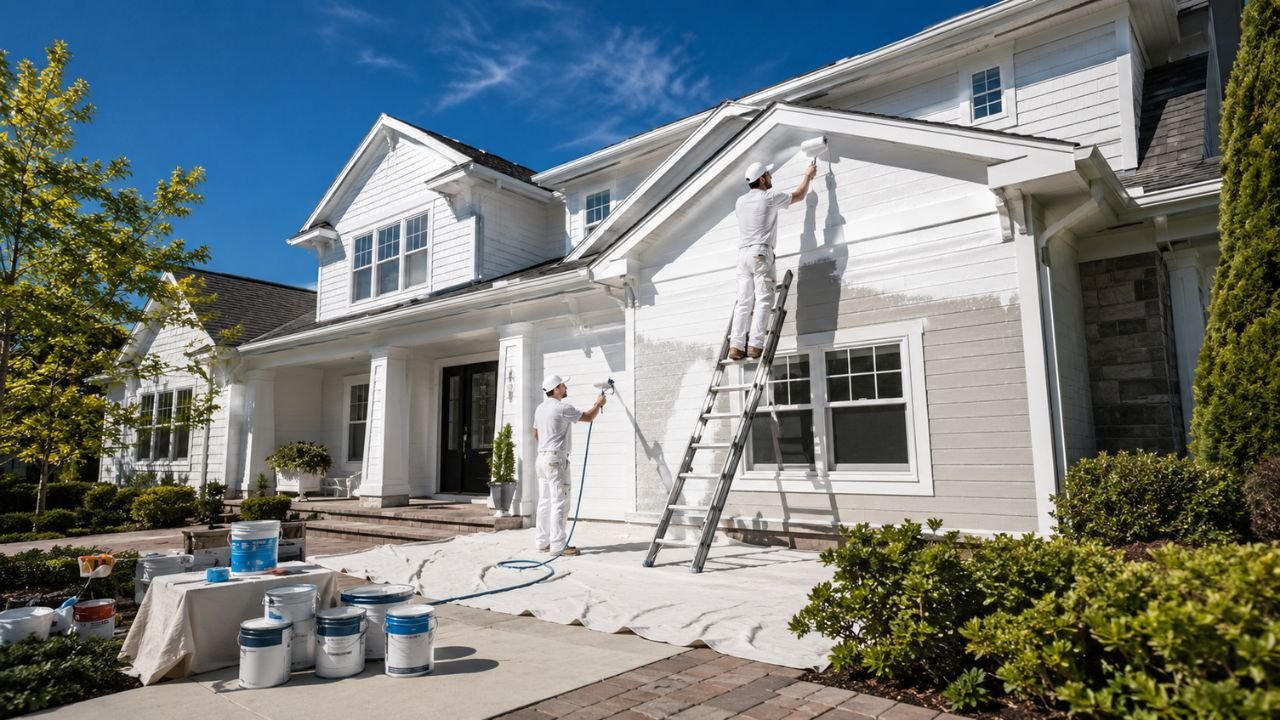
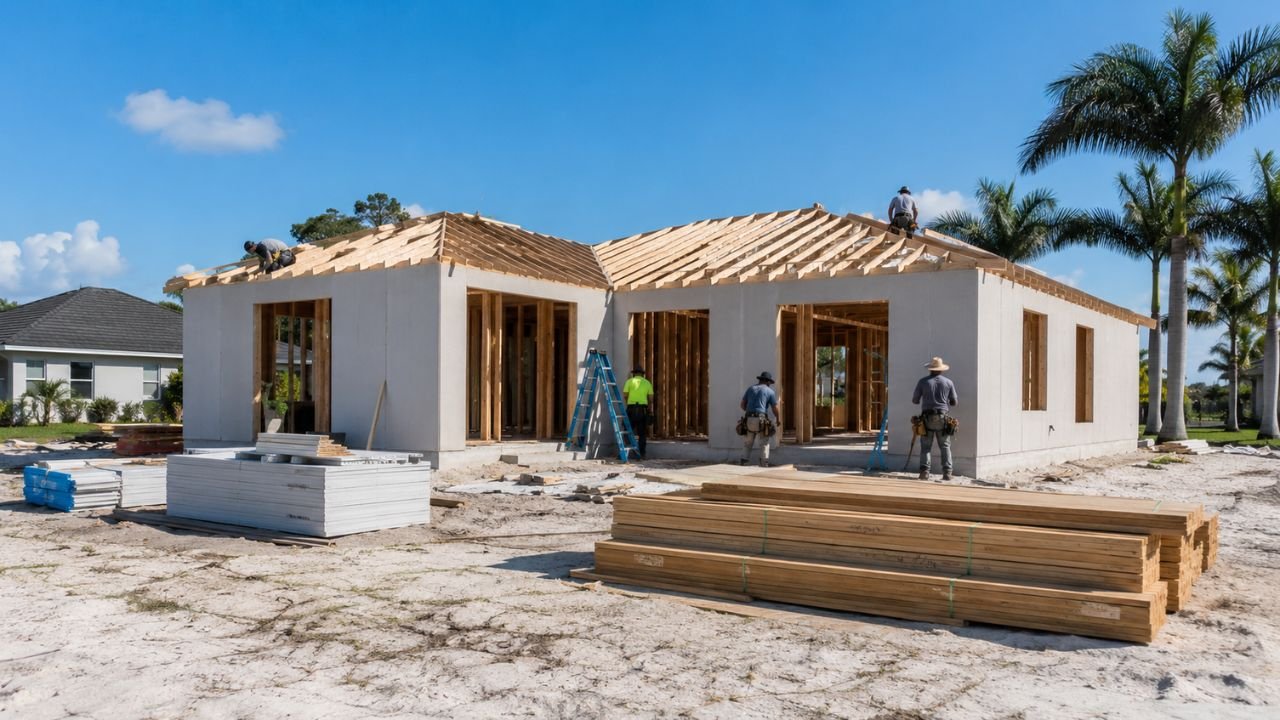
The cheapest way to build a house in Florida is to construct a simple, rectangular wood-frame home on a slab-on-grade [a shallow foundation where concrete is poured directly into a mold on the ground] in a North Florida county like Duval or Leon. For a basic finish level in 2026, expect to pay between $150 and $180 per square foot for construction. While wood frame is the least expensive structural method, homeowners must choose locations outside of High-Velocity Hurricane Zones (HVHZ) [Miami-Dade and Broward counties] to avoid mandatory, high-cost structural reinforcements.
However, the “cheapest” upfront build can be a financial trap if it ignores long-term insurance premiums. Opting for the minimum-spec roof and windows often results in higher annual wind-mitigation insurance costs, potentially erasing your construction savings within five to seven years. Achieving true affordability in Florida requires balancing initial material costs with the strict requirements of the Florida Building Code official portal.
Key Takeaways
- Location Matters: Impact fees [one-time charges for new developments to fund public infrastructure] vary from $5,000 to over $30,000 depending on the county.
- Shape Matters: A simple rectangular footprint with a hip roof [a roof where all sides slope downwards to the walls] is the most cost-effective and wind-resistant design.
- Method Matters: Wood framing is $18–$30/sq ft, while CBS [Concrete Block Structure] is $35–$55/sq ft, but CBS offers better insurance credits.
- The Owner-Builder Exemption: You can act as your own GC under Florida’s owner-builder exemption under Statute 489.103 if you meet strict occupancy and supervision rules.
The Baseline Cost of Building in Florida (2026)
The cost to build a house in Florida in 2026 has stabilized but remains 5% to 12% higher than previous years due to labor shortages and material inflation. For a standard 2,000 sq ft home, a mid-range build typically totals between $467,400 and $565,800 depending on the region.
Estimated Costs by Square Footage (Basic Finish)
- 1,200 sq ft: $180,000 – $216,000
- 1,500 sq ft: $225,000 – $270,000
- 2,000 sq ft: $300,000 – $360,000
These figures cover vertical construction but often exclude land purchase, site preparation, and municipal impact fees. Because market conditions fluctuate, relying on detailed construction cost estimates is safer than using broad per-square-foot averages that may not reflect your specific zip code’s labor rates.
Structural Choices: Wood Frame vs. Concrete Block (CBS)
In most of the United States, wood framing is the default. In Florida, the choice between wood and CBS [Concrete Block Structure] is a debate over upfront savings versus structural resilience. Wood framing is the cheapest structural method in Florida, costing roughly 40-50% less per square foot for the shell than concrete block.
However, wood-frame homes in Florida require extensive hurricane strapping and tie-downs to meet the Florida Building Code, Residential volume. CBS is the “Florida standard” because it naturally resists moisture, termites, and high winds, though it increases the shell cost to $35–$55 per square foot.
For those seeking the absolute lowest price, modular or prefab homes can sometimes offer savings of 10-15%, but only if the site is easily accessible for delivery and the local jurisdiction has straightforward permitting for off-site construction. The most cost-effective roof design is a simple hip roof with asphalt shingles, as this shape qualifies for the highest wind-mitigation insurance discounts.
The Geography of Construction Costs
Where you build in Florida is often more important than what you build. Regional labor rates and the presence of HVHZ [High-Velocity Hurricane Zone] mandates can swing a budget by 20% to 50%.
Florida County Cost Comparison Matrix (Standard 2,000 Sq Ft Build)
| County | Cost Per Sq Ft [VERIFY] | Impact Fees (Avg) | HVHZ Status | Primary Cost Driver |
|---|---|---|---|---|
| Miami-Dade | $450 – $550 | $25,000+ | Yes | HVHZ Code & Labor |
| Orange (Orlando) | $350 – $450 | $15,000 | No | High Demand |
| Duval (Jax) | $300 – $400 | $6,000 | No | Lower Labor Rates |
| Hillsborough | $350 – $450 | $10,000 | No | Flood Zone Costs |
| Collier (Naples) | $400 – $500 | $20,000 | No | Custom Specs |
| Leon (Tallahassee) | $280 – $380 | $5,000 | No | Logistics |
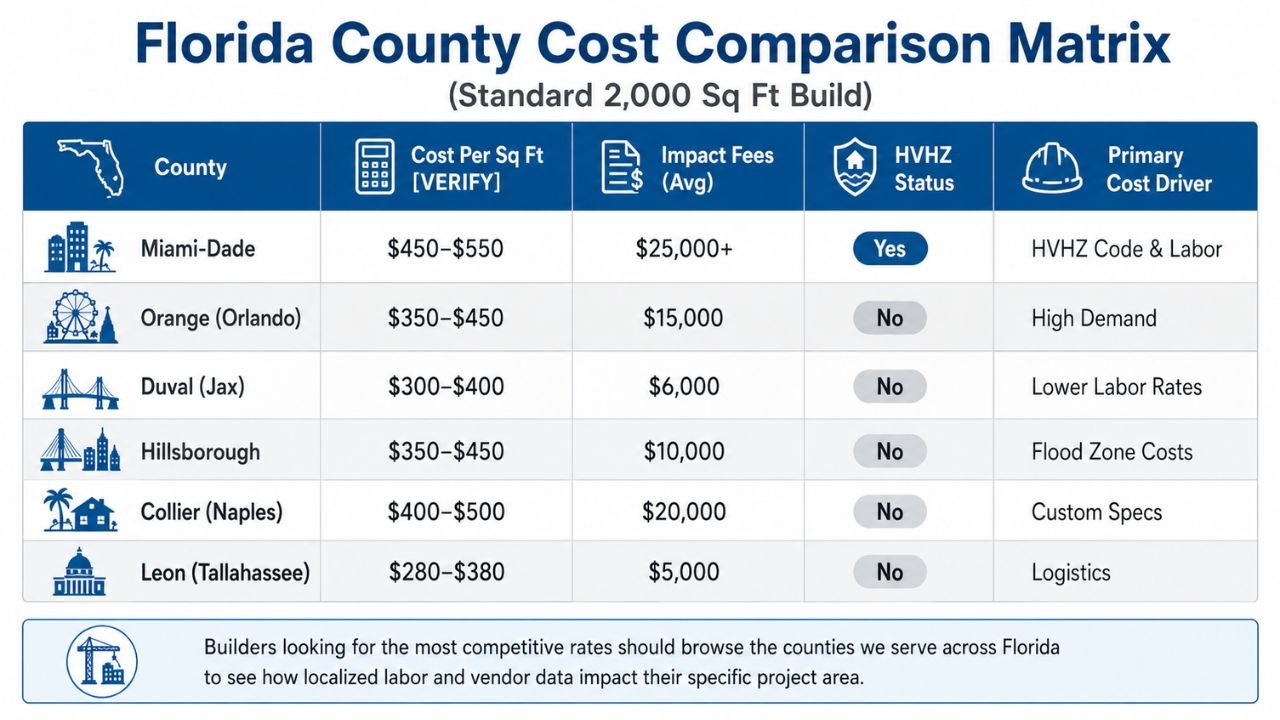
Builders looking for the most competitive rates should browse the counties we serve across Florida to see how localized labor and vendor data impact their specific project area.
Navigating Permits and the Owner-Builder Path
One of the most common ways Florida residents attempt to save money is by utilizing the owner-builder permit. According to Florida Statutes 489.103, an individual can act as their own general contractor if the property is for their own use and occupancy and is not offered for sale or lease within one year of completion.
Acting as your own GC can save you the 12% to 24% profit margin typically charged by a contractor, but it shifts all legal and financial responsibility to you. You must still hire licensed subcontractors for electrical, plumbing, and HVAC work. You should always verify a Florida contractor license before signing any trade contracts.
Florida Specific Cost Drivers & Hidden Expenses
First-time Florida homebuilders are often surprised by “soft costs” that national calculators ignore.
- Impact Fees: These fees, ranging from $10,000 to $30,000, are paid to the county to offset the burden of new residents on roads, schools, and parks.
- Impact Windows: In many zones, impact-resistant glass is mandatory. These units cost $800–$2,400 per window and can add $15,000 to $25,000 to a standard home build.
- High Water Table: Florida’s geology often requires the site to be “filled” with structural dirt to raise the slab-on-grade above the flood plain. Adding 12–24″ of fill can cost $7,000 to $15,000.
To manage these variables, most owner-builders find that residential construction estimating is their most important pre-construction step. A professional quantity takeoff ensures you don’t under-order materials or fail to account for the hurricane-resistant rebar and strapping required by the latest codes.
Honesty Note: The Price of “Cheap” in the Long Run
It is entirely possible to build to the bare minimum of the Florida Building Code to save money today. However, we must state plainly: choosing the cheapest roof, minimum-spec windows, and wood-frame construction will likely double your annual homeowners’ insurance premiums. Over a ten-year period, a “cheap” build often costs more than a structure built with CBS and high-efficiency MEP [Mechanical, Electrical, and Plumbing] systems. We recommend budgeting for a 10% contingency fund to cover the inevitable material price spikes and code-mandated upgrades that occur during the build.
Before you commit to a lot or a floor plan, you need a real budget based on local Florida data—not a rough guess.
Send us your plans today for a detailed, line-item estimate delivered in 24–48 hours.
FAQ: Building Cheap in Florida
Is it cheaper to build or buy a house in Florida?
Building is often more expensive upfront than buying an existing home, but a new build offers significant savings in insurance and maintenance. An existing home may require $30,000+ in immediate hurricane retrofitting or HVAC replacements that a new build already includes.
Can I save money with a tiny home or container home in Florida?
While material costs are lower, permitting container homes is notoriously difficult in Florida due to strict wind-load and insulation requirements. Unless you are in a very rural county with relaxed zoning, the “savings” are often lost in engineering and permitting delays.
What is the cheapest county to build in Florida?
Rural inland counties in North Florida and the Panhandle, such as Baker, Union, or Calhoun, generally have the lowest land costs, impact fees, and labor rates. However, you must factor in higher transport costs for materials.
Does a metal roof save money over shingles?
A metal roof costs $10–$18 per sq ft compared to $4–$7 for shingles. While metal is more expensive initially, its superior wind resistance and 40-year lifespan often make it the more economical choice for long-term Florida residents.
How much do permits cost for a new Florida home?
Permit fees vary by municipality but generally range from $5,000 to $15,000 for a single-family home. This is separate from impact fees, which can be significantly higher in high-growth areas like Tampa or Orlando.
Are wood-frame houses safe in Florida hurricanes?
Yes, provided they are built to current Florida Building Code standards with continuous load-path strapping (roof-to-wall-to-foundation). However, they remain more susceptible to flood damage and termites compared to CBS construction.