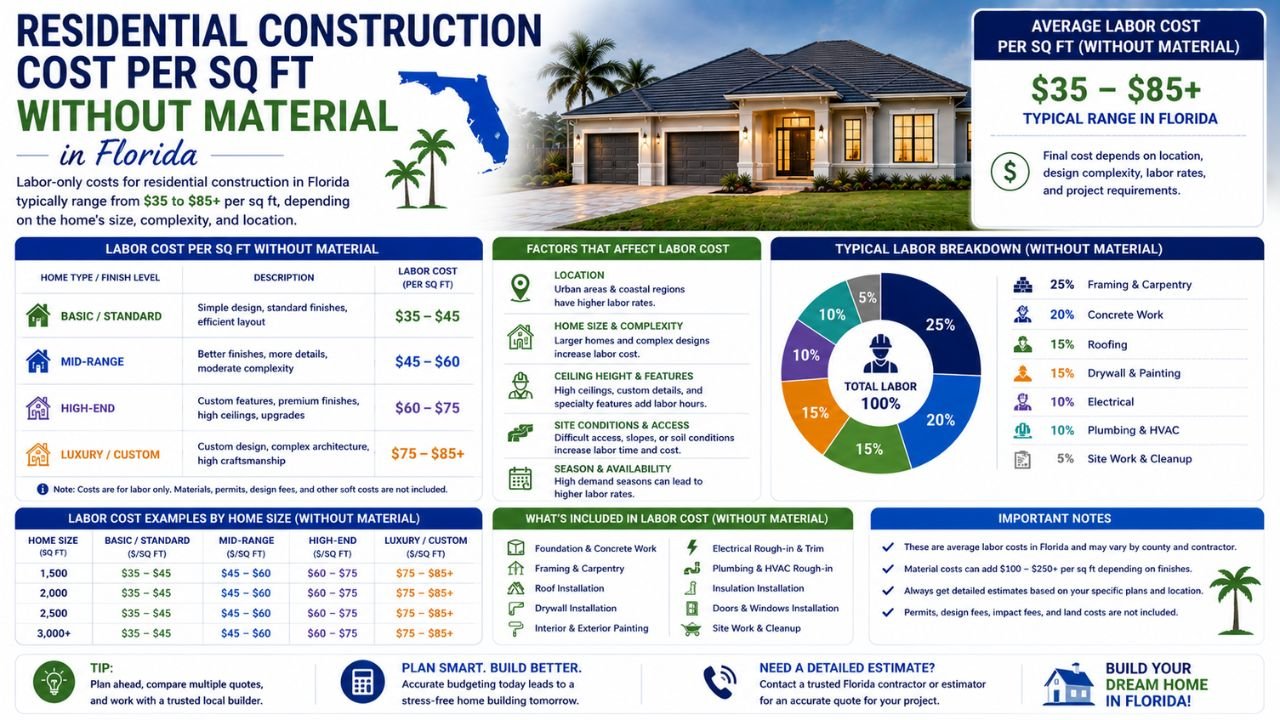
Understanding the residential construction cost per sq ft without material in Florida is a critical component for any property owner or developer aiming for budget transparency. In the construction industry, this is often referred to as “labor-only” pricing. Whether you are a homeowner managing your own build or a contractor comparing subcontractor bids, isolating labor costs helps you identify where every dollar is going without the price fluctuations of lumber, concrete, or steel clouding the data.
This guide explains what labor-only pricing entails, how much you should expect to pay across various Florida regions, and the specific factors—from hurricane codes to regional demand—that drive these rates.
What Does “Without Material” Mean?
In simple terms, “without material” pricing refers to the cost of human effort, expertise, and equipment usage required to install components of a home. When a contractor provides a labor-only quote, they are essentially saying: “You buy the wood, the shingles, and the pipes; I will provide the skilled tradespeople to put them together”.
This pricing model covers the manual labor, specialized tools (like saws, drills, and scaffolding), and the on-site supervision necessary to execute the plans. It removes the markup often applied to materials, allowing for a clearer comparison of different trades’ production rates and expertise.
What Labor-Only Pricing Includes
While every contract is unique, labor-only residential construction pricing typically covers the following:
- Site Labor: Grading, manual digging, and site cleanup.
- Framing Labor: Constructing the skeletal structure, including walls and roof trusses.
- Roofing Labor: The physical installation of underlayment, shingles, tiles, or metal panels.
- Drywall Labor: Hanging, taping, and finishing interior walls.
- Mechanical Trades: Rough-in and finish labor for electrical, plumbing, and HVAC systems.
- Finishes Labor: Installation of flooring, cabinetry, trim, and paint.
- Supervision: The cost of a foreman or lead to manage the crew’s daily activities.
What Is Usually Excluded
It is just as important to define what is not included to avoid massive budget gaps. Typically, the following fall outside of a labor-only estimate:
- Materials: All raw goods, fixtures, and appliances.
- Permits and Fees: Local government impact fees and building permit costs.
- Design Fees: Costs for architects and structural engineers.
- Land: The purchase price and closing costs of the lot.
- Utility Connections: Fees paid to utility companies for water, sewer, and power hookups.
- General Contractor Markup: Unless you are hiring a GC specifically for labor management, their 10–20% overhead and profit for the total build are usually separate.
Florida Labor Cost Drivers
The residential construction cost per sq ft without material in Florida is heavily influenced by the state’s unique environmental and regulatory landscape.
- Hurricane-Related Codes: The Florida Building Code is among the strictest in the nation. Labor rates are higher because trades must install additional reinforcements, such as hurricane straps, impact-rated glazing, and reinforced masonry, which require more man-hours than standard construction.
- Regional Demand: According to the Bureau of Labor Statistics Construction Employment data, labor rates in high-demand hubs like Miami, Tampa, and Orlando are significantly higher than in rural North Florida or the Panhandle.
- Complexity: A coastal home requiring an elevated foundation (pilings) or a custom home with intricate rooflines will see labor costs jump by 20–50% due to the specialized skills required.
Cost Per Sq Ft by Project Type
The following table provides a practical range of labor-only costs across Florida. Note that these are estimates for the labor portion of “hard costs” and do not include materials or land.
| Home Type | Labor Cost Range (Per Sq Ft) | Typical Features |
|---|---|---|
| Starter Home | $55 – $85 | Simple design, standard materials, inland location. |
| Mid-Range Home | $85 – $130 | Semi-custom plans, 2-car garage, standard finishes. |
| Custom Home | $130 – $210 | Unique architecture, complex framing, high-end trim. |
| Coastal Home | $180 – $320+ | Elevated foundations, impact-rated systems, HVHZ compliance. |
| Renovation | $90 – $150 | Varies widely; includes demolition and integration labor. |
How Contractors Calculate Labor Costs
Contractors rarely pick a number out of thin air. They use detailed residential construction estimating techniques, often breaking down the project into specific “man-hours”.
They look at production rates—for example, how many square feet of drywall a two-person crew can hang in an eight-hour shift. This helps them determine the schedule duration. As the NAHB Cost of Constructing a Home reports, labor market tightness can force contractors to increase these rates to retain skilled tradespeople.
Labor-Only vs Full Construction Cost
It is vital to distinguish these two figures. While you might see a labor-only rate of $80 per square foot, the total how much does it cost to build a house in Florida will likely be $250 to $400+ per square foot.
The “gap” between labor-only and full cost is filled by:
- Material Costs: Often 40–50% of the total budget.
- Soft Costs: Architectural fees, engineering, and permits.
- Management: General contractor overhead and profit.
How to Estimate Labor in Florida
To build a realistic labor-only budget, follow these steps:
- Define the Scope: Be specific about what the labor includes (e.g., “installation of 2400 sq ft of tile” vs “flooring labor”).
- Understand the Phases: Familiarize yourself with what are the 7 stages of construction to know when each trade will be on-site.
- Use Benchmarks: Compare your plans against the average cost to build a 1500 sq ft house in Florida to see if your labor quotes are within market ranges.
- Itemize Everything: Use a sample BOQ for house construction excel complete format with example to list labor and materials separately for every trade.
- Review Exclusions: Ensure your quotes clearly state who provides the tools, insurance, and site cleanup.
Final Thoughts
Determining the residential construction cost per sq ft without material in Florida is an exercise in precision. Rates vary significantly depending on whether you are building a starter home in Jacksonville or a luxury estate in Miami-Dade. By stripping away material costs, you can better negotiate with subcontractors and ensure your project stays financially viable.
Always remember that in Florida, cheap labor often becomes the most expensive labor if it doesn’t meet the rigorous standards of the building code. Always prioritize experienced, licensed tradespeople who understand the nuances of Florida’s construction environment.