Understanding the types of Bill of Quantities (BOQ) is crucial for accurate construction estimating, especially in a dynamic and regulated market like Florida. Whether you’re building a single-family home in Naples, a commercial space in Orlando, or a public utility project in Jacksonville, the type of BOQ you use will dictate your cost certainty and project success. This article simplifies a complex topic by focusing on the two main types of BOQ used in construction today, providing practical insight and local Florida examples to help you choose the right one for your needs.
👉Buy Construction BOQ Template at $97 Only
When professionals ask, “what are the two types of BOQ in construction,” they are almost always referring to the practical documents used at different stages of a construction project. This article answers that question directly and helps you navigate when to use each for the best results in your Florida projects.
What Is a BOQ in Construction?
Before exploring the two main BOQ types, let’s define what a Bill of Quantities actually is in a simple and practical way.
A Bill of Quantities, or BOQ, is a document that provides a detailed and itemized list of materials, labor, and other services required for a construction project. More than just a list, a proper BOQ includes measured quantities for each item, categorized by work type (e.g., earthwork, concrete, masonry, electrical, etc.), and provides a standardized format for pricing.
In construction estimating, the primary purpose of a BOQ is to provide a consistent and transparent basis for contractors to price the project during the tendering (bidding) process. This standard format ensures that all contractors are pricing the exact same scope, making bid comparison significantly more accurate and fair. Beyond tendering, a BOQ serves as a critical document throughout the project for cost control, progress payments, and managing change orders.
It reduces ambiguity, improves transparency, and helps both owners and contractors manage financial risk by clearly defining the work in measurable terms. If you don’t have a properly structured BOQ, comparing bids is like trying to compare apples and oranges.
What Are the Two Types of BOQ in Construction?
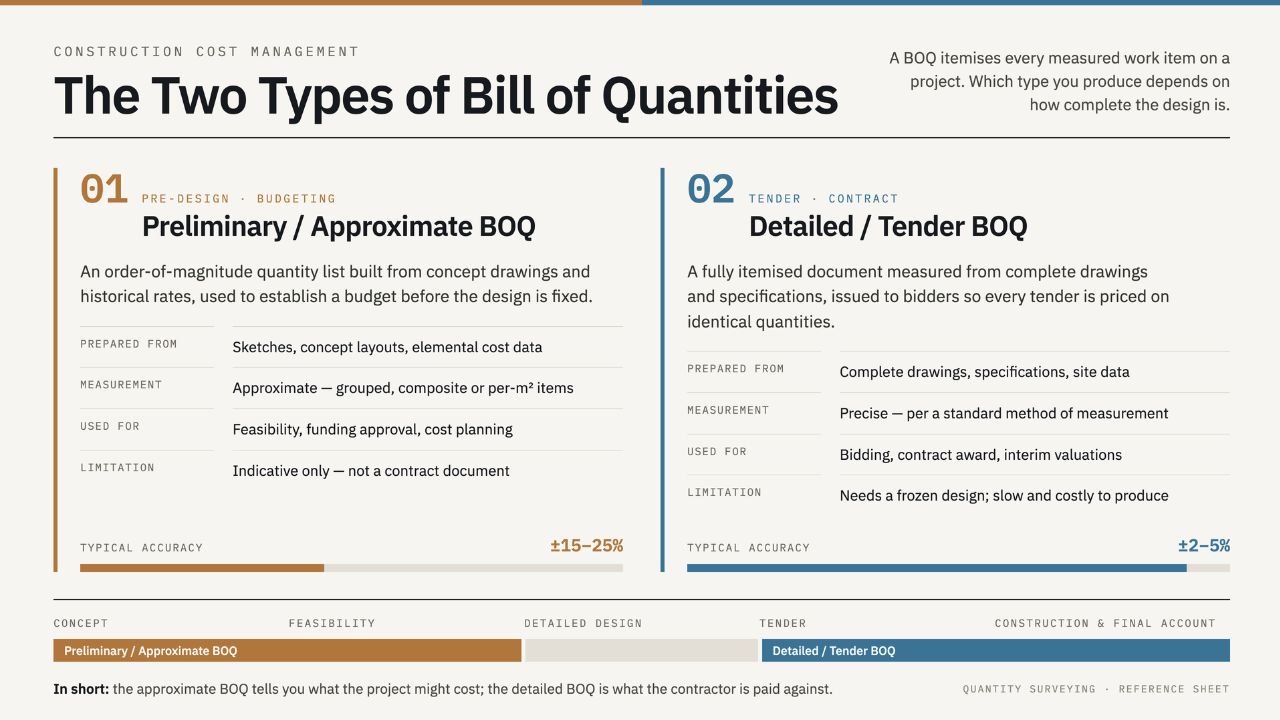
While there are many ways to classify BOQs, the construction industry generally focuses on two primary functional types when discussing them practically:
-
Preliminary / Approximate BOQ
-
Detailed / Tender BOQ
Each type serves a very different purpose, is prepared at a different stage of the project, and provides a distinct level of accuracy. It’s critical not to confuse the two or use them interchangeably.
Other terms you might hear include elemental BOQ, trade BOQ, or work section BOQ. These are just variations or different ways to group the detailed items within the main BOQ types. For example, a Detailed BOQ can be organized by trade (Division 04 Masonry, Division 26 Electrical, etc.). However, the fundamental classification comes down to whether it is a preliminary, approximate measure or a detailed, precise measure for tendering.
We will now explore each of these two main types in depth.
👉Buy Construction BOQ Template at $97 Only
Preliminary / Approximate BOQ
What It Is
A Preliminary BOQ, sometimes called an Approximate BOQ, is prepared early in the construction project lifecycle, typically during the feasibility or conceptual design phase. As the name suggests, the quantities in this document are approximate and are based on incomplete or preliminary design information, such as conceptual sketches or schematic diagrams.
When It Is Prepared
It is created at the very beginning of a project, long before final construction documents are ready. For a new development project in Florida, this is typically done before or during the design development phase to check the project’s financial feasibility.
Why It Is Used
The primary reason to use a preliminary BOQ is to get a handle on project costs before investing significant time and money into final design. It allows developers and owners to:
-
Assess Feasibility: Is this project financially viable?
-
Establish a Budget: What should the realistic target budget be?
-
Compare Design Options: Which design is more cost-effective?
-
Cost Plan: How can we allocate funds to different parts of the project?
-
Check High-Level Costs: Does the estimated cost per square foot seem reasonable based on preliminary plans?
Who Uses It
-
Developers & Owners: To manage early expectations and secure financing.
-
Architects & Engineers: To understand budget constraints during early design phases.
-
Cost Estimators: To provide early cost advice to the owner.
👉Buy Construction BOQ Template at $97 Only
Typical Florida Example: Early Condo Tower Budget
Imagine a developer planning a new residential condo tower in Miami. Final drawings, including the intricate details of CMU block walls, specific stucco specs, hurricane impact windows, and individual tenant build-outs, are not yet complete. However, the developer needs an initial cost estimate to check feasibility and seek financing from a bank.
An estimator would create a preliminary or approximate BOQ. This would estimate major quantities based on the concept, such as the total square footage of the structure, approximate cubic yards of concrete based on typical tower slabs, and estimated square footage of impact glazing. These quantities are not precise but provide a realistic order of magnitude for the budget. This is a crucial first step in any Florida construction project of this scale.
Detailed / Tender BOQ
What It Is
A Detailed BOQ, also frequently called a Tender BOQ, is the robust and accurate document the construction industry relies on for final pricing. It provides a precise, granular breakdown of every work item and material required, based on complete or nearly complete construction documents (drawings and specifications).
When It Is Prepared
This type of BOQ is prepared just before or during the tendering (bidding) phase, which is typically the final stage of pre-construction before a general contractor is selected and contracts are signed.
Why It Is Used
Its purpose is accuracy and transparency in tendering. It enables:
-
Accurate Pricing: Allows general contractors and subcontractors to provide a precise, firm fixed price for their work.
-
Fair Bid Comparison: Ensures all bidders are pricing the exact same scope of work, down to the last linear foot of piping.
-
Contract Formation: It often forms the basis of the final contract price.
-
Cost Management: Provides a detailed “schedule of rates” that is invaluable for managing progress payments and pricing change orders during construction.
-
Scope Clarity: Clearly defines the physical work to be done, reducing the potential for disputes.
Who Uses It
-
General Contractors: To prepare an accurate bid.
-
Subcontractors: To price their specific trade scope (e.g., Division 04 Masonry).
-
Quantity Surveyors & Estimators: To prepare the tender documents for the owner, or to create internal detailed takeoffs for the GC’s pricing.
-
Owners/Developers: To compare bids and form the base for the final contract.
👉Buy Construction BOQ Template at $97 Only
Typical Florida Example: Public School Tender
Let’s take a public school project in Jacksonville that has reached the tendering stage. All the architectural, structural (concrete slab-on-grade, CMU block walls), MEP (Mechanical, Electrical, Plumbing), and civil drawings are complete and approved.
The quantity surveyor preparing the tender documents will create a Detailed/Tender BOQ. This document will have hundreds of precise line items, such as the exact square footage of stucco needed, the number of particular types of impact-resistant doors, the specific linear feet of plumbing pipe, and the exact count of hurricane straps required by code. General contractors will use this detailed list to get quotes from subcontractors and provide their final, accurate bid to the school board. This detailed approach is mandatory for cost control on such a public works project.
Key Differences Between the Two Types
Understanding the functional purpose of each BOQ type is critical, but a direct comparison across several practical aspects can clarify their differences even further.
| Aspect | Preliminary / Approximate BOQ | Detailed / Tender BOQ |
| Level of Detail | Approximate and high-level. Items might be grouped. | Highly detailed, granular, and precisely itemized. |
| Primary Basis | Concept/Schematic Design (incomplete plans). | Final Construction Documents (drawings and specs). |
| Quantities | Estimated and based on assumptions. Less certain. | Precisely measured and definite. High certainty. |
| Timing | Early pre-construction phase (feasibility/concept). | Late pre-construction phase (tendering/bidding). |
| Primary Purpose | Cost planning, feasibility, and budgeting. | Accurate pricing, bid comparison, and contract. |
| Used for Final Pricing? | No. Provides an estimate of cost, not a firm price. | Yes. Provides the basis for a firm price from a contractor. |
| Used in Tendering? | No. | Yes, it is the fundamental document for a proper tender. |
| Preparing Professional | Typically prepared by owner’s cost estimator or QS. | Owner prepares for bidding; GC creates an internal version to price the bid. |
| Local Example Context | Cost check for a new house conceptual sketch. | Tender documents for a school based on final plans. |
When to Use Each Type in Florida Projects
So, when exactly do you need each of the two types of BOQ in construction for your Florida-based projects? The best practice is a sequential approach that follows the project timeline.
1. Use a Preliminary BOQ:
-
Stage: Feasibility Study, Concept Design, Schematic Design.
-
Situation: You are a developer exploring a new multi-family project in Tampa. You have a general concept of the number of units and amenities but no final blueprints. Before you commit to the land purchase and costly architectural fees, you must understand the high-level budget. A preliminary or approximate BOQ provides that early-stage cost plan to help you make an informed go/no-go decision.
-
Goal: Establish a baseline budget and check viability in the current Florida market.
2. Use a Detailed BOQ:
-
Stage: Design Development, Construction Documents, Tendering/Bidding.
-
Situation: The Tampa multi-family project from the example above has progressed successfully. Final construction documents are complete, detailing everything from the slab-on-grade concrete mix to the CMU reinforcement and specific hurricane ties. It’s now time to get final pricing from general contractors.
-
Goal: To obtain an accurate, competitive, and firm price for the work and form a robust construction contract. As an owner, this is when you send out the Detailed/Tender BOQ. As a general contractor, if you didn’t receive a BOQ from the owner, your estimating team must create a Detailed BOQ internally to create a competitive bid.
local market conditions in Florida—such as labor rates, material volatility, and specific regional build practices—apply to both types, but the application differs. In a preliminary BOQ, you might use a general unit rate based on historical data. In a detailed BOQ, you must use current, confirmed, and specific rates for materials and labor.
👉Buy Construction BOQ Template at $97 Only
Florida Construction Examples
Let’s bring this to life with two more specific examples that are common in Florida construction.
Example 1: Custom Home Build in Naples
A. Preliminary BOQ Stage: A couple in Naples wants to build their dream custom home. They have a basic conceptual sketch of the layout. They know they want a traditional “Florida-style” stucco finish on CMU block walls and a durable concrete tile roof, but they haven’t picked out specific windows or finishes. They are working with an owner’s estimator to create an initial cost budget before moving to final design.
-
BOQ Type: Preliminary/Approximate BOQ.
-
Why: This allows the estimator to produce a feasibility estimate to check if their dream home fits their realistic budget in Naples, without the costly investment of final architectural and engineering plans.
B. Detailed BOQ Stage: The design development is complete. Final blueprints are now in hand, specifying impact-resistant windows and doors, the specific count of hurricane straps, the precise dimensions of the CMU walls, and all final interior finishes. The couple is now ready to get firm quotes from custom home builders.
-
BOQ Type: Detailed/Tender BOQ.
-
Why: For final competitive bidding, contractors must price the exact same, detailed scope. The couple should provide a Detailed BOQ to ensure each builder provides an accurate, apples-to-apples bid.
Example 2: Commercial Retail Shell in Orlando
A developer is planning a small single-story commercial retail shell near a major theme park in Orlando. It will be built with typical concrete masonry unit (CMU) construction.
A. Preliminary BOQ Stage: The developer has a general idea of the total footprint and is working with an architect on the conceptual design. They need an initial budget for a construction loan application.
-
BOQ Type: Preliminary/Approximate BOQ.
-
Why: Quantities for the CMU block, slab, and stucco are all approximate based on the early layout. They are sufficient for cost planning but not for a firm contractor quote.
B. Detailed BOQ Stage: Construction documents are finalized. Specifics for the slab-on-grade thickness, the precise details of the structural CMU reinforcement, and the hurricane load requirements are now fully defined. The developer is now ready to send the project out to tender to multiple general contractors.
-
BOQ Type: Detailed/Tender BOQ.
-
Why: This is the only way for the developer to get an accurate, firm, and competitive fixed price for the work and to create a clear contract that minimizes future disputes.
Why the Difference Matters
Mistaking one BOQ type for the other can have severe practical and financial consequences for any construction project, especially in Florida.
-
Impact on Budgeting: Relying on a preliminary, approximate BOQ as a final price leads to realistic budget overruns when the actual detailed scope is revealed. This can cause projects to stall or lose funding.
-
Impact on Bidding: Trying to tender based on a preliminary, approximate BOQ leads to inconsistent bids and “apples-and-oranges” comparisons, as different contractors will make different assumptions about the missing details. You won’t get a truly competitive or comparable price.
-
Impact on Scope Clarity: A lack of detail means a lack of scope clarity. This is the root cause of many disputes and extensive, expensive change orders during construction, which can devastate a project’s budget. A detailed BOQ reduces this risk.
-
Impact on Risk Management: By precisely defining the work, a detailed BOQ shifts the quantitative risk away from the owner and allows for standardized pricing of any deviations, protecting both parties. Confusing approximate quantities for firm numbers only creates unmanaged risk.
👉Buy Construction BOQ Template at $97 Only
Common Mistakes When Working With BOQ Types
To ensure you use the two types of BOQ in construction correctly, avoid these all-too-common pitfalls:
-
Using a Preliminary BOQ for Tendering
This is perhaps the most common mistake. Sending a preliminary, approximate BOQ to contractors for competitive bidding is a recipe for disaster. Contractors will make different assumptions, leading to wildly different bid numbers and an inevitable wave of change orders later in the project. Always wait for detailed documentation.
-
Over-Reliance on High-Level Estimates
A preliminary BOQ is an estimate by design. While it provides a crucial initial cost plan, owners and developers must never treat it as a final, guaranteed price, especially in a dynamic market with fluctuating material costs (like the Florida CMU or impact window market).
-
Ignoring Florida-Specific Design & Code Requirements
This is a critical mistake in Florida construction. Both Preliminary and Detailed BOQs must explicitly account for Florida-specific factors:
-
Slab-on-grade construction.
-
Concrete masonry unit (CMU) block work and reinforcement.
-
Stucco finishes.
-
Hurricane straps and ties.
-
Impact-resistant windows and doors.
-
Specific Florida wind-load code requirements for the specific project location. Failing to account for these local specifications will lead to massive underestimation, regardless of the BOQ type used.
-
-
Treating an Approximate BOQ as a Firm Fixed Price
Confusing an estimate with a final price is a foundational error. A preliminary/approximate BOQ is a cost planning tool. A detailed/tender BOQ is a contract document. One gives you a “ballpark”; the other gives you the actual price.
Best Practices for Florida Contractors and Developers
To maximize construction estimating accuracy and minimize project risk in the Florida market, we recommend following these simple, practical best practices.
-
Use the right type of BOQ at the right stage. Never skip the sequential process. Start with Preliminary for feasibility, then use Detailed for tendering.
-
Be crystal clear about assumptions in a Preliminary BOQ. If you don’t have final window specs, state that the budget assumes a “typical commercial-grade impact window” to manage expectations.
-
Update the BOQ as the design develops. Construction drawings are iterative. Your cost documents should be too. Don’t let your BOQ fall behind the architectural plans.
-
Compare to similar completed Florida projects. Use historical cost data from real Florida projects to validate your estimates at both stages.
-
Ensure Detailed BOQs are accurate and precise. When it’s time for the Tender BOQ, invest in a thorough takeoff from a qualified estimator. Every item must be precisely quantified and well-described.
-
Insist on detailed BOQs for competitive pricing. If you are an owner, provide a detailed BOQ for tendering. If you are a general contractor, always demand a proper tender BOQ from the owner. If one isn’t provided, your estimating team must create an internal detailed BOQ for competitive and accurate pricing.
👉Buy Construction BOQ Template at $97 Only
Final Thoughts
Accurate cost control is a fundamental pillars of any successful construction project. The two types of BOQ in construction—Preliminary/Approximate and Detailed/Tender—are critical, sequential tools that serve different purposes at different project stages.
Mistaking an early-stage approximate estimate for a final, detailed price is a fundamental error that can cause significant financial and operational risk. However, by understanding what the two types of BOQ in construction are and when each applies, you can make more informed financial decisions, secure better financing, obtain more competitive bids, and manage project risk more effectively. This knowledge is your competitive edge, ensuring you build smarter and more successfully in the dynamic and rewarding Florida construction industry.