For decades, commercial contractors built their businesses on handshakes, legacy relationships, and word-of-mouth referrals. While a strong reputation will always be the backbone of the industry, relying solely on referrals is no longer enough to maintain a robust, predictable pipeline. Today’s developers, property managers, and facility owners are doing their research online long before they ever issue a Request for Proposal (RFP).
To stay competitive, you need proactive strategies that position your firm in front of the right decision-makers at exactly the right time. Implementing modern commercial construction marketing ideas is the most effective way to attract high-value projects, forge profitable partnerships, and keep your estimating team busy. In this comprehensive guide, we will share practical, proven commercial construction marketing ideas that actually help generate qualified leads and drive sustainable business growth.
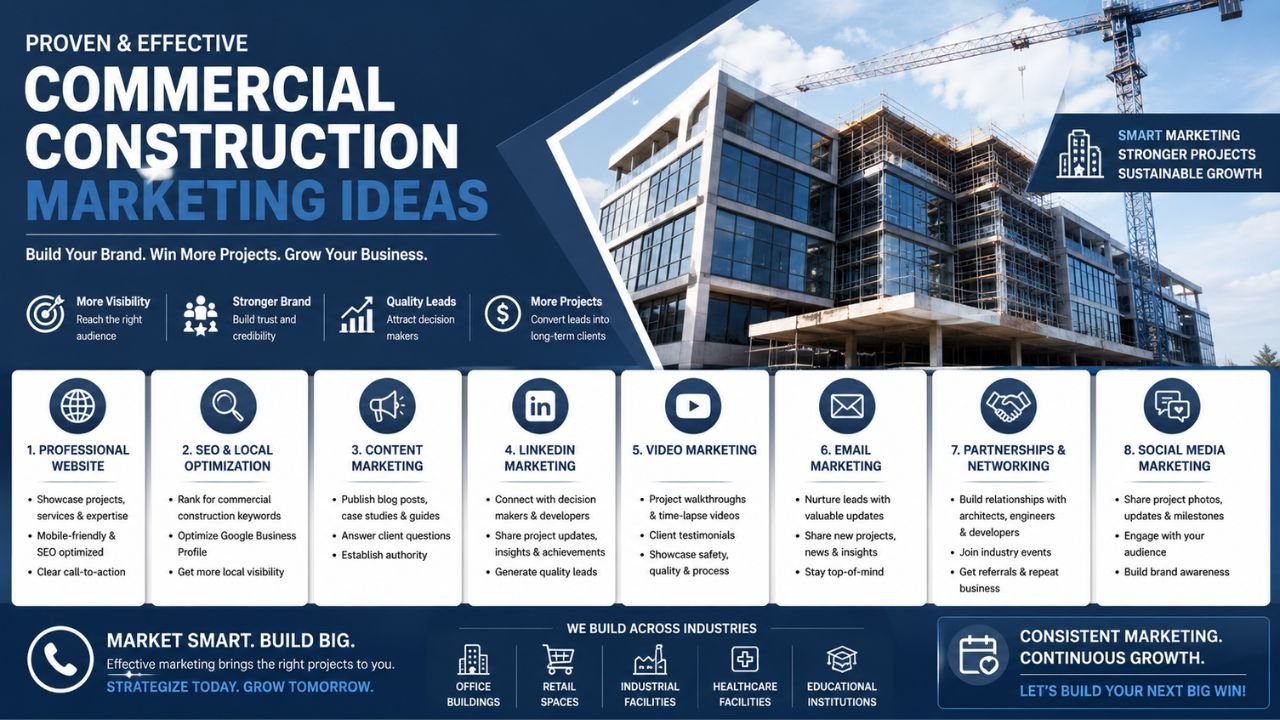
What Is Commercial Construction Marketing?
In simple terms, commercial construction marketing encompasses all the strategies, channels, and communications a construction company uses to promote its services, showcase its expertise, and build trust within the commercial real estate sector.
Unlike consumer-facing marketing—which often relies on quick, emotional purchases—construction business marketing is highly relationship-driven and logic-based. A commercial project is a massive financial investment carrying significant risk. Therefore, your marketing must be designed to prove your competence, showcase your safety record, and demonstrate your ability to deliver on time and on budget. Good marketing supports both top-of-mind visibility and bottom-line sales, ensuring that when an owner or general contractor needs a partner, your firm is the first one they call.
Why Marketing Matters in Commercial Construction
Historically, many commercial contractors viewed marketing as an unnecessary expense, assuming their past work would speak for itself. However, in today’s highly competitive landscape, relying exclusively on word-of-mouth is a dangerous strategy.
A proactive approach to commercial contractor marketing helps your firm in several critical ways:
-
Lead Generation: Consistent marketing campaigns ensure a steady flow of commercial project leads, preventing the feast-or-famine cycle common in construction.
-
Brand Awareness: It keeps your company’s name in front of architects, developers, and owners even when they aren’t actively building, ensuring you are top-of-mind when they are ready.
-
Credibility and Authority: Professional marketing materials prove that your firm is established, organized, and financially stable.
-
Better Project Fit: Targeted marketing allows you to attract the exact types of projects you want—whether that is medical office build-outs, tilt-up warehouses, or high-end retail spaces.
-
Client Trust: Transparency through marketing (like sharing behind-the-scenes processes) builds instant trust with prospective clients.
-
Long-Term Construction Business Growth: A systematized marketing approach builds an asset that generates compounding returns year after year.
Build a Strong Website
Your construction company website is your digital storefront, your most powerful sales representative, and the foundation of all your construction marketing ideas. If a developer hears your name and looks you up, a slow, outdated website will instantly damage your credibility.
A professional, high-converting website must be mobile-friendly, fast, and easy to navigate. To capture commercial project leads effectively, your site must include these core pages:
-
Services: Clearly define what you do. Have dedicated pages for commercial construction services, tenant improvements, design-build services, and any specialty trades you offer.
-
Project Portfolio: Commercial buyers want proof. Your portfolio should categorize projects by industry (e.g., healthcare, industrial, retail) so prospects can easily find relevant experience.
-
About Page: Highlight your company history, leadership team, core values, and safety record.
-
Process Page: Explain how you work. Breaking down your pre-construction, estimating, and construction phases shows owners that you are organized and systematic.
-
Contact Page: Make it incredibly easy for people to reach you with clear phone numbers, email addresses, and an inquiry form.
Use SEO and Local Search
Search Engine Optimization (SEO) is the process of optimizing your website so that it ranks highly on search engines like Google. When a developer types “commercial renovation contractor near me” into a search bar, you want your firm to be the first result.
Effective SEO requires using industry-specific keywords naturally throughout your website. Instead of just saying “We build buildings,” your service pages should target terms like “commercial office build-outs,” “industrial warehouse construction,” or “retail tenant improvements.”
Furthermore, local SEO for contractors is absolutely vital. By creating dedicated location pages for the specific cities and counties you serve, you increase your chances of being discovered by nearby owners, developers, and facility managers who are actively looking for local expertise.
Optimize Your Google Business Profile
One of the most powerful, yet frequently overlooked, marketing ideas for construction companies is optimizing your Google Business Profile (GBP). This free listing is often the first thing a prospect sees when they search for your brand or for local contractors.
A complete and optimized profile instantly improves your visibility and credibility. To get the most out of your GBP, ensure you cover the following:
-
Company Name Consistency: Ensure your business name, address, and phone number match exactly with what is on your website.
-
Service Areas: Clearly define the geographic radius or specific cities where you operate.
-
Project Photos: Regularly upload high-quality photos of your job sites, completed projects, and team members.
-
Reviews: B2B buyers read reviews, too. Ask your past commercial clients, architects, and partners to leave detailed reviews about their experience working with you.
-
Business Description: Write a clear, keyword-rich description of your commercial construction capabilities.
-
Response to Questions and Reviews: Always respond professionally to every review (both positive and negative) to show that you are attentive and value client feedback.
Publish Case Studies and Project Spotlights
Commercial construction is a high-risk industry for the buyer. Case studies are the ultimate tool for mitigating that risk. They prove that you have successfully navigated complex challenges in the past, making you a safe choice for the future.
A strong case study goes beyond a simple photo gallery in your project portfolio. It should tell a compelling story and follow a structured format:
-
Project Type and Scope: Give the basic details (size, location, industry, contract type).
-
The Challenge: What unique problems did the project face? (e.g., tight schedule, occupied building, complex zoning).
-
The Solution: How did your team solve the problem? Highlight your pre-construction planning, innovative engineering, or project management skills.
-
The Result: Share the final outcome, emphasizing on-time delivery, budget adherence, and client satisfaction.
-
High-Quality Photos: Include before, during, and after photos to provide visual proof of your capabilities.
Use Video Content
If a picture is worth a thousand words, a video is worth a million. Video content is one of the most engaging commercial construction marketing ideas available today. It allows you to showcase the scale of your capabilities, the activity on your jobsites, and the professionalism of your team in a way that text simply cannot.
Consider integrating these types of videos into your marketing strategy:
-
Progress Videos: Short drone clips showing weekly progress on a major job site.
-
Project Walkthroughs: A guided tour of a newly finished commercial space.
-
Team Introductions: Short interviews with your project executives, estimators, and superintendents to humanize your brand.
-
Time-Lapse Clips: A fast-forward view of a project from foundation pour to final ribbon-cutting.
-
Client Testimonials: A video of a satisfied developer or facility manager explaining why they trust your firm.
 Buy Construction BOQ Template at $97 Only
Build Referral and Partnership Systems
While we established that relying only on referrals is dangerous, referrals are still a massive driver of commercial project leads. The key is to turn passive word-of-mouth into an active, systematized referral engine.
To win more commercial work, you need to build strategic relationships with the people who know about projects before they go out to bid. Focus on networking with:
-
Architects and Design Firms
-
Commercial Real Estate Developers
-
Commercial Brokers and Leasing Agents
-
Structural and Civil Engineers
-
Property and Facility Managers
-
Specialty Subcontractors
Create a simple tracking and follow-up system. Regularly take these partners out to lunch, share their content on social media, and refer work to them whenever possible. When you help them win, they will help you win.
Run Targeted Paid Campaigns
For immediate visibility, paid advertising (such as Google Ads or LinkedIn Ads) is an incredibly effective tool for construction lead generation.
Google Ads allows you to capture “high-intent” traffic. When a business owner searches for “commercial renovation contractors,” your ad can appear at the very top of the page. LinkedIn Ads allow you to target specific job titles—such as “Director of Facilities” or “Commercial Real Estate Developer”—within your specific geographic territory.
The secret to successful paid campaigns is ensuring that your ads point to highly specific landing pages, not just your homepage. If your ad promotes medical office renovations, the user should land on a page entirely dedicated to your healthcare construction expertise.
Use Email Marketing and Follow-Up
Email marketing is a highly underutilized tool in commercial contractor marketing. When done correctly, it is one of the best ways to nurture warm leads and stay top-of-mind with past clients.
Your email strategy should be professional, brief, and value-driven. Avoid spamming your list with constant sales pitches. Instead, focus on:
-
Project Updates: Share exciting milestones from your current high-profile builds.
-
Newsletters: Send a quarterly update featuring recent case studies, team promotions, or industry insights.
-
Follow-Up Emails: Check in with past clients 6 and 12 months after project completion to ensure they are happy with the space and to ask about future phases.
-
Bid Reminders: Keep in touch with general contractors or owners during the pre-construction phase. Highlighting your professional estimating services in these emails can help you stand out.
-
Referral Requests: Politely ask satisfied clients if they know anyone else planning a commercial build.
Attend Industry Events and Join Associations
Digital marketing is crucial, but commercial construction will always be a relationship business. Combining your online visibility with face-to-face networking is the ultimate formula for construction business growth.
Make it a priority for your leadership and business development teams to attend industry events and join relevant associations. Depending on your target market, consider organizations like NAIOP (Commercial Real Estate Development Association), the Associated General Contractors (AGC), or the Design-Build Institute of America (DBIA).
Attending local trade shows, chamber of commerce meetings, and economic development councils ensures you are shaking hands with the people shaping the future of your local skyline. These relationships often lead to negotiated contracts, repeat work, and insider knowledge on upcoming bids.
Marketing Strategy Overview
To help you organize and prioritize these efforts, here is a quick breakdown of how these strategies support your overall pipeline:
| Marketing Strategy | Primary Goal | Timeframe for Results | Best Suited For |
| Website & SEO | Visibility & Lead Generation | Long-Term (6+ Months) | All Commercial Contractors |
| Google Business Profile | Local Search Dominance | Immediate to Medium-Term | Local & Regional Builders |
| Case Studies & Video | Trust Building & Sales Enablement | Immediate (Once Created) | Complex, High-Value Projects |
| Targeted Paid Ads | Direct Lead Generation | Immediate | Targeted Niche Services |
| Email & Networking | Relationship Building & Retention | Ongoing / Long-Term | Repeat Business & Referrals |
Final Thoughts
The most successful commercial construction marketing ideas do not rely on a single magic trick. Instead, they combine digital visibility, aggressive trust-building, and consistent, professional follow-up.
Whether you are a specialized commercial renovation firm or a large design-build contractor, marketing works best when it is intentionally designed to support your company’s ideal project type and client base. By building a fast website, optimizing for local search, proving your competence through case studies and video, and nurturing your professional network, you will transform your pipeline from unpredictable to highly profitable.
If you are ready to stop waiting for the phone to ring and want to start winning more of the projects you actually want to build, the time to upgrade your marketing strategy is now. For more information on how we can support your pre-construction and bidding efforts, visit our contact page today.