The construction industry is currently undergoing a massive digital shift, and at the heart of this revolution is Artificial Intelligence (AI). For decades, estimators spent countless hours manually clicking through PDF plans or scaling paper drawings with a physical wheel. Today, the conversation has shifted from “should we use technology?” to “which AI is best for construction estimating?“.
Contractors are adopting AI at a record pace because the margin for error in modern construction—especially in volatile markets like Florida—is thinner than ever. Between fluctuating material costs and labor shortages, speed and precision are the only ways to stay competitive. In this guide, you will learn how AI-powered tools work, compare the leading platforms available in 2026, and discover why the most successful bids combine high-tech automation with human local expertise.
What is AI in Construction Estimating?
Artificial Intelligence in construction estimating isn’t about a robot sitting at a desk; it’s about software that “thinks” and “sees” like a human estimator but at a much higher speed.
- Artificial Intelligence (AI): The overarching technology that allows software to perform tasks that typically require human intelligence, such as pattern recognition and decision-making.
- Machine Learning (ML): A subset of AI where the software improves its performance over time by analyzing past data. For example, if it identifies a “wall” correctly 1,000 times, it becomes faster at finding walls in the 1,001st project.
- Computer Vision: This is the “eyes” of the software. It allows the AI to “read” a 2D PDF or a 3D model, identifying symbols, lines, and text automatically.
- Automated Quantity Takeoffs: AI can now scan a floor plan and instantly calculate square footage, linear feet of walls, or counts of doors and windows, often reducing takeoff time by up to 80%.
- Predictive Cost Estimating: By looking at historical data and current market trends, AI can predict where material costs might be in six months.
- Bid Preparation & Document Analysis: AI can scan thousands of pages of specifications to find “gotchas” or specific requirements that a human might miss during a late-night bid session.
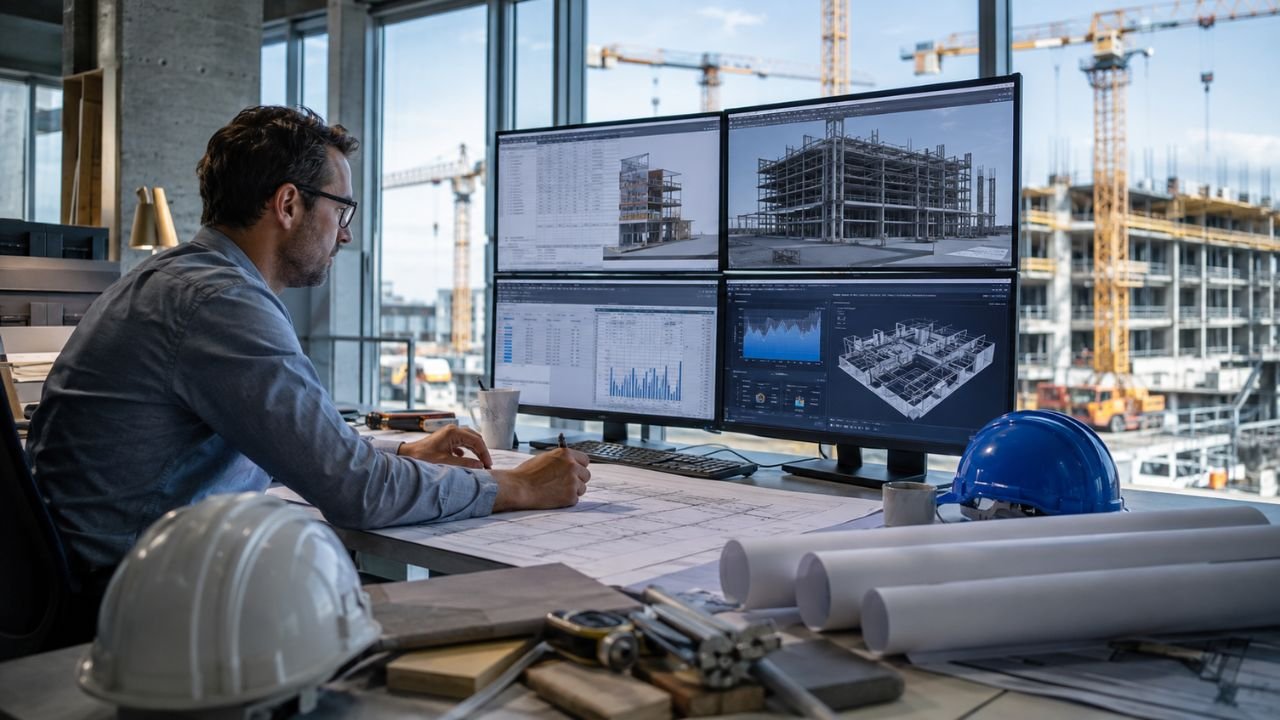
How AI is Transforming Construction Estimating
The integration of AI isn’t just a minor update; it is a fundamental transformation of the preconstruction workflow.
Automatic Plan Analysis
Instead of an estimator spending hours “naming” rooms and identifying materials, AI-powered estimating tools can automatically recognize objects like toilets, sinks, and electrical outlets. It can differentiate between a load-bearing wall and a partition based on line weights and architectural symbols.
Faster Quantity Takeoffs
Speed is the most immediate benefit. What once took two days can now be completed in twenty minutes. This allows firms to bid on more projects without increasing their headcount.
Historical Cost Analysis and Prediction
AI tools can analyze every bid your company has ever submitted. It can identify patterns, such as which subcontractors consistently come in over budget or which types of projects usually require more contingency funds.
Labor and Material Optimization
Advanced AI can forecast labor needs based on project complexity and even suggest material alternatives that might be more cost-effective based on current Florida supply chain availability.
Benefits of AI Construction Estimating
Why are Florida general contractors and subcontractors making the switch? The advantages go beyond just saving time.
- Unmatched Speed: Being the first to submit a professional, detailed bid often provides a competitive edge in a fast-moving market.
- Higher Accuracy: AI doesn’t get tired. It won’t miss the 50th window on a high-rise floor plan because of eye strain.
- Reduced Manual Labor: Estimators can shift their focus from “counting” to “strategizing”—spending time on value engineering and subcontractor relations.
- Lower Estimating Costs: By reducing the hours required per bid, the overhead cost of the estimating department drops significantly.
- Improved Bidding Success: With more accurate data and faster turnaround, contractors can refine their margins to be more competitive without risking profitability.
Best AI Construction Estimating Software
When determining which AI is best for construction estimating, you must look at how each platform applies these technologies to real-world plans.
1. Togal.AI
Company Overview: Togal.AI is a pioneer in the AI takeoff space, specifically designed to automate the most tedious parts of the 2D takeoff process.
- Best Use Cases: 2D quantity takeoffs for commercial and residential projects.
- AI Capabilities: Uses deep learning to automatically detect and measure rooms, walls, and objects on PDF plans.
- Key Features: Automated area detection, “point and click” object counting, and cloud-based collaboration.
- Pros: Incredible speed; works with most standard PDF drawings.
- Cons: Primarily focused on takeoff; still requires a separate pricing engine.
- Pricing Overview: Subscription-based (verify current rates on their official site).
2. Autodesk Construction Cloud AI
Company Overview: A massive ecosystem for construction management that has integrated AI (Autodesk AI) across its entire platform.
- Best Use Cases: Large-scale commercial, industrial, and design-build projects.
- AI Capabilities: Automated 2D takeoff and deep integration with 3D BIM models for quantity extraction.
- Key Features: Version control, cloud collaboration, and seamless handoff from estimating to project management.
- Pros: Industry-standard for complex builds; keeps everything in one ecosystem.
- Cons: High cost and steep learning curve for smaller firms.
- Pricing Overview: Enterprise-tier; quote-based.
3. STACK
Company Overview: A cloud-based favorite for Florida contractors, STACK focuses on ease of use and real-time team collaboration.
- Best Use Cases: Residential, light commercial, and trade-specific (roofing, framing) estimating.
- AI Capabilities: Implementing “Smart Takeoff” features that speed up common measurement tasks.
- Key Features: Browser-based (no install), built-in cost databases, and professional proposal generation.
- Pros: Very user-friendly; great for teams working across multiple job sites.
- Cons: Not as powerful as CostX for complex 3D/BIM work.
- Pricing Overview: Tiered subscription based on user count.
4. CostX
Company Overview: A leader in 5D BIM estimating, used by top-tier estimators who need to link 3D models directly to costs.
- Best Use Cases: High-rise commercial, institutional, and infrastructure projects.
- AI Capabilities: Automated quantity extraction from BIM models and advanced spreadsheet automation.
- Key Features: 2D and 3D takeoff in one tool; powerful “auto-revisioning” to track plan changes.
- Pros: Extremely precise; handles complex Florida HVHZ revisions better than most tools.
- Cons: Expensive and requires significant training to master.
- Pricing Overview: Premium pricing; quote-based.
5. Procore AI
Company Overview: Procore’s platform includes AI features designed to bridge the gap between preconstruction and field operations.
- Best Use Cases: Mid-to-large GCs who want their estimates to flow directly into project budgets.
- AI Capabilities: Automated bid leveling and document analysis to identify project risks.
- Key Features: Subcontractor management, centralized document control, and risk analysis.
- Pros: Unbeatable for project-wide visibility and collaboration.
- Cons: Estimating is an add-on to a larger, expensive suite.
- Pricing Overview: Enterprise-tier; based on annual construction volume.
Top AI Construction Estimating Software
| Software | Best For | AI Features | Cloud/Desktop | Pricing Level | Ease of Learning |
|---|---|---|---|---|---|
| Togal.AI | Fast 2D Takeoffs | Auto-room/wall detection | Cloud | Mid-Range | Easy |
| Autodesk | Large Commercial | BIM integration, ACC AI | Cloud | High | Moderate |
| STACK | Small-Mid GCs/Subs | Smart Takeoff, Cloud sync | Cloud | Mid-Range | Easy |
| CostX | 3D/BIM Projects | BIM auto-extraction | Desktop/Cloud | High | Hard |
| Procore | Multi-Project GCs | Bid leveling, Risk analysis | Cloud | High | Moderate |
| PlanSwift | Trade Contractors | Templated takeoffs | Desktop | Mid-Range | Moderate |
Can AI Replace Human Construction Estimators?
The short answer is no. While AI is a powerful “engine,” it lacks the judgment and local knowledge required to produce a “bid-ready” estimate in a market like Florida.
- Local Code Knowledge: No software automatically knows that a project in Miami-Dade requires different wind-load fasteners than one in Orlando due to High-Velocity Hurricane Zone (HVHZ) requirements.
- Scope Interpretation: AI might count 50 windows, but it won’t necessarily understand the “intent” of a vague architectural note that implies special flashing or labor-intensive installation.
- Value Engineering: AI can tell you how much something costs, but it can’t suggest a creative, cheaper alternative that still meets the owner’s aesthetic and code requirements.
- Subcontractor Relationships: Software doesn’t know that a specific local sub is currently overbooked or that another is desperate for work and might give you a better rate.
- Final Quality Control: Automated takeoffs can sometimes misread a scale or double-count overlapping plan layers. A human expert remains the “final filter” for accuracy.
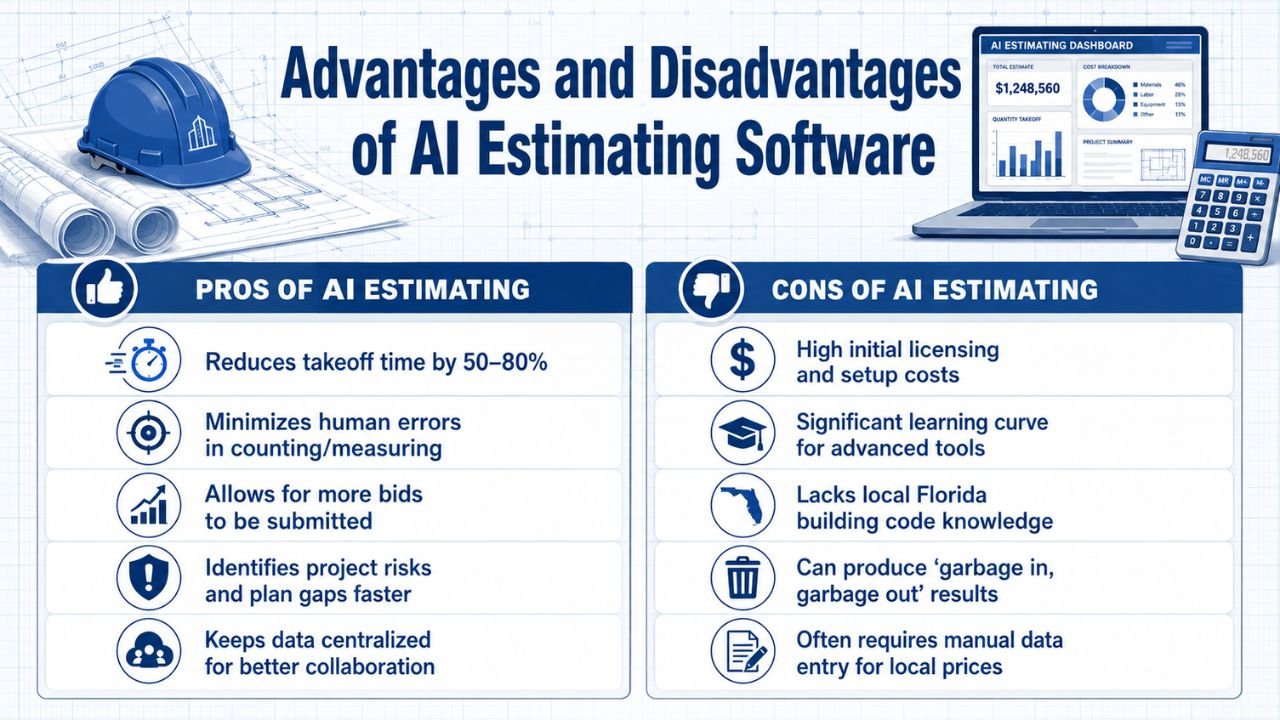
Advantages and Disadvantages of AI Estimating Software
| Pros of AI Estimating | Cons of AI Estimating |
|---|---|
| Reduces takeoff time by 50–80% | High initial licensing and setup costs |
| Minimizes human errors in counting/measuring | Significant learning curve for advanced tools |
| Allows for more bids to be submitted | Lacks local Florida building code knowledge |
| Identifies project risks and plan gaps faster | Can produce “garbage in, garbage out” results |
| Keeps data centralized for better collaboration | Often requires manual data entry for local prices |
How to Choose the Right AI Estimating Software
When evaluating which AI is best for construction estimating for your specific business, use this framework:
- Project Type: Do you mostly do residential renovations (STACK/Buildxact) or complex commercial builds (CostX/Autodesk)?
- Company Size: A solo estimator needs a tool with a shallow learning curve, whereas a firm with 10 estimators might benefit from a powerful enterprise platform like Procore.
- Budget: Don’t just look at the subscription fee; account for the time it will take your team to learn the tool.
- Integrations: Does the software talk to your accounting or project management tools? Double-entry is the enemy of efficiency.
- Accuracy vs. Automation: Some tools prioritize speed, while others prioritize deep BIM precision. Choose the one that aligns with your risk tolerance.
Common Mistakes When Using AI for Estimating
- Blindly Trusting Output: Never submit a bid based on raw AI data without a manual check. “Trust but verify” is the golden rule of modern estimating.
- Ignoring Local Labor Costs: National averages in a software database rarely reflect the actual rates in Miami, Tampa, or Jacksonville.
- Poor-Quality Drawings: AI is only as good as the plans you feed it. Low-resolution scans or messy PDFs can lead to major counting errors.
- Missing Project Scope: AI is great at counting objects but poor at identifying the “unseen” labor costs like mobilization, cleanup, or specialized permitting fees.
The Future of AI in Construction Estimating
Over the next 5–10 years, we expect to see:
- Generative AI: Imagine typing “Generate a preliminary estimate for a 5-story CBS apartment building in Broward County” and getting a 90% accurate draft in seconds.
- Voice-Enabled Estimating: Estimators in the field using headsets to “dictate” site conditions directly into their software.
- Predictive Supply Chain Alerts: AI that warns you three months in advance about a potential shortage in roofing tiles or impact-rated glass.
Why Professional Construction Estimators Still Matter
While technology is essential, the most successful Florida contractors realize that software is just one tool in the kit. Estimate Florida combines these modern AI technologies with over 15 years of boots-on-the-ground experience to provide estimates that software alone cannot match.
For Florida projects, you need an estimator who understands:
- HVHZ Compliance: Ensuring every line item meets the strict wind-load requirements of South Florida.
- Local Market Dynamics: Knowing how material costs spike during hurricane season and how labor availability shifts across all 67 Florida counties.
- Complex Value Engineering: Finding ways to save money without compromising safety or the Florida Building Code.
We deliver bid-ready, professional quantity takeoffs and cost estimates—often within 24–48 hours—allowing you to bid more jobs with total confidence.
Frequently Asked Questions
Which AI is best for construction estimating in 2026?
There is no “one size fits all” answer. Togal.AI is best for speed, STACK is best for small-to-mid-sized Florida GCs, and Autodesk/CostX are the leaders for large-scale BIM projects.
Can AI do a full construction estimate by itself?
No. AI can handle the “counting” and “measuring” (takeoff), but a human expert is still needed to apply local pricing, account for site conditions, and ensure code compliance.
Is AI estimating software expensive?
Prices range from a few hundred dollars per year for basic tools to over $50,000 for enterprise-level suites. Many tools are now subscription-based.
Does AI understand the Florida Building Code?
Generally, no. AI software measures quantities but does not automatically flag requirements for HVHZ wind-load or impact-glass specs unless manually programmed.
How much time can AI save on takeoffs?
Estimators report saving between 50% and 80% of their manual takeoff time when using AI-powered tools like Togal.AI or STACK.
What is the difference between AI takeoff and AI estimating?
Takeoff is the measurement of quantities from plans. Estimating is the process of applying dollar amounts, labor, and profit margins to those quantities to create a final bid.
Should a small contractor use AI software?
Yes, but they should choose a user-friendly, cloud-based tool like STACK or Buildertrend that doesn’t require a dedicated IT department to manage.
Does AI estimating software work on 3D models?
Yes. Tools like CostX and Autodesk Takeoff are specifically built to extract quantities directly from 3D BIM models.
Can AI predict future material price spikes?
Some advanced platforms use predictive analytics to forecast price trends, but they can still be caught off guard by major events like hurricanes or global supply chain shocks.
Do I need special training to use AI estimating tools?
Most modern AI tools are designed with “intuitive” interfaces, but enterprise tools like Sage or CostX usually require professional training to use effectively.
Can AI help with “value engineering”?
AI can provide cost alternatives, but true value engineering requires human creativity and an understanding of the client’s ultimate goals and local code limits.
Why should I use a professional service like Estimate Florida instead of just buying software?
Software is a tool, but experience is the asset. We provide the accuracy, local Florida pricing, and code-compliance checks that software often misses, saving you from costly bidding mistakes.